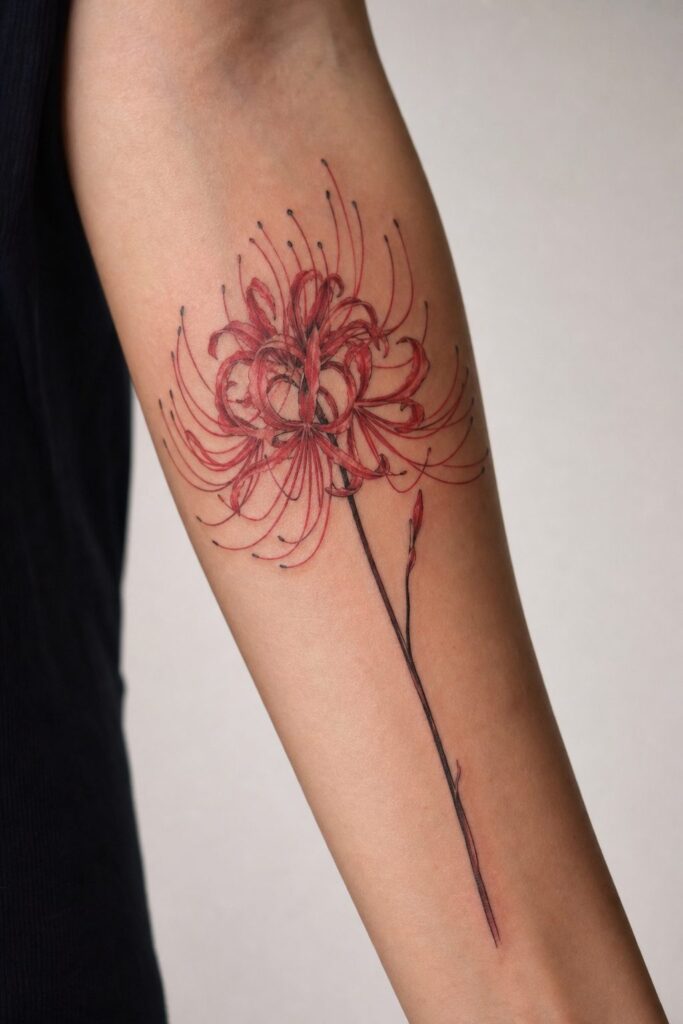
The spider lily tattoo most often symbolizes final partings, memory of the dead, and the thin boundary between endings and new beginnings. In Japanese and Korean traditions, it’s the flower of the afterlife and autumnal remembrance; in Western adoption, it’s become a marker of personal loss, transformation, or the beauty found in things that are temporary. The meaning you carry depends heavily on which cultural lens you bring, and whether you want the bloom to read as elegy or quiet hope.
Personal & Modern Meanings
Outside traditional contexts, the spider lily has become a tattoo people choose for intensely private reasons. The flower’s brief blooming period, sometimes just a week, mirrors how many want to mark a moment that passed too quickly. A parent gone suddenly. A version of yourself that didn’t survive. A relationship that ended without the closure you wanted.
From Grief to Growth
Some wear it as a memorial without the explicit imagery of dates or names. The flower does the work silently. Others use it to mark survival: the thing that should have destroyed you, but didn’t. The spider lily’s habit of blooming on bare stems without leaves, flower first, foliage later, reads naturally as emergence from stripped-bare circumstances. This isn’t about finding silver linings; it’s about acknowledging that growth sometimes looks strange and arrives out of sequence.
Reclamation and Subversion
There’s also a current of reclamation, particularly among younger collectors. Taking a flower associated with death and wearing it visibly can be an act of defiance against cultures that demand private grief stay hidden. The spider lily becomes less about who died and more about refusing to perform recovery on anyone’s timeline but your own.
Best Placements
Where you put this flower changes how it reads. The spider lily’s long, curling stamens and six spreading petals need room to breathe; cramming it into a space too small turns elegant lines into a blob over time.
- Forearm or calf: Enough flat surface for the petals to open fully, visible enough for personal significance without demanding explanation.
- Ribcage or side: Follows the body’s natural lines; the stem can curve with the floating ribs, and the bloom sits near the heart or lung, unspoken poetry if you want it, irrelevant if you don’t.
- Upper arm/shoulder cap: Classic placement that frames the flower like a specimen. Easy to expand into a larger piece later.
- Behind the ear or ankle: Small, but risky. The stamens become illegible quickly at this scale. Better as a bud or simplified silhouette than a full bloom.
- Hand or fingers: Bold choice. The spider lily’s association with finality makes this read as unflinching acceptance of mortality. Be prepared for faster fading and the need for touch-ups.
Flowing placements, where the stem can trail and the petals aren’t compressed, almost always produce better tattoos than boxing the image into a rigid geometric space.
How It Ages on Skin
Spider lilies present specific technical challenges that affect how they look at five, ten, and twenty years.
Line Weight and Detail
Those signature long stamens? They’re thin. Too thin, and they blur into the surrounding skin within a few years. A skilled artist will build them with slightly heavier line weight than nature provides, or rely on negative space and surrounding shading to suggest delicacy without using hairline strokes that won’t hold. The petal edges need similar attention, crisp enough to read as separate forms, not so sharp they look like clip art.
Shading and Color Saturation
The red spider lily (Lycoris radiata) is the most recognizable, but red ink fades faster than black and grey. It shifts toward orange or pink, then toward a muted rose. This isn’t failure; it’s physics. If you want the red to stay urgent, plan for a refresh at year seven to ten. White highlights, often used to suggest the translucent quality of petals, disappear almost entirely on medium to deep skin tones and fade significantly on lighter skin. Better to let the skin itself serve as highlight through uninked negative space.
Black and grey versions age more gracefully but lose the immediate recognition factor. The silhouette becomes more important than the color coding.
Mythology & Folklore
The spider lily’s cultural weight is substantial, and misunderstanding it can lead to tattoos that carry unintended messages.
East Asian Traditions
In Japan, the higanbana (red spider lily) is often linked to the autumnal equinox and the world of the dead. It grows wild near cemeteries and rice paddies, and some trace its association with final partings to Buddhist funeral practices. The flower commonly appears in stories about the Sanzu River, the boundary between life and death. In Korea, the kkot-baeng-i carries similar weight, flowers of the afterlife, blooming where you shouldn’t walk. Getting this tattoo without awareness of these associations can read as unintentionally flippant to people who grew up with the symbolism.
Western Adaptation and Drift
As the image spread through Western tattoo culture, much of this specificity softened. The spider lily became a general symbol of “beautiful death” or memento mori without the particular geographic and ritual context. This isn’t inherently wrong, symbols migrate and accrue new meaning, but collectors should know what they’re participating in. If you have Japanese or Korean heritage, the tattoo may carry layers you didn’t choose. If you don’t, wearing it without awareness can flatten a complex living symbol into aesthetic exoticism.
Color vs Black and Grey
This choice changes meaning as much as appearance.
Red spider lilies dominate the visual culture for a reason. The color is arresting, slightly unnatural, too vivid for most temperate flowers. That artificial quality serves the death-association; it doesn’t look like a flower you’d give a living lover. White spider lilies exist in nature and in tattooing, but they read as purer, more funereal in a Western context, less specifically tied to the Japanese higanbana tradition.
Black and grey shifts the focus to form. The curling stamens become calligraphic. The petals read as folding paper or fabric. It becomes more about the architecture of the flower than its cultural color-coding. This works well for people who want the personal meaning without the specific cultural baggage, or for those building larger botanical pieces where multiple flowers need visual harmony.
Yellow and orange spider lilies are less common in tattooing. They exist botanically but haven’t accrued the same symbolic density. They read as variation for variation’s sake unless you have a specific personal connection to those particular species.
Religious & Spiritual Angles
The spider lily doesn’t map cleanly onto any single religious system, which is part of its utility and its ambiguity.
In Buddhist contexts, particularly Pure Land traditions, the flower is often associated with the western paradise and the guidance of souls. Some trace this to the timing of its bloom during the autumn higan period, when families visit ancestral graves. The flower marks the threshold, not the destination.
For those without specific religious practice, the spider lily functions as a broadly spiritual symbol of impermanence. The bloom’s brief life, the leafless stem, the way it returns yearly from bulbs that seemed dormant, all of this supports meditation on cycles rather than linear progress. It doesn’t promise that endings are illusions, but it does suggest that what looks like ending might be interval.
Christian collectors sometimes struggle with the flower’s death-associations, though the resurrection aspect, the bulb’s return, the bloom from apparent nothing, offers connection points if you want them. There’s no established Christian iconography around the spider lily specifically, so using it in this context requires more explicit personal framing.
The Takeaway
The spider lily tattoo rewards intentionality. Its meanings are layered enough that wearing it without thought risks flattening something complex into mere aesthetics. The flower asks you to know why you’re marking permanence with an image of impermanence, whether that’s grief, survival, cultural connection, or the simple refusal to look away from what frightens.
Technically, it demands respect for scale and aging. The stamens need room. The red needs maintenance. The symbolism needs your honest understanding, not borrowed gravitas. Get it right, and you carry a small, precise weight: the beauty that exists specifically because it doesn’t last.
Frequently Asked Questions
Does a spider lily tattoo always mean someone died?
No. While death and memory are common associations, many people choose it for transformation, resilience, or the beauty of temporary things. The meaning depends on your intention and cultural context, not a fixed rule.
Is it culturally appropriative to get a spider lily tattoo if I’m not Japanese or Korean?
The key is awareness, not prohibition. Understand the flower’s significance in East Asian traditions, avoid treating it as mere exotic decoration, and consider whether your personal connection justifies wearing a symbol with that specific cultural weight.
How big should a spider lily tattoo be to age well?
At minimum, palm-sized for a full bloom. The stamens and petal separation need space to remain readable as they soften over time. Smaller works better as a bud or simplified silhouette rather than a detailed flower.
Can spider lilies work in a sleeve with other flowers?
Yes, but plan for visual contrast. Their spidery, radiating form differs from roses or peonies. They work well as transitional elements or focal points that break up rounder shapes, and they pair naturally with autumnal imagery like falling leaves or moon motifs.


Leave a Reply