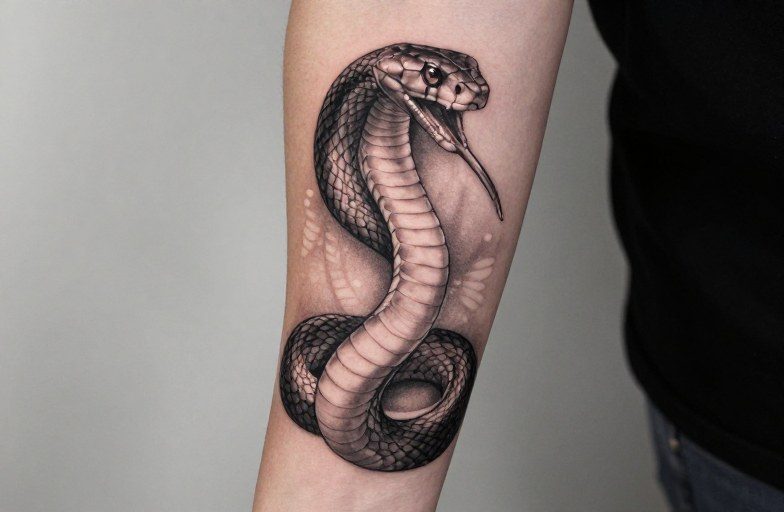
A snake tattoo on a woman most commonly signals transformation, personal power, and the willingness to shed old versions of herself. The meaning shifts noticeably based on how the snake is rendered, coiled and still, striking, paired with flowers or a skull, rendered in fine lines or bold traditional color. Unlike some symbols that flatten out over time, the snake holds tension: it can read as protective or threatening, sacred or seductive, depending on context.
Personal & Modern Meanings
Contemporary wearers often choose the snake as a marker of survived change, divorce, recovery, career pivots, coming out, surviving illness. The shedding process is biologically real; the snake literally crawls out of its former skin. That makes the metaphor land harder than abstract concepts like “new beginnings.”
Reclamation and Edge
For women specifically, the snake carries historical baggage as a symbol of temptation and dangerous sexuality. Getting one anyway, especially in visible placements, can function as reclamation. The wearer controls the narrative rather than inheriting it. Styles that emphasize this: dagger-through-snake compositions, snakes with multiple heads, or snakes wrapped around traditionally feminine imagery (roses, pearls, hands) to create friction between soft and hard.
Minimalist vs. Maximalist Intent
A single-line snake wrapping a finger reads as quiet, almost private symbolism. A full-color king cobra hood-spread across a thigh broadcasts something else entirely. Neither is more authentic. The minimalist version ages faster (fine lines blur, small scales become mush), so the commitment level differs practically, not just aesthetically.
Religious & Spiritual Angles
The snake’s spiritual resume is contradictory across traditions, which actually makes it more interesting as a tattoo choice.
Christian Context
In Genesis, the serpent initiates the fall; in Exodus, Moses’ bronze serpent on a staff heals those who look at it. Some Christian wearers use the snake to acknowledge human fallenness and the possibility of redemption. Others invert the symbol entirely, rejecting the association with evil and embracing the creature as knowledge-bearer. The design details telegraph which reading: a snake crushed under a heel reads orthodox; a snake entwined with an apple in luminous color reads more subversive.
Eastern and Indigenous Frameworks
Kundalini energy in Hindu tradition is often depicted as a coiled serpent at the spine’s base, rising through chakras. A snake tattoo along the spine directly references this. In some Mesoamerican traditions, rattlesnakes and feathered serpents held creator-deity status. Wearers with actual heritage connections sometimes choose these forms; others risk appropriation without understanding. The difference shows in execution, accurate iconography versus generic “tribal” patterning.
Similar & Related Symbols
Understanding what the snake isn’t helps clarify what it is.
- Ouroboros (snake eating its tail): Cyclical time, self-devouring, completion. More philosophical than the standard snake; less about personal transformation, more about cosmic patterns.
- Dragon: Power with social legitimacy, royalty, protection of community. The snake is more solitary, more ambivalent.
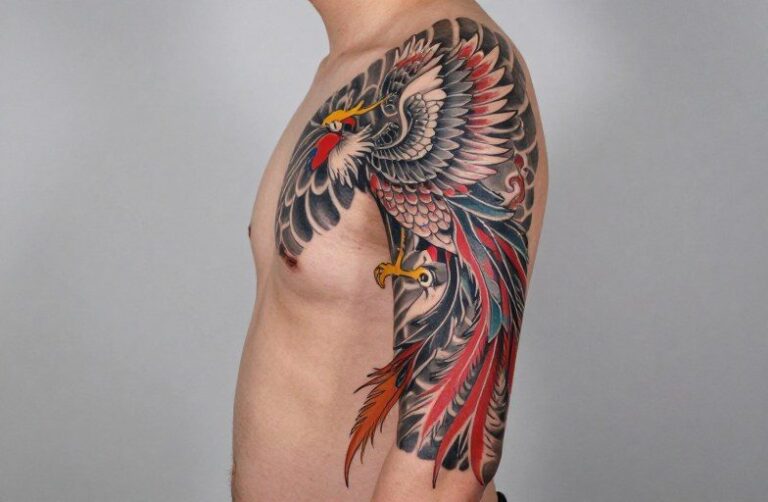
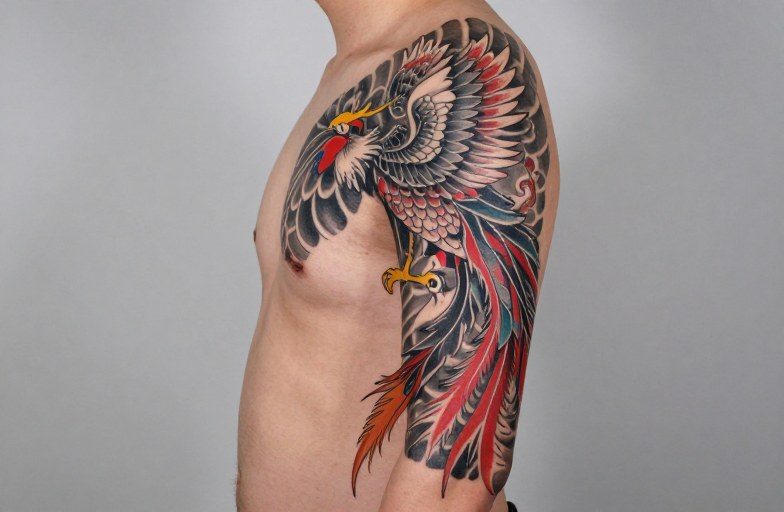
- Phoenix: Also rebirth, but spectacular and fiery. The snake’s rebirth is slower, messier, more incremental. A woman with both tattoos might be mapping different kinds of recovery.
- Medusa: The snake-haired figure adds gendered rage and the gaze as weapon. Pairing snake with Medusa imagery amplifies the protective-threat aspect.
- Moth or butterfly: Transformation with beauty as endpoint. The snake keeps its danger; it doesn’t become harmless.
Clients sometimes start wanting a butterfly, feel it’s too expected, and land on snake for the edge it retains.
How It Ages on Skin
Snake tattoos present specific technical challenges that affect how the meaning reads at year ten versus year two.
Scale Detail and Line Weight
Tiny individual scales drawn with single-needle work look crisp for maybe two years, then soften into texture without definition. Bold, simplified scales with consistent spacing, think traditional Japanese or American traditional, hold their shape for decades. The snake’s identity as snake depends on readable scale patterning; once that goes, it’s just a wavy line.
Movement and Wrapping
Snakes wrapped around arms or legs age better than flat, side-view snakes on flat skin. The wrapping creates natural dimension; the flat profile relies entirely on the artist’s shading to suggest roundness, and that shading lightens unevenly. A coiled snake on a shoulder cap, following the deltoid curve, maintains its form longer than the same design stamped on a forearm’s flat plane.
Color choices matter too. Solid black and grey snakes age most predictably. Greens, especially yellow-greens, can shift toward muddy olive or grey unpredictably. Red accents on tongues or eyes tend to hold.
Best Placements
Placement shapes meaning through visibility and body association.
- Spine: Direct kundalini reference; long vertical composition suits the snake’s body. Painful, slow to heal, hard to see yourself.
- Ribcage/side: Intimate, easily concealed. The snake’s curve follows the body’s natural architecture. Popular for first larger pieces.
- Thigh: Ample canvas for coiled compositions; readable in shorts or swimsuits, hidden professionally. The snake’s sensual associations amplify here.
- Forearm/wrist: Visible, daily reminder. A wrist-wrapped snake reads as personal talisman; a forearm piece reads more as identity statement.
- Behind ear/neck: Small, quick, but limited detail capacity. Often chosen for first tattoo; frequently covered later by larger work.
- Hand: High visibility, fast fading, professional implications. The snake’s “dangerous” symbolism intensifies in this exposed placement.
Consider how the snake’s head points. Toward the heart reads differently than toward the hand or upward toward the head. Some artists build this in deliberately; others don’t think about it unless asked.
Mythology & Folklore
Specific mythological snakes carry distinct resonances that some women explicitly invoke.
Greek and Norse Touchstones
The Lernaean Hydra, multi-headed, regenerating, maps onto battles that keep multiplying. The Midgard Serpent encircling the earth speaks to scale and patience. Neither is commonly rendered with full mythological context, but the visual vocabulary (multiple heads, massive coils) carries implicit weight. Medusa’s snake-hair, as noted, has seen revival as feminist symbol, though some scholars critique the flattening of a complex mythic figure.
Asian Serpent Traditions
The naga in Buddhist and Hindu contexts, often multi-headed cobras, function as protectors of sacred spaces and the Buddha himself. Japanese hebi (snake) folklore includes white snakes as wealth omens and the shapeshifting snake-woman figure. These carry specific cultural obligations; a white snake without engagement with that tradition reads as aesthetic choice rather than meaningful symbol.
Before You Decide
Ask yourself what specific transformation or quality you’re marking. The snake’s breadth is its strength and its weakness, too generic, and it becomes mere decoration. Consider whether you want the danger aspect present or minimized; this determines coiling versus extended posture, fangs visible or hidden, color temperature (cool greens versus warm earth tones). Research artists specifically for their snake work, scale patterning, head shape, and body thickness vary enormously in skill level. A snake that reads as powerful rather than decorative requires an artist who understands reptile anatomy, not just tattoo trends. Book consultations with multiple artists, bring reference images of real snakes alongside tattoo examples, and be wary of anyone who dismisses your questions about how the head direction or coil tightness affects meaning.
Frequently Asked Questions
Does a snake tattoo automatically signal that someone is dangerous or promiscuous?
No. The snake’s meaning depends heavily on style, placement, and personal context. A fine-line snake with flowers reads very differently than a traditional hooded cobra with a dagger. Cultural associations linger, but contemporary wearers largely define the symbol for themselves.
How painful is a snake tattoo compared to other designs?
Pain depends on placement, not subject. A snake wrapping a bony ankle hurts more than the same snake on a fleshy thigh. Spine and rib placements are consistently among the most intense. The snake’s long, continuous form sometimes requires longer sessions than compact designs of similar size.
Will a snake tattoo look dated in ten years?
Bold, simplified snakes in traditional or Japanese styles age gracefully. Highly detailed realism or trendy fine-line micro tattoos blur faster and can look period-specific. Choose technical approach over current aesthetic if longevity matters to you.
Can a snake tattoo be covered up if I change my mind?
Snakes are moderately coverable depending on size, color saturation, and original placement. Dark, large snakes are harder to cover than lighter, smaller ones. The curved shape can be adapted into floral or abstract work, but straight-line coverups often struggle with the snake’s serpentine flow.