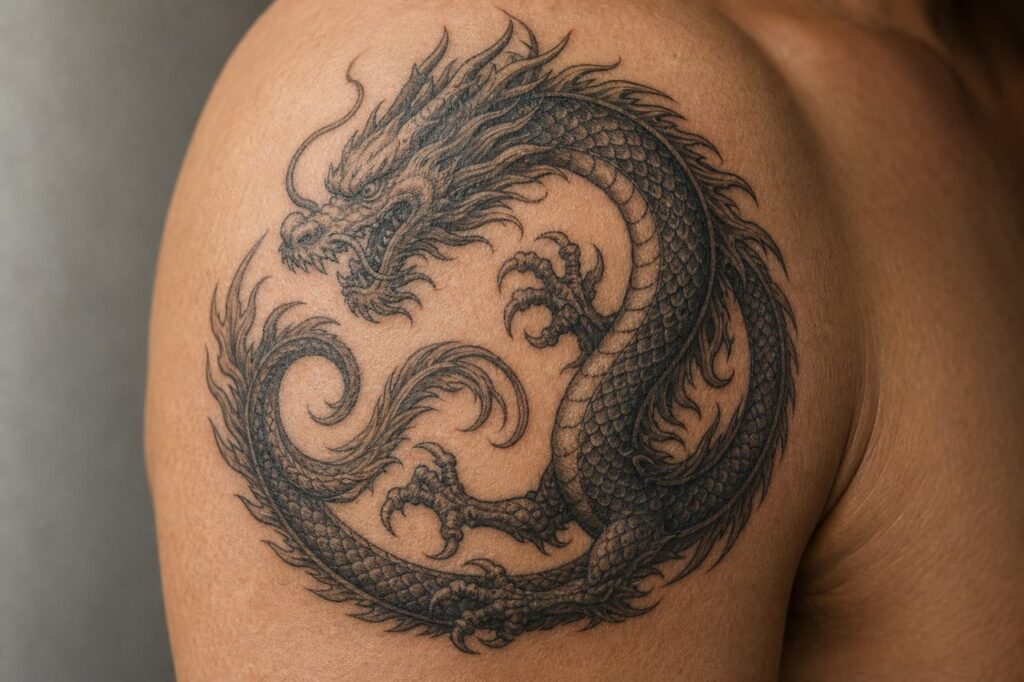
A dragon tattoo most commonly symbolizes raw power, fierce protection, and the tension between chaos and control. Across Eastern and Western traditions, the dragon represents a force that demands respect, sometimes a guardian, sometimes a destroyer, always something larger than human scale. The specific meaning shifts dramatically depending on whether the design draws from Chinese, Japanese, Celtic, or Norse sources, and whether the dragon is rendered coiled, ascending, or mid-combat.
Religious & Spiritual Angles
Spiritual traditions treat the dragon as more than a monster. In East Asian Buddhism, dragons often appear as protectors of the dharma, celestial beings that guard sacred texts and temples. A tattoo drawing from this lineage can signal devotion, discipline, or the aspiration to overcome internal obstacles. The dragon’s association with water and rain also connects it to purification and life-giving force in several religious contexts.
Christian and Western Esoteric Views
Medieval European Christianity cast the dragon as demonic, the serpent of Eden expanded into something winged and fire-breathing. Saint George slaying the dragon became a standard motif of spiritual triumph. Some modern esoteric traditions have reclaimed this imagery, using the dragon to represent the shadow self or the kundalini energy coiled at the spine’s base. A tattoo here might pair the dragon with a sword, cross, or geometric mandala to clarify which tradition it speaks to.
Symbolism & Core Meaning
At its foundation, the dragon embodies potency that borders on dangerous. Unlike the lion (noble, social) or the wolf (loyal, pack-oriented), the dragon is solitary and fundamentally uncontrollable. This makes it a symbol for:
- Personal sovereignty and refusal to be dominated
- Primal creative or destructive energy
- Transformation through trial, fire as forge rather than ending
- Wisdom earned through longevity and isolation
The direction a dragon faces or moves carries weight. Ascending dragons traditionally suggest ambition, spiritual growth, or rising above circumstance. Descending or coiled dragons can mean protection of something grounded, home, family, accumulated knowledge. Two dragons intertwined, common in Celtic knotwork, often represent balanced opposing forces rather than conflict.
Personal & Modern Meanings
Contemporary wearers rarely hew strictly to ancient symbolism. The dragon has become a flexible emblem for surviving difficulty, claiming space, or marking a period of radical personal change. Someone who rebuilt after addiction, loss, or imprisonment might choose a dragon specifically for its association with destruction and renewal, ashes as prerequisite.
Gender and Placement Shifts
Dragon tattoos have crossed old gender associations. Where Japanese tradition sometimes reserved certain dragon placements for men, contemporary collectors of all genders choose full-back pieces, delicate wrist coils, or thigh wraps. The scale of the dragon relative to the body changes its feel: a small dragon behind the ear reads as talismanic, almost secret; a chest-spanning piece demands confrontation. Fine-line single-needle dragons trend currently for their graphic quality, though they age faster than bolder traditional work.
Mythology & Folklore
Chinese mythology often linked dragons to imperial authority, the five-clawed dragon reserved for emperors, four claws for nobility. The dragon controlled weather, agriculture, and cosmic order. A tattoo referencing this tradition typically emphasizes the long, serpentine body, horns, and pearl of wisdom or power.
Japanese dragons, often linked to water deities like Ryūjin, feature more varied body proportions and frequently appear with clouds or waves. The number of toes differs from Chinese depictions (typically three), and the overall silhouette tends toward more muscular, compact forms.
European and Norse Variations
Norse mythology offers Fáfnir, a dwarf transformed into a dragon through greed, and Níðhöggr, gnawing at the roots of Yggdrasil. These are not noble creatures but warnings. Celtic dragons, by contrast, often guard treasure or entryways to other worlds, their forms interlaced with knotwork that suggests eternal cycles. A tattoo drawing from Celtic sources usually incorporates this interlacing directly into the body design rather than treating the dragon as separate from its background.
Design Tips & Pairings
Dragon tattoos succeed or fail on flow and anatomy. The dragon must move with the body’s musculature, not fight it. A back piece works best when the spine becomes the dragon’s central axis; a forearm coil should tighten near the wrist and expand toward the elbow. Poorly planned dragons look pasted on, their bodies broken by joints.
- Pair with cherry blossoms or peonies for Japanese-influenced balance between ferocity and beauty
- Add swords, shields, or armor for European medieval narratives
- Use geometric patterns or dotwork backgrounds for contemporary stylization
- Incorporate specific elements (fire, water, clouds) to clarify which tradition you’re referencing
Color choice matters for longevity. Reds and yellows fade fastest; deep blues, blacks, and greens hold longer. A dragon meant to read as fire-breathing needs enough contrast that the flame element doesn’t disappear into skin tone within five years. White ink highlights on scales almost always yellow or disappear entirely.
History & Cultural Roots
The dragon image appears independently across cultures with no single origin point. Chinese dragon imagery solidified during the Shang dynasty period, though earlier proto-dragon forms existed. European dragon depictions intensified during the medieval period, often linked to conversion narratives and the suppression of pre-Christian local deities. The convergence of snake, bird, and reptile features into a unified “dragon” likely reflects universal human responses to apex predators and the unknown.
Modern Tattoo Tradition
Dragon tattoos entered Western tattooing heavily through Japanese tebori influence in the mid-20th century, then through the proliferation of flash sheets and later custom Japanese-inspired work. Sailor Jerry and other American traditional artists simplified dragons for faster execution, creating a hybrid form that persists in street shops. Contemporary artists working in strict Japanese horimono tradition still apprentice for years before executing large dragon pieces, maintaining connection to method and meaning that flash-and-go work cannot replicate.
Before You Decide
Know which tradition you’re drawing from and why. A Chinese-style dragon with Japanese elements and Celtic knotwork reads as confused, not eclectic. Research matters: the number of toes, the presence of horns versus antlers, the body proportions all signal specific cultural sources to informed viewers. The dragon is too loaded a symbol to treat as generic fantasy.
Consider also the commitment. Large dragon pieces require multiple sessions, significant cost, and real estate that becomes harder to modify or cover as years pass. A dragon wrapping a forearm can extend to chest or back; plan for that possibility or contain it deliberately. The best dragon tattoos look inevitable, as if the body always held that shape beneath the skin.
Frequently Asked Questions
Does a dragon tattoo always mean something aggressive or violent?
Not necessarily. In East Asian traditions especially, dragons are associated with wisdom, benevolence, and protection. The meaning depends heavily on the specific cultural source and how the dragon is rendered, coiled and calm reads very differently than clawing and fire-breathing.
Which direction should a dragon face in a tattoo?
Ascending dragons traditionally suggest growth, ambition, or spiritual advancement. Descending dragons can mean protection of something grounded or already achieved. There’s no universal rule, but the direction should align with what you intend the piece to communicate.
How well do dragon tattoos age over time?
Bold-line traditional or Japanese-style dragons age better than fine-line or heavily detailed realistic work. Scale texture and small features tend to blur together as ink spreads slightly in skin. Plan for touch-ups, especially on color-heavy pieces with reds and yellows.
Is it culturally appropriative to get a Chinese or Japanese dragon if I’m not from those cultures?
This depends on approach. Working with a knowledgeable artist from that tradition, understanding the specific symbolism, and avoiding sacred or restricted imagery (like certain imperial symbols) shows respect. Treating the dragon as generic fantasy without engagement with its source is where problems arise.
Leave a Reply