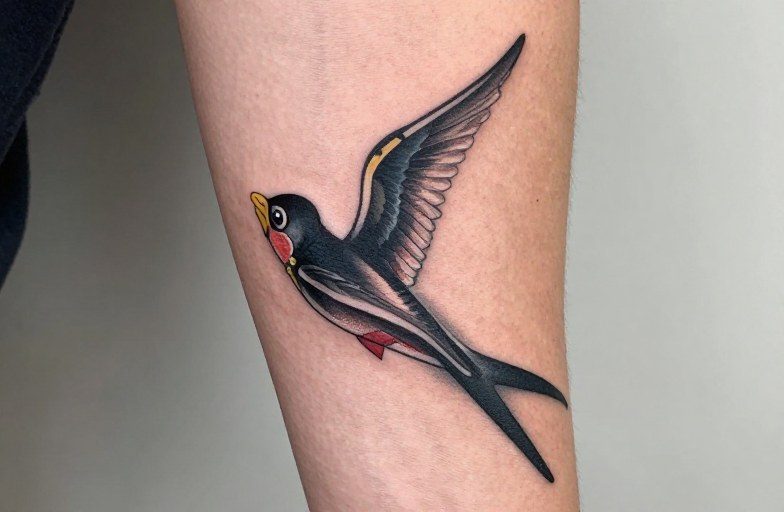
The Sailor Jerry swallow tattoo traditionally signals safe passage home and loyalty to loved ones left behind. Two swallows marked 10,000 nautical miles traveled, serious distance in the sailing era, earned slowly over years at sea. Today the design carries that heritage of commitment and homecoming, though most people wear it for the graphic boldness and personal resonance rather than literal seafaring credentials.
Symbolism & Core Meaning
Swallows migrate thousands of miles and always return to the same nesting grounds. Sailors adopted this as a promise: the bird goes out, weathers storms, finds land again. A single swallow often meant 5,000 nautical miles; a pair doubled that. Beyond mileage, the tattoo functioned as a kind of insurance policy, folk belief held that if a sailor drowned, the swallow would carry his soul to heaven.
Love and Fidelity
The swallow also anchored sailors to shore life. Getting the tattoo before a voyage meant you’d come back. Some would add a sweetheart’s name or initials beneath the bird, making the promise visible and permanent. The design’s compact size let it sit where a lover might see it, forearm, chest over the heart, rather than hidden on the back or leg like larger work.
Freedom and Return
There’s tension in the symbol: the bird is free, untethered, yet compulsively drawn home. That duality still appeals. People who travel constantly for work, who left hometowns and circled back, or who maintain long-distance relationships find the swallow speaks to their particular rhythm of departure and return.
Best Placements
Traditional swallow tattoos work best where the bird’s shape can breathe and read instantly from a few feet away. The classic Jerry design is roughly hand-sized, built for specific spots.
- Side of the chest/pec: The traditional location, especially for pairs facing each other. The pectoral muscle gives the bird a slight lift, and the curve of the ribs echoes the wing shape.
- Forearm, outer or inner: Highly visible, easy to show or cover with a sleeve. Inner forearm ages faster due to sun exposure and friction.
- Shoulder cap: Follows the roundness well. A single swallow here reads as landing or taking off; pairs can face inward toward the collarbone.
- Back of the hand: Hardcore traditional placement, but hand tattoos blur faster and carry professional visibility issues. The small bones and thin skin there don’t hold fine detail as long.
- Thigh: Larger canvas allows for more elaborate Jerry-style banners or additional elements like roses or daggers.
Neck and throat placements have become more common, but the swallow’s horizontal orientation fights the vertical space there. It can work, but usually requires design modification that drifts from the classic look.
Color vs Black and Grey
Sailor Jerry’s original flash sheets show swallows in bright, limited palettes: deep navy blue, scarlet red, bold yellow, with black outlines heavy enough to read across a barroom. That color choice wasn’t arbitrary, it was what the inks of the 1940s-50s could reliably produce and what held up under Pacific sun and salt.
Traditional Color
Classic color swallows keep the red breast (borrowed partly from the barn swallow’s actual coloring), blue-black wings, and sometimes a yellow beak or eye. The color blocks are flat, not shaded, with black separating every element. This approach ages with dignity: the black outline continues defining the shape even as color fades slightly. Touch-ups after 10-15 years are common and straightforward.
Black and Grey
Stripping the color changes the mood. Black and grey swallows feel more somber, more graphic, sometimes more contemporary. The breast becomes negative space or light grey wash rather than that signature red spot. Without color, the silhouette must be absolutely precise, there’s no red to draw the eye and forgive a slightly off wing curve. Healing tends to be cleaner with less color saturation, but the tattoo can look muddy faster if the grey tones aren’t properly saturated.
How It Ages on Skin
Swallow tattoos age well because of their structural strengths: bold outline, limited fine detail, high contrast. The design was literally built for longevity on working skin.
What Holds Up
The black outline is your insurance policy. Even when red breasts fade to pink and blue wings soften to grey, that outer contour keeps the bird recognizable. Traditional swallows avoid the tiny details that turn to mush, no individual feather lines, no photorealistic eye reflections. The stylized approach means a 20-year-old swallow still reads as a swallow, just slightly weathered in a way that suits the nautical heritage.
What to Watch
Color saturation varies by body zone. Chest swallows often hold color longest; forearms and hands see faster fading from sun and use. The red breast is typically the first area to need attention, as red pigments are generally less stable than black. White highlights (sometimes added to the eye or wing edge) frequently disappear entirely within a few years, especially on darker skin tones.
Skin changes matter too. Weight fluctuation affects the chest and stomach more than the forearm. A swallow on a bicep will distort if the muscle grows significantly. The design’s simplicity means it handles some stretching better than intricate pieces, but placement still matters for long-term shape integrity.
Similar & Related Symbols
The swallow doesn’t travel alone in traditional tattoo vocabulary. Understanding its neighbors helps clarify what you’re actually asking for.
- Sparrow: Often confused with swallows, sparrows in traditional tattooing represent different ideas, sometimes linked to imprisonment (“done my bird”), sometimes to lower-deck sailors rather than experienced hands. Visually, sparrows are chunkier, less streamlined, with shorter tails.
- Anchor: The classic companion piece. Anchor means stability, swallow means return; together they complete the narrative of going to sea and coming home.
- Ship: Represents the voyage itself, the broader context for the swallow’s mileage marker.
- Dagger through a swallow: A later traditional addition, often interpreted as loss of a friend at sea or betrayal by someone trusted.
- Swallow with a banner: Allows names, dates, or short phrases. The banner’s curves can integrate with the bird’s flight path or sit below as a separate element.
Modern interpretations sometimes blend swallows with non-nautical elements, roses, clocks, geometric frames. These can work visually but dilute the specific symbolic language. The swallow’s power comes partly from its established vocabulary; mixing too freely turns it into generic bird imagery.
Personal & Modern Meanings
Most people getting swallows today have never hauled line or measured knots. The meaning shifts accordingly without becoming meaningless.
Commitment in Various Forms
Long-distance relationships, military deployment, immigration and return, these modern separations mirror the sailor’s circumstance closely enough that the symbol transfers cleanly. Some get swallows after completing significant journeys: sobriety milestones, gender transitions, surviving illness. The “return home” becomes metaphorical, but the structure of going out and coming back intact remains valid.
Graphic Appreciation
Plenty of people choose swallows simply because they love the look. The bold lines, the dynamic shape, the way a good swallow seems to move even static on skin. This isn’t lesser motivation. Traditional tattooing has always mixed personal meaning with aesthetic preference. Sailor Jerry himself was selling flash to strangers who liked the pictures; deep symbolism was available but not mandatory.
What matters is knowing what you’re carrying. A swallow without the backstory is still a strong tattoo. A swallow with personal resonance becomes stronger.
Before You Decide
Few final considerations for a choice you’ll live with decades.
- Research the artist’s traditional work: Not everyone who does tattoos does clean traditional well. Look for consistent line weight, solid color packing, and healed photos, not just fresh work.
- Consider the direction: Swallows traditionally face toward the heart or home, or toward each other as pairs. Facing outward isn’t wrong, but know the convention you’re breaking.
- Size matters: Too small loses the boldness; too large and the stylization starts to look awkward. Hand-sized is the sweet spot for classic proportions.
- Think in pairs: Single swallows work, but the tradition strongly favors two. If you’re drawn to one, consider whether the composition might be stronger doubled.
- Healing is unglamorous: You’ll have a scabby bird for two weeks. Plan clothing and activities accordingly. The chest sweats and rubs; the forearm bumps against everything.
The Sailor Jerry swallow endures because it solved real problems: how to mark experience, how to promise return, how to wear something that stays readable across decades. Those solutions still work, whether your miles are nautical or metaphorical.
Frequently Asked Questions
Do I need to be a sailor to get a swallow tattoo?
Not at all. The design has been common civilian wear since the 1960s. What matters is understanding the heritage and finding your own connection to the symbolism of return and loyalty.
What’s the difference between a swallow and a sparrow tattoo?
Visually, swallows have forked tails and streamlined bodies; sparrows are rounder with shorter tails. Symbolically, they carry different traditional meanings, swallows for safe return and miles traveled, sparrows often for different life experiences.
How much does a traditional swallow tattoo typically cost?
Prices vary widely by region and artist reputation, but expect to pay for quality custom work rather than seeking bargain rates. A well-executed traditional piece from a specialist generally runs in the standard hourly range for your area.
Can a swallow tattoo be easily covered up later?
The bold black outline that makes swallows age well also makes them challenging to cover. Laser removal or significant fading is usually necessary before covering with a new design. Placement choice should account for this permanence.

Leave a Reply