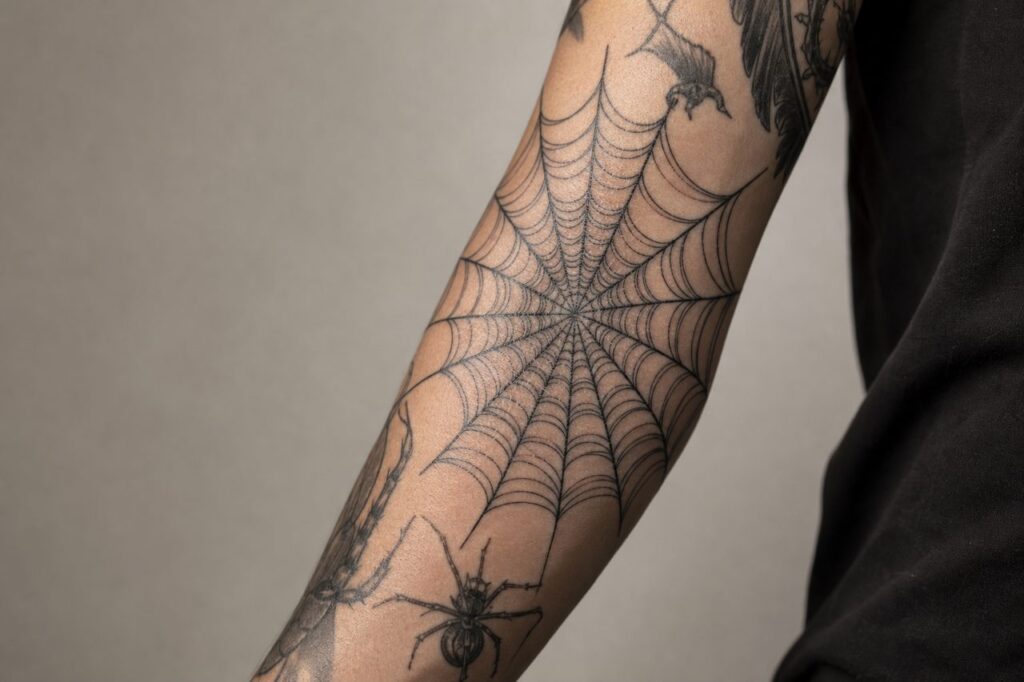
A spider web tattoo signals different things depending on where you put it, what surrounds it, and who is looking. On an elbow or knee, the design carries weight you cannot ignore: prison culture, time served, the slow grind of years. Move it to a forearm or rib, and it becomes something else entirely, patience, creative construction, the threads of fate pulling together and apart. You need to know both readings before you choose.
What the Web Means for You
Most people who walk into a shop asking for a spider web have one idea in mind. They leave with something that means more than they expected, or less than they should have understood. The design is deceptively simple: lines radiating from a center, connected by threads. Its simplicity lets it absorb context.
Time, Entrapment, and Survival
The classic elbow or knee spider web, sometimes with a spider at center or flies caught in the strands, remains tied to incarceration culture. The elbow placement specifically suggests leaning on it, rubbing against walls and time. On the knee, it implies crawling through difficulty. These meanings persist in many communities, and experienced artists will warn you if you seem unaware of the association.
Outside that context, you might read the web as surviving something that held you: addiction, an abusive relationship, a system that felt inescapable. The spider becomes the survivor, not the victim. The web is what you escaped, not what defines you. This reading works best when you place it somewhere visible during your daily work, a private reminder rather than a public statement.
Creative Patience and Construction
Spiders build elaborate structures from their own bodies. For artists, writers, musicians, and craftspeople, the web becomes a metaphor for slow, deliberate creation. The radial lines and spiral threads map onto the creative process: planning, execution, waiting, rebuilding. You see this interpretation most often on forearms, shoulders, or ribs, places the wearer can see while working.
- Elbow/knee: strongest prison/time association, impossible to fully separate from that history
- Neck/throat: high visibility, bolder social statement, harder to soften contextually
- Forearm/shoulder: personal meaning, creative or protective, more control over interpretation
- Hand/fingers: commitment to the symbol, harder to conceal, demands technical precision
- Ribs/side: private significance, less social signaling, more intimate scale
What You Pair It With
Spider webs rarely travel alone. The imagery around them sharpens or redirects their meaning in ways you should plan deliberately.
Common Pairings and What Changes
A spider in the web shifts focus from passive structure to active presence. The spider is predator, architect, patient hunter. Without it, the web reads more as environment or trap. A skull caught in the web leans mortality-heavy: time running out, death inevitable. A clock or hourglass similarly emphasizes time’s passage, sometimes with a more neutral or nostalgic tone than the prison reading.
Dreamcatchers share the web structure but carry entirely different cultural weight, often linked to Ojibwe origins and protective function. Pairing a spider web with dreamcatcher elements can create confusion or unintentionally mash together distinct traditions. Most artists advise keeping these separate unless you have specific personal or familial connection to both.
Barbed wire sometimes accompanies web work, especially on elbows, reinforcing confinement and struggle. Roses or other organic elements soften the design, pulling it toward natural cycles, growth, decay, the web as part of a larger ecosystem rather than isolated symbol.
Where the Symbol Comes From
Spider web symbolism predates modern tattooing by millennia, though specific origins are often murky and contested. You should be careful claiming certainty where scholars themselves disagree.
Weavers of Fate and Language
Greek mythology often links spider imagery to Arachne, the weaver transformed into a spider after challenging Athena. The story carries warnings about hubris but also celebrates technical skill. In West African and Caribbean traditions, Anansi the spider appears as trickster and storyteller, spinning tales rather than webs. These threads sometimes surface in tattoo choices for people with diasporic connections.
Native American traditions vary significantly by tribe and region. The dreamcatcher’s web, often linked to Ojibwe origins, filters bad dreams. Some Pueblo and Navajo traditions feature Spider Woman as a creator figure. You should understand which specific cultural source you are referencing, not treat “Native American” as a single category. Appropriation concerns are real, and artists in Native-run shops may question your connection to the imagery.
Norse mythology sometimes connects the web to the Norns, weavers of fate, though this association is less visually direct than others. The concept of threads of life appears across cultures: Greek Fates, Norse Norns, some Hindu and Buddhist imagery. This makes the web a broadly cross-cultural symbol of destiny, but also a generic one if you do not specify your personal reading.
How to Design It Well
Spider web tattoos demand technical precision. The design fails quickly when lines wobble or spacing grows uneven. You should know what makes the difference between a web that holds and one that collapses.
Line Work and Aging
Spider webs consist of thin, precise lines radiating from a center point with concentric or spiral connecting threads. This structure ages poorly if executed too small or too delicate. Lines blur and merge over five to ten years, especially on high-movement areas like elbows and knees. Bold, slightly heavier lines hold definition longer. Negative space, the gaps between threads, matters as much as the lines themselves. A web that fills in with skin tone over time becomes a muddy blob.
Black and grey dominates spider web tattooing, with occasional red accents for the spider or caught prey. Color rarely improves the design; the web’s power lies in graphic contrast and structural clarity. Shading within the web itself usually weakens the effect, making it look dirty rather than dimensional.
Placement Mechanics
The elbow presents genuine technical difficulty. Skin stretches and compresses dramatically, making straight lines challenging to execute and maintain. Experienced artists stencil the design with your arm both bent and extended, checking distortion. Knees pose similar problems. Flat areas like forearms and shoulders allow cleaner execution and more predictable aging.
- Minimum size: palm-sized for legibility over time, larger for elbows and knees
- Line weight: consistent, slightly bold, not hair-thin
- Negative space: protected, not filled with greywash
- Spider addition: requires separate technical skill, often best by same artist for cohesion
Spiritual and Religious Readings
Spider webs carry limited direct religious association, but spiritual readings proliferate. You should know which resonate with your actual beliefs and which you are borrowing for aesthetic effect.
Christian, Buddhist, and Pagan Contexts
Some Christian interpretations connect the web to human sin and entrapment, the world as a snare pulling away from divine focus. This tends toward negative symbolism, something to escape rather than celebrate. The spider’s patience and industriousness sometimes maps onto virtues of diligence and quiet faith, though this reading is less common in tattoo culture.
Buddhist and Hindu contexts occasionally reference the web’s illusion: Maya, the deceptive nature of material reality. The web looks solid but breaks under pressure; it catches but cannot hold. This philosophical reading suits minimalist, delicate web designs rather than bold prison-style work.
Contemporary pagan and Wiccan practitioners sometimes adopt spider imagery for its association with creation, feminine energy, and the weaving of reality. This tends toward more elaborate, decorative web designs, often with the spider prominently featured or with moon phases integrated into the radial structure.
What to Remember
Placement is meaning with spider web tattoos. An elbow or knee web carries historical weight you cannot erase through personal intention alone. You may reclaim it, redefine it, or ignore it, but you should do so knowingly. Artists in most shops will assume you understand the prison association if you ask for these placements; some will refuse if you seem naive about the implications.
The web’s technical demands are real. Thin lines blur. Small designs become illegible. Elbows and knees distort. You need an artist who has done this specific work before, who will stencil with your joint in multiple positions, who will tell you if your desired size is too small. The best web tattoos look simple because the hard work of precision is invisible.
Pair deliberately. A spider changes the reading. A skull changes it further. A dreamcatcher element risks cultural confusion unless you have genuine connection to both traditions. The web absorbs context, so you should control that context rather than letting it accumulate by accident.
Finally, know that the symbol has broadened far beyond its subcultural origins. You will see spider webs on people from every background, profession, and intention. What matters is whether your specific web, in your specific placement, with your specific surrounding imagery, says what you mean. The web itself says nothing fixed. It is a structure waiting for you to occupy it.
Frequently Asked Questions
Does a spider web tattoo always mean prison time?
No, though elbow and knee placements carry that historical association strongly. On forearms, shoulders, ribs, or other locations, the design commonly represents patience, creative work, survival through difficulty, or personal fate symbolism. Placement determines much of the reading.
How much does a spider web tattoo typically cost?
Simple black and grey web designs range from $150-$400 depending on size, placement difficulty, and artist experience. Elbows and knees often cost more due to technical complexity. Highly detailed work with a rendered spider or extensive surrounding imagery runs higher.
Do spider web tattoos age badly?
They can. Thin lines blur and merge over time, especially on high-movement areas like elbows and knees. Palm-sized minimum, slightly bold consistent line weight, and protected negative space help longevity. Avoid hair-thin lines and heavy greywash shading within the web itself.
Is it cultural appropriation to get a spider web tattoo?
The basic geometric web structure has no single cultural owner. However, specific combinations, spider web paired with dreamcatcher elements, or imagery drawn from specific Native American, African, or Caribbean traditions, require understanding and genuine connection to those sources. Avoid treating distinct cultural symbols as interchangeable decoration.
Leave a Reply