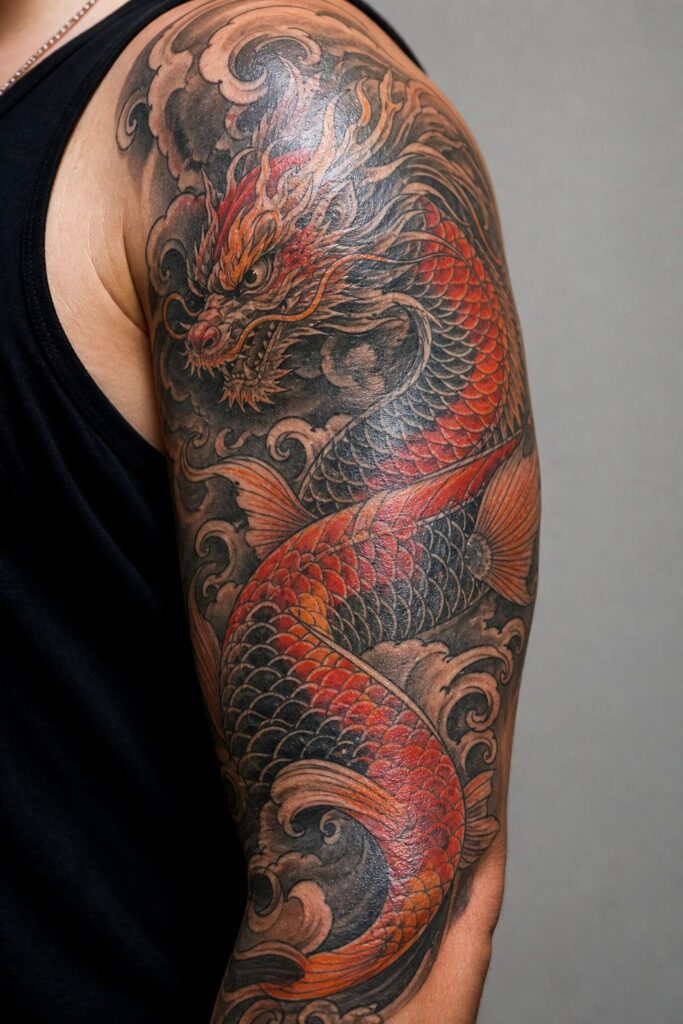
The koi fish and dragon tattoo represents the transformation from struggle to triumph. Rooted in East Asian folklore, it depicts the koi’s legendary swim upstream and its metamorphosis into a dragon at the waterfall’s summit. On skin, this pairing signals perseverance, ambition, and the payoff of enduring hardship.
Symbolism & Core Meaning
Two distinct creatures carry separate weight before they merge into a single narrative.
The Koi’s Upstream Journey
In Japanese and Chinese folklore, koi that swim the Yellow River’s rapids and crest the Dragon Gate waterfall transform into dragons. The fish itself stands for persistence against adversity, patience, and quiet determination. A koi swimming upward, head angled against the current, reads as active struggle. One drifting downward can suggest accomplishment or the ease that follows effort, though some wearers simply prefer the visual flow.
The Dragon as Arrival
Dragons in this context represent power, wisdom, and supernatural attainment earned rather than granted. Unlike Western depictions of dragons as hoarding or destructive, the East Asian dragon governs water, weather, and fortune. In the koi-dragon narrative, it is the destination: the self you become after the grind. The tattoo often stages this as partial transformation, scales emerging, whiskers lengthening, the body still fish-like, to keep the story in motion rather than resolved.
Personal & Modern Meanings
Contemporary wearers attach meanings that drift from folklore without abandoning its spine.
Career and Ambition
Someone finishing law school after working nights, a founder exiting a startup, an athlete recovering from injury, these narratives map cleanly onto the koi-dragon arc. The tattoo functions as a milestone marker rather than a general aspiration. Placement often reinforces this: forearms and calves keep the image visible during the daily grind, a private reminder that the current effort connects to a larger transformation.
Recovery and Reinvention
People rebuilding after addiction, divorce, or incarceration sometimes choose this design to mark a before-and-after without using words. The visual narrative does the work: the fish’s ugliness of struggle, the dragon’s authority of survival. The meaning stays specific because the imagery is sequential, not static.
Best Placements
Where this tattoo sits changes how the story reads and how well it holds.
Arm and Leg Sleeves
The full sleeve remains the classic format for koi-dragon work. The arm’s length accommodates the upstream journey: koi at wrist, turbulent water at elbow, dragon emerging at shoulder. On the leg, the vertical canvas suits the waterfall drop. Thigh pieces often place the dragon coiled around the hip, the koi below the knee, using the muscle’s natural taper to suggest ascent.
Back and Chest
A full back piece allows the dragon to spread across the shoulder blades while the koi occupies the lower back or waist, following the spine’s line. Chest placements split the narrative: koi on one pectoral, dragon on the other, connected by water or cloud across the sternum. This works better on broader frames; narrow chests compress the imagery and blur the distinction between the two figures.
- Forearm: High visibility, limited space, best for single koi with subtle dragon features, not full narrative
- Calf: Cylindrical surface suits swimming motion; holds color well; easy to show or hide
- Ribcage: Painful, but the vertical strip fits waterfall imagery; plan for multiple sessions
- Hand/finger: Generally discouraged, small scale loses the two-figure distinction, and ink falls out fast
Color vs Black and Grey
The color choice alters symbolism and longevity in specific ways.
Traditional Color Palettes
Classic Japanese irezumi uses limited, saturated color: red or orange koi, black and grey water, gold or green dragon scales. Red koi specifically symbolize love and courage; black koi represent overcoming adversity; gold koi signal wealth and prosperity. A red koi transforming into a golden dragon layers meaning but risks visual confusion if the palette muddies. Blue or white koi read as calmer, less aggressive in their ambition.
Black and Grey Realism
Black and grey execution emphasizes form over symbol. The dragon’s scales gain depth through shading; the koi’s movement reads through line weight and negative space. This approach ages more gracefully, color saturation drops faster, and touch-ups on large color fields look patchy. On darker skin tones, black and grey avoids the chalky opacity that bright pigments sometimes heal into. The tradeoff: cultural specificity softens, and the red-gold prosperity coding disappears.
How It Ages on Skin
Large, detailed Japanese-style tattoos age differently than minimalist work, and the koi-dragon format carries specific risks.
Line Spread and Detail Loss
The fine scales on dragon bodies, the koi’s whisker-thin barbels, and the turbulent water lines all sit at the edge of what skin holds. Over ten to fifteen years, lines spread approximately one to two millimeters. Whiskers blur into surrounding water. Small scale patterns merge into texture rather than readable pattern. Artists compensate by building in negative space, gaps between scales, open water around the fish, so spread has room without destroying the image.
Color Shifts
Reds and oranges in koi bodies are particularly reactive to sun exposure, shifting toward salmon or brown. Blues and greens in dragon elements hold better but can go muddy if over-saturated. Black outlines stay longest but can develop a blue-grey cast as they settle deeper in the dermis. The waterfall’s white foam, often achieved through untattooed skin, remains the most stable element, planning around skin-as-negative-space is a longevity strategy.
Religious & Spiritual Angles
The imagery carries spiritual weight that predates its tattoo use, though wearers engage with this selectively.
Buddhist and Taoist Resonance
The koi’s upstream struggle often links to Buddhist practice: the discipline of meditation, the gradual accumulation of merit, the eventual breakthrough sometimes called awakening. The Dragon Gate itself appears in Chan and Zen texts as a metaphor for sudden enlightenment after long effort. Taoist interpretation emphasizes the transformation as natural process, water flowing, fish becoming dragon, rather than earned reward. Wearers with active Buddhist practice sometimes add lotus elements or sutra text; others keep the imagery secular, appreciating the narrative structure without doctrinal commitment.
Contemporary Spirituality
Some wearers frame the koi-dragon arc through personal growth language: shadow work, integration, the hero’s journey. The dragon represents the integrated self, the koi the unacknowledged potential. This reading borrows the visual narrative without requiring cultural or religious adherence. It works because the image genuinely supports multiple interpretations, the transformation is visible, the mechanism unspecified.
Final Word
The koi fish and dragon tattoo endures because its narrative structure matches lived experience: effort, duration, change. Whether rendered in full color sleeve or restrained black and grey, the core remains the movement from one state to another. Choose placement based on your daily visibility needs and your body’s aging patterns. Prioritize an artist who understands Japanese compositional flow, how water moves, how negative space breathes, how the eye travels from fish to dragon. The meaning is in the transformation, not the arrival. A koi frozen mid-change, scales half-emerged, often carries more visual tension than a completed dragon preening on a shoulder. Let the story stay active.
Frequently Asked Questions
Does the direction the koi swims change the meaning?
Upward-facing koi traditionally represent active struggle and ambition, while downward koi can signify completion or the ease after achievement. Some artists treat direction as purely compositional, so confirm your intent before the stencil goes on.
Can this tattoo work on darker skin tones?
Black and grey execution holds detail and contrast reliably across all skin tones. Bright color work requires careful pigment selection, consult an artist experienced with your specific melanin level to avoid colors that heal ashy or disappear entirely.
How many sessions does a full koi-dragon sleeve typically take?
A full sleeve with detailed water background and two figures usually requires 25-40 hours across 6-10 sessions, depending on arm length, pain tolerance, and whether color or black and grey. Ribs or chest pieces run longer due to skin sensitivity and breaks needed.
Is it culturally appropriative for non-Asian wearers to get this design?
The koi-dragon narrative circulates widely in global tattoo culture, but respectful execution matters: avoid combining it with unrelated religious iconography, choose an artist trained in Japanese composition rather than copying flash sheets, and understand the folklore enough to explain why you chose it.

Leave a Reply