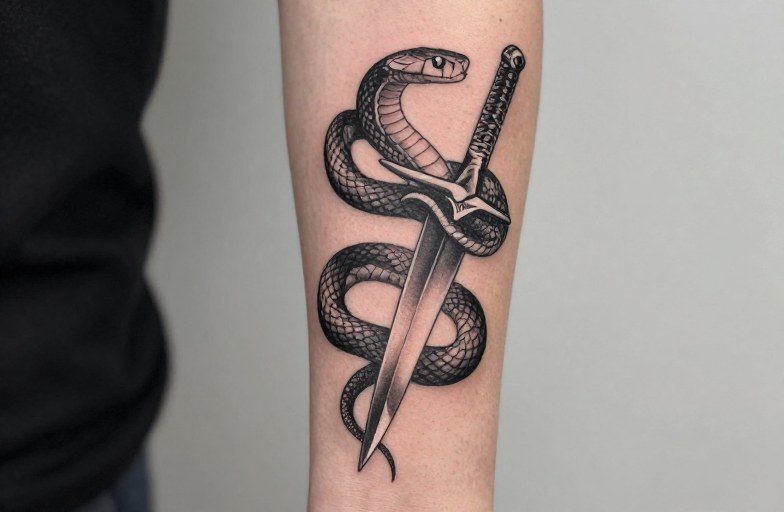
The snake and dagger tattoo pairs two ancient symbols of conflict: the blade as aggression or protection, the serpent as threat or renewal. Together, they usually read as a struggle between opposing forces, death against life, fear against courage, poison against the cure. Most people choose this image for its visual tension rather than a single fixed meaning, though the combination carries recognizable weight across cultures.
Personal & Modern Meanings
Today’s wearers gravitate toward this pairing for reasons that rarely show up in symbol dictionaries. The dagger stops the snake, or the snake coils the blade, either way, the image captures a moment of unresolved conflict, which suits people who don’t want their tattoo to resolve too neatly.
Protection and Defiance
A drawn dagger aimed at a striking serpent reads as active defense. This appeals to people who’ve survived something, addiction, betrayal, illness, and want the mark without the soft imagery of birds or flowers. The design doesn’t promise victory; it shows the fight itself. Placement matters here: forearms and calves keep the image visible, a choice that signals the wearer wants the symbol acknowledged by others.
Transformation Through Risk
Snakes shed skin; daggers draw blood. The combination can mark a painful change that required confrontation. Some pair the image with specific dates or small additions, roses for what was lost, chains for what was broken, though the core image stands alone without decoration. The meaning stays personal without needing explanation, which is partly why this design persists through trend cycles.
History & Cultural Roots
The pairing predates modern tattooing by centuries, though exact origins stay scattered across traditions rather than fixed to one source.
Mediterranean and Middle Eastern Threads
The Rod of Asclepius, single snake coiled around a staff, often linked to healing, while daggers in Greek and Roman contexts carried both martial and ritual significance. Some trace the snake-and-blade combination to protective amulets against venom, though the archaeological record mixes these with unrelated serpent imagery. What matters for tattoo history: sailors and soldiers in the 18th and 19th centuries carried these symbols home, where they entered the Western tattoo vocabulary.
The American Traditional Legacy
Sailor Jerry and his contemporaries standardized the image in the mid-20th century, rendering it with bold black outlines, limited color, and dramatic poses. The snake’s head typically faces the viewer, fangs exposed, while the dagger enters at an angle that creates maximum visual movement. This legacy means most snake and dagger tattoos still echo that compositional logic even when rendered in radically different styles.
Color vs Black and Grey
The choice between approaches changes how the symbol reads and how it survives over decades.
Traditional Color Palette
Classic American traditional uses red for the snake’s belly or tongue, green for scales, and silver-grey for the blade with yellow or gold for the hilt. These colors age predictably: reds and greens hold reasonably well, yellows fade fastest, and the heavy black outlines prevent the design from blurring into indistinct shapes. Color demands more space, small details below dime-size won’t hold the pigment through healing and sun exposure.
Black and Grey Realism
Photorealistic rendering emphasizes texture: snake scales catch light differently than steel, and skilled artists use this contrast for dramatic effect. The downside: fine grey shading in the blade’s reflection often softens within five to ten years, losing the crisp distinction that makes the image striking. Black and grey suits larger pieces where the artist can use deep blacks to anchor the composition as the mid-tones fade.
- Color traditional: bold, readable at distance, faster to execute
- Black and grey realism: subtle, contemporary, requires more maintenance over time
- Single-needle fine line: trendy but risky; thin snake scales and dagger edges blur within years
Similar & Related Symbols
The snake and dagger sits within a family of paired opposites that tattoo collectors often consider alongside it.
Snake and skull doubles down on mortality, losing the tension of active conflict for a more static memento mori. Dagger through rose softens the aggression with romantic sacrifice, popular, but the sentiment reads more explicitly than serpent imagery. Snake alone, without the blade, shifts toward renewal and cunning; the dagger’s addition introduces human will and violence into the equation.
Less common but visually related: the snake coiled around a sword rather than a dagger. Swords carry more heroic or mythic associations, St. George, Excalibur, while daggers feel personal, street-level, intimate. The switch changes the scale of the implied conflict.
How It Ages on Skin
This design contains elements that test tattoo longevity, so planning matters.
The Snake’s Head and Fangs
Open mouths with extended fangs create tiny negative spaces that close up during healing if the lines are too fine. A good artist leaves those spaces slightly larger than the final desired look, anticipating the ink spread. Tongues and eye details below three millimeters often become solid blobs within a decade; bolder simplification ages better than intricate accuracy.
The Dagger’s Edge and Hilt
Blade reflections rendered as thin grey lines disappear fastest. The strongest long-term approach uses solid black along the cutting edge with limited grey wash for shine. Crossguards and pommels offer opportunity for decorative detail, wire wrapping, gemstone settings, that can be simplified if aging demands it. Straight lines in the blade warp slightly on curved body parts; forearms and outer thighs keep truer geometry than ribs or shoulders.
Skin type affects outcome significantly. Oily skin spreads ink more; the heavy black outlines of traditional style compensate better than delicate realism. Sun exposure without SPF fades all approaches, but the red and yellow in traditional palettes suffer most visibly.
Who Chooses This Tattoo
Demographics here resist easy profiling. The design crosses gender, age, and subculture lines more than specialized imagery like biomechanical or purely ornamental work.
Military and first responders often select the dagger dominant, snake subdued, control over chaos. People in recovery sometimes choose the snake ascending, dagger lowered or dropped, survival without ongoing combat. Collectors building traditional-style sleeves include the image as a classic compositional element, sometimes without personal narrative attachment at all.
Placement trends differ by intention. Throat and hand placements signal confrontation, visibility, refusal to hide. Ribs and upper arms keep the image more private, revealed by choice rather than default. The back offers space for elaborate coiling and multiple daggers, though this scales the personal meaning toward theatrical display.
What to Remember
The snake and dagger tattoo works because it refuses easy resolution. Neither animal nor weapon clearly wins; the frozen moment invites projection without demanding fixed interpretation. If you’re considering this design, prioritize an artist who understands the compositional legacy, how the snake’s curve balances the dagger’s straight line, where negative space prevents muddiness, which details will survive decades of skin changes.
Ask to see healed photos, not just fresh work. The bold lines that look slightly crude when new become the reason the tattoo still reads in fifteen years. The delicate realism that photographs beautifully today may soften into a grey smear that loses the very tension that makes the image meaningful. Choose based on how you want this to look at fifty, not how it appears on Instagram tonight.
Frequently Asked Questions
Does the snake and dagger tattoo always mean the same thing?
No. The meaning shifts with composition, snake striking versus coiled, dagger raised versus plunging. Context from the wearer’s life matters more than any fixed dictionary definition.
Is this design only for men?
Not at all. Women choose this pairing across all styles, from delicate fine-line versions to heavy traditional work. The symbolism of conflict and protection isn’t gendered.
How much does size matter for this tattoo?
Size matters significantly. Below four inches, the snake’s scales and dagger details merge during healing. Five to eight inches allows the tension between elements to read clearly.
Can I combine this with other symbols without cluttering the design?
Yes, but sparingly. A small banner with text, a single flower, or minimal background elements work. Multiple additions usually fight the central conflict that makes the image powerful.

Leave a Reply