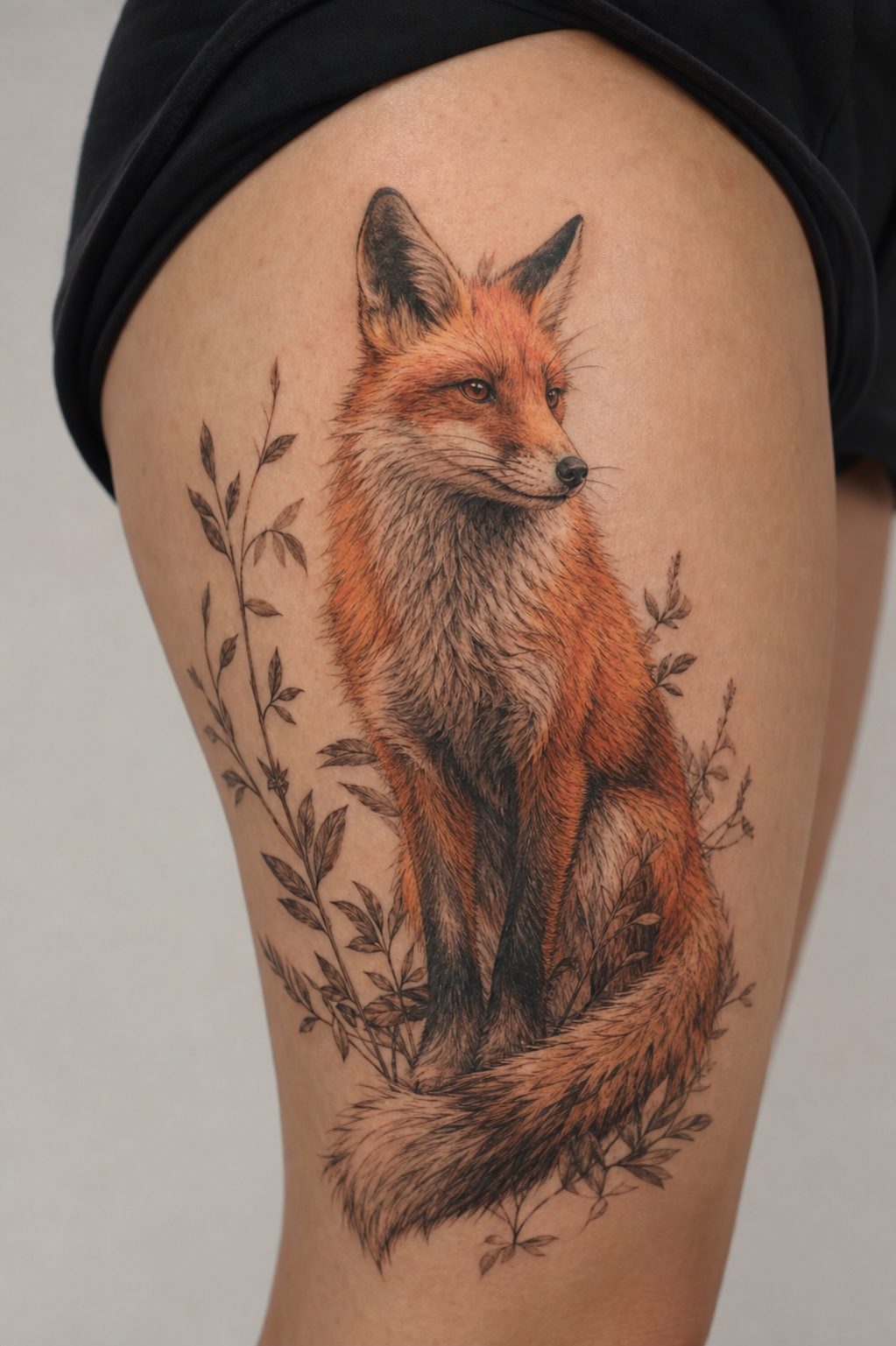
A fox tattoo most commonly signals adaptability, sharp intelligence, and the ability to thrive at the edges of things. Beyond the cartoonish trickster, the real animal is a solitary survivor, observant, quick, and fiercely territorial. That duality between playful mischief and raw survival instinct gives the fox its enduring appeal in tattoo culture.
Symbolism & Core Meaning
The fox operates as a symbol of liminal space: dawn and dusk, wilderness and human settlement, visible and hidden. Its meaning clusters around several concrete traits rather than vague mysticism.
Intelligence Without Brute Force
Foxes don’t rely on size or strength. A fox tattoo often appeals to people who solve problems laterally, who value strategy over confrontation. The nine-tailed fox of East Asian folklore amplifies this into supernatural wisdom and accumulated knowledge. In Nordic tradition, the fox’s ability to evade larger predators made it a figure of deserved respect, not ridicule.
Transformation & Disguise
The seasonal coat change, red to silver, thick to thin, grounds the fox in literal transformation. Kitsune legends extend this into shapeshifting, where the fox assumes human form to test, teach, or deceive. A tattoo leaning into this aspect often plays with half-formed features: human eyes in a fox face, or a figure dissolving into brush-tailed shadow.
History & Cultural Roots
Specific cultural associations vary sharply, and conflating them flattens the symbol’s actual depth.
East Asian Traditions
The Japanese kitsune is often linked to Inari, the deity of rice and prosperity, and serves as both messenger and independent trickster. Multiple tails indicate age and power, one tail per century, in common telling. Korean gumiho stories tend darker: the nine-tailed fox feeds on human essence, a predator-prey dynamic that some tattoo collectors explore through horror-influenced design. Chinese huli jing occupy similar territory, sometimes malevolent, sometimes romantic, always ambiguous.
European & Indigenous North American Threads
Reynard the Fox medieval tales used the animal to satirize power structures, peasant wit outsmarting noble predators. Some trace this to older Germanic fox-spirit traditions. Across Indigenous North American nations, fox appears variably: as a thief to be outwitted, a teacher of survival craft, or a clan totem. The specifics belong to individual nations and shouldn’t be treated as interchangeable.
Best Placements
Where a fox tattoo sits changes how it reads and how well it holds up.
- Forearm or calf: The elongated fox body suits these vertical canvases. A running fox follows the muscle flow naturally; a curled sleeping fox wraps well around the narrower wrist or ankle transition.
- Ribcage or side: Excellent for a fox in tall grass or mid-pounce, using the body’s natural curves for environmental storytelling. Pain here is significant, and the skin’s constant flexing demands simpler line work or heavier saturation to age cleanly.
- Upper back/shoulder blade: The broad, flat plane accommodates a fox with full tail display, bushy, multi-tailed, or interacting with moon or flame elements. Aging is favorable; sun exposure is minimal if you wear shirts.
- Behind the ear or along the hairline: Small, peeking fox faces work here, playing on the animal’s hidden-observer quality. Scale is critical: too much detail collapses into blur within a few years.
Hand and finger placements are generally poor for fox imagery. The fine features, narrow muzzle, delicate ear tufts, whisker spacing, blur rapidly on high-wear skin.
Color vs Black and Grey
This choice determines emotional temperature and practical longevity.
Color Approaches
Traditional red-orange fox fur translates well through saturated orange, deep rust, and cream belly accents. The risk: cheaper orange pigments fade toward peach or muddy brown, especially with sun exposure. Quality artists use a two-pass orange, warm yellow base, red-orange overlay, to maintain depth. White highlights on tail tips or chest patches rarely stay crisp; they yellow or disappear into surrounding skin tones.
Neo-traditional and Japanese approaches often push into purple, teal, or electric orange for stylized impact. Watercolor foxes, splashy, abstract, require a strongly defined black or dark grey structural line to prevent the “bleeding mess” look at five years.
Black and Grey
Superior for subtlety and longevity. A grey fox tattoo reads as nocturnal, winter-coated, or spirit-form. The value range, deep blacks in eye and nose, soft grey gradation through fur, holds better over decades. Japanese sumi-e brushstroke influence works exceptionally here: a few confident strokes suggesting form rather than rendering every hair.
Linework-only foxes (no shading) demand exceptional needle control. Fur texture rendered through line direction and spacing, not fill, separates skilled from amateur work. These age best at medium scale with generous negative space.
How It Ages on Skin
Fox tattoos face specific aging challenges tied to their common design elements.
Problem Areas
Thin whisker lines, delicate paw pads, and small eye highlights are the first casualties. A fox’s narrow muzzle can lose definition, becoming generic dog or wolf if the artist over-relies on fine line weight. Tail fur rendered as individual hair strokes spreads and softens; better to suggest density through clustered shading.
White ink in snow-dappled fox designs (arctic foxes especially) almost always disappears or turns yellow-grey. Plan for this: design the tattoo to read completely without the white, using it only as temporary enhancement.
What Holds Up
Bold silhouette foxes, solid black or saturated color shapes with minimal interior detail, remain legible for decades. The iconic curled-fox shape, tail wrapping around body, works because the overall form is unmistakable even as interior texture softens. Geometric foxes (triangular construction, polygonal facets) age better than photorealistic attempts at small scale.
Placement on low-friction, low-sun skin (upper arm, torso, thigh) extends clarity. Regular moisturizer and SPF application matter more for red/orange pigments than for black and grey.
Design Tips & Pairings
Successful fox tattoos usually commit to a specific symbolic register rather than piling on every possible association.
Coherent Combinations
- Fox and moon: Nocturnal, witchy, feminine-coded in Western tradition but not exclusively. Crescent moons frame a fox well; full moons behind create strong backlight silhouette.
- Fox and botanicals: Foxglove (digitalis) carries literal name connection and toxic beauty; grapevines reference Reynard’s thieving; autumn leaves reinforce seasonal transformation.
- Fox and geometric frame: Diamond or hexagonal borders contain the fox’s restless energy, creating a contained emblem rather than narrative scene.
- Multiple tails: Commit to a specific number with cultural resonance (one, three, nine) rather than arbitrary plurality. Each tail should be visually distinct, not cloned repetition.
Style Compatibility
Japanese irezumi foxes require understanding of specific regional conventions, Hokkaido versus mainland interpretations, Inari messenger versus independent yokai. Don’t mix incompatible elements: a kitsune with a Western compass rose reads as collision, not synthesis. Traditional American foxes work best when simplified to essential form, not attempting fur realism. Fine-line single-needle foxes need generous scale; at under three inches, the face becomes indistinguishable from cat or small dog.
Final Word
A fox tattoo succeeds when it respects the animal’s actual nature: observant, adaptable, surviving through precision rather than force. The best designs choose one symbolic thread, trickster, survivor, spirit, transformer, and execute it with technical awareness of how that imagery will settle into skin over years. Avoid the temptation toward excessive detail that photographs well fresh but muddles with age. The fox’s power has always been in what it reveals and conceals; a tattoo capturing that tension, simply and durably, outlasts any ornate rendering.
Frequently Asked Questions
Does a fox tattoo always mean I’m calling myself clever or tricky?
Not necessarily. Many people choose fox imagery for its adaptability, aesthetic appeal, or personal connection to the animal itself. The meaning depends on what you emphasize, a sleeping fox reads differently than a grinning trickster.
How big should a fox face tattoo be to keep the details sharp?
For a standalone fox face with clear eyes, nose, and ear structure, aim for at least palm-sized. Smaller than that, and the narrow muzzle and eye spacing blur into generic canine within a few years.
Can a fox tattoo work as a cover-up for an older piece?
The bushy tail and body create excellent coverage potential, but the face’s fine features require clean surrounding skin. A skilled artist can use the tail’s solid color or black fill to mask previous work while placing the detailed face on clearer skin.
Is there a difference between a red fox and an arctic fox tattoo in meaning?
Red foxes lean toward the traditional trickster, fire, and autumn associations. Arctic foxes emphasize survival, purity, and harsh-environment resilience. The color palette shift, warm versus cool, also changes the tattoo’s emotional register significantly.