
Delicate phoenix tattoos can stay readable, personal, and easy to cover when placement does the heavy lifting. I learned that after choosing a spot that showed under every sleeve. These ideas keep the silhouette fine, the meaning powerful, and the ink discreet when you need privacy. You’ll find meaningful options for first-timers and collectors alike!
- Start Small: Delicate Phoenix Tattoos for Wrists
- Why Ribcage Phoenix Tattoos Feel So Private
- Watercolor Delicate Phoenix Tattoos on Ankles
- Hide a Minimal Phoenix Behind the Ear
- Ornate Delicate Phoenix Tattoos on Forearms
- Build a Unique Phoenix Tattoo with Botanical Details
- Crescent Moon Phoenix Tattoos: Meaning Before Ornament
- Can Dainty Phoenix Tattoos Work on the Sternum?
- Geometric Delicate Phoenix Tattoos on Shoulders
- Matching Phoenix Tattoos for Sisters: Same Symbol, Different Details
- Colorful Phoenix Tattoos with Crisp Linework
1Start Small: Delicate Phoenix Tattoos for Wrists

A wrist phoenix works best when the body stays narrow and the wings don’t spread too far toward the hand. For your design, ask for single-needle linework with terracotta and olive accents, a small rising head, two crisp wing arcs, and a tail that follows the wrist instead of crossing it. This gives you a striking outline that still reads when your sleeve moves.
I’d keep the piece around 1 to 2 inches, because a larger bird can lose its delicate character on this narrow area. You’ll want your artist to leave small gaps between feathers rather than packing every section with ink. That negative space makes the phoenix look graceful instead of crowded.
A stone-gray wash can soften the terracotta without making the design feel heavy. You’ll want to protect the olive details from dense shading and constant sun exposure. A tiny dot cluster near the tail adds an understated spark, but I’d keep the overall design minimal.
If you’re comparing proportions, look at these tiny phoenix tattoos before your appointment. You’ll notice how the strongest examples use one clear gesture instead of several competing details. My favorite version has the phoenix angled slightly upward, as if it’s leaving the wrist rather than sitting on it!
2Why Ribcage Phoenix Tattoos Feel So Private

A ribcage phoenix can feel intimate because you control when anyone sees it. The design should follow the body’s vertical curve, with the head near the lower ribs and the tail tapering toward the waist. Clay-toned ink with a muted aged-brass accent gives it an elegant, almost whispered quality.
This placement is more painful than an outer forearm or thigh because the ribs have less padding and sit close to bone. You’ll want to discuss the exact position before the stencil goes on. I’d place the wings between two ribs rather than directly over the sharpest edge, since your breathing can make that spot move during the session.
For a meaningful variation, use fine-line featherwork with three longer strokes and only a few interior marks. That keeps the phoenix expressive without turning the side of your body into a crowded illustration. A tiny crescent or dot can sit near the tail, but I wouldn’t add flowers unless your artist can protect the bird’s silhouette.
Don’t choose this spot only because it’s private. Your skin will stretch and shift as you breathe, so you’ll need an artist who understands placement and stencil alignment. Browse these delicate snake tattoos for narrow body-following compositions, then compare them with delicate owl tattoos for feather spacing.
3Watercolor Delicate Phoenix Tattoos on Ankles

A watercolor phoenix on the ankle gives you vibrant color without requiring a large, loud design. Plum, soft gray, and rose-gold details can make the bird feel delicate while keeping the body readable. Start with watercolor ink that fades through the feathers instead of filling every shape evenly.
An ankle design needs a strong outer silhouette because the skin moves, rubs against footwear, and receives frequent sun. You’ll want the plum color concentrated around the body, with gray softening the wings and rose gold reserved for the tail. That creates a flowing transition without turning the tattoo muddy.
I’d keep the wings open and let the color carry some of the detail. A romantic watercolor effect can work beautifully here, but too many tiny splashes may blur as the tattoo settles. Ask your artist where they’ll leave untouched skin between the washes.
This placement can feel more tender than its small size suggests. Choose footwear that won’t press against the fresh tattoo, and follow your artist’s aftercare instructions closely. The result can be a vibrant ankle phoenix that stays personal and easy to conceal!
4Hide a Minimal Phoenix Behind the Ear

Behind-the-ear phoenix tattoos are small by necessity, which makes them ideal when you want an edgy symbol that stays easy to conceal. A narrow head, one lifted wing, and a single curved tail can fit naturally into the space without competing with your ear. Navy ink with small white gaps keeps the design sleek and discreet.
This area can be tender, and the skin is thin, so your session may feel sharper than the tiny size suggests. You’ll want to bring your hair down during the consultation and check whether the design disappears when you turn your head. I’d rather see a simple, polished phoenix here than an intricate one that becomes unreadable.
For your artist, ask about a stencil that sits slightly below the ear rather than directly in the fold. That placement gives the image more breathing room and makes it easier for you to cover with your hair. A walnut-brown tail accent can add a symbolic finish without making the design ornamental.
Don’t let the hidden placement push you toward an overly complicated image. The skin has limited space, and tiny feather marks may soften over time. These tiny phoenix tattoos show the scale to aim for, while delicate dragon tattoos can help you compare compact mythical silhouettes.
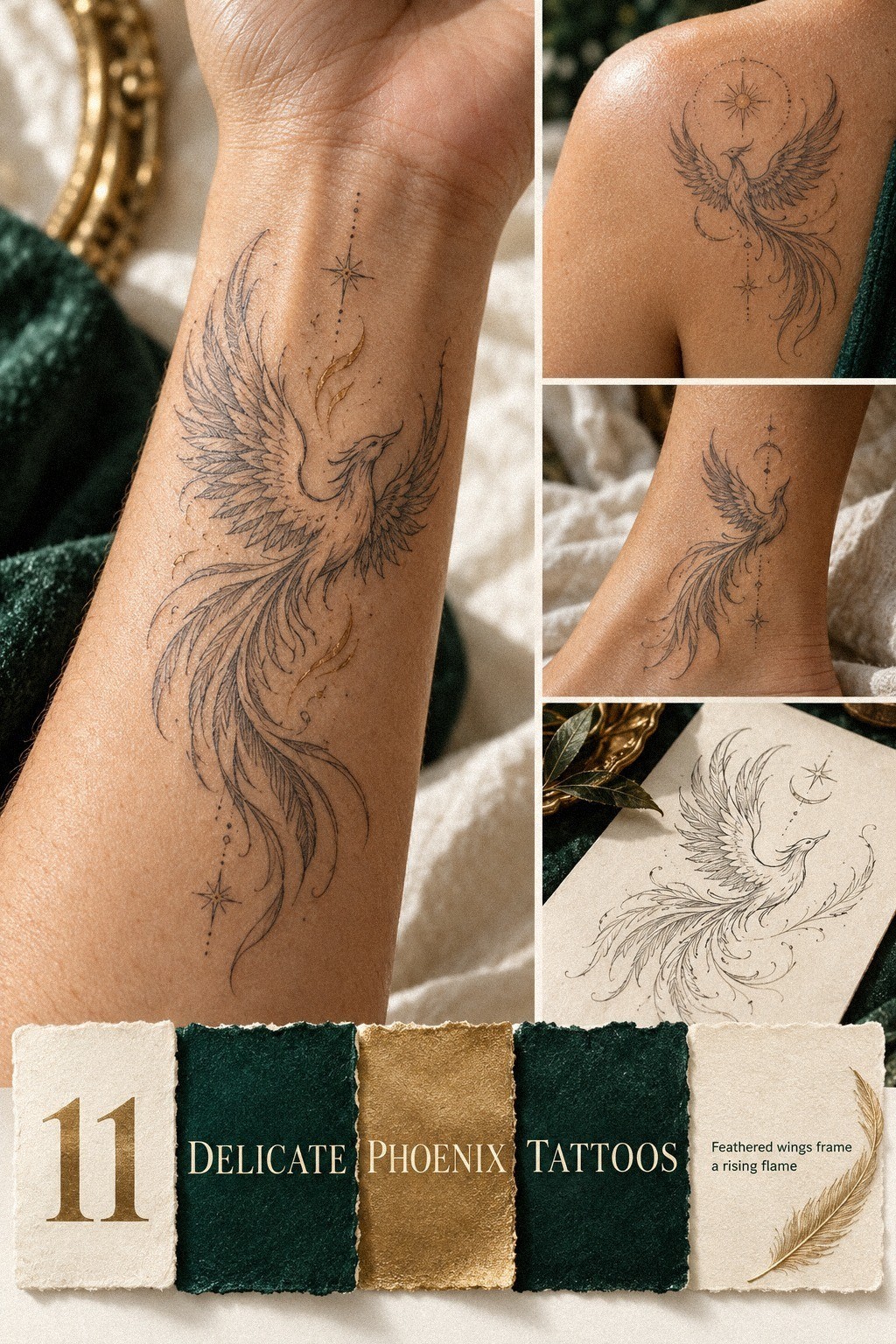
5Ornate Delicate Phoenix Tattoos on Forearms

A forearm gives you enough space for an ornate phoenix while still letting you cover it with a long sleeve. Emerald, gold, and cream can create a bold design without burying the feather structure. Emerald ink works best when the artist leaves clear skin breaks between the wing layers.
Ask for one dominant wing gesture and a tail that follows the length of your forearm. Too many isolated feathers can make an ornate tattoo look busy, while a few carefully placed curves keep it polished. Gold-toned details can highlight the head or tail without competing with the emerald body.
This is a strong placement for a meaningful symbol because you can see it easily and cover it when needed. A fierce phoenix may suit the forearm if you want visible transformation, while a softer design can feel more personal. I’d keep cream accents small so they support the silhouette.
Your artist should show you healed work with similar line density and color choices. The forearm usually offers reliable space for detail, but sun exposure can still soften lighter tones. A well-planned ornate phoenix can feel iconic without becoming oversized!
6Build a Unique Phoenix Tattoo with Botanical Details

A thigh phoenix gives you room to build a personal story around the figure. Forest-green and rust accents can suit high-contrast black ink with open skin breaks, carefully placed curves, and botanical details that don’t swallow the bird. The result can feel graceful, personal, and quietly dramatic.
Choose plants for meaning rather than decoration. A thorned stem can suggest survival, while a rust-colored leaf can suggest change after loss.
You’ll want your artist to design the botanical lines around the phoenix’s movement, not place random leaves beside it. The bird should remain the first shape your eye catches.
I’d use one plant and one feather rhythm here. Mixing roses, vines, moons, and stars can sound exciting during planning, but your tattoo may lose its focus. A fine-line botanical sprig with narrow leaves gives you a softer frame and lets the phoenix feel more symbolic than literal.
If your skin tone is deep, ask to see healed work on similar skin rather than relying only on fresh examples. Your artist should understand contrast, spacing, and how forest green and rust settle. These delicate unique butterfly tattoos offer useful ideas for botanical balance, while delicate dragon tattoos show how to keep a mythical subject dominant.
7Crescent Moon Phoenix Tattoos: Meaning Before Ornament

A crescent moon and phoenix make a meaningful pairing because both shapes suggest cycles, change, and return. On the shoulder, your artist can place the moon above the bird so the phoenix appears to rise toward it. Charcoal linework with dusty-rose shading and a brass-toned crescent keeps the composition symbolic without making it heavy.
I’d keep the moon open and slightly uneven, with two or three small stars at most. Your shoulder has enough space for detail, but you don’t need every celestial mark available. A bold moon can overpower the phoenix, so ask for a thinner lunar curve and a stronger bird silhouette.
This is one of the more flexible placements for privacy. You’ll be able to cover the tattoo with a sleeve, but you can also let the top edge show with a tank or open neckline. The shoulder is usually more tolerable than ribs or feet, and the skin gives your artist room to create a timeless design.
What makes this idea work for you? The moon can represent a quiet phase, while the phoenix carries the sharper transformation. Explore these minimalist phoenix tattoos for restrained compositions, then compare delicate owl tattoos if you want more nocturnal symbolism without adding extra objects.
It has real emotional range!
8Can Dainty Phoenix Tattoos Work on the Sternum?

A sternum phoenix can be dainty and intensely personal, especially when the tail feathers follow the centerline of your body. A single-feather structure suggests a design built from separated barbs rather than a fully filled bird. Flowing feather lines can make the phoenix feel ethereal.
This placement asks for careful symmetry and a steady hand. You’ll want the top of the design positioned so it doesn’t crowd your chest, while the tail should taper before it reaches the lower sternum. I’d rather see three long feather gestures than ten short marks that blur together after healing.
The sternum is among the more painful areas, especially over the bone. Your breathing may also make the skin move during the session, so talk with your artist about breaks and positioning. A small design can still feel powerful here because the location gives it emotional weight.
I’d skip heavy color on the sternum. Crisp black linework will give you the cleanest long-term read, while a warm-white or camel accent can be added only if the artist believes the skin and spacing support it. Look through these small phoenix tattoos and delicate snake tattoos for narrow, body-following ideas.
9Geometric Delicate Phoenix Tattoos on Shoulders

Geometric phoenix tattoos suit you if you want the softness of a delicate bird with a sharper visual system. The shoulder design calls for precise angles, measured feather divisions, and a circular or triangular structure behind the phoenix. Midnight-blue ink with copper and ivory details gives the design a sharp edge.
I’d use geometry as a support, not a cage. Your artist can draw the bird with flowing curves, then add a few precise lines around the wings to create contrast. If every feather becomes a triangle, the phoenix may look mechanical rather than alive.
That tension between soft and sharp is what makes this version compelling.
Shoulder skin offers useful space and is generally more tolerable than the sternum, hands, feet, or ribs. You’ll want the design checked as your arm moves, since the shoulder changes shape during motion. A stencil that looks centered while your arm rests may shift when you lift it.
For inspiration, compare these delicate eagle tattoos for wing anatomy and delicate dragon tattoos for angular mythical forms. I’d choose a shoulder phoenix over a fully geometric forearm piece if you want privacy, because a sleeve can cover it without hiding the composition forever.
10Matching Phoenix Tattoos for Sisters: Same Symbol, Different Details

Matching phoenix tattoos work best when the designs share one core shape but don’t need to be identical in every detail. Healed sage-green linework should be part of your planning reference, since two tattoos can settle differently even when the stencil matches.
You and your sister might choose mirrored wings, different tail directions, or one moon and one sun around the same bird. I’d use warm cream accents on one tattoo and soft brown accents on the other, while keeping the central phoenix shape consistent. That makes the pairing playful without making the tattoos look copied.
Before booking, compare your artists’ healed portfolios. Your skin, placement, and aftercare habits may differ, so the tattoos won’t age in exactly the same way. You’ll want a design with enough open space that slight changes won’t ruin the connection between the two pieces.
Don’t rush the symbolism just because the concept feels romantic. Talk through what the phoenix means to both of you, then choose one shared feature and one personal feature. These small phoenix tattoos can help with scale, while delicate unique butterfly tattoos offer ideas for paired designs that remain related without looking copied.
11Colorful Phoenix Tattoos with Crisp Linework

A colorful phoenix can still look delicate if the outline stays controlled and the palette remains focused. Terracotta ink around the body, with crisp black contours, stone-gray transitions, and small olive details, can make the color support the bird’s shape.
I’d choose two main colors and one accent rather than filling every feather. A terracotta chest, olive tail, and tiny stone-gray detail can look vibrant without turning the tattoo muddy. Your artist should explain how they’ll separate color fields, especially around the wings and narrow tail marks.
The upper arm gives you good privacy under short or long sleeves and usually feels more tolerable than ribs, hands, feet, or the sternum. You’ll still need to protect fresh color from sunlight after healing, because ultraviolet exposure can soften contrast over time. Ask how your artist expects each shade to settle.
For a bright but polished result, keep the linework crisp and let some skin remain visible. Solid black anchors around the head and wing joints will help the phoenix read if the color fades first. Browse these tiny phoenix tattoos for compact silhouettes and delicate eagle tattoos for strong wing placement.
Phoenix Rising: What the Symbol Can Carry
The phoenix can represent survival, grief, renewal, or a private turning point. A custom symbolism plan helps you decide whether the bird should look fierce, peaceful, or quietly victorious before you discuss feathers and color.
You don’t need to explain the meaning to anyone who sees it. That’s part of the appeal. A hidden phoenix can be personal without becoming secretive, and an understated mark can carry more emotional weight than a large statement piece.
I’d write down three words you want the tattoo to hold. Then remove anything that doesn’t serve those words. The final design will feel more iconic when the symbolism has room to breathe.
When Is a Custom Phoenix Worth the Cost?
A custom phoenix is usually worth paying for when your placement, skin tone, or personal symbolism needs more than a flash design can offer. A custom design deposit may increase the initial price, but it can solve problems before the needle touches your skin.
Ask what the quote includes. Some artists include one revision, while others charge separately for major changes. You’ll get better value when you arrive with a clear placement, approximate size, and a short explanation of what the phoenix means to you.
A lower budget doesn’t automatically mean a poor tattoo, but rushing toward the cheapest option can create expensive corrections later. I’d rather save for an artist whose healed work matches your goal than compromise on a delicate design that depends on restraint.
How to Compare Healed Work Before You Book
Fresh tattoos often look darker and sharper than they will after settling. Healed portfolio examples show whether an artist can preserve small gaps, smooth curves, and readable feather shapes over time.
Look for healed work on skin tones similar to yours. Check whether the wings still have separation and whether color remains distinct near the tail. Those details tell you more than a dramatic studio image.
You should also ask how the artist approaches aftercare, touch-ups, and placement changes. A professional answer is part of the experience and can help you decide whether the appointment is worth the investment.
Why I’d Choose Fine Lines Carefully
I used to think a delicate tattoo was automatically a safer tattoo. It isn’t.
A thin line can look romantic and understated in a fresh example, then soften more than you expected if the placement gets heavy sun, constant friction, or too much detail. I learned that by choosing a design whose feathers were packed too closely together.
Your best decision isn’t simply choosing black or color. It’s matching the design’s density to your skin, movement, and daily habits. If you work outdoors, a hidden placement may protect your tattoo better than a visible wrist.
If you sleep on your side, a rib design may be more annoying during healing than you imagine.
I’d also ask to see healed work from the same artist, preferably at least several months old. Fresh ink can look crisp, dark, and polished while the final result will be softer. Healed linework tells you whether the artist understands spacing, contrast, and restraint.
You don’t need to make the phoenix tiny to keep it private. A 2- to 4-inch design under an upper-arm sleeve can carry more detail than a 1-inch wrist mark, while still staying hidden when you need it to. The right phoenix isn’t the smallest one.
It’s the one whose lines have enough room to remain readable.
Tattoo Placement and Cost Guide
The table gives you a starting point, not a quote. Your artist’s region, experience, design complexity, and studio minimum will change the final number. You’ll want to ask for a range before the appointment, especially if you’re adding color, dense shading, or a custom botanical detail.
I’d prioritize a strong stencil and a healed portfolio over a bargain price. A custom tattoo stencil lets you check size, direction, and privacy before the needle starts. If the design looks cramped on paper, it won’t improve once it’s on your skin.
Ask whether touch-ups are included and how long the artist considers the tattoo eligible for a free adjustment. That policy can affect the real cost, particularly with fine lines and saturated color.
The Questions Worth Answering First
How much does a delicate phoenix tattoo usually cost?
A delicate phoenix tattoo usually costs about $50 to $100 at a studio minimum or about $100 to $250 per hour in the US. Clear pricing depends on your artist, region, placement, size, and detail.
You’ll get the most useful estimate by sending the reference, body area, approximate size, and color plan before booking. Ask whether the quote includes a studio minimum.
Are delicate phoenix tattoos a good idea for a first tattoo?
Yes, delicate phoenix tattoos can suit a first tattoo because you can choose a manageable placement and a personal symbol. A moderate design on the forearm, thigh, or shoulder may feel more tolerable than ribs or the sternum.
You’ll still want to avoid choosing solely by size. A meaningful phoenix with clean spacing can feel more personal than an ultra-tiny mark you’ll struggle to read later.
How do I choose a tattoo artist for delicate phoenix tattoos?
Choose an artist whose portfolio shows clean fine-line work, healed results, and strong hygiene practices. A healed portfolio matters because fresh tattoos can hide how thin lines settle.
You’ll want to check whether the artist regularly works with your preferred style and skin tone. Ask about their stencil process, aftercare instructions, and how they handle small details.
How much do delicate phoenix tattoos hurt?
Pain varies by placement, with ribs, feet, hands, and the sternum often feeling sharper than the forearm, thigh, or shoulder. Placement comfort depends on your body and the session length.
You’ll have a better experience if you eat beforehand, stay hydrated, and tell your artist when you need a pause. A small design can still feel intense over bone.
How long does a delicate phoenix tattoo take to heal?
The surface usually heals in about 2 to 3 weeks, while complete healing takes about 2 to 3 months. Gentle aftercare includes washing softly, moisturizing as directed, and avoiding sun and swimming early on.
You’ll need to follow your artist’s instructions rather than picking flakes or scratching. If redness, swelling, or pain worsens, contact a medical professional.
What’s the best placement for delicate phoenix tattoos?
The forearm, thigh, and shoulder are strong choices for visibility, comfort, and line clarity, while the ribs, sternum, and ankle offer more privacy but may feel more tender. Flexible placement lets you cover the tattoo when needed.
You’ll want to think about sunlight, clothing friction, and how much detail your chosen area can hold. A slightly larger design may age more clearly than a cramped miniature.
Where I’d Start First
If I had to pick one, I’d start with the crescent moon shoulder phoenix. Its open negative space will keep the silhouette readable as fine lines soften. Pin it for later and compare it with our minimalist phoenix tattoos guide before you book.
That is a design worth waiting for!

