
Delicate snake tattoos can stay crisp and personal when placement, spacing, and line weight work together. I once chose a tiny design without asking how it would age, and the result needed more thought than I gave it. These ideas balance discreet placement with meaningful symbolism. Your favorite may be hiding in plain sight!
- Wrap the Finger With a Fine-Line Snake
- Can a Tiny Snake Stay Hidden Behind the Ear?
- Let Botanical Linework Give the Snake a Flowing Path
- Contrast: A Minimal Snake Around the Ankle
- The Spine Makes an Ornate Snake Feel Vertical
- Crescent Moon, Snake, and Sacred Negative Space
- Let an Elegant Snake Cross the Wrist
- One Bloom, One Snake: Tiny Flowers With Restraint
- Dotwork Changes the Snake’s Texture
- Why the Collarbone Works for a Symbolic Snake
- Rib Cage Privacy, With a Daring Curve
1Wrap the Finger With a Fine-Line Snake

A fine-line snake wrapped around the finger feels striking because the design follows your natural movement instead of sitting like a sticker. The slim serpent coils around fair cool-pink skin with terracotta-and-olive accents, crisp scale marks, and a small head turned toward the knuckle. If you like small snake tattoos, this placement stays visible only when you choose to show your hand.
The best version uses single-needle linework with enough breathing space between each loop. A muted stone-gray contour can give the serpent definition, while tiny gaps protect the pattern from becoming a dark band. I’d skip dense shading here because fingers experience constant friction, washing, and sun.
Your artist should discuss finger tattoo touch-ups before you book. Finger tattoos can soften faster than designs on the upper arm, so you’ll want realistic expectations. If you’re comparing discreet ideas, browse these tiny snake tattoos for scale and placement references.
Keep the coil slightly open rather than perfectly circular. That small break makes the snake look intricate and alive, while your skin remains part of the design.
A thin tail crossing toward the palm can make the piece feel sleek without making it louder. I’d call this a sharp choice for anyone who wants a personal mark with controlled visibility.
2Can a Tiny Snake Stay Hidden Behind the Ear?

A tiny snake behind the ear is an understated choice with a surprisingly edgy outline. The slim serpent curls along medium warm ivory skin, tucked beneath the ear’s curve so you’ll see it in a mirror before anyone else does.
Its clay-toned contour gives the design a warm, expressive quality. If you want unique snake tattoos with low daily visibility, this placement has excellent restraint.
Ask for a compact silhouette rather than a crowded miniature illustration. The head, curve, and tail need to read first; the scales can stay selective. Fine clay-brown linework works well here because it keeps the contour crisp without filling the small area with heavy texture.
Behind the ear can feel tender, and the machine may seem louder than expected. You don’t need a dramatic design to make the placement memorable. A tiny forked tongue or one open eye gives your snake a symbolic detail without adding clutter.
Don’t hide the reference from your artist. Show the exact side of the ear, your preferred visibility, and whether you wear your hair up often.
You’ll find more compact inspiration in these small snake tattoos, especially if you’re still judging scale. Yes, really!
A hidden placement can still feel fierce when the head has a clear gesture. I’d keep the tail simple and let the negative space do some of the work.
3Let Botanical Linework Give the Snake a Flowing Path

A serpent paired with botanical linework creates an elegant sternum design, especially when the vine follows the center of your body instead of spreading too wide. On medium olive skin, the snake can curve through small leaves and fine stems, using plum-gray linework with a restrained rose-gold accent.
I’d choose one botanical element, not an entire garden. A narrow olive branch, a sprig of lavender, or two pointed leaves can support the snake while keeping its silhouette readable. Open botanical linework should remain spacious around the ribs and sternum because dense marks may blur together as the tattoo settles.
Your artist may suggest placing the snake slightly below the sternum’s center for better movement. Listen to that advice if your anatomy calls for it.
You’re designing with your body, not placing a printed image on a flat surface. This area can also be more sensitive than the forearm.
For a softer visual language, compare the structure with delicate unique butterfly tattoos. The losing option here is a symmetrical floral frame that boxes in the snake. Let one stem trail farther than the other, and the result will feel personal rather than overly arranged.
A graceful asymmetry can make the whole design seem more alive. I’d rather see one expressive leaf than six decorative marks fighting for attention.

4Contrast: A Minimal Snake Around the Ankle

A minimal snake coiled around the ankle looks graceful when the body follows the narrow curve above the foot. On golden tan skin, a deep-navy serpent can wrap once or twice, leaving visible skin between the loops. You’ll get a dainty result that still reads clearly with sandals.
The ankle moves constantly, so line weight matters more than extra detail. Pale cream touches at the eye and head can anchor the design, while the rest stays light. I’d avoid placing the entire snake directly over the ankle bone if you’re sensitive to bony areas.
Your artist should show you how the design will sit when you’re standing, not only when your leg is stretched. That small adjustment can keep the coil from looking crooked in everyday life. If you’re choosing between restrained styles, this guide to minimalist snake tattoos can help you compare silhouettes.
Don’t judge the tattoo while it’s freshly wrapped. The skin may look swollen, and the lines can seem darker than they’ll appear once settled.
Give your design time to become timeless. The ankle version wins when the snake feels like it belongs to your movement.
This placement is understated but not forgettable. I’d choose an open coil over a closed band because it gives your skin somewhere to breathe.
5The Spine Makes an Ornate Snake Feel Vertical
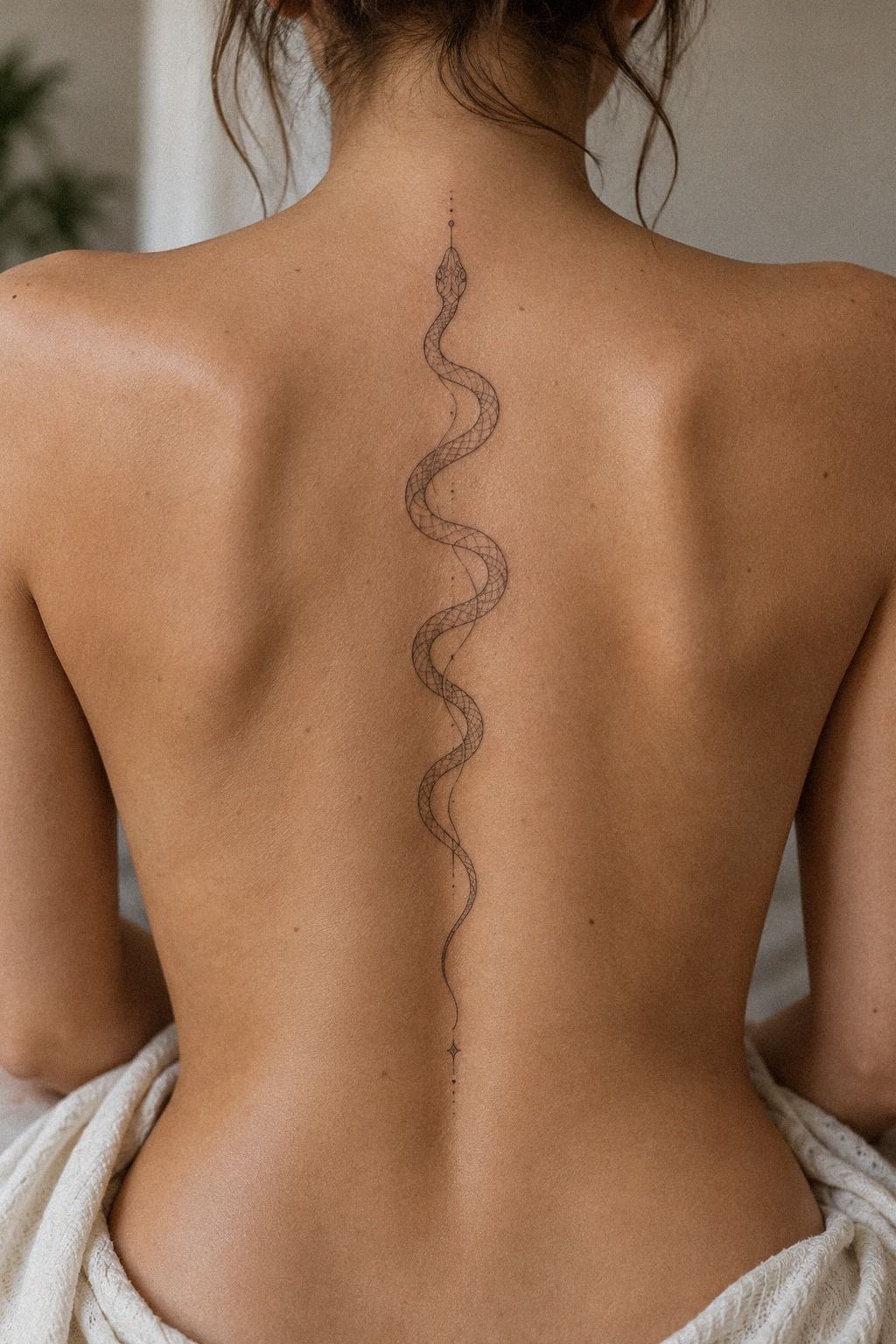
An ornate snake along the spine gives you a powerful vertical design, even when the drawing itself remains fine and controlled. Emerald linework and restrained gold details can stand out against cream negative space without turning the piece into visual noise.
6Crescent Moon, Snake, and Sacred Negative Space

A small snake wrapped around a crescent moon creates a sacred pairing on deep ebony skin, especially when the negative space remains open around the ribs. The serpent’s forest-green body can follow the moon’s outer curve while a rust-colored head rests near one tip. You’ll get a meaningful symbol without extra stars or words.
Contrast matters here. Rust crescent details can give the moon enough presence beside a fine snake, but the shape shouldn’t become a heavy block. Ask your artist whether the opening needs to be slightly wider after healing.
Rib placement can feel more intense than areas with extra cushioning. You don’t have to prove anything by sitting through a design larger than you wanted. A compact composition may be the more empowering choice because it respects your comfort.
If you’re drawn to animal symbolism with a lighter visual touch, compare it with delicate bird tattoos. The strongest version leaves the moon visibly separate from the snake in at least one place. That opening keeps the design ethereal instead of tangled.
I’d keep the moon slightly imperfect. A handmade curve can feel more romantic than a mathematically exact crescent.
7Let an Elegant Snake Cross the Wrist

An elegant snake winding across the wrist has a sharp visual quality because the placement gives the body a natural horizontal path. On fair cool-pink skin, a charcoal serpent with dusty-rose accents can travel from the outer wrist toward the thumb side, with a small head angled toward the hand.
The wrist is a high-motion area, so your artist may simplify the scales. Fine charcoal contouring should carry the design, while tiny muted-gold dots suggest texture without filling every turn. I’d skip a fully closed bracelet shape because it can look rigid.
You’ll see this tattoo often, which makes the design intimate. Ask yourself what you want to notice six months from now. A fierce eye, a relaxed coil, or a tail that disappears beneath your watch can change the mood.
If you’re collecting references, save this beside tiny snake tattoos and compare how the wrist changes the scale. Your artist’s healed portfolio matters more than an untouched result. Fine lines can look delicate at first, but they need room to settle.
A wrist snake can be expressive without becoming loud. I’d angle the head toward the hand if you want the gesture to feel active.
8One Bloom, One Snake: Tiny Flowers With Restraint

A unique snake tattoo with tiny flowers feels romantic when the serpent winds through one stemmed bloom instead of competing with a bouquet. On medium warm ivory skin, black snake linework with camel accents can sit near the shoulder blade while the body curves beneath the petals.
The flower should support the snake’s movement. Fine black floral outlines can create a soft boundary, but too many petals will make the upper back look busy. I’d choose one larger flower and two smaller buds, then leave the rest of the skin open.
Your artist can use the stem to guide the eye from the shoulder toward the center of the back. That matters if you want the tattoo to feel longer without making the snake larger.
You’re building movement, not adding detail for its own sake. Would you rather have five small flowers nobody can read, or one clear bloom?
For another animal design with botanical energy, see tiny unique butterfly tattoos. The better choice has fewer competing lines.
It will look vibrant when the petals, scales, and skin remain distinct. That is the whole trick!
A single bloom can give the snake a playful edge without turning the design sugary. Keep the petals crisp, and the composition will stay polished.
9Dotwork Changes the Snake’s Texture

A delicate snake in fine dotwork has a gritty texture that changes the mood without requiring heavy shading. Midnight-blue dots with copper highlights can create an expressive contrast against ivory negative space while keeping the piece delicate.
10Why the Collarbone Works for a Symbolic Snake

A symbolic snake over the collarbone gives you an expressive design with a built-in sense of movement. The head can angle toward the shoulder while the tail follows the natural curve beneath the collarbone. Sage-green linework keeps the gesture soft but meaningful.
Fresh and healed tattoos don’t look identical. Healed black linework may appear gentler, and small gaps can become easier to see. Ask your artist for healed linework examples before you commit.
The collarbone has a delicate curve, but it’s also close to bone. Your comfort matters more than forcing the snake into a perfectly straight position. I’d let the design adapt to your posture for a polished result.
You’ll want to discuss visibility, clothing friction, and sun exposure before booking. If you’re comparing symbolic animals, delicate eagle tattoos can help you think about how gesture changes meaning. A quiet snake can feel haunting when the eye remains open.
Don’t copy a healed reference line for line. Your skin, posture, and healing process won’t match anyone else’s. Use the reference as evidence, then let your artist redraw the design for you.
A collarbone snake can feel feminine or masculine depending on the head shape, curve, and scale. I’d make the tail disappear slightly beneath the shoulder line if privacy matters.
11Rib Cage Privacy, With a Daring Curve

A graceful snake along the rib cage creates a feminine and quietly daring placement on deep brown skin with a warm undertone. Terracotta-and-olive linework can give the curve a raw, personal quality without making the design loud.
What Changes the Cost?
The final price depends on the artist’s minimum, the design’s size, the amount of detail, and the placement. A tiny snake may be quick, but a difficult location can still affect the quote.
If your budget is limited, ask whether a simpler outline will preserve the idea. You may get stronger value from a clear two-inch snake than from a crowded miniature that needs correction later.
A higher price isn’t automatically better. Look for consistent healed spacing, clean work, and an artist who explains the process. That evidence tells you whether the tattoo is worth it.
For a second reference point, compare tiny snake tattoos before you decide how much detail you actually need. I’d pay for careful placement before I’d pay for decorative clutter.
A Quick Cost and Time Table
These are broad estimates, not a promise. A written tattoo quote is the best way to compare artists because shop minimums and regional prices vary.
Ask what the price covers before you pay a deposit. Some artists include a short touch-up, while others charge separately. That small detail can change the real cost.
If you’re still deciding between delicate styles, delicate unique butterfly tattoos can help you judge how much size affects detail.
Why I Keep Coming Back to Fine Snake Linework
I’ve always liked snake tattoos because they can hold several meanings without explaining themselves. A coil can suggest renewal, protection, transformation, danger, or simply a fascination with the animal’s shape. That range is personal, and it’s why I’d rather see someone choose a private placement than copy the loudest design online.
I made my own mistake by focusing on the untouched result instead of the healed outcome. The line looked crisp on appointment day, but I hadn’t asked how the spacing would settle. Now I tell people to study healed tattoo work, ask direct questions, and notice whether fine lines still look intentional.
The best design decision usually comes down to placement, contrast, and restraint. Hands, feet, ribs, and sternum can feel more painful because they sit close to bone or experience constant movement. Forearms, thighs, and shoulders are often more tolerable.
Fine lines can soften, and that isn’t a failure. A tattoo needs enough black structure to remain readable, especially if the design is tiny. I prefer a clear silhouette over a microscopic masterpiece packed with details nobody will see later.
If you’re comparing animal symbolism, delicate owl tattoos show how a restrained outline can still feel expressive. You don’t need to make the tattoo public to make it important. That’s the whole appeal of these placements.
A snake can be classic, edgy, or almost sacred depending on the gesture. I’d choose the meaning first and let the style follow.
How I Compare Private Placements
Start with visibility. A sleeve-friendly placement gives you control during work or formal events, while the ribs and spine can stay almost completely private.
Next, consider movement. Fingers, wrists, ankles, and feet experience more friction than the upper arm or thigh. That doesn’t make them bad choices, but it does mean you’ll need realistic touch-up expectations.
Finally, ask whether the placement suits the snake’s shape. A winding body needs room to turn.
A small head needs enough contrast to remain readable. If the anatomy fights the design, the tattoo won’t feel as sleek.
For more shape comparisons, save tiny unique butterfly tattoos and delicate bird tattoos beside your snake references. Different silhouettes can reveal how much space your preferred placement really needs.
I’d rather move a design by half an inch than force it into a spot where the curve feels awkward. That tiny adjustment can change everything.
Where Fine Lines Give the Best Value
A clear outline usually offers better value than excessive detail in a tiny design. Strong line weight can keep a small snake readable even after the skin settles.
The best placement depends on what you’ll actually live with. A wrist may be easy to admire, while a rib tattoo may feel more meaningful because it stays yours.
If you’re unsure, book a consultation before paying a deposit. Bring your references, show the side of your body you prefer, and ask how the design will age. That conversation can save money and prevent regret.
For more scale comparisons, browse small unique butterfly tattoos and delicate bird tattoos. Different animals can reveal how much space a minimal outline really needs.
A dainty design isn’t automatically cheaper if it requires microscopic precision. The strongest value usually comes from a readable idea with enough room to heal.
Questions I’d Ask Before Booking
I’d ask how many healed examples the artist can show. A healed portfolio matters because settled lines often look gentler than untouched ones.
I’d also ask whether the quoted price includes a touch-up. Some artists build one small correction into the service, while others charge by time.
Then I’d ask about aftercare, sun exposure, friction, and clothing. You’re not being difficult. You’re checking whether the design will fit your life.
If the answers feel rushed, wait. A confident artist should explain the trade-offs without pushing you toward a larger or more expensive tattoo.
I’d also ask whether the artist has worked on your skin tone before. Contrast, saturation, and spacing can all affect how a delicate snake reads once healed.
The Questions Worth Answering First
How much does a delicate snake tattoo usually cost?
A delicate snake tattoo typically costs about $50 to $150 at a shop minimum, while many artists charge roughly $100 to $250 per hour in the US. Your final price depends on the artist, region, size, detail, and placement.
Ask for a written estimate before you book. A tiny design can still reach the shop minimum, while a longer spine or rib piece may require several hours.
Are delicate snake tattoos a good idea for a first tattoo?
Yes, a delicate snake can be a manageable first tattoo if you choose a tolerable placement and an artist with healed linework. Forearms, thighs, and shoulders are often easier than ribs, feet, hands, or the sternum.
Your first tattoo doesn’t need to be huge. A small, meaningful design can give you a better sense of your comfort and style before you consider a larger piece.
For more compact inspiration, compare small snake tattoos before you settle on scale.
How do I choose a tattoo artist for delicate snake tattoos?
Choose an artist whose portfolio shows clean healed linework, not only untouched tattoos. Look for consistent spacing, strong hygiene practices, and experience with fine-line or dotwork designs.
Your consultation should include placement, line weight, aftercare, and realistic aging expectations. If you’re comparing artists by price alone, you may miss the value of careful design work.
How much do delicate snake tattoos hurt?
Pain varies by person, but ribs, feet, hands, and the sternum are often more sensitive because they sit near bone or experience frequent movement. Forearms, thighs, and shoulders are usually more tolerable.
You don’t have to choose the most painful placement to prove commitment. Comfort planning can help you stay relaxed and make the session easier.
How long does a delicate snake tattoo take to heal?
The surface usually heals in about 2 to 3 weeks, while complete healing can take around 2 to 3 months. Follow your artist’s aftercare, wash gently, moisturize as directed, and avoid swimming and direct sun while the skin recovers.
The final appearance takes patience. Don’t judge the line weight during the first few days, when swelling and surface dryness can change how the tattoo looks.
What’s the best placement for delicate snake tattoos?
The best placement depends on visibility, pain tolerance, and how much movement your design needs. A forearm offers easy viewing and usually tolerable sessions, while the rib cage feels more private but can be more sensitive.
Your artist can adapt the snake to your anatomy. If privacy matters most, a rib placement or spine may give you the balance you want.
For a different perspective on discreet animal symbolism, browse delicate unique butterfly tattoos.
The One I’d Choose First
If I had to pick one, I’d start with the minimal ankle snake. Its open coil stays readable, moves naturally, and remains easy to cover when you want privacy.
Pin it for later, then compare the healed work before you book your artist. A design is worth it when the placement feels right, the linework stays clear, and the symbolism remains yours.
I’d also keep tiny snake tattoos nearby while comparing proportions. The right choice won’t merely look stylish in a reference; it’ll still feel meaningful when the novelty fades. That is a fierce little choice!

