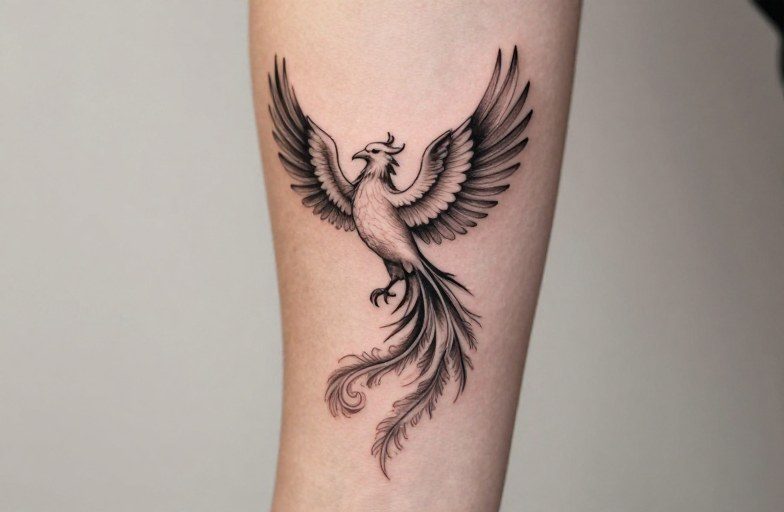
The phoenix carries weight without needing to shout. In minimalist hands, that weight gets sharper, pared down to the essential gesture of rising, of flame becoming form. What you’re left with is a tattoo that reads instantly from across a room but rewards closer inspection with deliberate, thoughtful detail. This guide covers how to execute that balance: where to place it, how to style it, what keeps it legible for decades, and how to make it yours without cluttering the concept.
How to Personalize It
Minimalism doesn’t mean generic. The constraint of simple lines actually forces harder choices, and those choices become the personal mark.
Abstracting the Silhouette
Instead of drawing a bird, consider the motion. A single continuous line that loops upward and resolves into a wingtip. A triangle of negative space where the body would be, with two tapering strokes for tail feathers. Some artists render the phoenix as a flame that almost accidentally resembles a bird in profile, viewers catch it a half-second later, which is more interesting than immediate recognition. The key is identifying what aspect of the myth matters to you: rebirth, fire, flight, cyclical return. Let that single quality drive the abstraction.
Incorporating Subtle Markers
Birth years, coordinates, or small roman numerals can tuck into the negative space beneath a wing or along the trailing edge of a tail feather. Keep any text at 2mm minimum height or it will blur within five years. Another approach: matching the number of tail strokes to a significant number, seven thin lines for a date, three for siblings, etc. These embed personal meaning without adding visual noise.
Matching & Pairing Ideas
The phoenix pairs naturally with symbols of complementary energy. What changes is how minimalist execution affects those pairings.
Complementary Symbols
- Phoenix + moon: The lunar cycle echoes the rebirth theme. A thin crescent placed above or below the bird creates vertical composition without crowding.
- Phoenix + lotus: Both rise from destruction (ash, mud). A single lotus line beneath the phoenix grounds the upward motion.
- Phoenix + serpent: Ouroboros energy, destruction and renewal locked in loop. Works as a circular composition with the phoenix breaking the circle at its apex.
Placement Pairings for Couples or Friends
Matching minimalist phoenixes on inner forearms, mirrored so they face each other when arms are extended. Or one person carries the rising form, the other carries a single ash or ember stroke, complete only when together. The restraint of minimalist style keeps these from feeling like matching t-shirts; they’re more like shared vocabulary.
Trending Variations
What’s shifting in minimalist phoenix design right now isn’t the symbol, it’s the technical approach and the conceptual framing.
Single-Line Execution
One unbroken stroke from first contact to lift. The artist never picks up the machine. This demands enormous planning: the line must cross itself strategically to create implied feathers, use pressure variation for weight, and resolve at the beak or wingtip with intentional finality. Not every artist works this way; it’s worth seeking someone with specific continuous-line portfolio pieces. The result feels spontaneous but is deeply controlled.
Negative Space as Fire
Rather than drawing flames, the phoenix shape is carved out by surrounding blackwork. The bird itself remains skin-tone, defined only by the dark that crowds it. This reads as emergence, form coalescing from chaos. Heals with strong contrast but requires confident aftercare; any scabbing in the surrounding black risks patchiness that undermines the effect.
Color Choices
Minimalist phoenixes live mostly in black, but limited color can work if applied with the same restraint.
Black and Gray
The default for good reason. Fine black lines hold their edge; gray wash can suggest smoke or ash trailing the form. A common technique: solid black beak and eye, with the body rendered in three progressively lighter gray values. This creates depth without outline dependency. Avoid heavy black fill in small pieces, it will spread and swallow detail over time.
Strategic Color Accents
One small area of saturated color against otherwise black linework. A vermillion wingtip. A single gold eye. The tail’s final feather in deep blue. These function like a struck match in a dark room: disproportionate impact from minimal application. Warm tones (orange, red, yellow) are most common but not obligatory; a cool phoenix reads as moonlit or ash-cold, which is its own valid interpretation.
Best Placements
Minimalist phoenixes need room to breathe, but not much of it. The determining factor is line length and direction of motion.
Vertical Spaces
- Inner forearm: The rise of the phoenix follows the natural upward sweep of the arm. Visible, easy to show or hide with sleeve length.
- Behind the ear: Small, ascending, partially hidden. The hairline frames it like a secret. Scale must be tiny, overworking this area causes blowout fast.
- Ribcage: Follows the curve of the floating ribs. Painful, but the canvas rewards the composition with organic flow.
Horizontal or Wrapping Spaces
Collarbone, sternum, or wrist circumference. The phoenix can be elongated, stretched in flight rather than rising. Wrist pieces work best as a small head and wing burst, not full body, too much detail in a wrap-around band will compress and distort. Ankle and foot placements are possible but suffer from friction and sun exposure; expect faster fading and plan for touch-ups.
Popular Styles
Minimalist is a constraint, not a style unto itself. These are the specific aesthetic languages that constraint gets filtered through.
Fineline
Needles grouped tight, running at higher speed, depositing minimal ink per pass. Lines hair-thin, often with parallel hatching for shadow. The fineline phoenix looks drawn with a technical pen, precise, architectural, almost diagrammatic. Ages well if protected from sun; the thinness makes it vulnerable to UV degradation.
Geometric
The bird broken into triangles, rhombuses, straight lines. Feathers become facets. The circle of rebirth becomes literal, a perfect ring the phoenix intersects. This style risks looking like generic sacred geometry unless the artist specifically understands avian anatomy and abstracts from it rather than imposing pattern arbitrarily.
Hand-Poked
No machine. Dot by dot, the form accumulates. The line quality has slight waver, human irregularity that reads as organic warmth. Slower to execute, slower to heal, but the texture is unmistakable. Best for smaller scales where the dot density can stay consistent.
Key Takeaways
A minimalist phoenix succeeds when every element justifies its presence. The abstraction should resolve to “bird” and “fire” without literal rendering. Placement should respect the direction of motion, rising pieces want vertical canvas, flight pieces want horizontal. Black and gray offer longevity; color accents demand restraint. Single-line and negative-space variations require artists with specific technical confidence, not just conceptual willingness. Most importantly, the myth you’re referencing is already understood; your job is choosing which gesture of it to freeze, not explaining the whole story. The best minimalist tattoos trust the viewer to meet them halfway.
Frequently Asked Questions
How small can a minimalist phoenix be before it loses detail?
For linework, keep the main body at least 2 inches in its longest dimension. Below that, feather separation and facial features blur together within a few years. Single-line designs can run slightly smaller since they don’t rely on internal detail.
Does a minimalist phoenix need to face a specific direction?
Rising compositions usually face right or upward in Western reading patterns. There’s no traditional requirement, but upward-facing birds feel more aspirational while downward-facing can read as descent or mourning, intentional if that’s your aim, confusing if not.
How do minimalist phoenixes age compared to traditional bold ones?
Thin lines spread and fade faster than heavy traditional work. Expect softening at 5-7 years rather than 15-20. The tradeoff is a cleaner look when fresh and less visual weight permanently. Sunscreen and moisturized skin extend clarity significantly.
Can a minimalist phoenix be covered up or expanded later?
Yes, but plan for it. Leaving strategic negative space around the original allows for flame or smoke additions. A purely geometric minimal piece expands more gracefully than a single-line design, which has less natural integration points.