
A tiny small butterfly tattoo stays crisp longest when you choose readable spacing, a placement that suits your skin, and aftercare you’ll actually follow. I learned that a fine-line stencil can look intricate on paper yet lose its shape when every wing vein is packed together. This guide keeps your design delicate, symbolic, and readable!
- Begin With Fine Line Tiny Butterfly Wings
- What Should a Symbolic Tiny Small Butterfly Tattoo Mean?
- Why Does Behind-the-Ear Placement Work?
The best version isn’t automatically the most ornate. It’s the one with a striking silhouette, intentional spacing, and a detail that feels personal.
If you’re spending money on permanent ink, the design should be worth the cost long after the appointment. A meaningful silhouette gives you that confidence.
Before You Start: The Crisp-Line Rule
Your first decision isn’t the butterfly’s color. It’s whether your chosen design can still read when the lines soften slightly over time. Ask your artist to show the shape at the intended size, then view it from arm’s length.
If you can’t identify the wings immediately, your version is too intricate. Check the intended tattoo size before discussing embellishments.
A black ink outline usually gives you the clearest starting point. You’ll want open negative space between the upper wings, lower wings, and body. That gap matters because very fine lines can spread as skin ages, especially with repeated sun exposure.
A minimal butterfly with three readable zones often stays more polished than an ornate one with twelve tiny marks.
Use the table below as a planning guide. These are typical US references, not a quote from your artist, and your region, placement, and studio minimum can change the final price.
If you’re comparing references, start with these small butterfly tattoo designs and save only the shapes you’d still love without the decorative extras. Your tattoo should feel personal, not borrowed. Keep one saved reference folder instead of collecting every option you see.
Read the Healed Portfolio Before You Book
Choose an artist by healed work, not only fresh photographs. Fresh ink can look sharp, saturated, and striking under studio light.
Healed photographs show you what the same artist’s lines look like after the surface settles. You’ll learn far more from a six-month image than from a perfect appointment-day close-up.
A healed portfolio tells the honest story.
Ask to see fine-line butterflies, small black tattoos, and work on skin tones similar to yours. A single-use liner cartridge can produce clean work, but equipment won’t replace steady hand pressure or thoughtful spacing. Look for wings that remain symmetrical without looking stiff, and bodies that don’t overpower the design.
And check the studio’s hygiene practices before you pay a deposit. You should see sealed needles, fresh gloves, protected surfaces, and clear aftercare instructions.
If you’re unsure, ask direct questions. A reputable artist won’t act offended because you want to understand the process!
I’d skip an artist who only shows filtered, freshly finished tattoos. The portfolio should include close-ups, healed examples, and different placements. You can also compare the artist’s approach with this small fine line butterfly tattoo guide before you book.
Look for a consistent line quality across multiple clients.
The Budget Question: What Makes the Price Worth It?
A tiny tattoo can cost less than a large piece, but small doesn’t always mean simple. Your artist still spends time discussing placement, preparing the stencil, setting up safely, and checking the final shape.
A slightly higher price may offer better healed results when it includes careful consultation and proven linework. The consultation time is part of the service.
Think about value rather than the lowest quote. If an artist’s healed portfolio shows crisp, graceful butterflies at the size you want, the extra investment may be worthwhile. A bargain appointment isn’t a bargain if you later pay for a cover-up or correction.
Long-term readability deserves more weight than a low first quote.
Set a realistic budget before you contact studios. Include the minimum charge, a possible deposit, and a touch-up only if the artist recommends one after healing.
That keeps the decision practical without making the tattoo feel transactional. Ask about the deposit policy before you confirm your appointment.
- Begin With Fine Line Tiny Butterfly Wings
- What Should a Symbolic Tiny Small Butterfly Tattoo Mean?
- Why Does Behind-the-Ear Placement Work?
- Keep Tiny Small Butterfly Linework Crisp and Delicate
- Can Dots Make a Unique Tiny Butterfly Tattoo Better?
- Choose Tiny Small Butterfly Ink for the Wrist
- How Should Color Accents Work on a Tiny Butterfly Tattoo?
- Shape a Unique Tiny Butterfly Tattoo Around Scars
- Balance Bold and Minimal Butterfly Tattoo Details
- How Do You Prepare Skin for a Tiny Butterfly Tattoo Session?
- Protect Your Tiny Small Butterfly Tattoo During Healing
1Begin With Fine Line Tiny Butterfly Wings
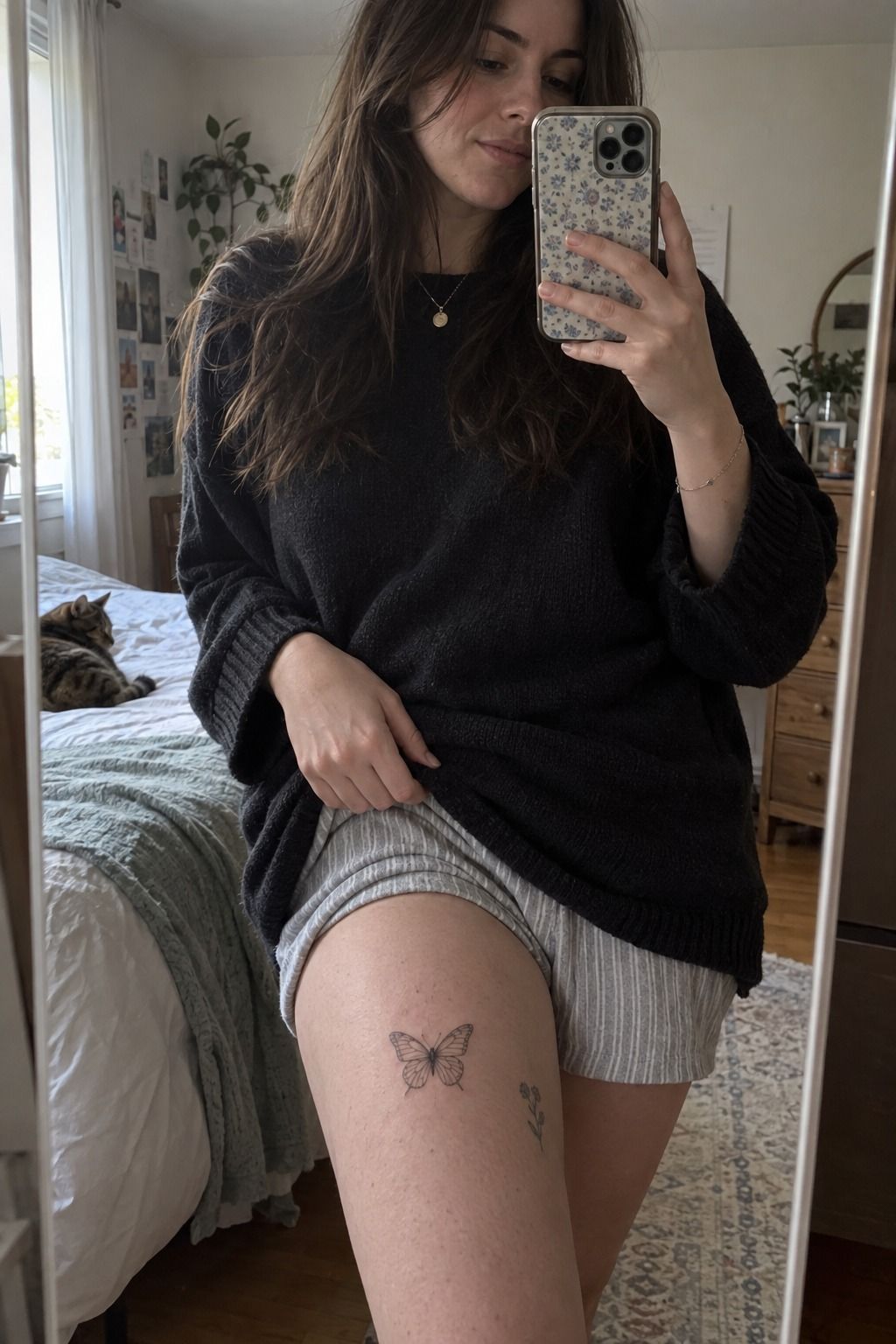
Begin with the outer silhouette. Your artist can create a symmetrical butterfly with open wings, a narrow body, and enough breathing space between each section. On fair cool-pink skin, a sterile transfer stencil helps you inspect the shape before any needle touches your thigh.
Turn your leg slightly and check whether the wings still look balanced from different angles.
You’ll want the upper wings to carry the main identity. Keep the lower wings simpler, especially if the tattoo is small. I’ve seen delicate designs become confusing because every wing received the same amount of detail.
That approach sounds fair, but it makes the butterfly look busy instead of graceful. Let the upper-wing silhouette do most of the visual work.
Ask for one meaningful interior feature, such as a small central dot or a single curved vein. A 3RL liner may suit fine detail, but your artist should choose the configuration and depth for your skin. You don’t need to dictate equipment.
You need to explain how crisp, flowing, and understated you want the finished shape to feel.
And photograph the stencil before you approve it. Your eye catches spacing problems more easily in a phone image than in a mirror.
If you love the silhouette but not the internal marks, ask for fewer. This is where you can make the design elegant without making it generic.
A phone stencil photo gives you a useful second look.
For more delicate reference points, browse small fine-line butterfly tattoo ideas. Save the references that still look expressive after you mentally remove half the details. The strongest option usually has a clear outer contour.
2What Should a Symbolic Tiny Small Butterfly Tattoo Mean?

Choose the meaning before you choose the decoration.
3Why Does Behind-the-Ear Placement Work?

Behind the ear gives a tiny butterfly an intimate, slightly edgy placement. On medium olive skin, a crisp black outline can peek out when your hair moves and disappear when you want privacy.
You’ll need to think about visibility, hair products, headphones, and how easily you can follow aftercare in a narrow area. The behind-the-ear placement has a distinct personality.
A disposable skin marker lets your artist test the position before the stencil goes on. Ask to see the butterfly with your head upright and turned slightly.
A placement that looks centered in profile can shift when your neck relaxes. Your artist should check the wing angle against the ear’s curve.
This area can be more sensitive than a thigh or shoulder, and sessions may feel intense even when the tattoo is small. You don’t have to prove anything. If you’re nervous, tell your artist before starting, eat according to studio guidance, and bring water.
A short break won’t make you less fierce!
I like this placement for a dainty, minimal butterfly, not a dense ornate one. The available skin is limited, and extra detail can blur the silhouette.
Compare it with other options in this small butterfly tattoo placement guide before deciding where your own mark should live. Consider the aftercare access as carefully as the appearance.
4Keep Tiny Small Butterfly Linework Crisp and Delicate

Protect crispness by editing the drawing before the appointment. The butterfly on golden tan skin in this idea uses open wings, symmetrical veins, and a controlled outline. You’ll want the main contour to remain visible even if a few interior lines soften.
That means fewer marks, better spacing, and no visual clutter. Start with an actual-size stencil.
A fine-line stencil sheet should show the complete design at the actual planned size. Don’t approve a large drawing and assume it will shrink well. Ask your artist to make the stencil match your body, then inspect the wing gaps and body width.
Tiny changes can make the design feel more polished.
I’d skip micro-text inside the wings. It may look meaningful in a digital mockup, but skin isn’t a flat screen.
Sweat, friction, sun, and natural aging all affect tiny marks. A sharp, expressive outline usually gives you a stronger result than details nobody can read later.
Treat micro-text as a warning sign for this scale.
And remember that healing changes the first impression. The surface may settle over roughly 2 to 3 weeks, while complete healing can take about 2 to 3 months. Follow your artist’s instructions, avoid picking, and don’t judge the final linework too early.
Your patience protects the result. The healing timeline matters when you assess crispness.
If you want a cleaner direction, compare these small butterfly tattoo stencil designs and look for open shapes rather than dense interiors. Choose the most readable stencil rather than the most intricate one.
5Can Dots Make a Unique Tiny Butterfly Tattoo Better?

Use dots as punctuation, not as filler. A hand-drawn butterfly with small dot clusters can look whimsical and vintage when the marks support the wings. You’ll want the dots to reinforce the shape rather than compete with it.
Three carefully placed marks can feel more intentional than a full field of stippling. The dotwork pattern should have a clear purpose.
Ask your artist to separate the dot work from the outer contour. A black stencil transfer makes that distinction easy to see before the session.
If the dots touch every vein, the wings may lose their clean rhythm. Leave a little negative space around the body so the butterfly doesn’t become one dark knot.
This is a good place to choose one unusual feature. Try an uneven dot trail beneath one wing, a small gap in the lower outline, or a single curved antenna.
I’d avoid copying a flash design exactly if you want a personal tattoo. Change one meaningful detail while keeping the original silhouette intact.
That single custom feature can make the design feel yours.
And save the reference beside your own sketch. You’ll spot what you’re reacting to: the dots, the symmetry, the line weight, or the attitude.
For more options, browse this small butterfly tattoo stencil collection and mark the designs that still feel bold after you remove the embellishment. Your personal sketch gives the artist useful direction.

6Choose Tiny Small Butterfly Ink for the Wrist

The wrist is visible, practical, and expressive. On deep ebony skin, a strong black butterfly can read beautifully when the outline has enough contrast and the wings aren’t overloaded. You’ll want to think about watches, bracelets, hand movement, and how often the placement receives sunlight.
The wrist placement keeps the symbol close and visible.
A solid black ink outline can give the wrist design a sharp foundation. Ask your artist whether the butterfly should face toward your hand or toward your forearm. That small choice changes how you’ll see it while moving.
I prefer the direction that lets you read the wings naturally when your arm rests.
Wrist tattoos may be more sensitive than the thigh or shoulder, and the skin can experience frequent friction. Don’t schedule the appointment right before a long day of repetitive work if you can avoid it.
Your artist may also advise you about covering, washing, and keeping the area protected during early healing. Pay attention to those friction points.
If you’re comparing visible placements, look at this small butterfly tattoo arm inspiration. You’ll notice how a wrist butterfly feels more personal and immediate, while an upper-arm version gives the wings more visual space.
Choose the placement you’ll enjoy seeing, not the one that photographs best! The arm reference can clarify that difference.
7How Should Color Accents Work on a Tiny Butterfly Tattoo?

Color can make a tiny butterfly vibrant, but it should have a job.
8Shape a Unique Tiny Butterfly Tattoo Around Scars

A scar can become part of the design, but your artist must evaluate it first. On a shoulder with medium warm ivory skin, a butterfly can sit beside a scar, frame it, or use the wing shape to draw attention away from one edge. You’ll want the design to respect the texture instead of pretending the skin is completely even.
The healed scar needs an honest assessment.
Bring healed-scar photographs and explain how old the scar is. A scar tissue assessment may show that the area accepts ink differently from surrounding skin, and some scars shouldn’t be tattooed without professional advice. Your artist can tell you whether the area is suitable, whether the design needs more space, and whether a medical opinion makes sense.
Don’t force the butterfly directly across the thickest section just because the symbolism sounds poetic. I’d rather place a graceful wing beside the scar than risk muddy lines in an unstable texture. That choice can still feel meaningful, and it gives your tattoo a more natural flow.
A side placement may protect the clarity of the mark.
If you’re planning around an existing mark, sketch several orientations. You can explore unique tiny small butterfly tattoo ideas and ask your artist to adapt one to your shoulder.
Your body’s history should guide the composition, not be treated as an inconvenience. Seek professional clearance when the scar is raised, changing, or painful.
9Balance Bold and Minimal Butterfly Tattoo Details

Balance comes from contrast. On an upper arm with medium olive skin, you might pair a bold outer contour with minimal interior veins. The result can feel sleek, sharp, and readable without losing the delicate character that drew you to fine-line work.
Let the outer contour carry the identity.
Choose one dominant feature: the wings, the body, or the dot detail. A solid black wing edge can anchor the design while the opposite wing stays lighter. You’ll want your artist to keep the visual weight intentional, especially if the butterfly is small enough that every mark changes the expression.
I made the mistake of treating every reference detail as necessary. It wasn’t.
The more I removed, the more the butterfly looked alive. You can keep one ornate curve or a small dot cluster, but don’t let the extras flatten the silhouette. Controlled line weight gives the design more authority.
And compare the design in both black ink and a lighter digital preview. Your eye may prefer the dramatic version on screen, while your skin needs the understated version to remain crisp.
If you want a stronger black direction, review these small black butterfly tattoo examples before your consultation. A blackwork reference can reveal how little detail you need.
10How Do You Prepare Skin for a Tiny Butterfly Tattoo Session?

Preparation starts before you enter the studio. Bring the approved reference, wear clothing that gives easy access to the placement, and arrive with enough time to discuss the stencil.
You’ll feel more confident if you’re not rushing through a meaningful decision. Keep the approved reference easy to reach.
A fragrance-free cleanser is useful for gentle washing after the appointment, but your artist’s aftercare instructions come first. Don’t arrive with irritated, sunburned, or freshly exfoliated skin. Your artist needs a calm surface for a clean stencil and controlled application.
Fresh ink is only the beginning. Ask how the artist expects the butterfly to settle, whether a touch-up is common, and what signs would require medical advice. These questions are sensible, not dramatic!
Write down the aftercare questions you want answered.
What should you bring? A phone reference, water, comfortable clothing, and a willingness to pause if the placement feels wrong.
You can also review small butterfly tattoo designs one last time, but stop browsing when your decision is clear. Too many options can make a meaningful choice feel strangely distant. Comfortable appointment clothing keeps the session simpler.
11Protect Your Tiny Small Butterfly Tattoo During Healing

Treat the fresh tattoo gently while the surface heals. Behind the ear on deep brown skin with a warm undertone, friction from hair, headphones, hats, and fingers can irritate the area.
You’ll want to keep the artist’s recommended covering in place for the instructed time, then wash as directed. The healing film should follow your artist’s instructions.
A post-tattoo washing routine may vary by artist, placement, ink load, and covering. Don’t copy someone else’s routine because their tattoo healed well.
Your skin and timing can differ. Follow the instructions you received, especially around washing and moisturizing.
Avoid pools, prolonged soaking, direct sun, and picking at flakes. A small butterfly can look dull or uneven during the early stage, and that doesn’t mean the final result has failed. The surface often settles over 2 to 3 weeks, while complete healing takes about 2 to 3 months.
Give the healing process enough time.
And protect the healed work from UV exposure over time. Sun can soften fine lines and fade accents, which matters when your whole design depends on crisp spacing. Your artist’s advice outranks anything you read online, so contact the studio if the healing looks unusual or painful.
UV protection helps preserve the contrast.
The Design Audit I Use Before Booking
I’ve learned to judge a butterfly tattoo by its future outline, not its appointment-day sparkle. Fresh ink is dark, precise, and emotionally loud.
That first look can make almost any design feel iconic. The harder question is whether you’ll still recognize the butterfly when the smallest interior marks soften. Focus on the future silhouette.
Cover the details with your thumb and look only at the silhouette. Then uncover the wings and remove one interior line at a time.
If the design becomes stronger as details disappear, you’re close. If it collapses without every vein, I’d redraw it before booking.
This thumb test is quick and revealing.
I also think about how the tattoo will fit your routine. A wrist placement can feel empowering because you’ll see it constantly.
Behind the ear feels intimate and slightly daring. A thigh placement can stay private. None is universally right, and anyone who tells you otherwise hasn’t considered your skin, work, or daily habits.
Your daily routine belongs in the decision.
The most polished results usually come from a clear decision: readable outline, sensible spacing, and an artist whose healed work you trust. You don’t need the most ornate reference in the saved folder.
You need a butterfly that still feels like yours after the novelty fades. Use this small butterfly tattoo design reference for comparison, not imitation.
A readable outline is the final benchmark.
The Aging Test I Use Before Booking
Would I choose color every time? No.
Would I choose black linework every time? Also no.
I’d choose the version that survives the aging test and keeps one meaningful detail intact. That’s where a timeless tattoo becomes personal, rather than simply fashionable.
The aging test rewards restraint.
A future-proof silhouette matters more than a dramatic appointment-day effect. Ask yourself whether the outline still looks graceful at a smaller visual scale.
If yes, the design has lasting value. If not, remove detail before you add color.
This is also where you decide whether a more expensive artist is worth the investment. Clean placement, careful spacing, and a strong healed portfolio can matter more than saving the first $50.
Trust that signal! Review these black butterfly tattoo examples and compare the healed structure. The artist investment should serve the result.
A Few Things Worth Answering
How much does a tiny small butterfly tattoo usually cost?
A tiny small butterfly tattoo usually costs about $100 to $300 in the US, though a studio minimum may be about $50 to $100 and hourly rates may run about $100 to $250. Your artist, region, placement, detail, and color choice all affect the quote. A clear stencil helps avoid surprises.
Are tiny small butterfly tattoos a good idea for a first tattoo?
Yes, they can be a strong first tattoo because the design is small, readable, and easy to personalize. Choose a tolerable placement such as the forearm, thigh, or shoulder if you’re nervous. A meaningful silhouette will matter more than adding every decorative detail.
How do I choose a tattoo artist for a tiny small butterfly tattoo?
Choose an artist who shows clean linework, healed photographs, consistent symmetry, and safe studio practices. Ask for examples on skin tones similar to yours and confirm their experience with small designs. A healed portfolio tells you more than a fresh photograph under bright studio lighting.
How much do tiny small butterfly tattoos hurt?
Pain varies by person and placement. Ribs, feet, hands, and the sternum are often more sensitive, while the forearm, thigh, and shoulder are usually more tolerable. Placement comfort can make your first session easier, so tell your artist if you need a break.
How long does a tiny small butterfly tattoo take to heal?
The surface generally heals in about 2 to 3 weeks, while complete healing can take about 2 to 3 months. Wash gently, moisturize as instructed, avoid sun and swimming, and don’t pick flakes. Patient aftercare helps the fine lines settle cleanly.
What’s the best placement for a tiny small butterfly tattoo?
The best placement depends on visibility, sensitivity, and how much space your design needs. The forearm, thigh, and shoulder are often more tolerable, while behind the ear offers a discreet, intimate look. A readable placement gives your butterfly enough room to age well.
Is a tiny butterfly tattoo worth the cost?
It can be, provided the artist has healed work, the design has enough spacing, and the placement suits your routine. The best value comes from a tattoo you’ll still recognize and enjoy after the initial excitement fades. Long-term readability should guide the decision.
Start With the Single-Stroke Rule
If I had to pick one step, I’d start with the silhouette. A butterfly that reads clearly without its interior details will age more gracefully than a crowded design.
Save your strongest reference, book an artist with healed work, and let the outline earn the rest. That’s the single-stroke rule most likely to feel worth it years from now!


One response to “How to Create a Tiny Small Butterfly Tattoo That Stays Crisp – 11 Ideas”
[…] what it means before the appointment, especially if you’re setting a shared budget. Save these tiny small butterfly tattoo ideas for a sister […]