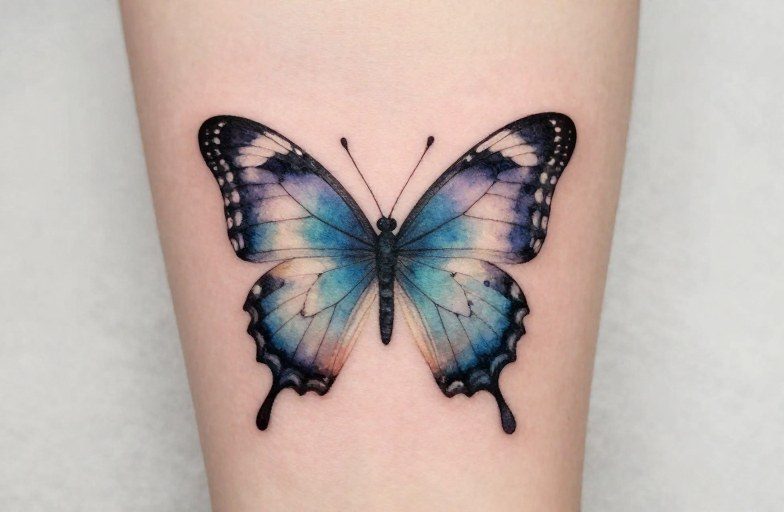
A watercolor butterfly tattoo takes the recognizable silhouette of a butterfly and renders it with the loose, fluid aesthetic of watercolor painting: transparent color layers, visible brushstroke textures, splatter effects, and deliberate color bleeds that seem to dissolve into the skin. Unlike traditional tattoo styles that rely on solid fills and bold outlines, this approach mimics how pigment behaves on wet paper, soft edges, gradients that shift from saturated to nothing, and occasional backruns where darker pools at the edges. The butterfly subject provides natural symmetry and recognizable structure, which anchors the otherwise chaotic color application and prevents the piece from becoming unrecognizable abstraction.
Key Characteristics & Motifs
Recognizing genuine watercolor technique versus generic color work matters when you’re evaluating an artist’s portfolio. The style has specific visual signatures that separate it from other color-heavy approaches.
Signature Visual Elements
- Color bleeds and backruns: Darker pigment pooling at the edges of lighter washes, creating that characteristic watercolor bloom effect
- Visible “brushstroke” texture: Achieved through needle grouping and hand movement that mimics directional paint application
- Splatter and drip effects: Fine dots and trailing lines that suggest flicked paint or gravity-pulls
- Negative space as white “paper”: Skin left untouched to read as the white of the paper in traditional watercolor work
- Soft edge transitions: Gradients that fade to nothing rather than stopping at a hard boundary
Butterfly-Specific Adaptations
The butterfly form offers built-in advantages for this style. Wing veins provide natural dividing lines for color sections without requiring heavy black outlines. The bilateral symmetry lets artists plan mirrored color flows that feel intentional rather than random. Many pieces keep the body and antennae in sharper focus, sometimes with fine linework or dotwork, while letting the wings dissolve into pure color. Monarch patterns translate well because their orange-and-black structure already reads clearly even with soft edges, but blue morpho and swallowtail species also work beautifully due to their iridescent quality that watercolor mimics naturally.
Who It Suits
This style attracts people who want color-forward pieces without the graphic heaviness of traditional or neo-traditional work. The aesthetic reads feminine to most viewers, though that association is cultural rather than inherent, plenty of men wear watercolor pieces successfully. What actually determines fit is skin tone, lifestyle, and pain tolerance.
On fair to medium skin, the translucent color layers read as intended; on deeper skin tones, the same washes can disappear or heal to muted versions that lose the watercolor effect. That doesn’t mean the style is off-limits, strategic use of more saturated pigments and less reliance on negative space adapts the approach. Talk to artists who regularly work on your skin tone and ask to see healed photos, not just fresh work.
The style also suits people comfortable with visible, colorful tattoos. This isn’t a piece that hides easily. Even smaller watercolor butterflies carry visual weight because of the color saturation involved.
Best Placements
Where the Style Functions Best
Flat, relatively stable surfaces preserve the watercolor illusion better than areas that stretch and compress dramatically. The upper arm outer bicep, forearm inner or outer, shoulder blade, thigh front or side, and calf all provide good canvases. Ribs work but require design adaptation, the curvature distorts symmetrical wings, so many artists angle the butterfly to follow the body’s flow rather than fighting it.
Wrists and ankles present challenges. Small scale means detail loss, and these high-movement areas heal with more blur. If you want a watercolor butterfly on the wrist, expect the artist to simplify significantly, perhaps a single wing with color wash rather than full bilateral form.
Scale Considerations
Watercolor technique needs room. Splatter effects at micro scale become muddy dots; gradients compressed too small read as flat color. Most successful pieces start around 3-4 inches at minimum dimension. Larger pieces, 6 inches plus, let artists build multiple color layers with proper spacing between elements.
Common Mistakes to Avoid
Clients and artists both make predictable errors with this style. Knowing them in advance saves cover-up conversations later.
Design-Level Errors
- Too many competing colors: Watercolor paintings typically limit palettes; tattoos should too. Four to five dominant hues maximum, with one or two accent colors
- Butterfly shape lost in abstraction: The form needs enough definition to read immediately; pure color blobs with vague wing suggestions fail as both art and tattoo
- Forced realism combined with watercolor: Hyper-detailed wing scales with loose color bleeds create visual confusion rather than interesting contrast
Technical Execution Problems
Heavy black outlines destroy the watercolor effect. Some artists use a “watercolor with outline” hybrid, but that’s a different style, know which you want. Similarly, over-saturation of pigment in the color bleeds creates solid pools that read as mistakes rather than intentional backruns. The best watercolor tattooers understand watercolor painting enough to replicate its accidents deliberately.
Another frequent issue: the “faded from day one” problem. Some artists create pieces that look appropriately soft fresh, but heal to nearly invisible because they relied too heavily on diluted pigment and negative space. Healed photos in the artist’s portfolio matter enormously here.
Linework & Technique
The relationship between line and color in watercolor butterfly tattoos varies by artist approach. Some use no linework at all, building form purely through color value shifts, lighter where wings catch light, darker toward body and wing edges. Others employ extremely fine single-needle lines for antennae, body segmentation, and key vein paths, letting these structural elements ground the color chaos.
Needle and Application Specifics
Artists typically use magnum needles for color washes and round liners for fine details and splatter effects. The “brushstroke” look comes from needle movement, pulling in consistent directions, varying speed to create tapering lines, and using whip-shading techniques for soft edges. Color packing happens with less saturation than traditional styles; the goal is transparency, not opacity.
White ink sometimes highlights, but many watercolor purists avoid it, relying instead on skin tone for brightness. On darker skin, strategic use of white can define edges that would otherwise disappear, though white heals unpredictably and often yellows over time.
Aftercare Notes
Watercolor tattoos heal with particular considerations because of their reliance on subtle gradation and negative space. Any scabbing or ink loss in a gradient area creates visible banding, hard edges where soft transition should exist. Following artist instructions precisely matters more than with heavy blackwork, where small healing variations hide easily.
During healing, keep the piece moisturized but not soaked. Aquaphor or similar in thin layers, switched to unscented lotion after day three or four per most artist protocols. Sun exposure is the long-term enemy; UV degrades the lighter pigments, yellows, pinks, pale blues, faster than darker colors. Without sun protection, a watercolor butterfly can shift from bold to muddy in a few years. Plan for touch-ups, especially on high-exposure placements.
Over time, the soft edges that define the style will blur slightly. This is normal tattoo aging, but in watercolor work it’s more visually consequential. A piece that read as intentional softening at five years may read as poorly defined at fifteen. This doesn’t mean avoid the style, just understand that maintenance touch-ups every several years preserve the intended effect.
What to Remember
Watercolor butterfly tattoos succeed when the artist understands both watercolor painting principles and how tattoo pigment behaves in skin, not common knowledge, and not taught in all apprenticeship programs. Look for portfolios with multiple healed examples, not just fresh photography. Ask specifically about how colors in your chosen palette heal on your skin tone. The style demands technical confidence with soft edges and negative space; choose someone who specializes in it rather than someone who “can do that too.” The butterfly form gives you structural reliability; the watercolor treatment gives you visual softness. Together they create pieces that read as both recognizable and dreamlike, but only when executed with deliberate control over what looks like happy accident.
Frequently Asked Questions
Do watercolor butterfly tattoos need touch-ups more often than other styles?
Yes, generally. The lighter pigments and soft edges that define the style fade faster than bold blackwork or saturated traditional color. Plan for a touch-up every 5-8 years to maintain the watercolor effect, sooner if the placement gets significant sun exposure.
Can a watercolor butterfly tattoo be covered up if I change my mind?
Covering watercolor is difficult because of the light colors and negative space. Black and gray cover-ups work better over faded color, but you’ll lose the watercolor aesthetic entirely. Laser lightening first expands your options significantly if you’re considering removal or replacement.
How do I tell if an artist actually specializes in watercolor versus just doing colorful work?
Ask to see healed photos specifically, and look for the signature elements: intentional backruns, directional brushstroke textures, and controlled splatter. Generic colorful tattoos lack these deliberate “accidents.” Also ask what watercolor painting experience they have, understanding the medium matters.
Will the white “paper” areas stay looking like white paper over time?
Those areas are actually your skin showing through, not white ink. They’ll remain as your natural skin tone, which means any tanning or skin darkening changes their appearance. On some skin tones, these areas can become more prominent as surrounding color fades, creating unintended contrast.
Related Style Guides
2 responses to “Watercolor Butterfly Tattoos: Style Guide”
[…] you’re comparing visible placements, look at this small butterfly tattoo arm inspiration. You’ll notice how a wrist butterfly feels more personal and immediate, while an upper-arm […]
[…] may change the mood, too. Browse this watercolor butterfly tattoo collection and these rose butterfly tattoo meanings. One botanical accent can make the design feel meaningful […]


Leave a Reply