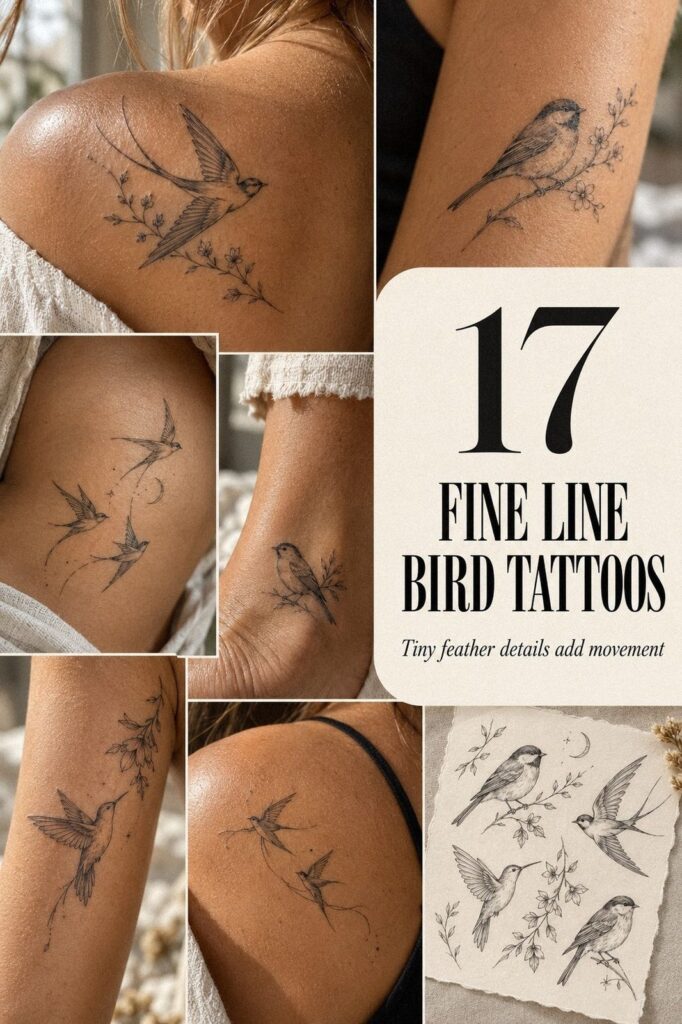
Fine line bird tattoos can be a low-regret first piece when you choose a readable silhouette, a placement with enough skin support, and an artist who shows healed work. I learned that after my first delicate design blurred sooner than expected. These ideas keep the bird crisp, personal, and expressive without making the choice feel heavy!
Small Fine Line Bird Tattoos on the Wrist
A small bird in mid-flight works beautifully on the wrist because the placement makes the motion visible from several angles. Your artist can keep the wings open, the body narrow, and the tail slightly lifted so the design feels flowing instead of stiff. I’d choose a terracotta outline with a small olive accent here, because dense shading can make a tiny wrist piece look muddy over time.
Keep your design minimal, but don’t make it vague. A crisp beak, two open wings, and one curved feather line will read better than a crowded bird full of microscopic marks.
You’ll want to ask for a wrist stencil first, then move your wrist naturally. If the wing crosses your crease, the tattoo may distort when you bend your hand.
For a personal reference point, browse these tiny bird tattoos before your appointment. They’ll help you compare silhouette, scale, and spacing without copying one design exactly. A small bird tattoo collection can also show you how different birds read when the details stay restrained.
I’ve seen people push for ornate feathers here, and I’d skip that. The wrist rewards an understated shape with one meaningful detail, such as a split tail, a lifted wing, or a tiny star near the flight path. That restraint makes the result feel polished rather than unfinished.
Your skin will move, your sleeve may rub against it, and sunlight can fade fine lines faster. Use gentle aftercare, keep the area out of direct sun while it heals, and don’t judge the final softness too early. The surface usually heals in about 2 to 3 weeks, though the tattoo settles more fully over 2 to 3 months.
Fine Line Bird Tattoos in Flight
A bird in flight looks especially delicate on the ankle, where the design can follow the natural line above the foot. Your artist might angle the head upward and let the wings point toward the shin, creating a graceful direction instead of a flat stamp. I’d use a clay-toned line with a muted gold accent and leave the surrounding skin open so the negative space stays sharp.
The ankle is more sensitive than an outer forearm because there’s less padding near the bone. You’ll want to eat beforehand, bring water, and tell your artist if the position becomes uncomfortable. A short session is often easier for a first tattoo than trying to force every feather into one appointment.
For a related visual study, look through these minimalist bird tattoos. The strongest examples use a bold outline as the anchor, then add only one or two expressive marks. You can also compare minimalist fine line butterfly tattoos if you’re deciding whether your bird should feel more organic or more symbolic.
I’d avoid placing the wings directly over the ankle bone. That area can make a striking design feel interrupted, and the skin movement won’t help your lines stay even. Ask your artist to shift the bird slightly upward or toward the outer ankle instead.
Your final piece can feel light without becoming weak. Choose a fierce wing angle, a delicate tail, and enough breathing room around the silhouette. That combination gives you an elegant tattoo that won’t need extra symbols to explain why it matters.
Unique Fine Line Bird Tattoos Behind the Ear
Behind the ear is a daring placement for a bird because the design can feel hidden until you turn your head. A small bird with open wings fits the curved area well, especially when your artist keeps the body close to the hairline. I’d choose a plum outline with soft grey detail and a tiny rose-gold accent, since crowded marks can disappear in that tight space.
Your skin tone matters here, not because one tone is better, but because contrast affects how easily you’ll see the healed lines. Ask your artist to show healed examples on skin with a similar undertone if possible. You’ll get a more honest idea of how delicate, sharp, or understated the result may look.
If you’re still comparing tiny concepts, these fine line butterfly tattoo ideas can help you think about wing rhythm. A bird usually feels more personal when the wing position carries the emotion. Upward wings can look empowering; lowered wings can feel quieter and more haunting.
I wouldn’t choose a long quote or detailed branch behind the ear. You’ll lose the clarity that makes the placement special. One bird, one flight direction, and one meaningful curve is enough.
Your artist may need to work slowly because the area is small and curved. You’ll hear the machine close to your ear, which can feel intense even during a short appointment. Stay still, breathe evenly, and don’t let the compact size convince you that the process will feel effortless.
Fine Line Bird Tattoos with Botanical Details
A bird paired with botanical details gives your fine line design a more symbolic story. On the inner forearm, the artist can place the bird above a slender stem, a few leaves, or a small wildflower without making the composition heavy. I’d use navy linework with restrained white negative space and let the bird remain the clearest focal point.
Choose one plant with a reason behind it. Olive leaves can suggest peace, rosemary can connect to memory, and a small fern can feel organic without becoming ornate. You’ll want to tell your artist what the plant means to you, then let them simplify it for skin rather than drawing every leaf vein.
For another nature-led reference, explore watercolor fine line butterfly tattoos. The color treatment differs, but the spacing can help you see how a delicate subject stays readable beside a second form. A tiny fine line butterfly tattoo is useful when you’re considering a very restrained botanical companion.
I’d skip a full bouquet around a small bird. It sounds romantic, but the extra stems can turn into a tangled mark as the tattoo ages. One curved branch and two or three leaves will look more polished than a miniature garden.
Your forearm gives you a more tolerable placement than ribs, feet, or hands, which can make it a confident first choice. Keep the bird crisp, make the plant slightly lighter, and leave the background untouched. The final effect can feel graceful and timeless without shouting for attention.
Fine Line Bird Tattoos Across the Collarbone
A collarbone bird design works best when it follows the body instead of sitting like a sticker. The strongest single choice is a small open-wing silhouette with a slightly lifted head. I’d use an emerald outline with tiny gold and cream accents, then keep the transferred design clean and open on skin.
Your artist can test the placement with a stencil while you stand, sit, and relax your shoulders. That matters because the collarbone shifts with posture. You’ll want the wings to remain balanced when your shoulders drop, not only when you’re holding yourself perfectly still.
If you like the drawn-sheet feeling, compare it with fine line moth tattoo references. Moths bring a more moody, symmetrical energy, while birds feel more flowing and playful. Looking at both can help you decide whether your tattoo should suggest movement, transformation, memory, or freedom.
A collarbone piece can feel feminine, masculine, or completely personal depending on the line weight and placement. I’d avoid a thick frame around it. The collarbone already gives the tattoo structure, so an added border would make the design feel boxed in.
Your artist may recommend a slightly stronger outline than you expected. Listen to that advice if the bird is small, because ultra-light lines can lose their edge once the skin settles. The result should stay delicate, but it still needs enough contrast to remain readable years from now.
Fine Line Bird Tattoos Inspired by Swallows
Swallows bring a classic tattoo language to a fine line approach. On the shoulder, you have enough room for a bold wing shape, a curved tail, and a small amount of single-needle detail without squeezing everything together. I’d choose a forest-green swallow with a rust accent and smooth dark edges instead of trying to recreate every feather.
Your artist can make the bird feel more vintage by widening the wings and sharpening the tail fork. You’ll want to discuss whether the design should look like a real swallow or a symbolic flash-style bird. Those are different directions, and mixing them can make the final piece feel uncertain.
A swallow can represent return, loyalty, travel, or survival, so the symbolism doesn’t need extra lettering. If you’re drawn to a more expressive result, ask for a slight upward tilt. That gives the bird an empowering feeling while keeping the shape sleek.
I’d skip heavy red or blue color in a fine line swallow unless your artist has strong healed color examples. A forest-green palette gives you a sharper, timeless foundation, especially for a first piece. You can always add a small accent later, but removing a muddy accent isn’t simple.
Your shoulder is generally more tolerable than ribs, feet, or hands, though everyone’s experience differs. Keep the aftercare simple: wash gently, moisturize as directed, and avoid soaking the tattoo in a pool while it heals. The bird should look crisp before you decide whether it needs anything else.
Fine Line Bird Tattoos with Single Needle Shading
Single needle shading can give a wrist bird a little depth without turning it into a heavy blackwork piece. Your artist might shade beneath the wings, along the chest, and near the tail while leaving the center of each feather open. I’d ask for dusty-rose shading with a charcoal outline and a restrained gold accent that supports the silhouette rather than competing with it.
The best shading is subtle enough that you notice it after the silhouette. You’ll want to see healed examples, not only fresh tattoos under bright studio lights. Fresh ink can look dramatic, while healed shading often becomes more understated and soft.
Here’s a simple cost guide using typical US ranges:
Prices vary by artist, city, demand, and appointment minimum. You’re paying for judgment as much as needle time, so the cheapest option isn’t always the best value. A skilled artist may tell you to simplify the bird, move it, or strengthen one line.
I made the mistake of focusing on the fresh appearance once. Don’t do that. Your tattoo needs to look good after the swelling fades, the surface flakes, and the ink settles into its long-term shape.
You’ll get the most timeless result when the outline remains crisp and the shading stays restrained. Fine lines can widen with age, and UV exposure can speed fading, so use sun protection after healing. That small habit supports the long-term clarity you wanted in the first place.
Fine Line Bird Tattoos on the Ribcage
A ribcage bird can feel intimate because the design stays hidden beneath clothing until you choose to show it. The open-wing shape works well when it follows the curve of the ribs rather than crossing them in a rigid line. I’d keep the black ribcage silhouette slightly larger than a wrist bird so the wings don’t collapse into one mark.
Ribs are among the more painful tattoo placements because the skin is close to bone and the area moves with breathing. You’ll want to schedule enough time, wear clothing that gives the artist access, and avoid arriving exhausted. A delicate design doesn’t guarantee a delicate sensation.
Your artist can angle the bird toward the center of your body or let it fly toward your side. The first feels more inward and personal; the second feels more open and expressive. Which direction feels right when you imagine seeing it years from now?
I’d avoid adding a large quote under the bird. The rib curve already creates drama, and too much text can compete with the movement of the wings. A tiny symbol may work, but only if it has a real connection to your story.
Your skin may feel tight while it heals, especially when clothing rubs across the area. Follow the aftercare instructions you receive, keep the tattoo clean, and avoid soaking it. The final piece can be haunting and elegant, but only if you give the placement enough space to breathe.
Fine Line Bird Tattoos Symbolizing Freedom
A freedom-themed bird doesn’t need a chain, quote, or horizon line to explain itself. The open wings already carry that meaning. On the ankle, a midnight-blue flying bird with a copper accent can feel personal and understated, especially when the head points forward and the tail trails behind in one clean gesture.
You’ll want to decide whether freedom means escape, independence, recovery, or movement for you. That answer can shape the bird’s posture. A fierce upward flight feels different from a quiet bird gliding across the skin, even when both use the same fine line technique.
If your meaning leans toward simplicity, review tiny fine line butterfly tattoos for ideas about keeping symbolism small. For a more grounded subject, compare small bird tattoo designs and notice which silhouettes still read clearly at a glance.
I’d avoid stacking several symbols just because each one sounds meaningful. Your tattoo becomes stronger when one image carries the emotional weight. One bird can hold an entire chapter of your life if you let the shape stay clear.
An ankle bird may fade faster if it receives constant sun, friction, or skin movement from footwear. You can support its longevity by choosing a placement with less rubbing and protecting healed ink from UV exposure. The idea is powerful without becoming visually loud.
Fine Line Bird Tattoos with Geometric Accents
A geometric accent can give your bird a crisp, modern counterpoint. Pair geometric line accents with one circle, triangle, or short ray pattern rather than a full geometric cage.
Your artist should keep the geometry secondary. You’ll want the bird to remain recognizable even if the accent is removed mentally. A thin circle behind the wings can suggest the sun, while a few angular lines can create contrast without making the piece feel mechanical.
Look at fine line moth tattoo ideas if you’re drawn to symmetry. Moths naturally support geometric structure, while birds usually benefit from more uneven, flowing movement. That contrast can help you choose an accent that supports your subject instead of fighting it.
I’d skip perfectly repeated micro-lines on a very small tattoo. They may look sharp on the stencil, but tiny spacing changes can become obvious after healing. A clean triangle or open arc will age more gracefully than a dense pattern.
Your artist may suggest leaving the geometric shape incomplete. Trust that instinct if the open edge keeps the bird from feeling trapped. The final design can be edgy, sleek, and personal while still allowing the flight pose to lead.
Fine Line Bird Tattoos for Minimalist Ankles
A minimalist ankle bird is a strong choice when you want something visible but not overpowering. On deep brown skin with a warm undertone, your artist can use a clear black silhouette and generous negative space so the wings stay readable. I’d choose solid black anchor lines with only one interior feather mark.
Your artist should assess contrast in person and explain how the ink may settle. You’ll want a design that reads at normal distance, not one that only looks intricate in a tiny reference image. A graceful outline with a sharp tail often works better than delicate detail that disappears.
For a small reference library, browse minimalist bird tattoos and tiny bird tattoos. You can compare ankle placement, flight direction, and how much open skin surrounds each bird. Keep your favorite examples as conversation starters, not templates.
I’d avoid placing the bird directly where a shoe strap rubs. That friction can irritate fresh skin and may make aftercare annoying. Move the design slightly above the strap line or toward the outer ankle if your artist agrees.
Your ankle may feel more sensitive than an inner forearm, especially near the bone. Go in prepared, follow the healing instructions, and remember that the surface can look calm before the tattoo is fully settled. With a personal silhouette and a bold enough outline, the result can stay timeless, delicate, and easy to live with.
Build the Bird Around One Meaning
Start with the feeling before you choose the species. A meaningful bird tattoo might represent freedom, grief, family, migration, faith, or a private turning point. You don’t need to explain the full story to everyone who sees it.
Once you know the meaning, choose the gesture. A lifted wing feels hopeful. A bird looking backward can suggest memory.
Two birds may speak to connection, while one sharp silhouette can feel more independent and fierce.
I’d write down three words before your consultation. Maybe they’re “quiet, brave, returning.” Those words give your artist useful direction without forcing a literal symbol into the design. This small step can save money because it reduces random revisions.
The strongest concept often has fewer parts than you expected. One species, one flight direction, and one supporting detail may be enough. That restraint can make the final tattoo feel iconic rather than crowded.
What Makes a Fine Line Bird Tattoo Worth It?
A fine line bird tattoo is worth it when the design still reads after the fresh contrast softens. That means the silhouette, placement, and line weight have been considered together. A beautiful idea isn’t enough if the skin can’t hold its smallest details.
The real value is in the artist’s judgment. You’re paying someone to understand how a mark behaves on moving skin, how much spacing a feather needs, and when a tiny element should be removed. I’d rather have a simpler bird with strong line structure than an intricate design that ages poorly.
Ask to see healed work before you book. Fresh ink can look striking under studio lighting, but healed examples show whether the lines remain sharp, balanced, and recognizable. That information is worth more than a dramatic social media post.
Your budget should include the shop minimum, the consultation, the session, and appropriate aftercare. Don’t spend every dollar on the appointment and then choose the cheapest aftercare product or rush the decision. The tattoo’s long-term value depends on the whole process.
And yes, sometimes a higher quote is worth it. If the artist has consistent healed work, understands your placement, and tells you when an idea needs simplifying, that experience can prevent an expensive correction later!
The Audubon Question: Real Bird or Symbol?
A realistic bird can be striking, but realism demands more anatomical detail and more room. A natural bird silhouette gives you greater flexibility for a small first tattoo, especially on the wrist, ankle, or behind the ear.
Think about whether you care more about species accuracy or emotional movement. A recognizable swallow, sparrow, or wren may carry a specific memory. A symbolic bird can give you the freedom to combine a familiar wing shape with a personal tail or posture.
The Audubon question is really a question about purpose. Are you honoring one actual bird, or are you using the bird as a personal sign? Both directions can be meaningful, but they call for different reference material and different expectations.
I’d avoid asking for photorealism at a tiny scale. The result may lose the crisp, understated quality that drew you to fine line work in the first place. Let the artist preserve the gesture rather than forcing every feather into the skin.
Black Ink, Grey Wash, or Color?
Black ink usually gives a fine line bird the strongest long-term contrast. A black ink outline can remain readable with very little interior detail, which is why it works so well for first tattoos and smaller placements.
Grey wash can add depth, but it needs room to breathe. Ask your artist whether the shading will remain visible after healing or simply soften into a vague haze. Subtle doesn’t mean invisible.
Color can be beautiful, especially for a bird with a strong symbolic connection. Still, color introduces another maintenance question. You’ll want healed examples in the same style before deciding whether the extra expense and care are worth it.
For a delicate design, I’d choose one dominant approach. Black outline with a tiny accent can feel polished.
Black, grey, several bright colors, and dense texture may compete for attention. Your tattoo doesn’t need every possibility at once.
Place the Bird Where Your Life Can Hold It
Choose placement based on your real habits, not only how it looks in a reference image. A forearm tattoo placement may suit you if you want to see the bird often, while a rib or upper-thigh design can stay more private.
Think about sun exposure, clothing friction, sports, work, and whether you regularly wear straps across the area. An ankle bird may deal with shoes.
A wrist bird may meet watchbands. A shoulder piece may rub against fabric during exercise.
Your artist can help you test the position with a stencil. Stand, sit, bend, walk, and relax your posture. If the design only looks balanced when you’re frozen in one pose, it needs another adjustment.
Placement also affects cost. A quick, accessible area may require less time than a curved or sensitive spot.
Don’t choose a painful location just because someone online called it more meaningful. The best value is a tattoo you can comfortably live with.
A low budget can make a first tattoo feel tempting, but the cheapest quote doesn’t always represent the best value. You’re buying design decisions, hygiene, equipment, consultation time, and the artist’s ability to work with your skin.
Ask what the quoted cost includes. Some artists use a shop minimum, while others price by the hour or give a flat rate for a small design. A shop minimum may cover a short appointment even when the tattoo itself takes little time.
Bring your questions before the appointment. Ask about healed work, revisions, deposits, aftercare, and whether a stencil adjustment is included. Clear answers are part of the experience, not an inconvenience.
If the design is outside your budget, simplify it before changing artists. Remove extra symbols, reduce shading, or choose a more accessible placement. A clean, intentional tattoo is better than a crowded concept forced into a shorter session.
Why Fine Line Bird Tattoos Keep Working
I’ve changed my mind about fine line tattoos more than once. At first, I thought every line had to remain impossibly thin for the tattoo to count as delicate.
That idea caused my first mistake. A line that’s too faint may look elegant on appointment day, but it can lose its clarity as the skin settles.
Now I care more about line weight: a bold enough outer silhouette, restrained interior detail, and a placement that doesn’t force the design to fight movement.
The best bird tattoos also leave room for the viewer. I don’t need a quote under every wing or a symbolic object beside every feather.
A personal tattoo can be meaningful without explaining itself immediately. When I look at a simple bird with an expressive flight path, I can feel the story without seeing every chapter spelled out.
That’s why I’d choose a readable silhouette over a crowded realistic study for a first piece. You’re not failing to be creative by simplifying.
You’re giving the tattoo a stronger chance to remain crisp, graceful, and recognizable after the fresh contrast softens. Ask your artist what they’d remove first.
Their answer tells you whether they understand restraint.
I also care about healed portfolios more than dramatic flash sheets. Fresh ink can look sharp under perfect lighting, while healed examples show the real relationship between skin, pigment, and line weight.
If an artist only displays fresh work, I’d keep looking. Your first tattoo deserves patience, not pressure.
Fine line bird tattoos can be feminine, masculine, romantic, raw, or completely personal. The strongest choice is the one that matches your reason for getting it and respects what the skin can hold. Keep the bird clear, protect it from UV exposure once healed, and let the design carry its own quiet confidence!
A Few Things Worth Answering
How much does a fine line bird tattoo usually cost?
A small fine line bird tattoo often costs about $100 to $300 in the US. Your artist may charge a shop minimum of about $50 to $100, or use an hourly rate around $100 to $250. Region, experience, placement, and detail all affect the final quote.
Are fine line bird tattoos a good idea for a first tattoo?
Yes, fine line bird tattoos can be a meaningful first choice when you select a readable design and a tolerable placement. Your forearm, shoulder, or thigh may feel easier than ribs, feet, hands, or sternum. Choose an artist with healed examples and clean linework.
How do I choose a tattoo artist for fine line bird tattoos?
Review the artist’s portfolio for consistent single-needle linework, healed examples, and designs similar to yours. You’ll also want a hygienic studio, clear aftercare instructions, and an artist who explains when your bird needs stronger lines or fewer details.
How much do fine line bird tattoos hurt?
Pain varies, but ribs, feet, hands, and sternum are usually more uncomfortable because they have less padding and more bone sensitivity. Your forearm, thigh, or shoulder may feel more tolerable. Session length, placement, and personal sensitivity all matter.
How long does a fine line bird tattoo take to heal?
The surface usually heals in about 2 to 3 weeks, while the tattoo settles completely over about 2 to 3 months. Wash gently, moisturize as directed, avoid soaking, and protect healed ink from strong sun to support long-term clarity.
What’s the best placement for fine line bird tattoos?
Your forearm or shoulder is often a practical choice because the skin is easier to work on and generally more tolerable. The ankle, wrist, ribs, and behind the ear create stronger visual statements, but they may involve more movement, friction, or sensitivity.
Where I’d Start First
If I had to pick one, I’d start with the small wrist bird. Its open wings read clearly, the placement keeps the design personal, and you can judge the silhouette before adding anything else. Pin the wrist idea for later and compare it with these small fine line butterfly tattoos before booking.
One response to “No-Regret Fine Line Bird Tattoos for Your First Ink”
[…] save references that show healed work, not only fresh black lines. The healed comparison in our fine line bird tattoos guide helped me notice how much the design depends on spacing.Not sure […]