
Small moth tattoo designs can stay crisp for years when you choose readable linework, sensible placement, and enough negative space. I learned that after seeing a delicate wing blur because the original stencil tried to say too much. Start smaller in detail, not smaller in judgment. Your artist’s restraint matters!
- Start With Fine-Line Small Moth Tattoo Ideas: The Fine-Line Threshold
- Pick Intricate Wings For Your Small Moth Tattoo: How Fine Is Too Fine?
- Choose A Unique Small Moth Tattoo Silhouette: The Negative-Space Rule
- Place Your Small Moth Tattoo Above The Ankle: Bone Over Trend
- Keep Antennae Crisp In Tiny Moth Linework: The Two-Weight Rule
- Plan A Symbolic Small Moth Tattoo Composition: Meaning Before Ornament
- Add Moon Phases Around Your Small Moth Tattoo: The Three-Point Orbit
- Match Dotwork Texture To Delicate Moth Wings: Texture Over Shading
- Select A Bold Blackwork Small Moth Tattoo: The Ink-Weight Test
- Balance Symmetry Across Your Moth Tattoo Design: Stencil Over Guesswork
- Protect Sharp Details During Small Moth Tattoo Healing: The Aftercare Clock
1Start With Fine-Line Small Moth Tattoo Ideas: The Fine-Line Threshold
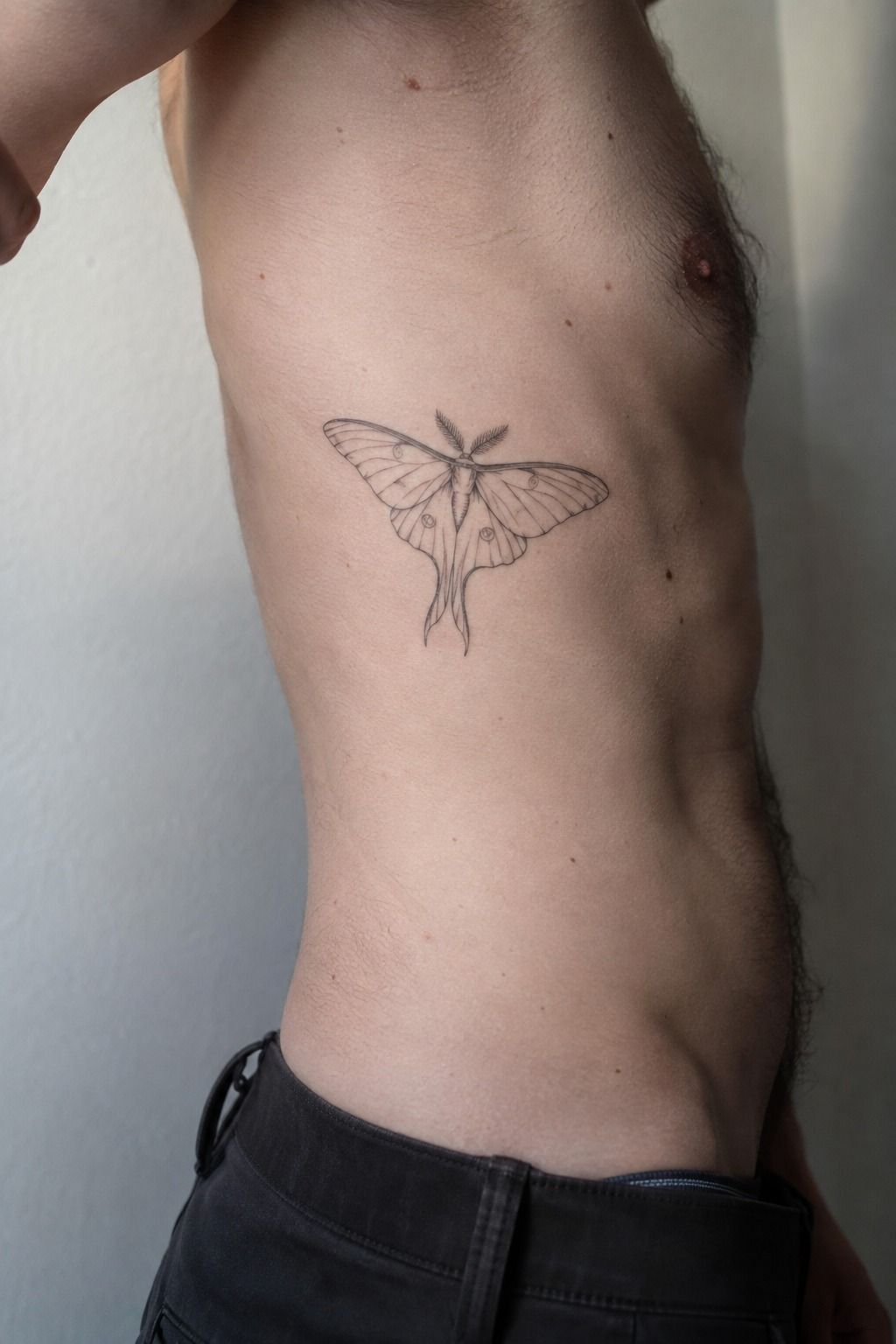
Begin with the moth’s main shape before choosing decoration. Ask your artist to draw the spread wings, rounded body, and feathered antennae at the actual size you want. Then inspect the design from arm’s length.
If you can’t read the silhouette quickly, your single-needle cartridge is carrying too much information.
For fair, cool-pink skin, the rib placement can give the moth a personal, understated quality. The crisp black outline looks delicate against the skin, while open wing panels keep the image expressive instead of muddy. Compare this approach with these small butterfly tattoo ideas before committing.
I’d skip tiny interior symbols at this stage. A moon, eye, or star can be meaningful, but your moth needs a strong body first.
My rule is simple: one striking silhouette, two or three wing divisions, and only then a few intricate marks. That keeps the result sleek and personal.
Print the sketch at the intended size and hold it beside your ribs. Your body curves, breathes, and shifts, so a flat drawing can look sharper on paper than it does on skin. A thermal stencil lets you test the shape without guessing.
Give yourself a day before approving it. You’ll notice whether the antennae feel graceful or fussy, whether the wings look bold enough, and whether the moth still feels meaningful after the first excitement fades.
That pause is powerful. That test saves regret!
Ask one more question before you approve the final outline: what happens if the smallest mark disappears? A readable silhouette should still carry the moth’s identity even after years of normal fading.
2Pick Intricate Wings For Your Small Moth Tattoo: How Fine Is Too Fine?
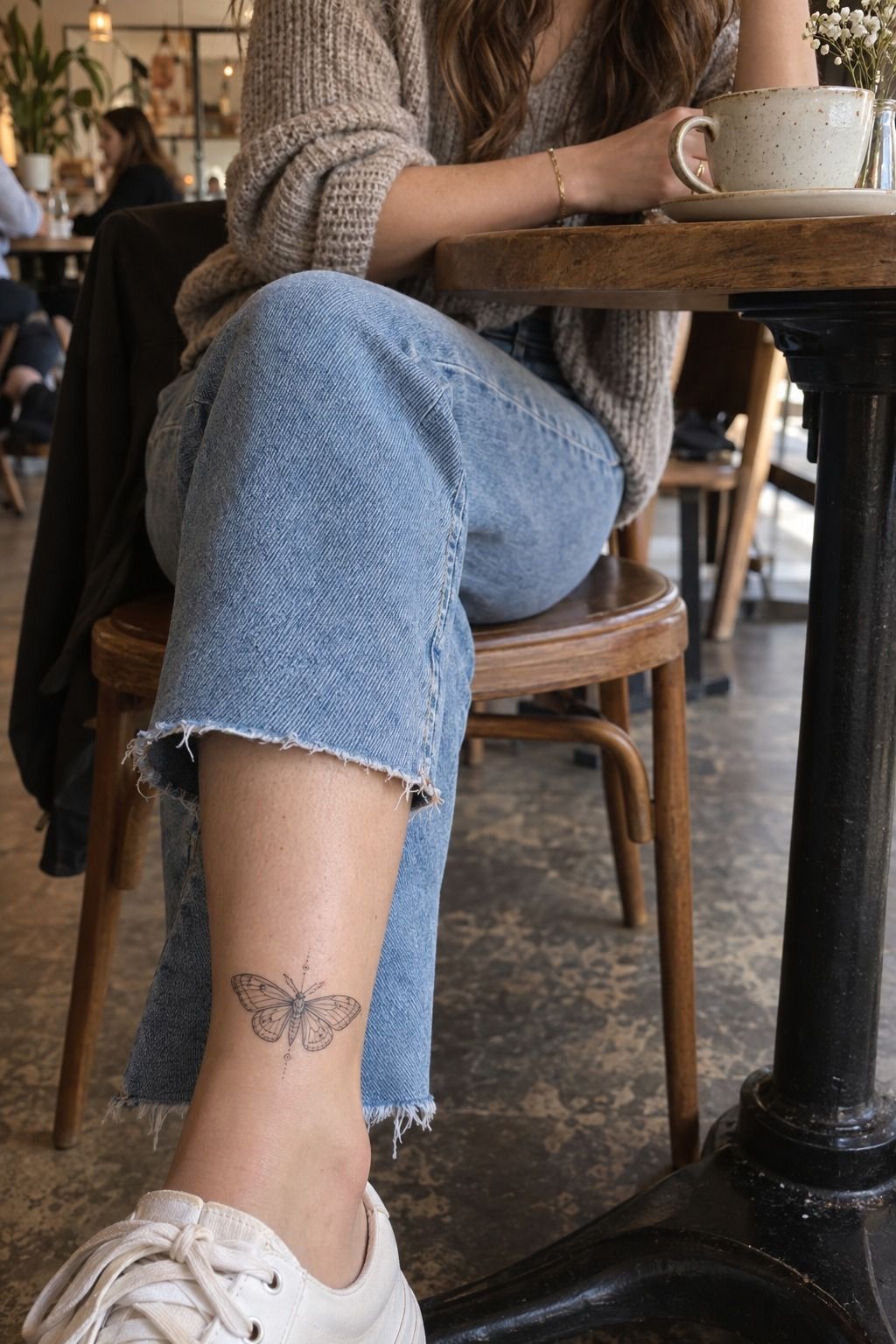
Choose wing details with a clear hierarchy. The outer contour should carry more visual weight than the interior marks.
That contrast makes the design intricate without turning every line into the same visual volume. Your eye should land on the wing shape first.
For medium warm ivory skin, black linework can look crisp and elegant when the artist leaves clean breaks between veins. I’d ask for three-round liner ink only where the wing structure needs definition, then leave open skin in the softer sections. A tightly packed web of lines may look ornate on day one and confusing later.
You’ll want to discuss healed examples, not only fresh photographs. Ask your artist to show work photographed after the surface has settled, ideally in natural light. Fresh ink can look sharp and edgy because the skin is irritated; healed work tells you whether the delicate pattern survived.
Could you still identify the moth if the smallest dots disappeared? That’s the test.
Keep the outer wings, central body, and antennae readable even if some fine marks soften. The result will feel more timeless than a design that depends on every microscopic detail.
Don’t mistake restraint for plainness. Add one expressive feature, such as a dark thorax, a small notch in the wing edge, or a graceful curve through the lower wings. Read about the meaning behind moth tattoos if symbolism is guiding those choices.
A healed photograph is more useful than a perfect appointment-day image. Look for clean gaps, controlled line weight, and an expressive shape that still feels polished after the skin has recovered.
3Choose A Unique Small Moth Tattoo Silhouette: The Negative-Space Rule

Choose a silhouette that gives your moth a recognizable personality.
4Place Your Small Moth Tattoo Above The Ankle: Bone Over Trend

Place the moth above the ankle when you want visibility without putting the design directly on the moving joint. The upper ankle gives a small moth a clear vertical zone, but the area still experiences friction from socks and shoes.
Ask your artist to test the position while your foot is relaxed and while you’re standing. Skin can shift around the ankle, and a design that seems centered while seated may sit too high when you walk.
Ankle placement can feel stylish and personal, but it isn’t automatically the best choice. Consider your work clothes, sun exposure, and how often the tattoo will rub against footwear. A crisp design needs practical protection after the appointment.
If you want less friction, compare the ankle with the forearm or outer thigh. Those areas often offer more stable skin and may be easier to protect during healing. The final choice should fit your routine, not just a trend.
The ankle joint also changes how a vertical moth reads from different angles. A slightly longer body may look graceful when you’re standing, while a broad wing shape can feel compressed when the foot bends.
5Keep Antennae Crisp In Tiny Moth Linework: The Two-Weight Rule

Keep the antennae simple because they’re often the first detail to disappear when a tiny moth loses clarity. A clean curve can suggest feathering without drawing every filament. Your artist should prioritize the outer rhythm over miniature decoration.
A fine-line needle grouping can create elegant antennae, but the width must suit the design’s final scale. Ask whether the artist plans to use one consistent line or a slightly stronger body outline with lighter antennae. I prefer the second approach because the body anchors the moth while the antennae stay delicate.
Avoid placing antennae where they’ll be crossed by a crease, bracelet, or frequent friction point. You’ll get a more polished result if each curve has open skin around it. A crisp line needs visual breathing room, especially when the tattoo is smaller than your palm.
Look for a version with a clear head, two balanced curves, and no tangled ends. If the antennae resemble stray threads in the stencil, they won’t become more readable after healing. That’s an honest warning, but it saves you regret.
Don’t let an artist add decorative flourishes just because the paper looks empty. A sharp, symbolic moth can feel more iconic with two confident antennae than with six fussy ones.
If you’re comparing animal symbolism, this wolf tattoo meaning resource can help you think about clarity in a different subject. Keep it clean!
A two-weight outline often gives the best balance. The body and wing edge can stay bold enough to survive distance, while the antennae retain a dainty, expressive quality.
6Plan A Symbolic Small Moth Tattoo Composition: Meaning Before Ornament
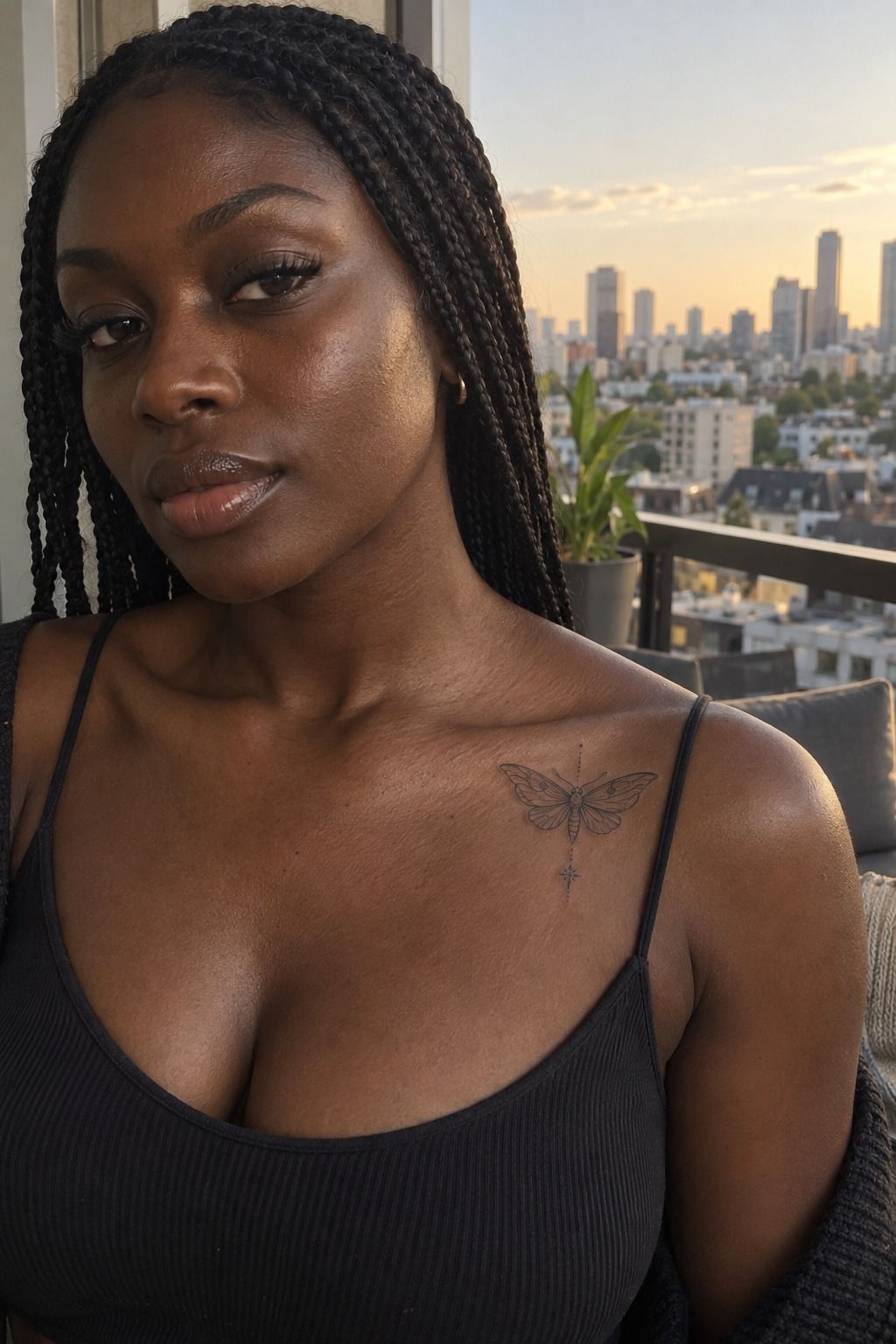
Plan the symbolism before adding stars, lettering, or extra insects. Decide what the moth represents to you, then choose only the marks that strengthen that meaning.
A personal symbol might be transformation, nighttime solitude, memory, resilience, or attraction to the unknown. You don’t need to explain every detail to other people. The design only needs to feel honest when you look at it.
Try writing one sentence about the tattoo before opening a reference folder. If the sentence says “a moth that represents survival,” a crowded collection of unrelated symbols may weaken the idea. A minimal design can still feel empowering.
The moth can feel sacred, haunting, or romantic depending on the linework and surrounding symbols. Choose the emotional direction first, then let the shape follow. The luna moth meaning reference may help if you want a more specific symbolic starting point.
I’d choose one central symbol and one supporting mark at most. A meaningful crescent can reinforce a nighttime theme, but five competing symbols can make the tattoo feel less personal.
7Add Moon Phases Around Your Small Moth Tattoo: The Three-Point Orbit
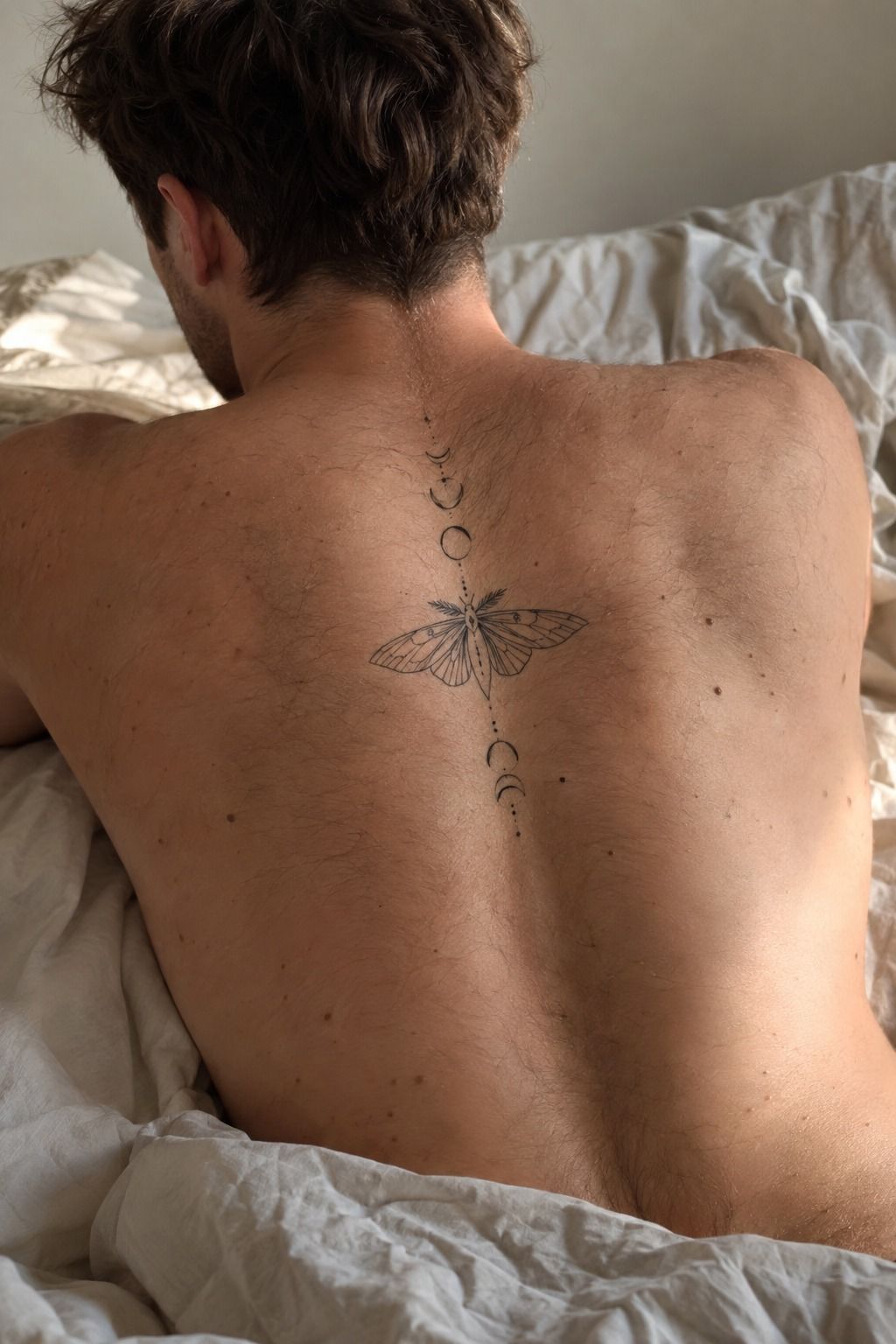
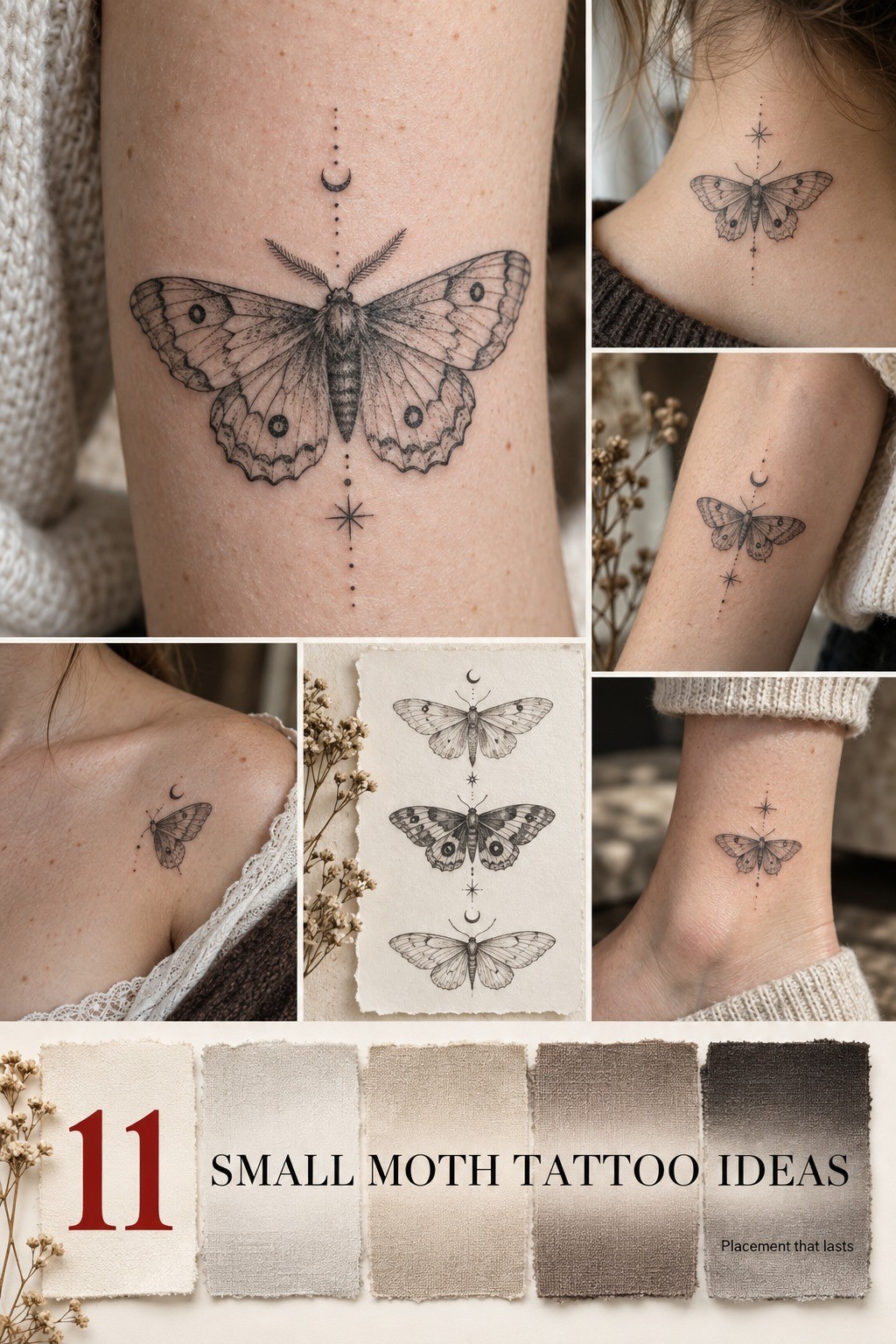
Add moon phases only after the moth reads clearly on its own. A short sequence of lunar marks can follow the body without competing with it. Your composition should feel flowing, not like separate stickers placed in a row.
Use three points as a starting structure: one crescent above, one small circle near the body, and one crescent below. The exact symbols can change, but the spacing should remain deliberate. A black tattoo stencil marker helps your artist test the orbit before any needle touches skin.
The spine can support a powerful vertical composition, though it may feel sharper than an ankle or thigh placement. If you’re sensitive to bony areas, tell your artist before the appointment. You’ll want a design that looks ethereal and meaningful, not one you rush through because the session feels overwhelming.
I’d keep the moon phases lighter than the moth. If every mark has the same weight, the composition loses its center. Let the wings carry the boldest lines, then allow the lunar symbols to act as quiet punctuation.
Leave enough distance between the phases and the wing tips. Crowded symbols can merge as the skin settles, especially along a narrow line such as the spine. Explore these luna moth tattoo ideas for direction, but let the final arrangement belong to your story.
A three-point orbit works because it creates movement without demanding much extra detail. It can feel whimsical, sacred, or classic depending on the size and shape of the moons.
8Match Dotwork Texture To Delicate Moth Wings: Texture Over Shading

Match dotwork to the wing structure instead of sprinkling dots everywhere.
9Select A Bold Blackwork Small Moth Tattoo: The Ink-Weight Test
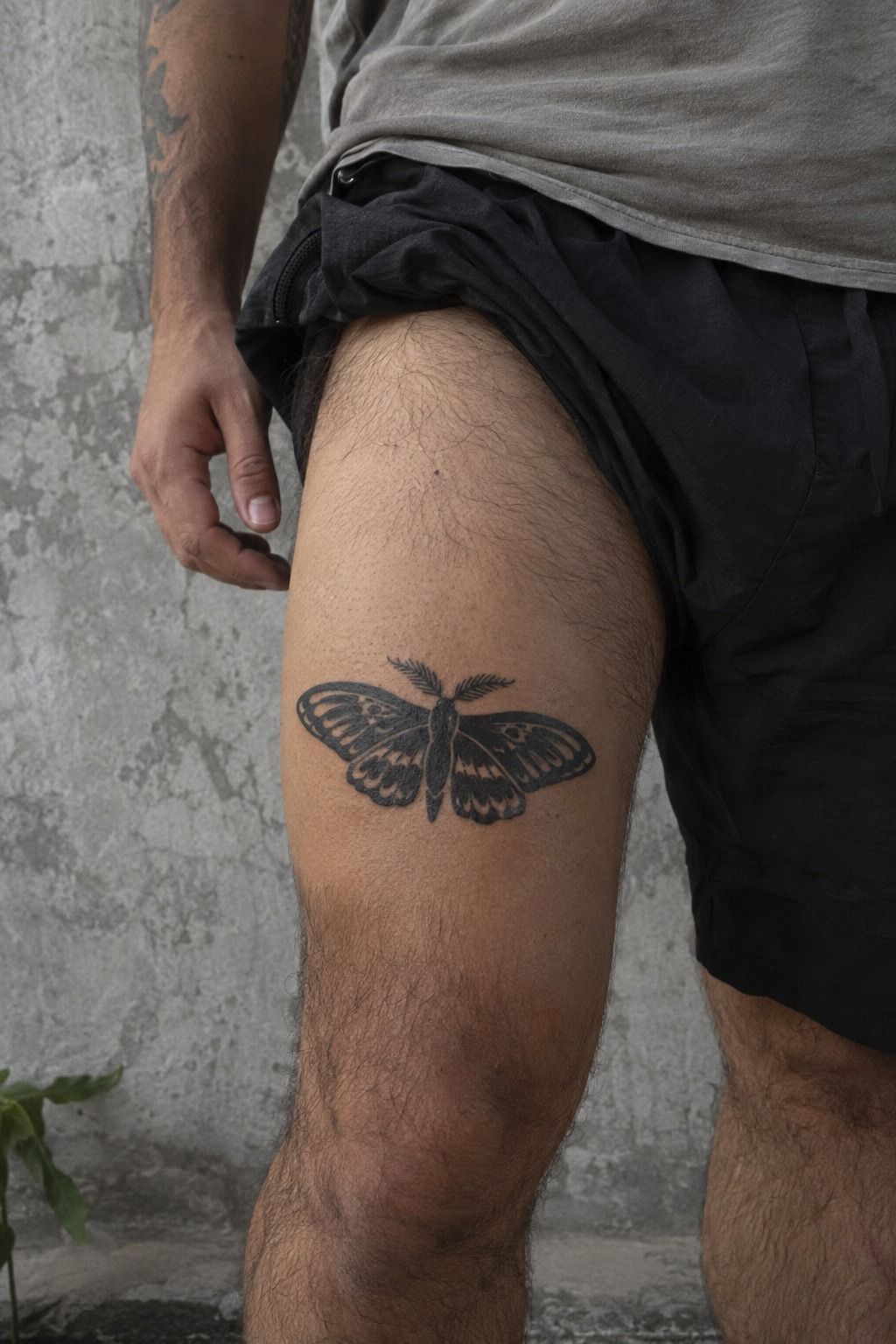
Select blackwork when you want a fierce, graphic moth that stays readable from a distance. Strong filled areas and clear antennae can make the moth bold without filling every wing panel solid.
Ask for a solid black tattoo pigment test on paper at the final size. You’ll see whether the dark areas overpower the body or give it enough structure. Blackwork can feel iconic and timeless, but a heavy shape still needs open channels.
The thigh is often more tolerable than ribs, feet, hands, or sternum, though everyone responds differently. You’ll want to wear loose clothing and avoid pressure on the area during early healing. A clean disposable razor may be used by the studio, but preparation should remain hygienic.
I’d choose two strong black areas over full saturation for a small moth. A dark body and upper-wing accents can create a sharp focal point, while open lower wings preserve a delicate edge. That contrast gives you both boldness and restraint.
Think about aging before approving the darkest version. Solid black generally holds readability well when placement and aftercare are good, but UV exposure can soften any tattoo over time. For a darker symbolic direction, compare this wolf and dreamcatcher tattoo meaning guide for composition ideas.
A blackwork test stencil can reveal whether the moth feels polished or overly dense. Step back several feet and check it again. If the body disappears into the wings, remove ink before the appointment.
10Balance Symmetry Across Your Moth Tattoo Design: Stencil Over Guesswork
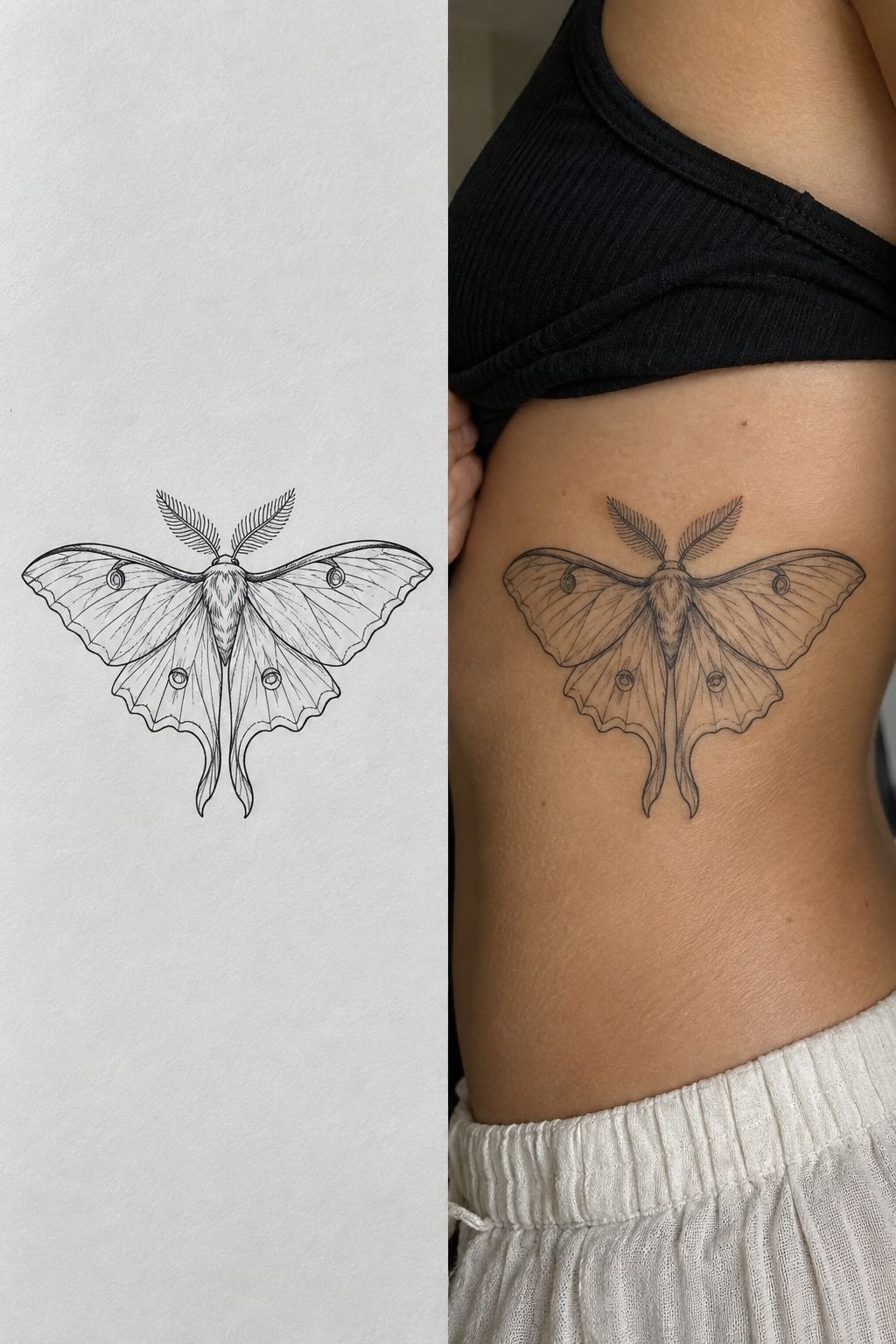
Balance symmetry by comparing the stencil with healed work, not by trusting a fresh drawing alone. Your eye can spot whether the wings remain even, whether the body stays centered, and whether the open spaces survived.
Ask your artist to use white stencil paper for the first placement and photograph it before starting. Step back, relax your posture, and check the design in a mirror. You’ll catch small tilts that aren’t obvious when you’re looking down at your own skin.
Perfect mirror symmetry isn’t always necessary. Bodies aren’t flat, and a moth can look more natural when the wings respond subtly to the placement. Still, the body axis should feel controlled, especially if you want a sleek, polished design.
I’d rather see a slightly simpler symmetrical moth than an ornate design with one wing crowded and the other empty. Your tattoo should remain crisp when you glance at it quickly. If you’re uncertain, ask the artist to remove one interior mark from each side and compare the result.
Don’t approve the stencil while standing stiffly or twisting to see it. Your artist should check it in the position where the tattoo will normally be seen. You can also revisit this moth tattoo meaning page while deciding whether symmetry or symbolism matters more.
A centerline stencil makes small corrections easier before the needle starts. It also gives you a calm way to discuss balance without relying on memory or instinct alone.
11Protect Sharp Details During Small Moth Tattoo Healing: The Aftercare Clock
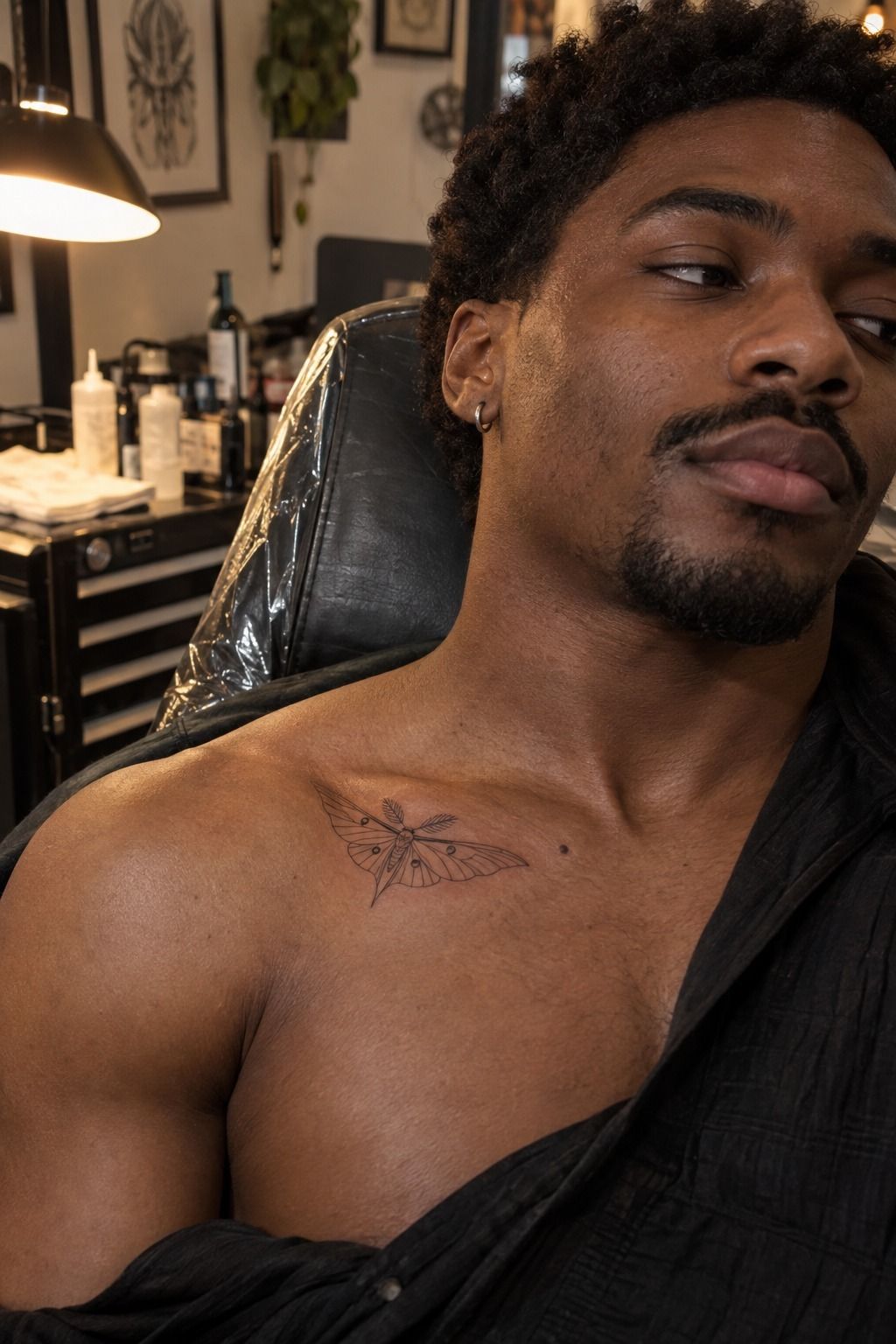
Protect sharp details during healing by following the studio’s instructions exactly. A fine-line moth can look delicate and crisp at first, but the surface usually needs about 2 to 3 weeks to settle. Complete healing can take about 2 to 3 months, so your final judgment should wait.
Wash gently with clean hands and mild, fragrance-free soap, then pat dry. Use a thin layer of the recommended unscented healing balm, not a heavy coating that leaves the skin wet. Your goal is clean, calm skin, not a glossy layer of product.
Avoid swimming and strong sun during early healing. Don’t pick flakes, scratch the wings, or cover the tattoo with tight clothing unless your artist specifically tells you to. The antennae and tiny wing marks need patience while the surface closes.
If the design sits on your ankle, foot, hand, ribs, or sternum, expect more sensitivity than you might feel on the forearm, thigh, or shoulder. A soft cotton shirt can reduce friction on collarbone work, while loose socks may help an ankle tattoo.
Take healed photos in natural light after the surface feels normal. If a fine line softened more than expected, your artist can discuss a touch-up after the skin has fully recovered.
Keep the moth away from UV afterward, because crisp linework ages better when you protect it. Patience protects the line!
A touch-up appointment should wait until the skin is fully healed. Rushing back too early can irritate the area and make it harder to judge which marks genuinely need attention.
Why Crisp Linework Beats Extra Detail
I’ve changed my opinion about small moth tattoos after seeing how quickly a crowded design loses its point. My first instinct was to add moon phases, lettering, dots, and a tiny eye because each symbol felt meaningful on its own. Together, they made the moth harder to read.
The healed comparison photo taught me more than any trend board could.
For me, the best design decision is choosing what to remove. A striking outline, a readable body, and one symbolic accent can feel more personal than an ornate arrangement borrowed from five references. You’re not submitting a drawing for grading.
You’re choosing an image that will live with your movement, your skin, and your changing taste.
I also think placement deserves more respect than style labels. Fine-line, dotwork, and blackwork can all work when the design suits the area.
A delicate rib tattoo asks different questions than a bold thigh moth. Your artist should explain those tradeoffs clearly, and you should feel comfortable walking away if the answer is only a promise.
The practical part matters just as much. Typical US pricing may start around $50 to $100 as a studio minimum, while hourly rates often sit around $100 to $250. A small moth may cost about $100 to $300, depending on the artist, region, detail, and placement.
Those numbers are starting points, not a promise. Your best investment is a portfolio showing healed moths in the style you want. I’d pay for clean judgment before I’d pay for extra decoration, because readable work is what keeps the tattoo meaningful.
That makes the design worth it.
A Quick Placement Check
Before booking, rate each possible placement for visibility, friction, pain, and long-term readability. A placement checklist keeps excitement from making the decision for you.
The forearm is easy to see and often simple to protect. The thigh gives the artist more room for strong wings. The collarbone can look elegant and feminine, but clothing may rub against it during healing.
The ankle, foot, hand, ribs, and sternum may bring more friction or sensitivity. That doesn’t make them wrong. It means you should understand the tradeoff before spending your budget.
If you want a meaningful animal tattoo with a slightly different silhouette, browse these wolf tattoo ideas and compare how their shapes behave at small sizes.
A stable skin area can be helpful when crispness matters most. Ask how movement, sun exposure, and repeated rubbing might affect your chosen location over time.
What I’d Simplify Before Booking
I’d simplify any design that needs a verbal explanation before it can be recognized. A moth should read as a moth first, then reveal symbolism through the smaller details.
Remove duplicate stars, extra dots, tiny lettering, and interior lines that don’t change the silhouette. If two marks perform the same job, keep the cleaner one. The result can become sharper and more expressive immediately.
Ask your artist to prepare two versions: one with every requested detail and one reduced by roughly twenty percent. The comparison makes value easier to judge. You may discover that the simpler design is more stylish and more durable.
If you’re unsure whether to choose a moth or butterfly, compare these small butterfly tattoo ideas and ask which silhouette still feels personal without decoration.
A reduced-detail sketch can feel surprisingly powerful. It shows whether the concept depends on genuine shape or on a pile of tiny marks that won’t survive at the final scale.
Meaning That Still Feels Personal
A moth can represent change, attraction, grief, secrecy, resilience, or a fascination with darkness. None of those meanings needs to be universal. Your interpretation is enough.
I like symbolic tattoos that leave some room for mystery. A sacred crescent, a single eye, or a restrained halo can suggest a story without spelling it out. That keeps the design personal rather than overly literal.
You might choose a moth because it feels haunting, empowering, or quietly romantic. You might simply love the wings. Both reasons are valid, and neither requires a complicated composition.
For another symbolic direction, this phoenix tattoo meaning guide can help you compare transformation themes without copying another creature’s visual language.
Write the meaning in your own words before you show references to the artist. A personal symbolism note can keep the consultation focused when several beautiful ideas start competing.
How to Judge Tattoo Cost and Value
Judge the cost by the artist’s judgment, hygiene, healed results, and fit with your idea. A low price isn’t useful if the tattoo needs an early correction or loses its structure quickly.
Ask whether the quoted price includes a consultation, stencil adjustments, and a possible touch-up policy. Some studios use a minimum even for a small design. Knowing that figure protects your budget.
The most useful question isn’t “How cheap can this be?” It’s “What am I getting for the price?” Clear communication, careful placement, and an artist who knows when to simplify can make the investment worth it.
If the quote feels high, ask what detail could be removed without weakening the concept. A smaller session may lower the cost while preserving the bold silhouette and meaningful center.
A studio minimum isn’t automatically a warning sign. What matters is whether the artist’s portfolio, hygiene standards, and healed results justify the total.
Your Small Moth Tattoo Shopping List
Bring a few references, but don’t arrive with ten nearly identical designs. Choose one favorite silhouette, one texture direction, and one example of the line weight you prefer.
Write down your preferred tattoo placement, approximate size, symbolic elements, and budget before the consultation. This gives the artist useful boundaries without forcing them to copy someone else’s work.
Wear clothing that gives easy access to the selected area. For an ankle, bring loose socks. For a thigh or rib placement, choose garments that won’t press against the fresh tattoo afterward.
Also bring questions about healed results, needle groupings, aftercare, and touch-ups. A prepared consultation can save both time and money.
Save your reference images in one folder and label the reason you like each one. A line-weight reference is more useful than a collection of unrelated screenshots.
Questions to Ask Before You Commit
Ask to see healed work in a similar size and style. Fresh tattoos can look vibrant and sharp, while healed examples reveal whether the artist’s line discipline matches your expectations.
Ask how the design will be adjusted for your skin, movement, and chosen placement. A thoughtful artist should explain what they’d enlarge, remove, or strengthen.
Ask whether the proposed detail level is realistic for the final size. If the answer is vague, request a simpler version before paying a deposit.
You can also read this moth tattoo meaning guide before your appointment and decide which symbolism actually belongs in your composition.
Ask about the needle grouping planned for the outline and interior marks. The answer won’t guarantee a result, but it can reveal whether the artist has thought carefully about scale.
The Questions Worth Answering First
How much does a small moth tattoo usually cost?
A small moth tattoo usually costs about $100 to $300 in the US, though a studio minimum may be around $50 to $100 and hourly rates can run about $100 to $250. Your artist, region, placement, and detail level will change the quote.
Is a small moth tattoo a good idea for a first tattoo?
Yes, a small moth tattoo can be a meaningful first tattoo when you choose a readable design and a tolerable placement. Forearm, thigh, and shoulder areas are often easier than ribs, feet, hands, or sternum. Start with healed portfolio photos, not only fresh linework.
How do I choose a tattoo artist for a small moth tattoo?
Choose an artist with healed examples of clean linework, fine antennae, and balanced wings. Healed portfolio photos matter because fresh ink can hide how lines settle. Confirm studio hygiene, ask about needle groupings, and choose someone who explains what they’d simplify.
How much do small moth tattoos hurt?
Pain depends on your body and placement. Ribs, feet, hands, and sternum are often more sensitive because they’re close to bone or experience movement, while forearms, thighs, and shoulders are commonly more tolerable. Tell your artist if you need breaks.
How long does a small moth tattoo take to heal?
The surface usually heals in about 2 to 3 weeks, while complete healing can take about 2 to 3 months. Wash gently, moisturize as directed, avoid swimming and strong sun, and don’t scratch peeling skin. Your artist’s aftercare instructions should lead.
What’s the best placement for a small moth tattoo?
The best placement depends on visibility, pain tolerance, and how much movement the area gets. Upper ankle, forearm, thigh, and collarbone are practical starting points, while ribs, feet, hands, and sternum may feel more intense. Browse these luna moth tattoo ideas before choosing your shape.
Start With Line Discipline Over Extra Symbols
If I had to pick one step, I’d start with the silhouette. A clear body and open wings will survive visual distance better than crowded symbolism. Save the strongest reference, show it to your artist, and let the details earn their place after the moth already reads.
A clear moth silhouette is the foundation for every style, from minimal fine-line work to vibrant blackwork. If the shape feels strong before the extra symbols arrive, the finished tattoo has a better chance of staying crisp, personal, and timeless.


3 responses to “How to Design a Small Moth Tattoo That Stays Crisp – 11 Ideas”
[…] crisp without packing the design with fragile marks. I showed my artist references from this small moth tattoo collection and explained what I didn’t want: dense blackwork, cartoon eyes, or decorative flourishes […]
[…] the negative space gives you better long-term value. Compare it with these small moth tattoo ideas and tiny moth tattoo […]
[…] another placement comparison, browse small moth tattoo ideas and pay attention to how body width changes the mood. A collarbone moth can feel romantic and […]