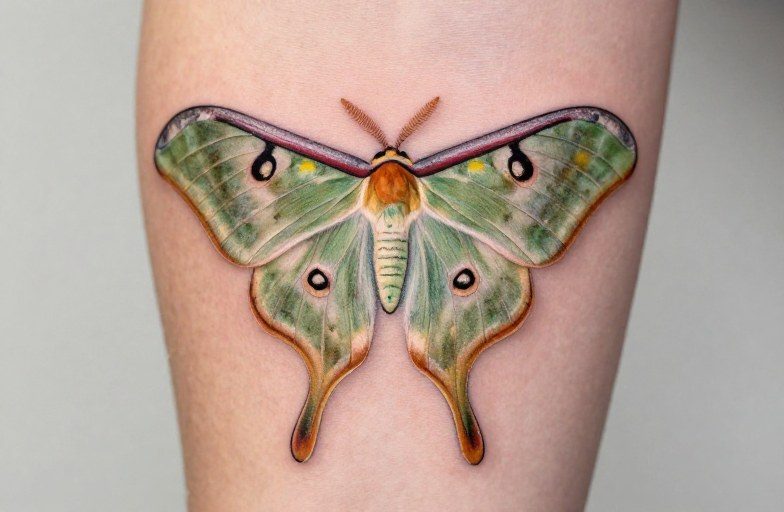
A luna moth tattoo most commonly represents transformation, the briefness of beauty, and an almost magnetic pull toward light, literal or metaphorical. Unlike the death’s-head hawkmoth with its gothic associations, the luna moth carries a softer, more ethereal symbolism tied to renewal and the acceptance of impermanence. People drawn to this design often connect with its adult lifespan of roughly one week, a biological fact that underscores themes of living fully in a short window.
Similar & Related Symbols
Butterflies dominate the transformation tattoo category, yet the luna moth offers a distinct nocturnal counterpoint. Where monarchs and swallowtails signal daytime rebirth and social visibility, moths operate in darkness, attracted to flame, moonlight, artificial porch bulbs. This creates a different symbolic register: intuition over display, shadow work over public renewal.
Moth vs. Butterfly in Tattoo Culture
Butterfly tattoos, especially on shoulder blades and ankles, peaked in the 1990s and early 2000s with a mainstream, feminine-coded aesthetic. Luna moth designs have gained traction more recently, partly through scientific illustration revival and partly through their stranger, less domesticated silhouette. The long, trailing hindwings read as more architectural, less cute. For clients wanting transformation symbolism without the butterfly’s cultural baggage, the luna moth provides an elegant alternative.
Death’s-Head and Other Hawkmoths
The death’s-head hawkmoth, skull pattern on thorax, featured in The Silence of the Lambs, carries overt memento mori energy. The luna moth shares family ties (both are Saturniidae) but diverges sharply in tone. Polyphemus moths, with their eyespot wings, suggest watchfulness and protection. Cecropia moths, the largest North American species, emphasize scale and presence. Luna moths occupy a middle space: noticeable enough to stop you mid-step if one lands on your screen door, yet delicate enough to tear if handled roughly.
- Butterfly: daylight, social transformation, visibility
- Luna moth: nocturnal, private change, attraction to light/danger
- Death’s-head hawkmoth: mortality, warning, pop-culture menace
- Polyphemus moth: protection, observation, defensive symbolism
Mythology & Folklore
Moths in general suffer from symbolic neglect compared to butterflies, often cast as pests or symbols of destructive obsession. The luna moth, named for its moonlike coloration and nocturnal habits, has accumulated gentler associations through its striking appearance rather than ancient myth.
Native American and Regional Lore
Some traditions in the eastern woodlands, where Actias luna ranges, link large silk moths to ancestors or spirits of the recently deceased, messengers rather than threats. The specific luna moth lacks the documented mythological weight of, say, the black witch moth in Latin American folklore, but its ghostly green glow and size (wingspans up to 4.5 inches) inspire reverence in regions where it appears. In parts of Appalachia, spotting one near a home has been considered a sign of upcoming change, neutral to positive rather than ominous.
Scientific Naming and Literary Appearance
Linnaeus classified it in 1758, giving it the luna epithet for the moon. Contemporary poets and novelists have used it as shorthand for fragility, rarity, and the poorly adapted, adult luna moths lack functional mouthparts and cannot eat, living solely to reproduce. This biological detail amplifies its tattoo symbolism: a creature that burns through its reserves without replenishment, committed to its brief purpose.
Who Chooses This Tattoo
The demographic skews toward people in transitional phases, career pivots, recovery from loss, gender transitions, geographic relocations. The luna moth’s week-long adult lifespan resonates with those who have faced mortality directly or who want to mark a period of intense, unsustainable growth that nonetheless produced something necessary.
Common Motivations
Attracting the light carries dual readings: positive aspiration toward knowledge, love, or spiritual truth; and negative self-destruction, the moth-to-flame archetype of pursuing what damages you. Tattoo clients often acknowledge both, wanting the complexity rather than a single upbeat message. The green coloration also appeals to those with nature-witch or cottagecore aesthetics, though the design transcends subculture when rendered in fine-line blackwork or dotwork.
Gender and Placement Patterns
While not exclusively feminine-coded, luna moth tattoos appear frequently on women and nonbinary clients between 25 and 40, often as first or second tattoos rather than heavy collectors’ pieces. The trailing hindwings suit flowing compositions that follow muscle lines, making the design naturally adaptable to bodies with curves rather than forcing a rigid geometric shape.
Best Placements
The luna moth’s elongated wings demand vertical or diagonal real estate. Horizontal placements, across the lower back, across the collarbone, fight the natural wing shape and require distortion that ages poorly.
Vertical and Diagonal Options
Along the forearm’s inner surface, the wings can spread with the body aligned to the radius bone, creating a natural landing posture. The ribcage, following the curve between floating ribs and hip, allows the hindwings to trail toward the waist. Sternum pieces work when the body runs down the centerline and wings extend toward, but not onto, the breasts, preserving readability. Upper thighs provide excellent canvas for larger compositions with botanical elements or moon phases.
Scale Considerations
Too small, and the antennae’s feathered structure blurs into indistinguishable lines within five years. The minimum workable size for recognizable detail sits around 3 inches in wingspan. At 6+ inches, artists can render the eyespots, wing venation, and body segmentation with lasting clarity. Behind-the-ear placements, popular for tiny moths, generally fail for luna moths specifically, their distinctive trailing wings get compressed into a generic blob.
- Forearm inner: readable, moderate visibility, easy to expand into sleeve
- Ribcage/hip: private, follows natural curves, significant pain zone
- Sternum: central, symmetrical, requires careful wing positioning
- Upper thigh: large scale possible, concealable, good for detailed work
- Shoulder blade: wings can span across, but horizontal tendency risks distortion
Religious & Spiritual Angles
No major religion claims the luna moth as primary symbol, which makes it adaptable without doctrinal baggage. Its spiritual resonance emerges from biological fact interpreted metaphorically.
Pagan and Nature-Based Frameworks
In Wiccan-influenced practice, the moon connection aligns with lunar deities and cycles. The green color corresponds to heart chakra work in some New Age systems, though this is contemporary attribution rather than historical tradition. The moth’s complete metamorphosis, egg, caterpillar, pupa, winged adult, maps neatly onto initiation and degree systems in various occult paths.
Christian and Secular Interpretations
Some Christians adopt the luna moth as resurrection symbol, though butterflies dominate that niche. The inability to feed as an adult can read as total dependence on providence, or as a model of single-minded purpose. Secular humanists often gravitate toward the evolutionary poetry: a creature so committed to reproduction that it sacrifices its own sustenance, built by natural selection into something that exists purely to continue.
How It Ages on Skin
Green ink, central to most luna moth tattoos, presents specific aging challenges. Traditional greens containing chromium compounds can shift toward blue or gray as the yellow component fades faster. Modern organic pigments behave differently but vary by manufacturer.
Line Work vs. Shading Longevity
Antennae rendered in fine single-needle lines blur within 3-7 years depending on sun exposure and skin type. The wing edges, if done as hairline outlines without saturation, can disappear into surrounding skin tone. Solid black linework with limited green fill ages more gracefully than full color realism. Dotwork and stippled shading hold definition longer than smooth gradients, which tend to muddy as the ink disperses in dermis.
Color Realism vs. Blackwork Alternatives
Full-color luna moths with yellow eyespots, pinkish wing bases, and pale green bodies look stunning fresh but require touch-up commitment. Black and grey versions with selective white highlights sacrifice species accuracy for longevity. A middle path, black linework with limited green wash in the wings, offers recognizability without demanding frequent maintenance. White ink, often used for wing highlights, yellows or disappears entirely on most skin tones within 2-5 years.
Before You Decide
Research your artist’s healed portfolio, not just fresh photos. Moth wings require precise line confidence; wobbling shows immediately in the symmetrical structure. Ask specifically about their green pigment choices and how those have healed in past clients. Consider whether you want the moth alone or integrated with moon phases, botanical elements, or geometric frames, each choice shifts the symbolic weight and the technical demands. The luna moth’s beauty is inseparable from its fragility; your tattoo should be built to outlast the reference, but the meaning it carries is meant to be lived, not merely displayed.
Frequently Asked Questions
Does a luna moth tattoo always mean someone went through trauma?
Not necessarily. While many choose it after difficult transitions, others connect with its scientific uniqueness, its attraction to light, or simply its visual elegance. The meaning depends on the wearer’s context, not a universal rule.
How much detail can actually fit in a small luna moth tattoo?
Less than most reference photos suggest. Below 3 inches wingspan, the feathery antennae and wing veins merge into solid shapes. If you want small, simplify to silhouette or bold linework rather than attempting realistic detail.
Will the green color look the same on darker skin tones?
Green ink reads differently across skin tones, often brighter on pale skin, sometimes muted or ashier on melanin-rich skin. Experienced artists adjust pigment selection and saturation levels; this is a conversation to have during consultation, not a limitation.
Can a luna moth tattoo work in a traditional or neo-traditional style?
Yes, though it requires adaptation. The natural moth’s soft edges and trailing wings get reinterpreted with bolder outlines, limited color blocks, and stylized proportions. Not every artist comfortable with realism handles this translation well, ask to see specific moth examples in their preferred style.
Related Tattoo Meanings
One response to “Luna Moth Tattoo Meaning: Transformation, Light, and Impermanence”
[…] Luna Moth Tattoo Meaning: Transformation, Light, and Impermanence […]


Leave a Reply