A phoenix tattoo means rising again after total destruction. The core symbol is straightforward: the bird burns, dies, and returns from its own ashes. People get this after divorce, addiction recovery, career collapse, loss, or any moment where they had to rebuild from nothing. The meaning is rebirth, but the edge is that rebirth required the fire first.
Mythology & Folklore
The phoenix crosses cultures more than most mythic creatures, though details shift dramatically. Understanding these roots helps explain why the tattoo carries different weight for different people.
Greek and Roman Sources
Herodotus described a bird in Arabia that lived 500 years, built a nest of spices, and ignited itself. The young phoenix emerged from the ashes. Roman adaptation added the detail of the bird flying to Heliopolis to deposit its father’s remains, introducing filial duty and pilgrimage into the cycle. This version emphasizes that rebirth isn’t solitary; it carries the past forward.
Eastern Parallels
The Chinese fenghuang and Japanese hō-ō are often linked to phoenix symbolism, though they’re distinct creatures. The fenghuang represents virtue and grace, appearing only during just rule. The hō-ō descends from heaven to mark new eras. These associations sometimes blend into Western phoenix tattoos, adding layers of moral renewal or epochal change that the Greek version lacks.
Similar & Related Symbols
The phoenix sits in a family of destruction-and-renewal imagery. Knowing the alternatives clarifies why someone might choose the bird over another symbol.
- Ouroboros: Snake eating its tail, cyclical renewal without the fire trauma. More abstract, less narrative.
- Lotus: Rises from mud, blooms clean. Gentler rebirth, no destruction required. Often paired with phoenix in Eastern-influenced designs.
- Butterfly: Transformation through stages, not catastrophe. More about growth than survival.
- Broken clock or hourglass: Time and mortality, no renewal. Sometimes combined with phoenix to mark “time ran out, then started again.”
- Resurrection imagery (cross, rising Christ): Direct religious parallel, but loaded with specific doctrine the phoenix avoids.
The phoenix differs in requiring active, violent self-destruction. A lotus doesn’t choose the mud. A phoenix, in most versions, builds its own pyre.
Common Variations & Styles
How the bird gets rendered changes the tattoo’s emotional register significantly.
Traditional/American
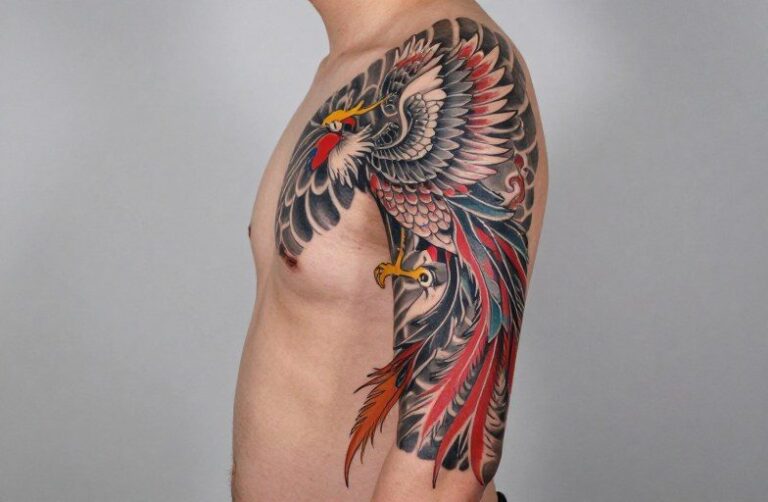
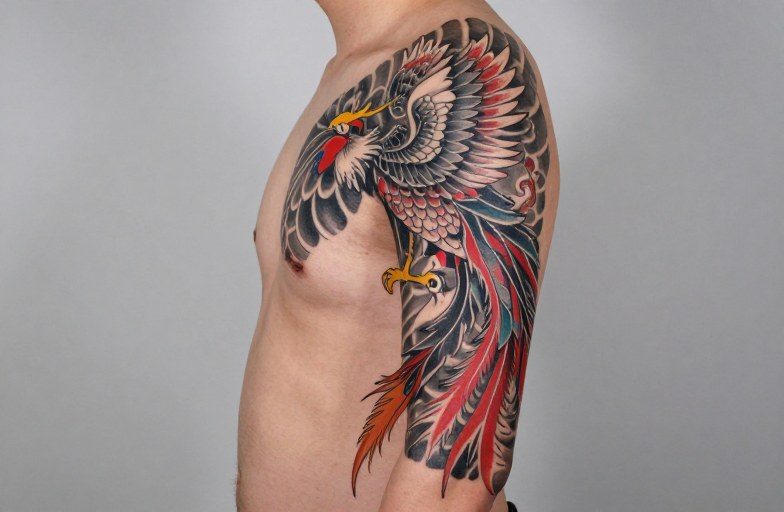
Bold lines, limited color palette, the bird often mid-flight with flames trailing. Readable from distance, ages well because of heavy linework. The traditional style tends to emphasize triumph over tragedy, less agony, more victory lap. Good for people who want the symbol without visual darkness.
Realistic/Neo-Traditional
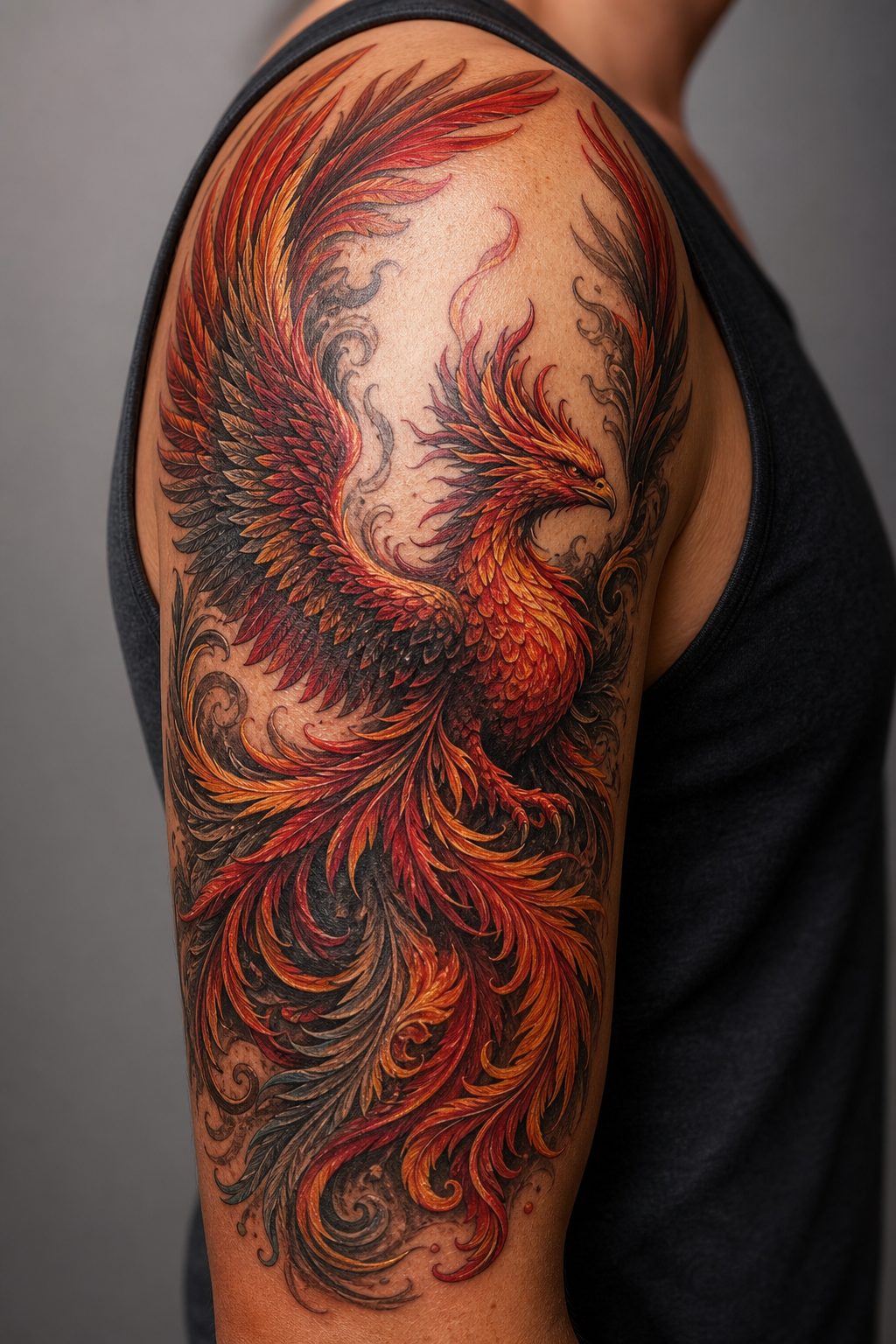
Feather detail, dynamic poses, full color. The bird might be actively burning, flames consuming wing feathers, smoke in the background. This version doesn’t look away from the pain. Requires more skin real estate to read properly; small realistic phoenixes turn to mush as ink spreads.
Geometric and Abstract
Silhouette filled with flame patterns, or the bird constructed from triangles and negative space. Often blackwork or limited palette. Strips away narrative for pure symbol. Ages extremely well if lines are bold enough; fine geometric detail in feathers blurs within five years.
Phoenix Paired With Other Elements
- Clock or date: Marks the specific moment of “death” and rebirth.
- Names or script: Risky, attaching a person to a symbol of destruction and return can read strangely if the relationship sours.
- Compass or map: Direction after being lost.
- Opposite elements (water, ice): Visual contrast, but symbolically muddies the fire-rebirth logic unless the artist knows how to integrate them.
How It Ages on Skin
Phoenix designs have specific aging challenges because of their typical elements.
Fire and smoke effects are usually rendered with soft gradients and fine lines. These are the first things to degrade. A red-to-yellow gradient in 2024 becomes a single muddy orange by 2034. Black linework defining the bird’s actual form holds; the atmospheric effects around it don’t. If the tattoo’s impact depends on flames, plan for touch-ups or design around the limitation.
Feather detail is another aging trap. Individual barbs drawn too fine, common in realistic styles, spread into indistinct texture. The bird becomes a brown or red blob. Bold outlines between feather groupings preserve readability. A phoenix that reads clearly at ten years probably sacrificed some feather realism for structural clarity.
Color choice matters practically. Red ink has a reputation for faster fading, though modern pigments have improved. Yellow and orange need warm undertones in skin to pop; on very cool or deep skin tones, they can look ashy without enough saturation. Experienced artists adjust for this rather than using the same palette on everyone.
Placement affects aging too. A phoenix on the ribs or stomach stretches with weight change, distorting the wing geometry. Upper arm, thigh, back, more stable canvas.
Religious & Spiritual Angles
The phoenix predates Christianity but got adopted early. Clement of Alexandria and Tertullian used it as proof of resurrection doctrine. Some early Christian tomb art includes phoenix imagery. This history means the tattoo can read as explicitly Christian to some viewers, even if the wearer intended something broader.
Christian Rebirth
For believers, the phoenix can parallel baptism, death of the old self, emergence new. The fire becomes purifying rather than destructive. Crosses integrated into the design make this explicit. The symbol works here because it’s pre-Christian, avoiding the cliché of directly illustrating scripture.
Secular and Eclectic Spirituality
Outside doctrine, the phoenix functions as a personal symbol of survived trauma. No divine intervention required. The fire is literal hardship: illness, bankruptcy, betrayal, addiction. The ashes are the aftermath. The return is self-willed or simply endured. This interpretation is probably the most common among actual tattoo clients, and it requires no supernatural framework.
Some trace alchemical connections, the phoenix as the “red king” or completion of the magnum opus. This is less commonly requested but shows up in esoteric circles. The alchemical phoenix is less about personal trauma and more about achieved transformation, often integrated with other hermetic symbols.
Best Placements
The phoenix is a vertical, ascending form. Wings spread, tail trailing fire, head up. This shape dictates placement more than most designs.
- Full back: The classic. Wingspan across shoulder blades, tail down the spine. Allows full narrative pose, rising, burning, both. Maximum detail possible. The canvas matches the ambition of the symbol.
- Thigh (front or outer): Vertical space for a rising pose without the commitment of a back piece. Less painful than ribs, easy to show or conceal. Good for medium detail.
- Upper arm to shoulder: Wing extending across deltoid, body on outer arm. The wrap creates movement. Limited vertical space means a more compact pose, often coiled rather than fully extended.
- Ribs/side: Vertical, but extremely painful and prone to distortion with breathing and body change. The phoenix’s long tail follows the rib line naturally. Only recommended if you’ve tested your pain tolerance elsewhere.
- Chest: Asymmetrical, bird emerging from one side, flames across sternum. High visibility, significant pain on sternum bone. The heart-under-fire reading is available here, sometimes wanted, sometimes too obvious.
- Forearm: Small canvas. Simplified silhouette or head-and-flames only. Full phoenix on forearm usually looks cramped and ages poorly.
Flow matters. A phoenix facing downward or horizontal reads wrong, defeated, or at least static. The pose should ascend, even in compact placements.
The Takeaway
The phoenix tattoo works because the symbol is structurally honest about recovery. It doesn’t pretend the fire didn’t happen. The ashes are part of the image. The return is visible only because the destruction was total.
That honesty is why it persists. People choose it after genuine collapse, not mild inconvenience. The tattoo’s visual drama, flames, wings, rising motion, matches the emotional weight of what it’s marking. A smaller, quieter symbol wouldn’t carry it.
Get it big enough to read, simple enough to age, and specific enough to mean your particular fire. The phoenix is common; your reason for rising isn’t. The tattoo should hold both.
Frequently Asked Questions
Does a phoenix tattoo always mean someone went through trauma?
Not always, but usually. The symbol’s structure requires destruction before rebirth. Some people get it preemptively or for aspirational reasons, but the core meaning is surviving and returning from something that burned you down.
What’s the difference between a phoenix and a firebird tattoo?
The firebird is specifically Slavic folklore, Russian, mostly, associated with a glowing feather that brings trouble and adventure. Visually similar, but the narrative is about pursuit and consequence, not self-immolation and return. Tattoos of the two often look identical, so the distinction is in the wearer’s intent.
How much does a detailed phoenix sleeve or back piece typically cost?
A full-back realistic phoenix with color runs multiple sessions at several hundred dollars per session, often totaling in the thousands. Simpler black-and-grey designs or smaller pieces cost less. The range is enormous based on artist reputation, location, and detail level. Consult specific artists for quotes.
Can a phoenix tattoo be cover-up friendly?
Yes, unusually so. The flames and smoke surrounding the bird are natural cover-up elements, dark, irregular, forgiving of existing ink underneath. Many phoenixes are intentionally designed to incorporate and transform older tattoos they replace, which fits the symbolism neatly.