A moth tattoo most commonly represents attraction to light against darkness, transformation through life stages, and the acceptance of mortality. Unlike the butterfly’s cheerful rebirth symbolism, the moth carries an edge of fatal devotion, drawn to flame even at the cost of burning. That tension between beauty and danger gives moth tattoos their lasting power.
Mythology & Folklore
Across cultures, moths slip through the boundary between worlds. Their nocturnal nature and powdery, easily damaged wings made them natural symbols for the fragile and the otherworldly.
European Folk Beliefs
In British and Irish folklore, a moth entering the house often carried a soul, sometimes a living person’s spirit wandering, sometimes a ghost returning. The death’s-head hawkmoth, with its skull-like thoracic marking, became particularly ominous. Victorian mourning culture embraced this unease; the moth appeared on memorial jewelry and, later, as tattoo imagery for those who wanted to wear their fatalism visibly.
Japanese Traditions
Japanese folklore links moths to restless spirits and obsessive love. The phrase “like a moth to a flame” translates directly into warnings about destructive passion. Some regional stories describe moths as transformed souls of women who died from unrequited love, giving certain moth designs a specifically feminine, tragic resonance that still appeals in contemporary Japanese tattooing.
Personal & Modern Meanings
Today’s collectors gravitate toward moth imagery for reasons that split roughly into two camps: those drawn to the transformational narrative, and those who identify with the self-destructive pursuit.
Transformation and Growth
The complete metamorphosis, egg, larva, pupa, adult, offers an honest symbol of ugly becoming beautiful, of hidden change. Luna moths, with their pale green wings and long tails, dominate this interpretation. They’re short-lived as adults (roughly one week), which adds urgency: the transformed self has limited time to exist in its final form. This resonates with people who’ve undergone major identity shifts, recovery, gender transition, career abandonment, and want to mark the finite nature of their new chapter.
Fatal Attraction and Risk
The moth’s compulsion toward light despite destruction speaks to addictive personalities, to artists who burn out young, to anyone who recognizes their own self-damaging drive toward intensity. This isn’t romanticized; it’s an honest acknowledgment. The flame doesn’t love the moth back. Death’s-head hawkmoths work best here, the skull marking removes any ambiguity about the outcome.
Religious & Spiritual Angles
Moths appear in sacred texts and practices with consistent ambiguity: they’re either seekers of divine truth or examples of misguided devotion.
Christian Symbolism
The biblical moth as destroyer of stored treasure (Matthew 6:19, James 5:2) represents the corruption of earthly goods. But this destruction also points toward the necessity of spiritual over material investment. Some Christian collectors use moth imagery to mark renunciation of wealth or status. The creature that ruins your hoarded grain becomes, paradoxically, a teacher about impermanence.
Gnostic and Esoteric Traditions
Gnostic texts sometimes describe the material world as darkness and the divine as light; the soul’s journey resembles the moth’s ascent. This differs from the fatal interpretation, the flame becomes salvation, not destruction. Thelema and certain ceremonial magic traditions adopted the moth (and butterfly) as symbols for the psyche’s emergence from material constraint. These connections explain why moth imagery appears frequently alongside esoteric symbols: eyes, moons, geometric mandalas.
History & Cultural Roots
Tattooed moth imagery has specific historical concentrations rather than universal ancient practice.
Sailor tattoos of the early-to-mid twentieth century occasionally included moths, though less commonly than swallows or butterflies. The meaning was often practical superstition: moths navigate by moonlight, so a moth tattoo supposedly helped a sailor find his way home. This is commonly associated with, though not exclusive to, British and American naval traditions.
Japanese irezumi incorporated moths more frequently, often alongside skulls or as standalone pieces on the back or upper arm. The yakuza adoption of full-body suits included moth imagery for members who wanted to mark personal transformation or, conversely, destructive loyalty to the organization.
The 1990s and 2000s saw moth tattoos surge in alternative and goth subcultures, partly through the influence of films like The Silence of the Lambs (1991), which featured the death’s-head hawkmoth prominently. This pop-culture moment permanently shifted the moth’s tattoo association toward the macabre and psychological.
Design Tips & Pairings
Placement and pairing choices dramatically shift how a moth tattoo reads.
Placements That Work
- Throat or neck: High visibility matches the moth’s vulnerability; the creature has nowhere to hide. Line-heavy designs work best here since throat skin ages and stretches unpredictably.
- Hands and fingers: Small, simple moth silhouettes survive the heavy wear and frequent sun exposure of hand placement. Detailed shading fades fast here.
- Ribcage and sternum: The body’s central axis suits the moth’s bilateral symmetry. Sternum pieces can incorporate the flame or light source directly below the moth, creating narrative composition.
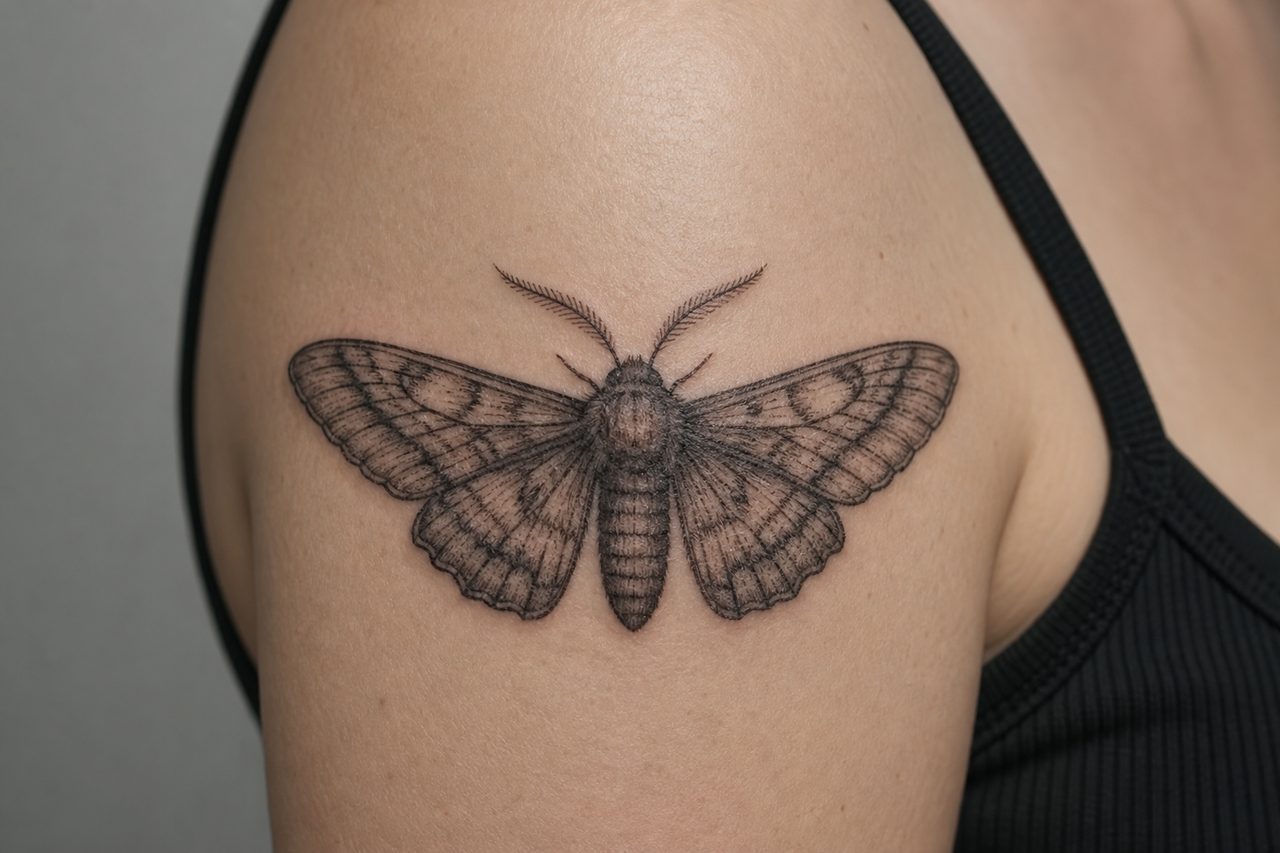
- Upper arm and shoulder: Enough flat surface for detailed wing venation. The natural curve of the deltoid can follow the moth’s wing shape.
Common Pairings
Flames or candles beneath the moth complete the narrative, what it’s drawn toward. Skulls, particularly with death’s-head hawkmoths, reinforce mortality. Moon phases above or behind the moth emphasize nocturnal cycles and feminine energy. Broken lightbulbs or burnt wicks subvert the expectation, suggesting the moth arrived too late or the attraction was already extinguished.
Botanical elements like night-blooming flowers (evening primrose, moonflower) ground the moth in its actual ecology rather than pure symbolism. This approach appeals to collectors who want natural history accuracy alongside personal meaning.
Color vs Black and Grey
The choice between color and monochrome affects both immediate impact and long-term appearance.
Color Realism
Luna moths demand pale green and yellow to read correctly; the species has no other coloration. Madagascar sunset moths offer iridescent options, blues, oranges, golds, that translate beautifully to tattoo but require an artist experienced with color saturation. These bright pigments fade faster than black, especially on areas with sun exposure. Expect touch-ups within 3-5 years for color moth tattoos on arms, hands, or lower legs.
Black and Grey
The death’s-head hawkmoth works almost exclusively in black and grey; its natural colors are muted browns and greys anyway. This palette ages more gracefully, with softer edges that blur slightly rather than turning muddy. High-contrast blackwork moths, solid black silhouettes with white highlight dots, remain readable for decades but offer less nuance in wing texture. Dotwork and stippling can suggest the powdery quality of moth wings without relying on fine lines that will spread over time.
Red accents (a single flame, eyes, or the thoracic skull marking) in an otherwise black and grey piece create focal points without the maintenance burden of full color. This compromise has become increasingly common in contemporary moth tattooing.
The Takeaway
Moth tattoos carry weight because they refuse simple positivity. The same image can mean transformation or self-destruction, spiritual seeking or misguided obsession, depending on species choice, pairing elements, and placement. The death’s-head hawkmoth on a throat reads as confrontation with mortality; the luna moth on a ribcage suggests private, fragile change. Neither is wrong; neither is the “real” meaning. What matters is specificity, knowing which moth, which light source, which outcome you’re choosing to wear. The best moth tattoos don’t just depict the insect; they stage the moment before contact, the suspended choice between flight and flame.
Frequently Asked Questions
Does a moth tattoo always mean death or something negative?
No. Luna moths and similar species emphasize transformation, growth, and the beauty of brief adult life. The meaning depends heavily on which species you choose and what you pair it with. A moth with a growing plant reads very differently than a moth with a skull.
What’s the difference between a moth and butterfly tattoo meaning?
Butterfly tattoos generally emphasize joyful rebirth, daylight, and social visibility. Moth tattoos carry more nocturnal, solitary, and potentially self-destructive associations. The butterfly’s transformation is celebrated; the moth’s is often complicated by its fatal attraction to light.
How well do detailed moth tattoos age over time?
Fine wing venation and antennae details tend to blur and soften within 5-10 years, especially on high-movement areas like elbows, wrists, or ribs. Simpler silhouettes and bolder contrast last longer. For detailed pieces, choose flatter, more stable skin like the upper arm or thigh.
Is the death’s-head hawkmoth tattoo connected to The Silence of the Lambs?
The film’s poster and imagery permanently popularized this species for tattooing, but the moth’s symbolism predates the movie by centuries. Some collectors choose it specifically for the film reference; others for its traditional associations with death and the supernatural. The meaning depends on your personal intent.