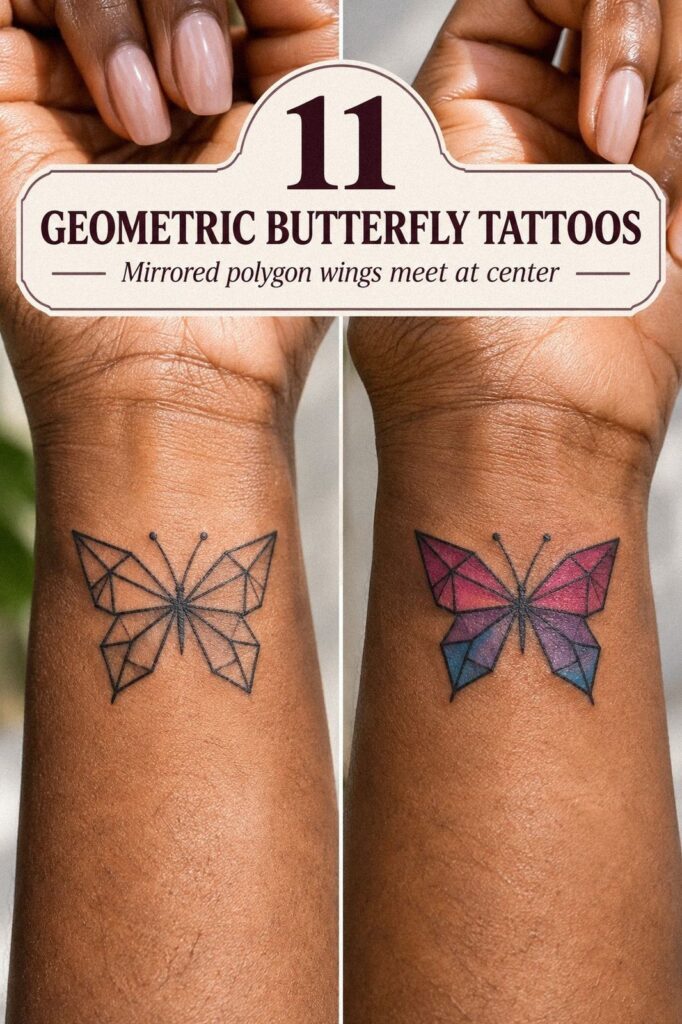
The short answer: geometric butterfly tattoos age best when the design has clear spacing, a readable silhouette, and enough black ink to support the fine details. I learned that after watching tiny lines blur together on a rushed piece. You want a striking tattoo that still feels meaningful years later. Placement matters.
My honest rule is simple: choose the strongest shape before chasing intricate decoration. A crisp, personal design can be more valuable than an ornate one that loses its structure as it heals.
- Small Geometric Butterfly Tattoo On The Wrist
- Intricate Geometric Butterfly Tattoo With Fine Linework
- Unique Geometric Butterfly Tattoo Behind The Ear
- Bold Geometric Butterfly Tattoo Across The Shoulder
- Minimal Geometric Butterfly Tattoo On The Ankle
- Geometric Butterfly Tattoo With Sacred Symmetry
- Colorful Geometric Butterfly Tattoo On The Forearm
- Geometric Butterfly Tattoo Framed By Dotwork
- Delicate Geometric Butterfly Tattoo Along The Collarbone
- Geometric Butterfly Tattoo With Abstract Wing Shapes
- Meaningful Geometric Butterfly Tattoo On The Ribcage
1Small Geometric Butterfly Tattoo On The Wrist
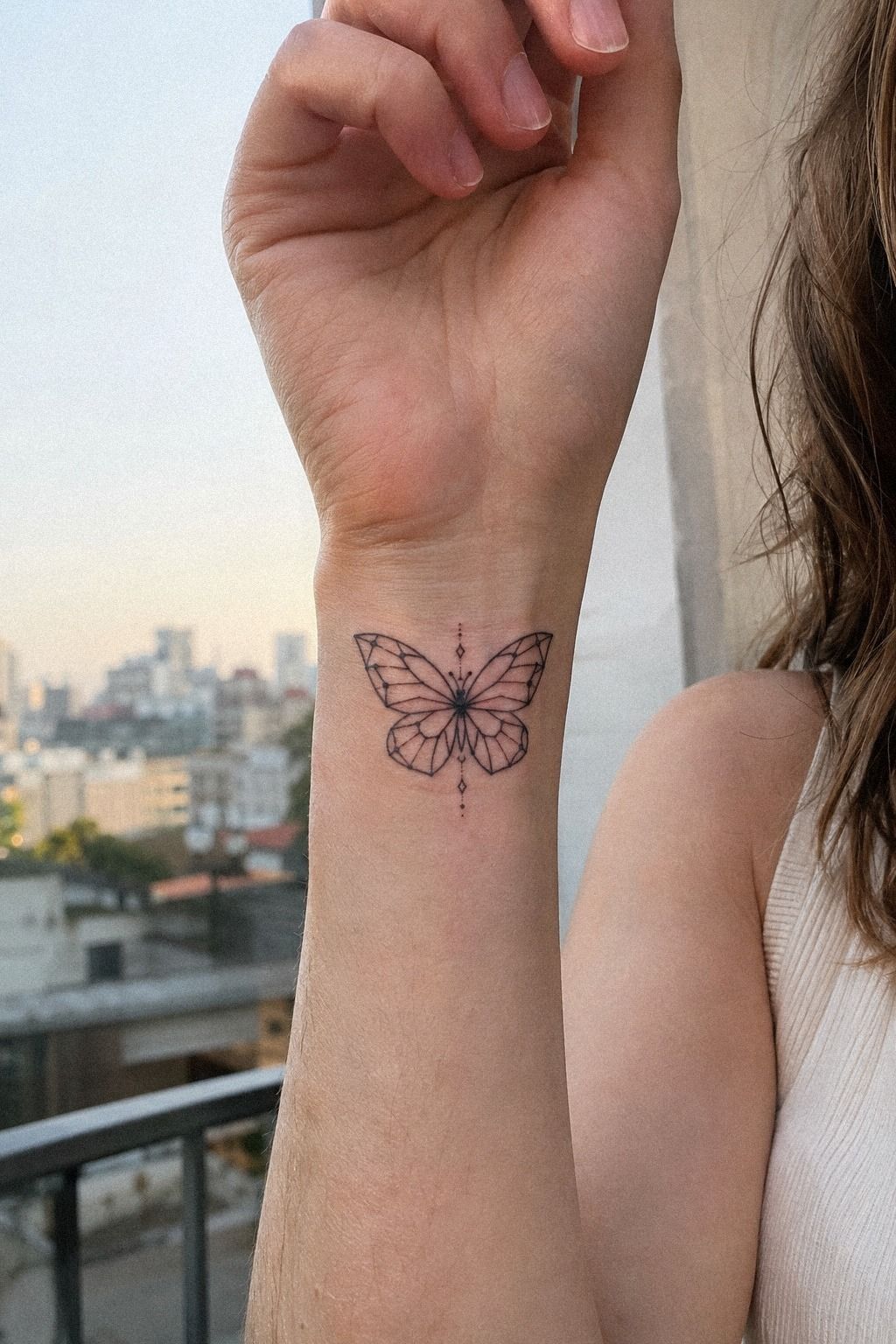
A small wrist butterfly works when you keep the wing structure crisp and the center compact. A terracotta, stone, and olive palette can create sharp contrast without needing heavy shading.
I’d choose symmetrical open wings, two or three interior triangles, and a clean lower body. That keeps your design minimal but still expressive.
Your wrist moves constantly, so overcrowded details won’t stay as readable as they first appear. Ask your artist for breathing room between the outer contour and the inner geometry.
A fine-line needle can create delicate angles, but your artist should balance it with one stronger outline. That contrast helps the butterfly remain recognizable.
I’ve seen tiny wrist pieces look polished at first and muddy later because the wings were packed with micro-lines. Don’t copy that approach. A crisp diamond, a narrow negative-space channel, and one small circle can feel more meaningful than twenty decorative marks.
A practical wrist shortlist might include:
– Open symmetrical wings with a narrow center. – A single-needle outline with one bold anchor. – Terracotta, stone, and olive ink accents. – A discreet vertical orientation.
If you’re comparing sizes, start with these geometric small butterfly tattoo ideas. Your wrist can handle a stylish piece, but it won’t forgive a design that’s too dense. This is a powerful first option!
2Intricate Geometric Butterfly Tattoo With Fine Linework
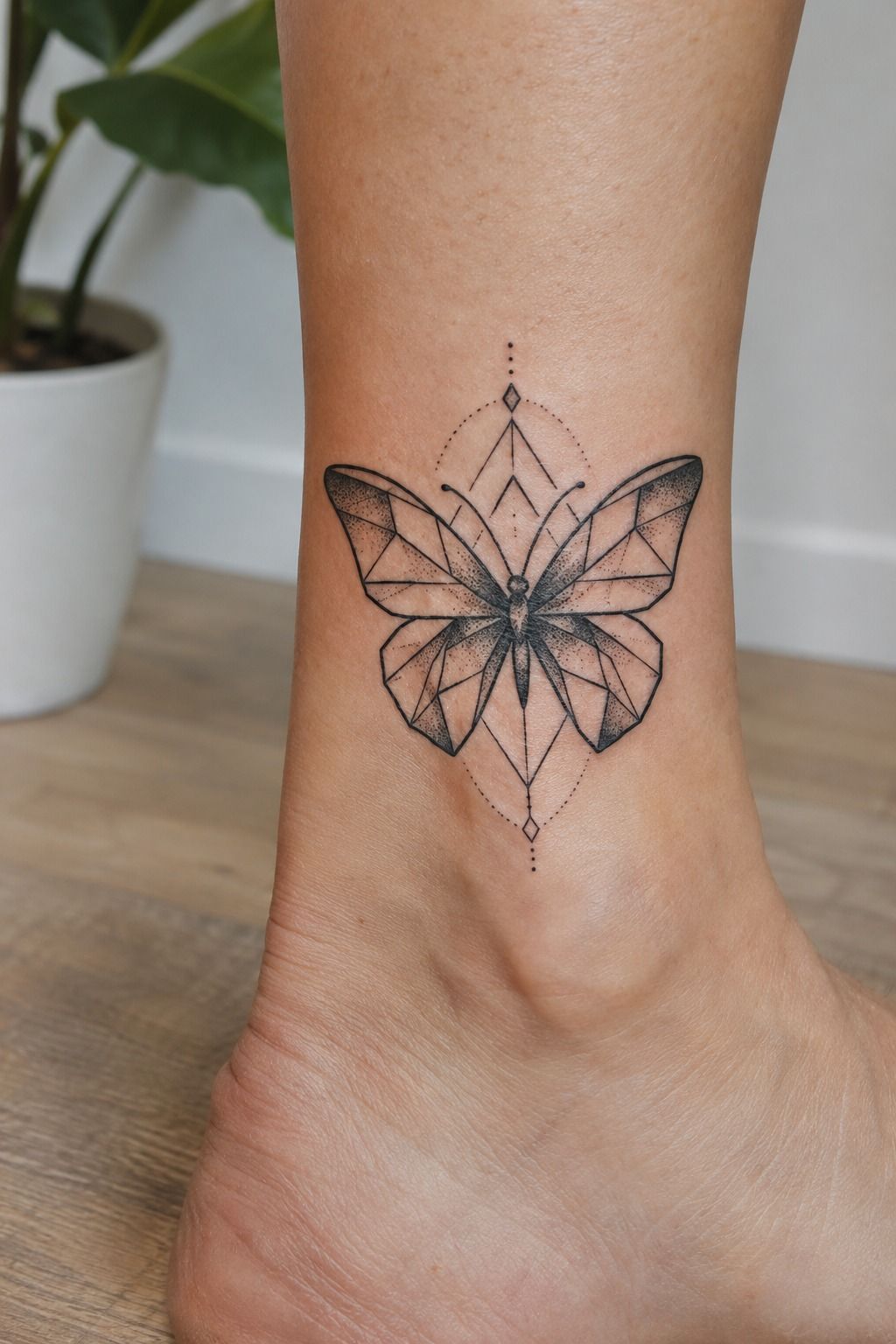
Fine linework makes an ankle butterfly feel intricate without turning it heavy. A clay, linen, and aged-brass palette can keep the design delicate while giving each geometric facet a graceful sense of separation.
3Unique Geometric Butterfly Tattoo Behind The Ear
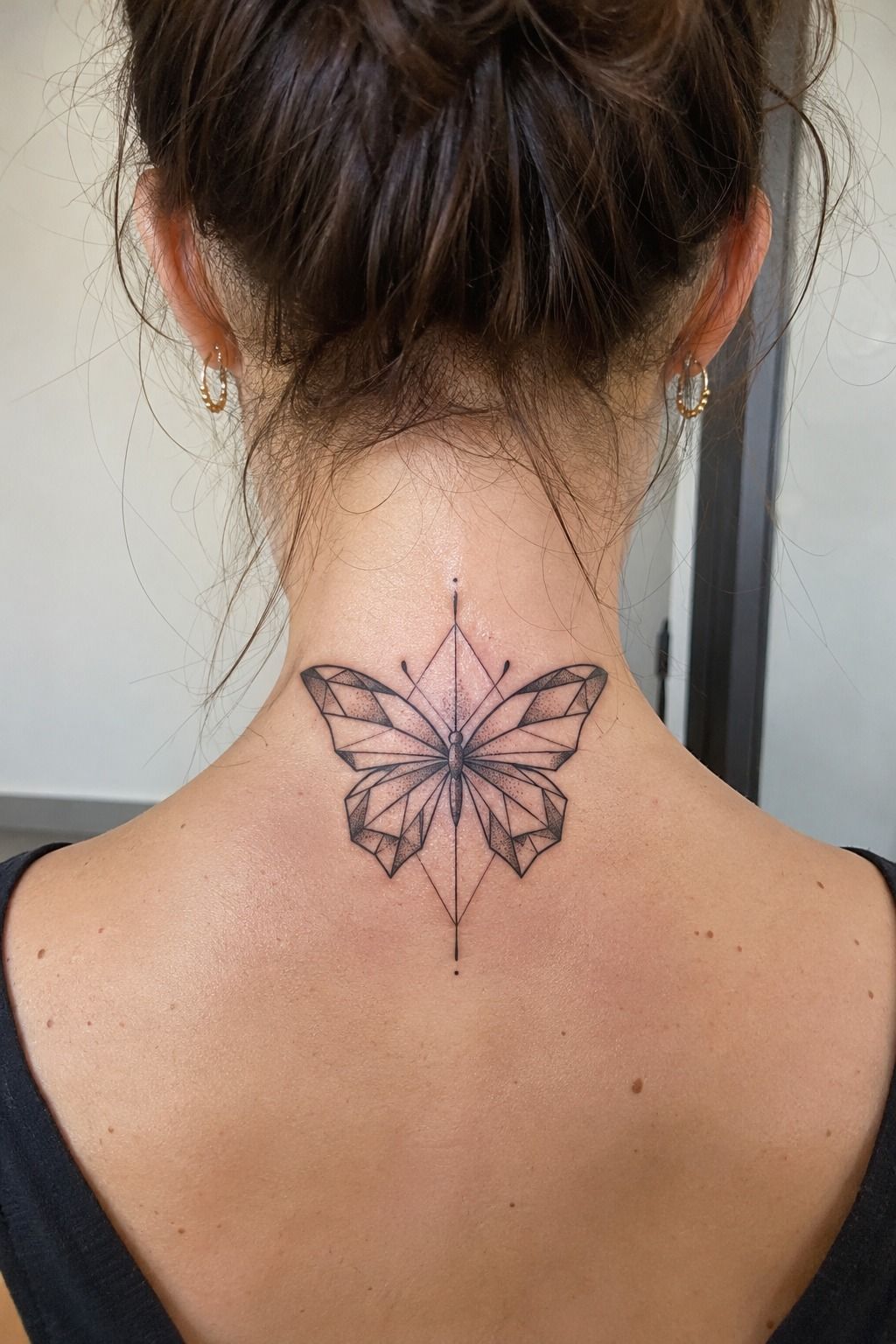
Behind the ear is a discreet placement, but the design still needs a bold silhouette. A plum, grey, and rose-gold palette gives the butterfly a unique profile without making the shape feel aggressive. I’d choose a compact design with one symbolic center mark.
The skin behind your ear curves, and that curve can distort a perfectly flat stencil. Your artist should adjust the wing angle while the stencil is on your body, not simply press down a paper drawing and hope for the best. A plum center line gives the design structure, while small open spaces keep it from becoming a dark spot.
This placement suits you if you want something personal that won’t be visible in every setting. It can still feel empowering when you catch it in a mirror.
Because the area is small, you’ll want to avoid excessive ornamental detail. A few clean facets will age more gracefully than a crowded mandala.
Ask for:
– A compact open-wing silhouette. – One geometric stencil adjusted to your ear’s curve. – A short lower body. – Minimal dot accents near the wing tips.
You can compare more unusual layouts in this collection of unique geometric butterfly tattoo ideas. Your artist’s stencil adjustment matters more here than adding another layer of detail. The result should feel intimate, polished, and unmistakably yours.
4Bold Geometric Butterfly Tattoo Across The Shoulder
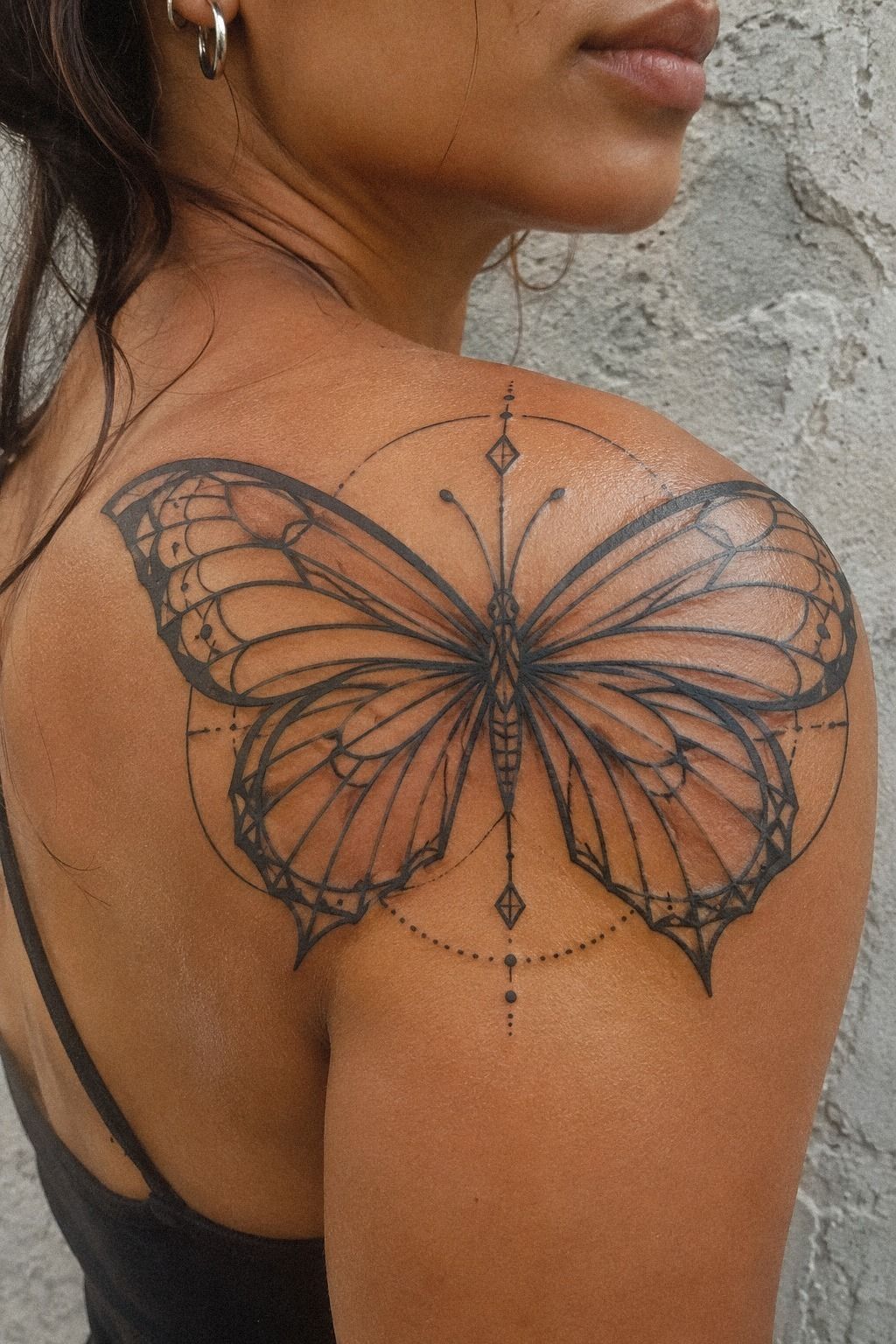
A shoulder butterfly gives you more surface area, so you can make the geometry bold without losing elegance. Navy, white, and walnut-brown tones create a classic contrast that keeps the wings recognizable.
5Minimal Geometric Butterfly Tattoo On The Ankle
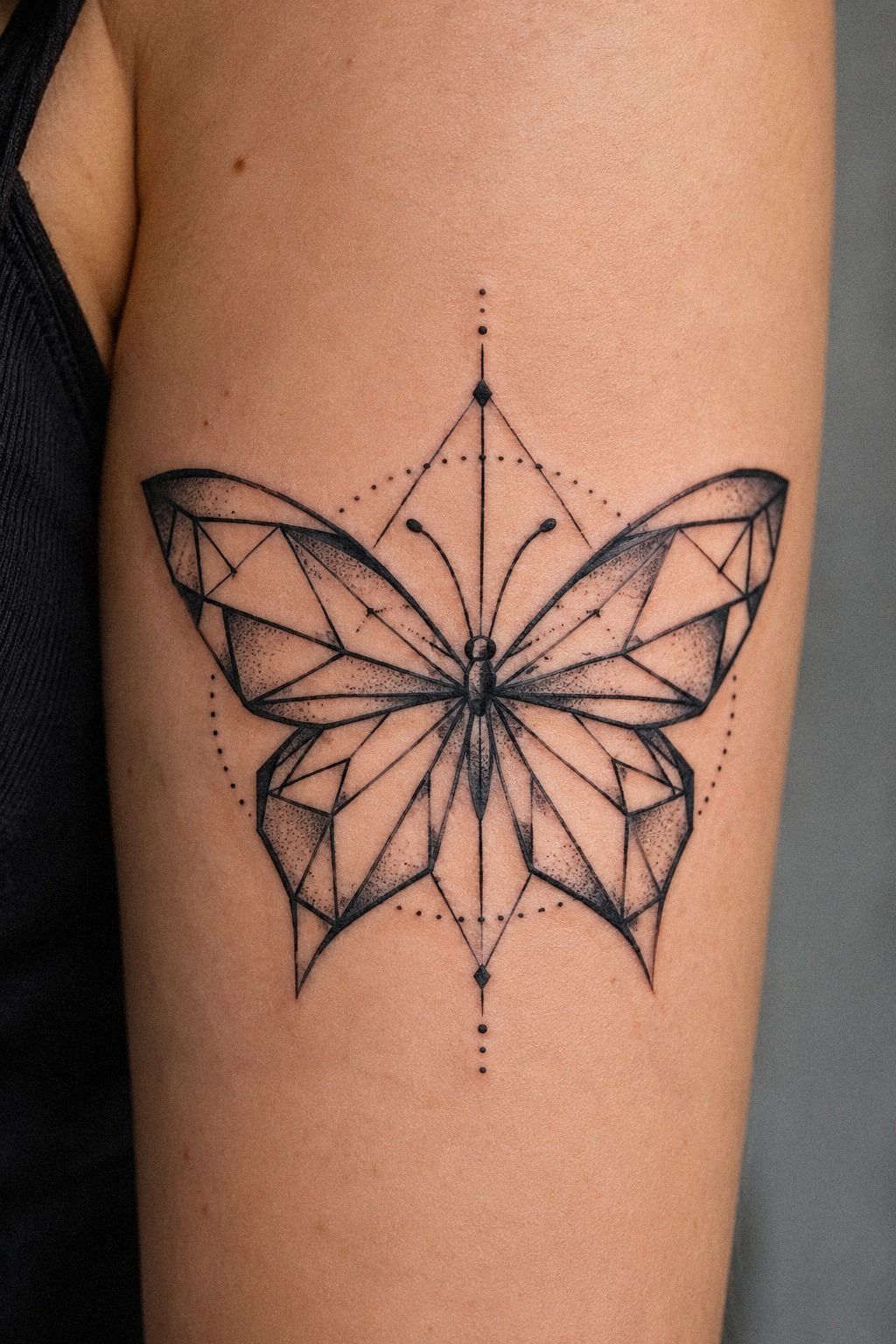
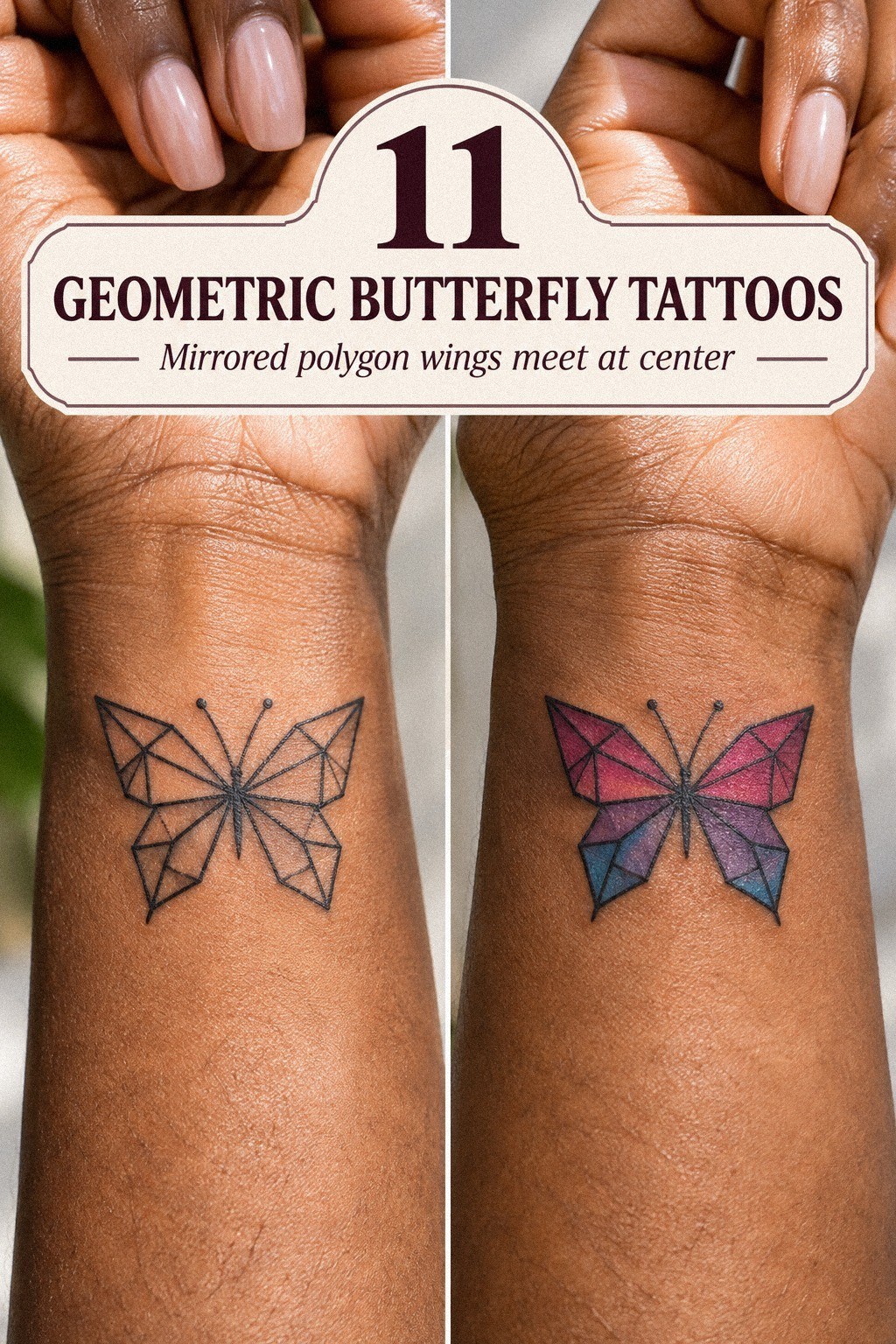
A minimal ankle butterfly should rely on shape rather than decoration. The flash-sheet concept works because several clean geometric options can be compared before you commit.
On paper, look for a design with a clear center, open wings, and enough space between the lines. Your favorite sketch may need to grow slightly on skin.
I’d choose a crisp diamond-based butterfly with one circle at the thorax and no more than four interior wing divisions. Emerald, gold, and cream accents can make that structure feel vibrant without overwhelming it. A full-size stencil can reveal whether the design still reads when you view it from several steps away.
The ankle can be delicate and stylish, but it’s also exposed to friction. If you wear boots daily, tell your artist before choosing the exact placement.
Don’t put the finest wing tip where your shoe repeatedly rubs. Your aftercare will be easier if you can keep that area clean and protected.
A practical shortlist might include:
– A minimal geometric outline. – A tiny symmetrical butterfly. – A narrow vertical option. – A version with one bold center triangle.
For more printable inspiration, save these geometric butterfly tattoo stencil options. You’ll get a dainty result, but it won’t feel forgettable if the proportions are deliberate.
6Geometric Butterfly Tattoo With Sacred Symmetry
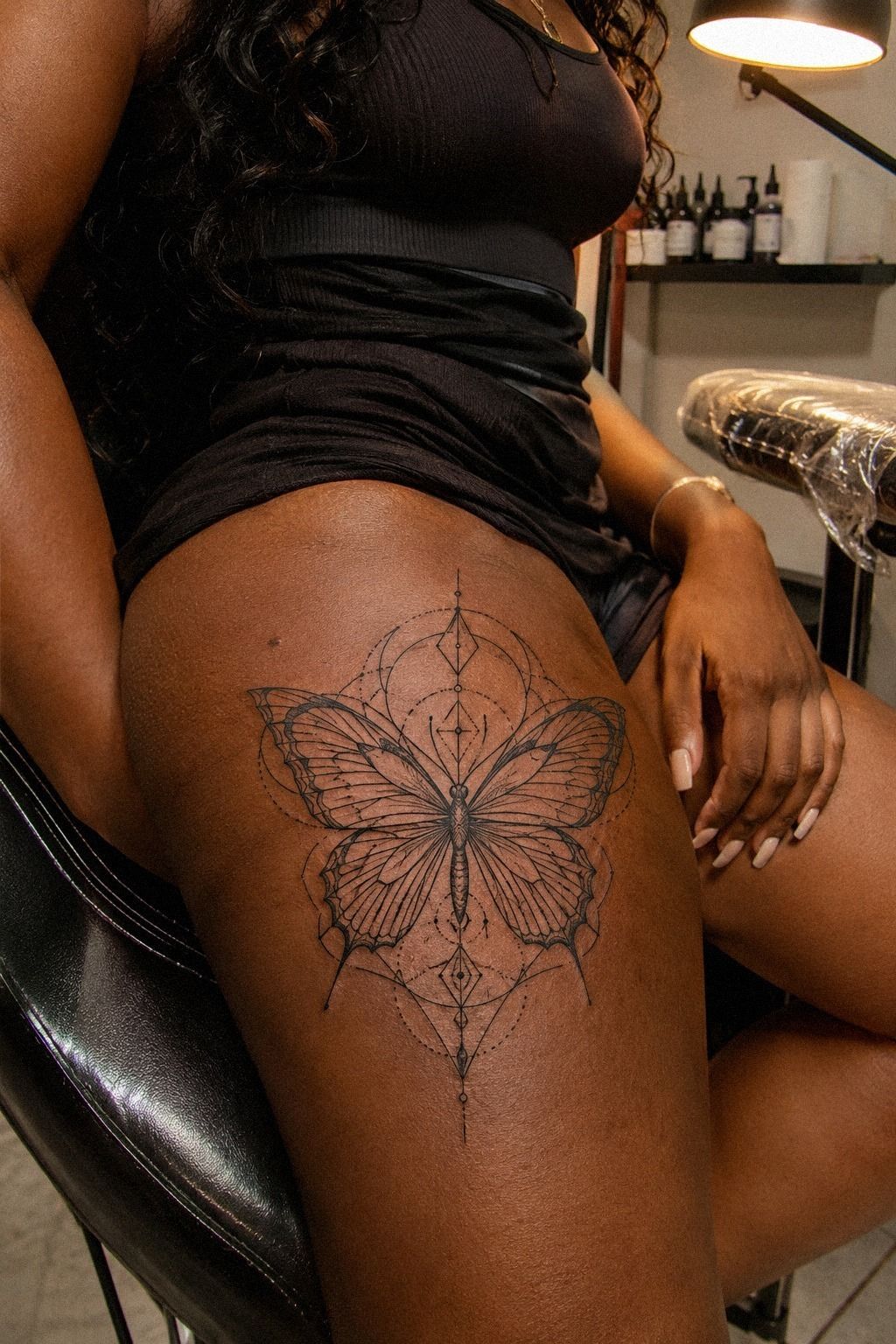
Sacred symmetry gives a thigh butterfly a more meaningful visual language. Forest green, rust, and natural-oak tones can make the design feel powerful while preserving its graceful balance.
7Colorful Geometric Butterfly Tattoo On The Forearm
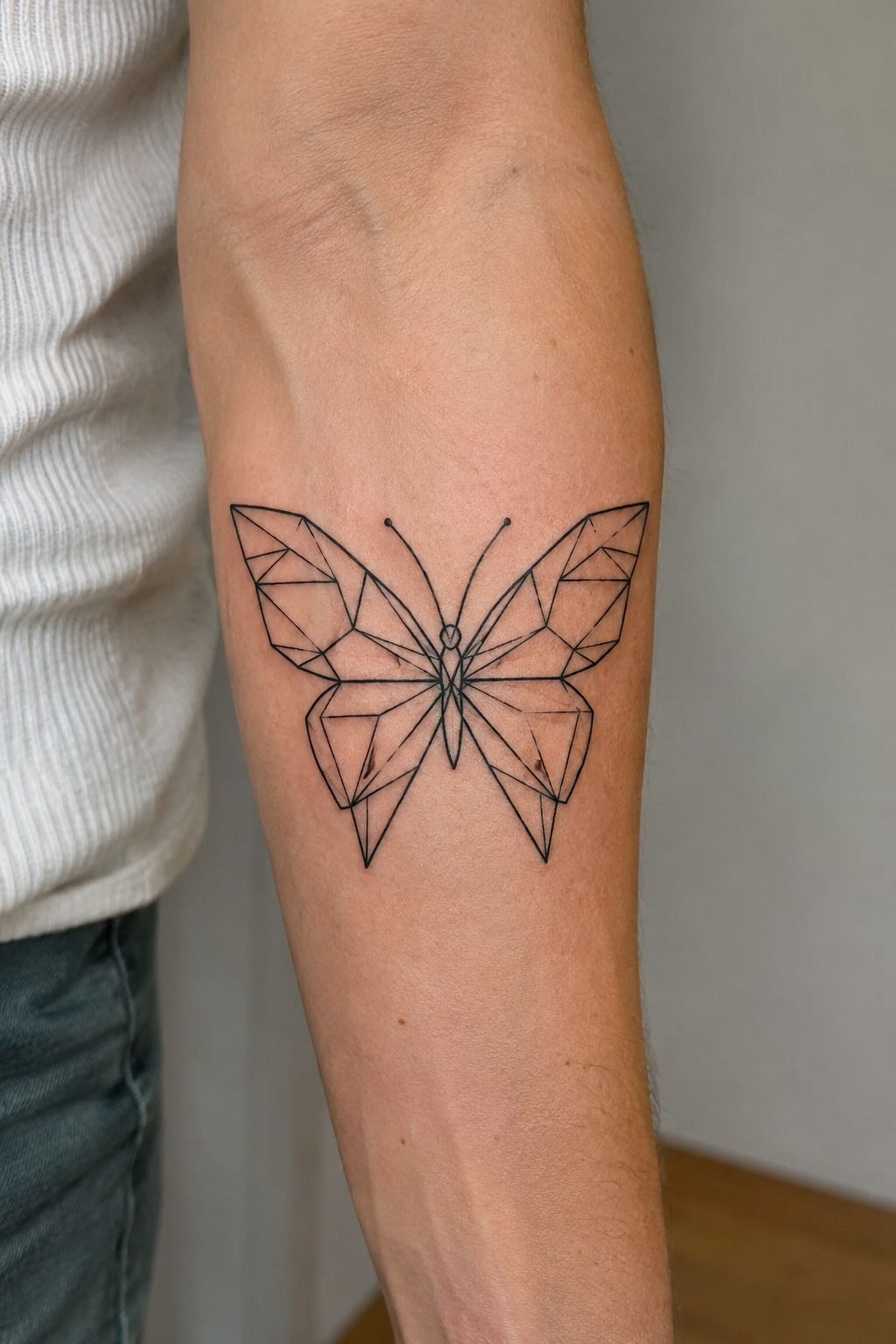
Color can make geometric wings feel vibrant, but it needs a clear structure underneath. A dusty-rose, charcoal, and brass palette can sit inside crisp sections without losing the butterfly silhouette. I’d use one main color, one supporting shade, and a small untouched area so the design doesn’t become visually noisy.
A dusty-rose accent could anchor the upper wings, while charcoal defines the central structure and brass warms selected facets. Your artist should test how the colors interact with the linework before starting. I’d skip a rainbow effect across every segment.
It sounds playful, but too many competing colors can flatten the geometry.
Your forearm is visible, which makes it a good placement for a design you want to enjoy often. It’s also a useful area for checking whether your artist’s lines stay steady over a longer section. If you’re nervous, ask to see a stencil at the exact size and angle you’ll wear it.
Try this color plan:
– Charcoal outline with open negative space. – Dusty rose pigment in two upper-wing sections. – A small brass accent near the lower wings. – No more than three total ink colors.
If you prefer softer color movement, compare these watercolor small butterfly tattoo ideas. Your geometric base should stay crisp even if the color fades, so the outline deserves the most attention. The finished effect can be playful, daring, and deeply personal!
8Geometric Butterfly Tattoo Framed By Dotwork
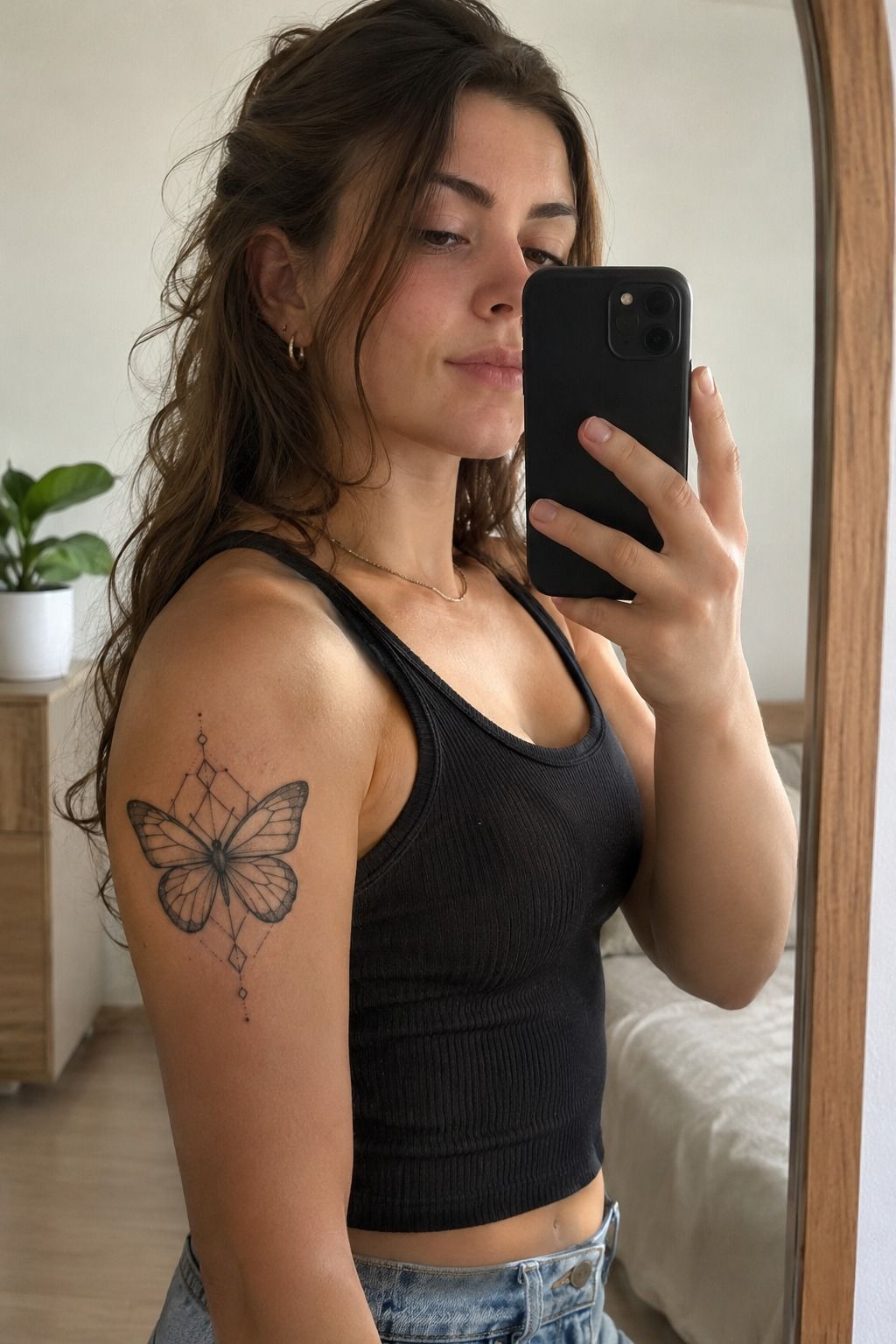
Dotwork creates a textured frame around the butterfly without changing the central silhouette. A warm-white and camel palette with black accents can make the open wings feel more dimensional. I’d keep the dot pattern lighter near the outer edge and denser close to the butterfly, creating a gradual transition.
The inner forearm gives your artist a relatively clear working surface, but your arm’s natural length can make the design look wider than expected. A graduated dot pattern should follow the butterfly’s proportions rather than becoming a separate circle around it. I’d avoid perfectly uniform dots because a subtle change in density feels more organic.
You’ll want to ask how the artist spaces dots after healing. Fresh dotwork can look darker than expected, especially when the points are packed closely.
Your artist should explain what will soften and what needs to stay firm. That conversation is more useful than choosing a reference only because it looks delicate online.
A strong frame includes:
– Clear negative space around the wing edges. – One stronger line through the body. – A narrow vertical orientation. – A soft halo that doesn’t overpower the butterfly.
If you want to compare gentler butterfly treatments, look at these watercolor fine line butterfly tattoos. Your dotwork should support the geometry, not compete with it. The right spacing makes the design feel refined and slightly haunting.
9Delicate Geometric Butterfly Tattoo Along The Collarbone
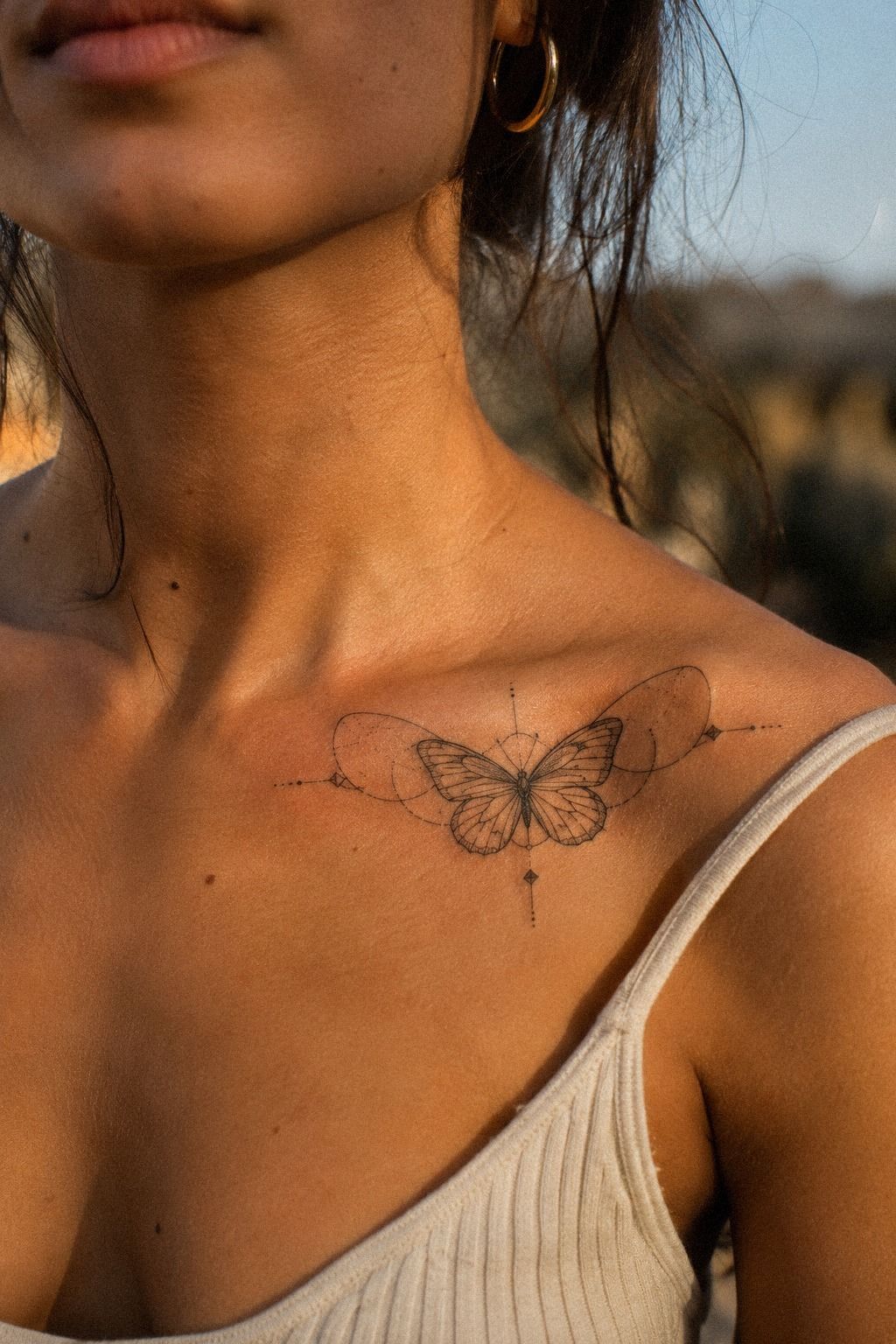
The collarbone is ideal for a delicate butterfly that follows a natural horizontal line. A midnight-blue, copper, and ivory palette can look graceful when the center sits just below the bone and the wings extend outward. I’d keep the lower body narrow, because a heavy center can make the piece feel visually stuck.
Your collarbone moves with your shoulders, so placement should be checked while you stand naturally. A thin midnight-blue contour can trace the shape, but your artist should avoid stretching the design too far toward the neck. The best version feels like it belongs to the curve of your body rather than fighting it.
I’d choose understated geometry here. A few angular facets, two small circles, and clean open space will give you an elegant result.
More detail isn’t automatically more meaningful. If the tattoo is meant to mark a quiet personal change, the restrained approach may say more.
Ask your artist to show:
– A full-size collarbone stencil. – A balanced left-to-right wing span. – Fine lines supported by a slightly stronger outer edge. – A placement option under clothing and above it.
Your collarbone can be sensitive, so plan clothing that won’t rub during healing. For a softer alternative, review these watercolor butterfly tattoo designs. This placement feels feminine, polished, and quietly symbolic without demanding attention.
10Geometric Butterfly Tattoo With Abstract Wing Shapes
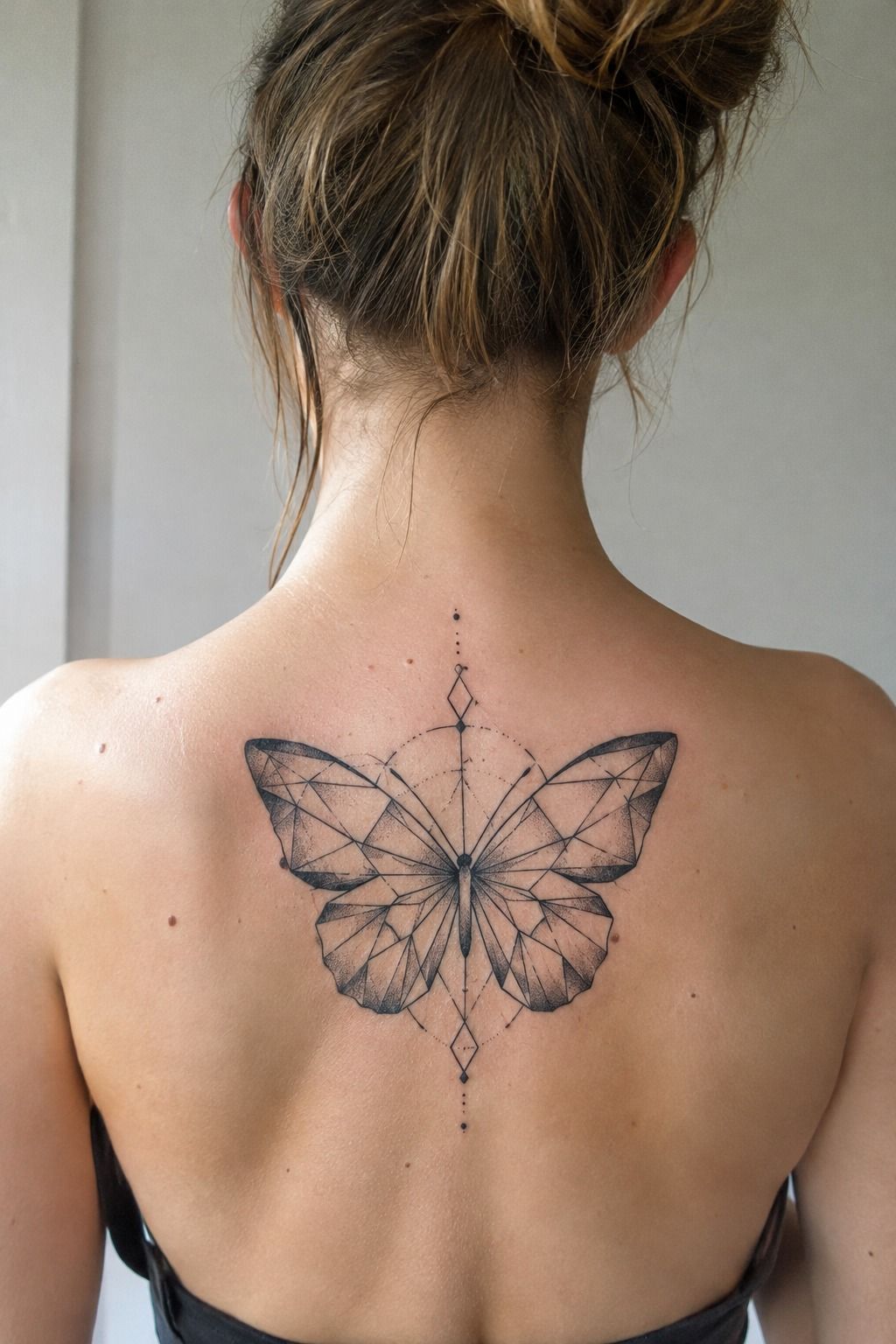
Abstract wing shapes let you move beyond the usual mirrored butterfly while keeping the subject recognizable. Sage green, warm cream, and natural-wood tones can make the composition feel expressive without weakening its crisp geometry.
11Meaningful Geometric Butterfly Tattoo On The Ribcage

The ribcage gives you room for a meaningful butterfly with a longer vertical shape. A terracotta, stone, and olive palette can create a striking silhouette while open spaces keep the wings readable. I’d place the body along the natural line of the ribs and let the wings angle slightly outward.
Rib tattoos can be more painful for many people because the skin sits close to bone. You’ll want to plan a calm day, eat beforehand, and wear clothing that won’t press against the area. A solid terracotta center can help the design stay legible, while carefully spaced linework adds the intricate quality you want.
Think about longevity before you choose the final detail count. Very fine lines may soften or widen over time, especially with sun exposure.
Your artist can combine a delicate interior with a stronger silhouette so your butterfly remains recognizable. I’d choose that balance over an ultra-thin design that looks impressive only when fresh.
A meaningful ribcage layout might include:
– A vertical butterfly composition. – Symmetrical outer wings. – One personal symbol inside the thorax. – Terracotta, stone, and olive accents balanced with open skin.
For another bold direction, compare these watercolor butterfly tattoo arm ideas. Your ribs can hold an expressive piece, but the meaning should lead the design. The geometry is there to give that story a lasting shape!
Choose Scale Before Detail
Scale decides how much visual information your tattoo can carry. A striking miniature may need only an outline and one center mark, while a larger piece can support symbolic geometry, dotwork, and subtle contrast.
I’d rather see a clean, slightly larger butterfly than a crowded tiny one. That’s especially true when you’re paying for longevity. Ask for two or three size options and compare the negative space, not just the overall width.
The right size also depends on your skin tone, placement, and daily exposure. Readable line spacing is the real measure of value. If the gaps are too narrow before healing, they may become harder to distinguish later.
Compare Fresh Ink With Healed Work
Fresh tattoos are saturated and sharp. They’re also at their most vivid. Healed work tells you much more about the artist’s judgment, especially when the design uses thin geometry.
Ask to see healed butterflies at several sizes. Look for whether the outer silhouette remains crisp, whether small circles stay open, and whether the interior marks have merged.
You’re not searching for perfection. You’re checking for consistent decisions.
A healed tattoo portfolio can justify a higher cost when it shows reliable results. I’d put more weight on that evidence than on an impressive social-media post. It’s one of the clearest ways to decide whether the artist’s price is worth it.
Price the Design Around Longevity
The cheapest quote isn’t always the best budget decision. A rushed stencil, weak spacing, or unsuitable needle choice can cost more to correct later.
That doesn’t mean you need the most expensive artist. It means you should understand what the price includes.
Ask whether the quote covers the consultation, stencil adjustments, and a reasonable touch-up policy. The final tattoo cost usually depends on size, placement, detail, artist experience, and local rates.
If the price difference between two sizes is small, I’d compare their future readability. The larger option may offer better value if it protects the silhouette. You’re buying judgment as much as ink, so choose the version that still feels worth it after the first excitement fades.
Ask Better Questions at Your Consultation
A good consultation should feel specific. Bring your references, but explain what you like about them: the wing angle, the negative space, the center symbol, or the contrast. Your artist can then build something personal instead of tracing a disconnected collection of details.
Ask how the design will change after healing, where the strongest lines should go, and which details are likely to soften. A clear consultation plan helps you make decisions before the stencil is on your skin.
You can also ask about session length, aftercare products, touch-up pricing, and whether the placement will be visible or easy to cover. Those practical answers affect the real value of the tattoo as much as the drawing itself.
When Color Earns Its Cost
Color is worthwhile when it supports the geometry. It’s less convincing when it’s added only to make a simple design seem more elaborate. One vibrant accent can look more polished than a full spectrum spread across every wing.
Think about how the color relates to your skin tone and daily sun exposure. A controlled color palette keeps the structure dominant, which helps the butterfly remain recognizable if the pigment softens.
If you’re comparing blackwork with color, ask for quotes at the same size. That lets you judge the actual cost difference instead of guessing.
Sometimes the extra price is modest and worthwhile. Sometimes a crisp black design has stronger long-term value.
The Placement Longevity Rule
I used to think a tattoo aged well because the artist had an exceptionally steady hand. That matters, but it isn’t the whole story. Your placement, sun exposure, line spacing, and design scale all decide what remains readable.
A tiny butterfly packed with hair-thin geometry may look exquisite on appointment day, then lose its hierarchy as the lines soften. A slightly larger design with a clear silhouette usually has a better chance.
For your consultation, ask to see healed work from the artist, ideally across different skin tones and placements. Fresh ink shows saturation. Healed ink shows judgment.
I’d pay closer attention to the way the artist handles negative space than to how dramatic the design looks.
Your aftercare matters just as much. Wash gently, moisturize as advised, and avoid direct sun and swimming while the surface heals.
I’ve seen people focus so hard on the design that they ignore the first two weeks afterward. Don’t make that mistake.
Protect the tattoo while it settles, then keep using sun protection because UV can fade ink over time.
The Questions I Get Asked Most
How much does a geometric butterfly tattoo usually cost?
A geometric butterfly tattoo typically costs about $100 to $300 in the US, depending on size, placement, artist, and region. Some studios charge a $50 to $100 minimum, while hourly rates often fall near $100 to $250. Ask your artist for a quote after sharing the size and placement.
Are geometric butterfly tattoos a good idea for a first tattoo?
Yes, they can be a strong first tattoo because you can choose a tolerable placement, a clear silhouette, and a personal meaning. Your forearm, shoulder, or thigh may feel easier than ribs or feet. Start with a design you’ll still recognize if the finest lines soften.
How do I choose a tattoo artist for geometric butterfly tattoos?
Look for healed photos showing clean geometric linework, balanced symmetry, and consistent spacing. Your artist should specialize in the style, explain how the design will age, and work in a hygienic studio. Ask to see healed examples, not only fresh appointment results.
How much do geometric butterfly tattoos hurt?
Pain varies by person and placement. Ribs, feet, hands, and sternum are often more sensitive because the skin is close to bone.
Your forearm, thigh, and shoulder may feel more tolerable. A short consultation can help you plan breaks and realistic session timing.
How long does a geometric butterfly tattoo take to heal?
The surface usually heals in about 2 to 3 weeks, while complete healing can take about 2 to 3 months. Wash gently, moisturize as directed, avoid swimming and direct sun, and don’t pick at peeling skin. Your artist’s aftercare instructions should take priority.
What’s the best placement for a geometric butterfly tattoo?
Your forearm, shoulder, and thigh are practical choices for readable geometry and often more tolerable sessions. The wrist, ankle, and collarbone offer a more delicate look but experience more movement or friction. Choose the placement that fits your visibility preference and long-term line spacing.
Where I’d Start First
If I had to pick one, I’d start with the bold geometric butterfly across the shoulder. It gives your artist enough room to preserve the silhouette, spacing, and contrast that fine geometry needs. Pin the shoulder idea for later and compare healed blackwork before booking your session.