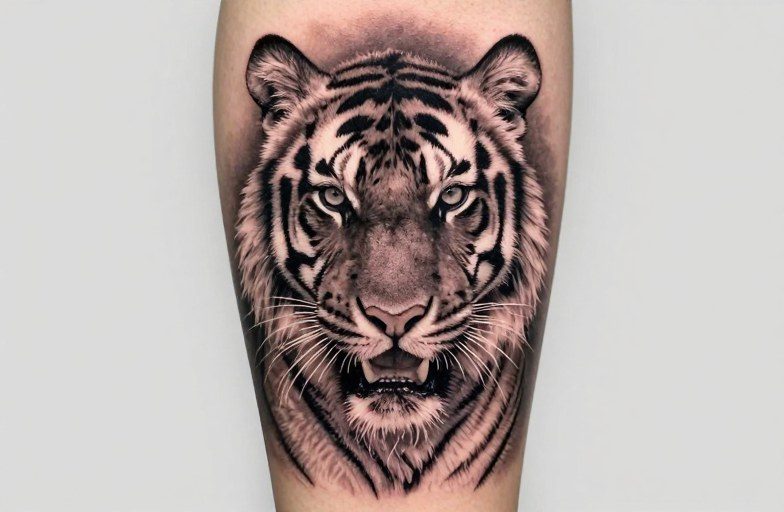
A realistic tiger tattoo replicates the animal’s actual appearance with photographic accuracy, striped fur rendered strand by strand, amber eyes catching light, muscle tension frozen mid-stride. Unlike traditional or neo-traditional tiger designs that simplify forms into bold outlines and flat color, realism relies on smooth gradients, precise value shifts, and the absence of black cartoon borders. The goal is illusion: on skin, the tiger should look like it could breathe.
Choosing the Right Artist
Realistic animal portraiture demands a specific skill set. Not every talented tattooer can execute convincing fur texture or capture the structural geometry of a feline skull beneath fur. You need someone whose portfolio demonstrates repeated success with wildlife realism, not just one or two decent pieces mixed among unrelated styles.
What to Look For in a Portfolio
Examine healed photos, not just fresh work. Fresh realism looks deceptively good, ink sits on the surface, colors pop, contrast reads strong. Healed work reveals whether the artist actually understands how pigment settles at different depths. Look for:
- Consistent fur direction that follows anatomical flow, not random strokes
- Eyes with dimensional depth, corneal highlights placed correctly, not flat white dots
- Transitions between orange, white, and black fur that avoid muddy gray bands
- Whiskers rendered as negative space or extremely fine single-needle lines, not thick scratches
Ask to see a piece healed two-plus years. If the artist can’t produce one, that’s information.
Consultation Red Flags
Be wary of artists who agree to copy a photograph exactly without discussing composition adaptation. Skin isn’t paper; a photo that works at 8×10 inches may collapse at 5×7 on a curved forearm. Good artists redraw reference to account for body contours, movement, and how the eye travels across a living surface. If they want to stencil a raw photo and start tattooing, keep looking.
Key Characteristics & Motifs
Realistic tiger tattoos succeed or fail on specific visual elements. Understanding these helps you evaluate designs and communicate with your artist.
The Face and Eyes
The tiger’s face carries the design. Striping patterns are unique to individuals, no two tigers share identical markings, so artists typically work from reference photos of specific animals (Amur tigers for heavier fur, Sumatran for denser stripe concentration). The eyes require particular attention: round pupils in daylight, elliptical in low light. Misplaced highlights destroy the illusion instantly. The “third eyelid” (nictitating membrane) visible at the inner corner adds authenticity when rendered subtly.
Body Position and Action
Static poses read as flat. Realistic tigers work best in implied motion, shoulders coiled, weight shifting, tail providing counterbalance. Full body designs need 12+ inches minimum to resolve detail in paws and facial structure. Head-and-shoulder compositions allow larger scale at smaller overall sizes, concentrating detail where viewers look first.
- Roaring tigers: challenging due to open mouth complexity (teeth, tongue, throat depth), but dramatic when executed well
- Stalking/low crouch: excellent for wrapping around limbs, uses natural body curves
- Profile walking: most forgiving for first large piece, clear silhouette reads immediately
Best Placements
Tiger realism needs room. The amount of detail in a convincing face, whisker pores, individual hair groupings, subtle color shifts in the nose leather, doesn’t compress well. That said, certain body areas suit the form better than others.
High-Impact Large Areas
The thigh offers flat, stable skin with minimal distortion from movement. A full thigh piece can accommodate a walking or crouching tiger at natural scale. The outer upper arm provides similar advantages with easier visibility for the wearer. The back, between shoulder blades down to mid-back, suits a tiger emerging from or dissolving into background elements, smoke, bamboo, shadow.
Smaller and Curved Surfaces
The forearm works for head portraits or partial compositions, but the radius bone’s curve can distort facial symmetry. Calf muscle creates similar challenges, the tiger’s face may appear pinched when the muscle flexes. Ribs and stomach move too much; realistic tigers here often blur within five years as the skin’s constant stretching and compression grinds fine detail into soft gray.
Hands, feet, and neck are poor choices. The skin structure in these areas sheds pigment faster, and the scale required makes meaningful detail impossible. A “realistic” tiger thumbnail-sized becomes a striped smear within months.
How It Ages
All tattoos age. Realistic color work faces particular challenges because it depends on subtle value relationships that time actively erodes.
The Color Shift Timeline
Fresh tiger orange, typically mixes of red, yellow, and small amounts of white, heals about 15% darker than it appears during the session. Over two to three years, ultraviolet exposure breaks down the yellow component faster than red, pushing the orange toward a rust or brown cast. The white fur areas, which rely on untinted skin showing through or very dilute pigment, often darken as the skin’s natural tanning response accumulates around the ink particles.
Black stripes hold longest but can spread slightly at edges, especially if the artist worked too shallow or too saturated in one pass. This “blowout” turns crisp stripes into soft gray bands.
Maintenance Reality
Sunscreen matters enormously for color realism. Unprotected tiger tattoos fade noticeably within three to five years. Beyond sun protection, there’s no maintenance that restores original vibrancy, touch-ups can replace lost saturation but never perfectly match the first application’s freshness. Plan for a single significant touch-up at year five to eight, particularly on the orange tones and eye highlights.
Common Mistakes to Avoid
Most realistic tiger failures stem from predictable decisions. Avoiding these doesn’t guarantee excellence, but it prevents the most common disappointments.
Design Errors
- Stripes treated as black outlines rather than organic markings that follow muscle and fur flow, real tiger stripes curve, taper, and occasionally split; they don’t outline body parts like a coloring book
- Over-saturated orange that ignores the actual tawny, sometimes almost ochre base color of real tiger fur
- Missing the “ruff”, the longer fur around the neck and cheeks that gives tigers their distinctive silhouette; smooth-faced tigers look like oversized house cats
- Incorrect stripe density: Amur tigers have fewer, broader stripes; Sumatran and Indochinese tigers carry more numerous, thinner markings
Technical Execution Problems
Overworking the skin during sessions creates longer healing and more pigment loss. Realistic fur requires many passes at low saturation; impatient artists who try to pack color too fast cause scarring that traps ink unevenly. Similarly, excessive white ink application, attempting to make fur “pop”, often heals yellowish or falls out entirely, leaving patchy bright spots that don’t read as natural highlight.
Cost & Sessions
Realistic tiger tattoos are expensive because they’re slow. A palm-sized head portrait in full color takes four to six hours. A full thigh piece with environmental background can run twenty to forty hours. Artists specializing in this work typically charge $150-$400 hourly depending on location and reputation, with major metropolitan areas and established names at the higher end.
Session Structure
Most artists break large pieces into four-to-six-hour sessions spaced three to four weeks apart. This allows complete healing between sittings and prevents skin trauma that compromises the final result. Attempting to power through a ten-hour session for a back piece typically yields worse outcomes than the same work in two sessions, the last two hours of any long sitting see diminished precision as both artist and client fatigue.
Budget for the full project, not just the first session. Half-finished realistic work looks worse than incomplete traditional or blackwork because the partial illusion creates visual confusion. Save until you can commit to completion.
Final Word
A realistic tiger tattoo done well is a technical achievement that remains visually compelling for decades. Done poorly, it’s an expensive lesson in how unforgiving realism can be as skin changes. The difference lies in artist selection, patience with process, and honest assessment of whether your budget and pain tolerance match your ambition. Start with reference research, study actual tiger photography, notice how light interacts with fur structure, understand that the animal’s power comes from weight and tension, not just teeth and stripes. Bring that visual literacy to your consultations. The best collectors aren’t passive canvases; they’re informed participants in a collaboration that happens to be permanent.
Frequently Asked Questions
How long does a realistic tiger tattoo take to heal?
Surface healing takes two to three weeks, but the color fully settles over six to eight weeks. During this time, the orange may appear dull or slightly brownish before brightening as the skin’s top layer regenerates. Avoid swimming and direct sun throughout this period.
Can a realistic tiger tattoo be done in black and gray instead of color?
Yes, though it requires exceptional skill to prevent the tiger from reading as a generic big cat. The artist must rely on stripe pattern accuracy and fur texture detail, since color won’t signal “tiger” immediately. Black and gray also ages more gracefully but loses the distinctive orange that makes the species recognizable at distance.
Why do some realistic tiger tattoos look blurry after a few years?
Fine detail in fur texture, especially around the muzzle and eyes, relies on extremely small pigment deposits. Over time, these diffuse slightly as the immune system processes ink particles. Excessive sun exposure accelerates this dramatically. Choosing slightly larger scale and bolder detail zones helps preserve readability.
Is it disrespectful to get a tiger tattoo if it’s not part of my cultural background?
The tiger carries specific sacred significance in several Asian cultures, particularly Korean, Chinese, and some Southeast Asian traditions. Realistic portrayal without accompanying cultural symbols or religious context is generally not considered appropriation, but understanding the animal’s role in traditions you reference shows respect. Avoid combining realistic tigers with spiritual elements you haven’t researched.


Leave a Reply