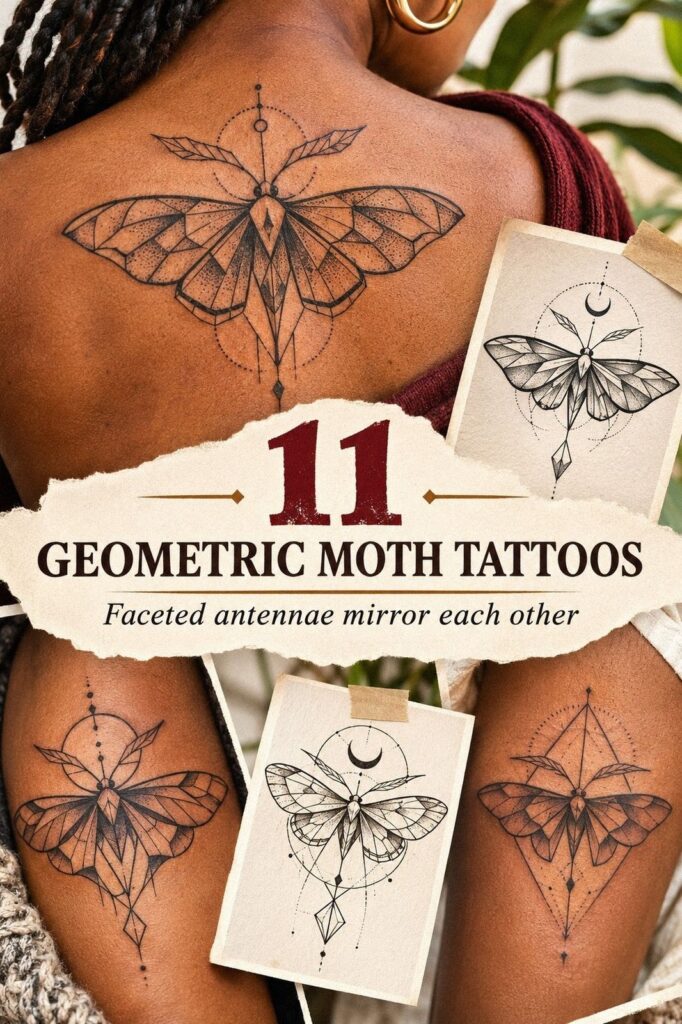
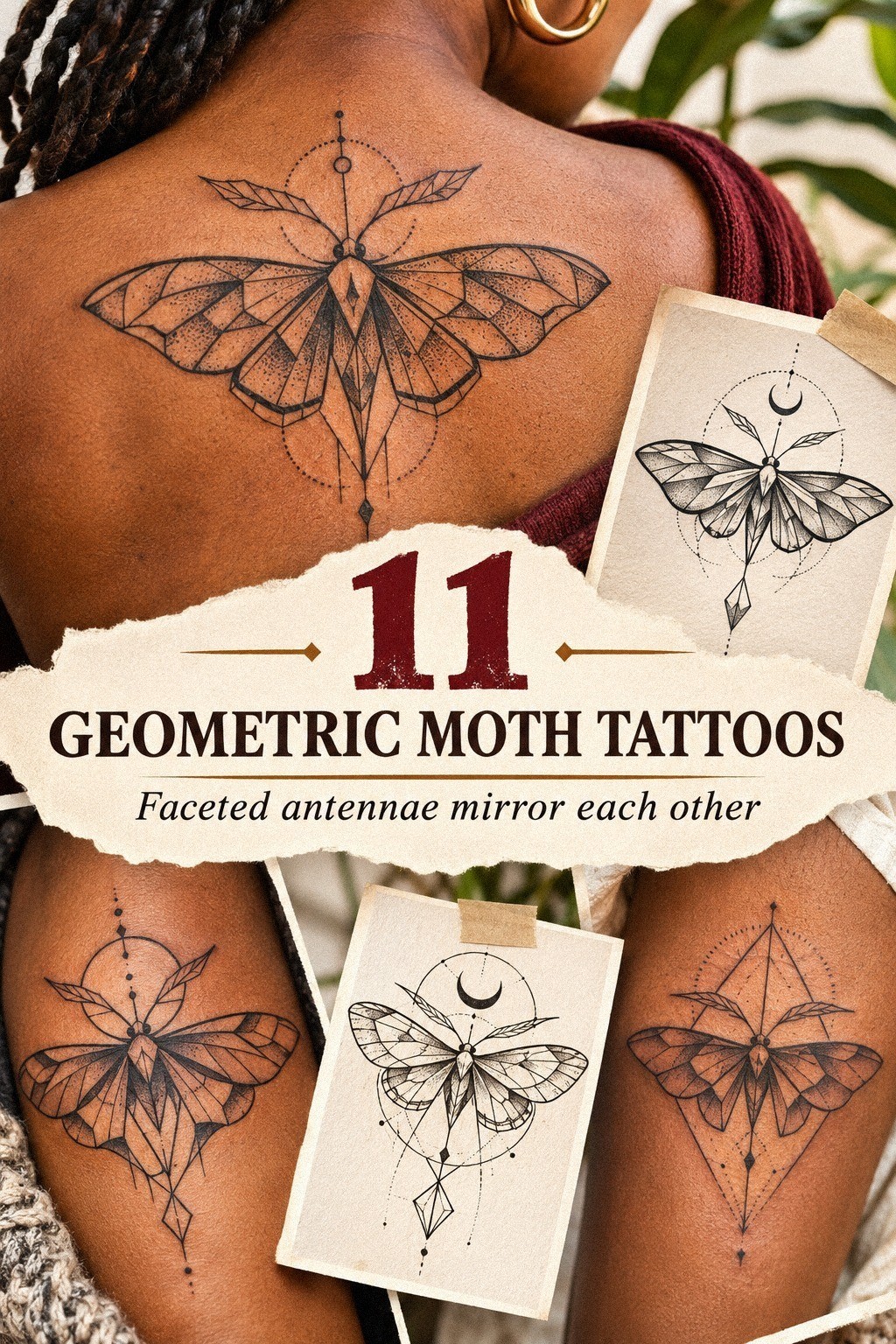
A geometric moth tattoo should be easy to hide without losing its sharp silhouette. The best version feels like a personal mark when you see it and nearly invisible beneath the right sleeve. You’ll make better decisions if you solve the shape, placement, line weight, and meaning in that order.
- Start With a Striking Geometric Moth Silhouette
- Choose Intricate Linework for Small Moth Tattoos
- Where Should You Place a Hideable Moth Tattoo?
- Keep Wing Patterns Crisp and Balanced
- The Meaning Ladder: Which Symbols Belong?
- Bold Symmetry or Delicate Balance?
- Add Delicate Shapes for Understated Ink
- What Should Geometric Style Say About You?
My quick answer? Start with a striking silhouette, test it at full size, and remove details before adding more. A bold moth doesn’t need to shout.
Hideability Is a Design Constraint
A hideable tattoo isn’t a timid tattoo. It’s a controlled design that lets you decide when the moth is visible and when it stays private. That choice can make the piece feel more meaningful, especially if your workplace or family setting affects what you show.
Think about your usual clothing before you choose a placement. A sleeve, watch, sock, or high-waisted garment may cover the tattoo, but only if the wing tips don’t extend beyond the natural edge. Your artist can help you test those boundaries.
The value of a concealed design is flexibility. You can reveal it deliberately, keep it covered during formal occasions, or let it become a quiet detail that belongs mostly to you. Before your consultation, compare small moth tattoo ideas and notice which silhouettes would remain readable under fabric.
- Start With a Striking Geometric Moth Silhouette
- Choose Intricate Linework for Small Moth Tattoos
- Where Should You Place a Hideable Moth Tattoo?
- Keep Wing Patterns Crisp and Balanced
- The Meaning Ladder: Which Symbols Belong?
- Bold Symmetry or Delicate Balance?
- Add Delicate Shapes for Understated Ink
- What Should Geometric Style Say About You?
- Test Unique Moth Tattoo Ideas on Skin
- Pain, Pace, and Price: What Matters Most
- Protect Your Crisp Design Through Healing
1Start With a Striking Geometric Moth Silhouette

Begin with the outer silhouette before you add symbols, shading, or tiny interior marks. Your moth should read clearly from a distance, even if half the geometry eventually disappears into skin movement or clothing.
I’d use blackwork as the anchor, then decide how much open skin belongs inside the wings. Keep the upper wings broad and slightly angular. Let the lower wings taper toward the body so the design feels fierce without becoming visually heavy.
If you’re considering a calf tattoo, follow the leg’s vertical line instead of forcing a perfectly square shape. A calf placement can hide well beneath trousers, but the design still needs enough height to preserve its flowing movement.
The Wing-Span Rule
Your wing span should support the placement, not fight it. A design that’s too wide can wrap awkwardly around your calf, while one that’s too narrow may lose its powerful presence. Ask your artist to show the stencil at its actual size before you approve the layout.
Don’t add ornamental dots simply because empty skin makes you nervous. Negative space gives the wings air and helps the strongest lines remain crisp as the tattoo settles. If the moth stops reading, simplify it!
Look at small moth tattoo ideas with your intended placement in mind. The right comparison isn’t the most ornate design. It’s the one that keeps a clear shape after you imagine it smaller, covered, and viewed from different angles.
A Small Moth Needs Fewer Promises
A small tattoo has less room for every line to explain itself. That doesn’t make it less expressive. It means each mark needs to carry more visual weight.
Your best value may come from paying for a confident artist who simplifies well. A cheaper appointment can become an expensive correction if the final moth is muddy, crowded, or difficult to cover. The budget should include judgment and healed examples, not just minutes under the needle.
2Choose Intricate Linework for Small Moth Tattoos

Small moth tattoos need intricate linework that stays disciplined. Your artist should build the design from a few confident marks, not dozens of fragile lines competing for the same area.
Ask about single-needle linework only after you’ve seen healed examples. Fresh tattoos can look crisp and delicate, while healed photographs reveal whether the gaps stayed open and whether the pattern still feels sharp.
You’ll want visible openings between the wing ribs, especially if the tattoo will be smaller than your palm. A compact design can still carry bold symbolism and expressive force when the central body has enough strength.
The Three-Gap Test
I call this the Three-Gap Test. Each small wing should have at least three readable pockets of skin between its strongest lines. Those gaps create rhythm and stop the moth from turning into a dark blur.
Your artist can test the design with a stencil and a quick photograph from several steps away. If the interior disappears immediately, the linework is asking too much from the final size. A simpler pattern will usually offer better long-term value.
Fine line isn’t automatically a delicate style or a feminine one. A compact moth can feel edgy, sharp, and masculine when the thorax and wing edges are decisive. Don’t choose thin lines just because the design is small.
The upper back gives your tattoo more room than hands, feet, or ribs. It’s also easier to conceal under a shirt, which makes it a practical choice for a meaningful design. Compare this minimalist moth tattoo collection before you finalize the density.
3Where Should You Place a Hideable Moth Tattoo?

Placement changes the mood before anyone notices the symbolism.
Skin Changes the Geometry
Your skin tone affects contrast, but it shouldn’t limit your choices. A thoughtful artist adjusts line spacing, black saturation, and detail density to help the design remain readable on your skin.
Ask to see healed work across several complexions. The strongest portfolio shows technical range, not one repeated look. That evidence is more useful than a low quote or a trend image.
Contrast isn’t only about using more black. It’s also about preserving open skin between major shapes. A crisp tattoo often depends on restraint more than intensity.
4Keep Wing Patterns Crisp and Balanced

This is where your geometric moth begins to feel intentional structure instead of merely symmetrical. Your goal is balance, not identical decoration inside every compartment.
Use sterile stencil paper to mark the central body, upper wing points, lower wing points, and strongest interior lines. Those landmarks matter more than tiny matching details.
If one side has a slightly different curve because of the arm’s shape, that’s fine. Your eye reads the major rhythm first. Perfect mirroring can make a living design feel stiff.
The Mirror-Loss Check
Fold the sketch down the center and compare both sides, then deliberately remove one small detail from each wing. This is the Mirror-Loss Check.
If the moth still reads clearly, the structure is strong. If it falls apart, fragile lines are carrying too much responsibility. Ask your artist to strengthen the silhouette before adding anything new.
I’d avoid filling every wing section with black. Strong black saturation can age well when it’s placed thoughtfully, but crowded contrast leaves no room for skin to separate the pattern.
You’ll usually get a sharper result from three bold areas and several clean openings than from one uninterrupted block. That approach also gives your artist more flexibility if your skin responds differently during healing.
For another structured comparison, browse geometric butterfly tattoo examples. Look at the rhythm of the wings, not the subject itself.
5The Meaning Ladder: Which Symbols Belong?
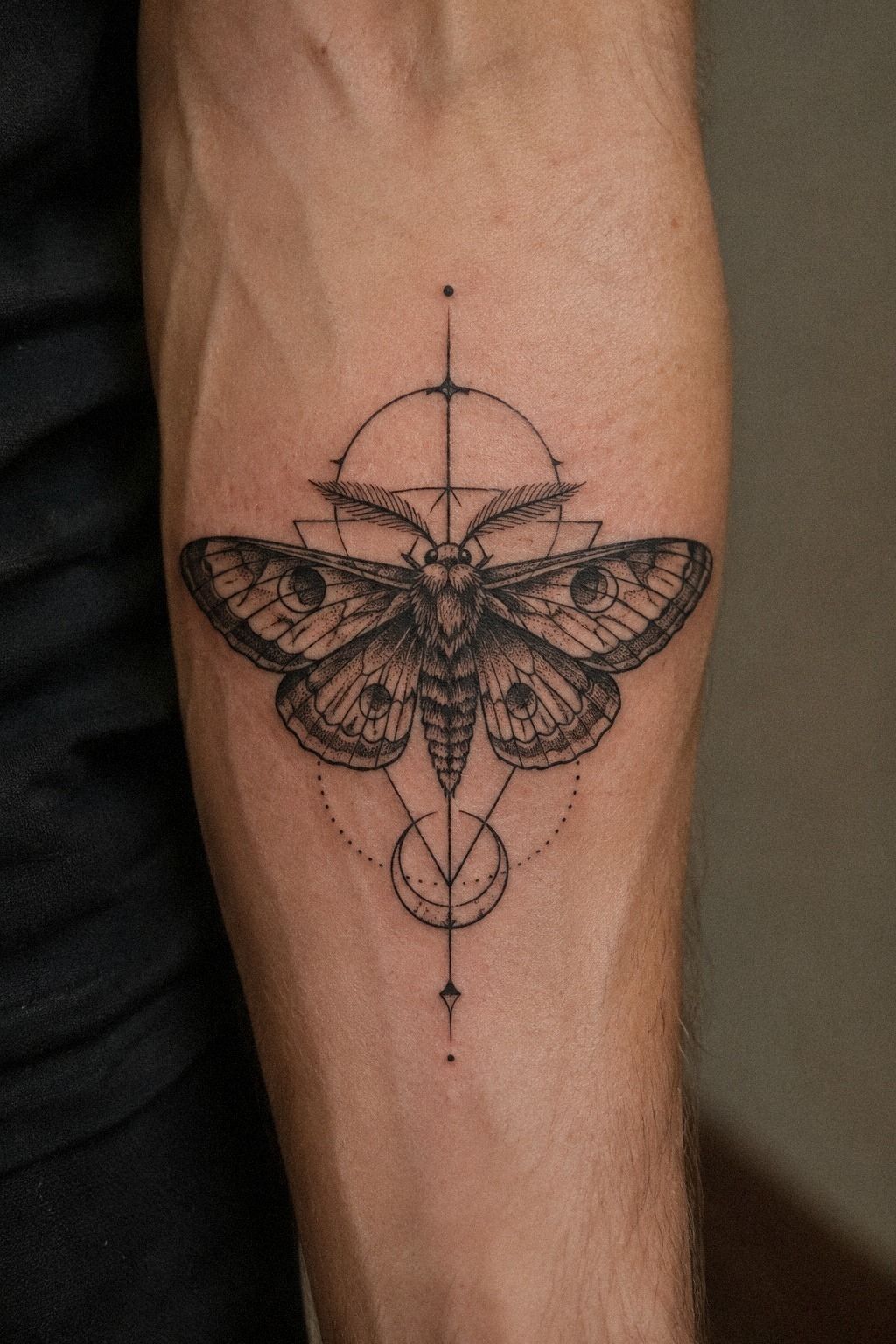
Choose symbols that make the moth feel symbolic meaning without making it overexplained. A crescent, star point, eye, botanical shape, or repeated triangle can work, but each mark should have a reason to stay.
Use archival sketch paper to make three versions: restrained, ornate, and nearly abstract. Compare them at the intended tattoo size. The design that looks clever when enlarged may feel crowded on skin.
Keep the symbols outside the strongest wing ribs so the moth remains readable. You’ll notice quickly which version feels meaningful and which one only looks stylish on paper.
The Meaning Ladder
Rank every symbol from essential to optional. The essential mark carries your story.
The optional mark fills space. If you need to simplify later, remove the optional marks first.
A moth can represent change, attraction to light, resilience, night, or a shape you’ve carried in your imagination for years. Your meaning can be intimate without becoming literal. One honest crescent may say more than five borrowed symbols.
Read this Luna moth meaning guide if you’re still deciding what the moth represents. Use it as a prompt, not a template.
Symbols Should Earn Their Place
The personal value of a tattoo doesn’t come from how many symbols it contains. It comes from whether the personal meaning still feels true after the trend has passed.
You don’t need a dramatic explanation for an expressive design. Maybe you like the moth’s nocturnal shape.
Maybe its transformation feels sacred. Maybe you simply want an intricate creature with a fierce gaze.
Compare the ideas in this moth tattoo meaning guide and write down the words that actually sound like you. Then remove anything that feels borrowed.
6Bold Symmetry or Delicate Balance?

Start with a strong central axis through the head, thorax, and abdomen.
7Add Delicate Shapes for Understated Ink
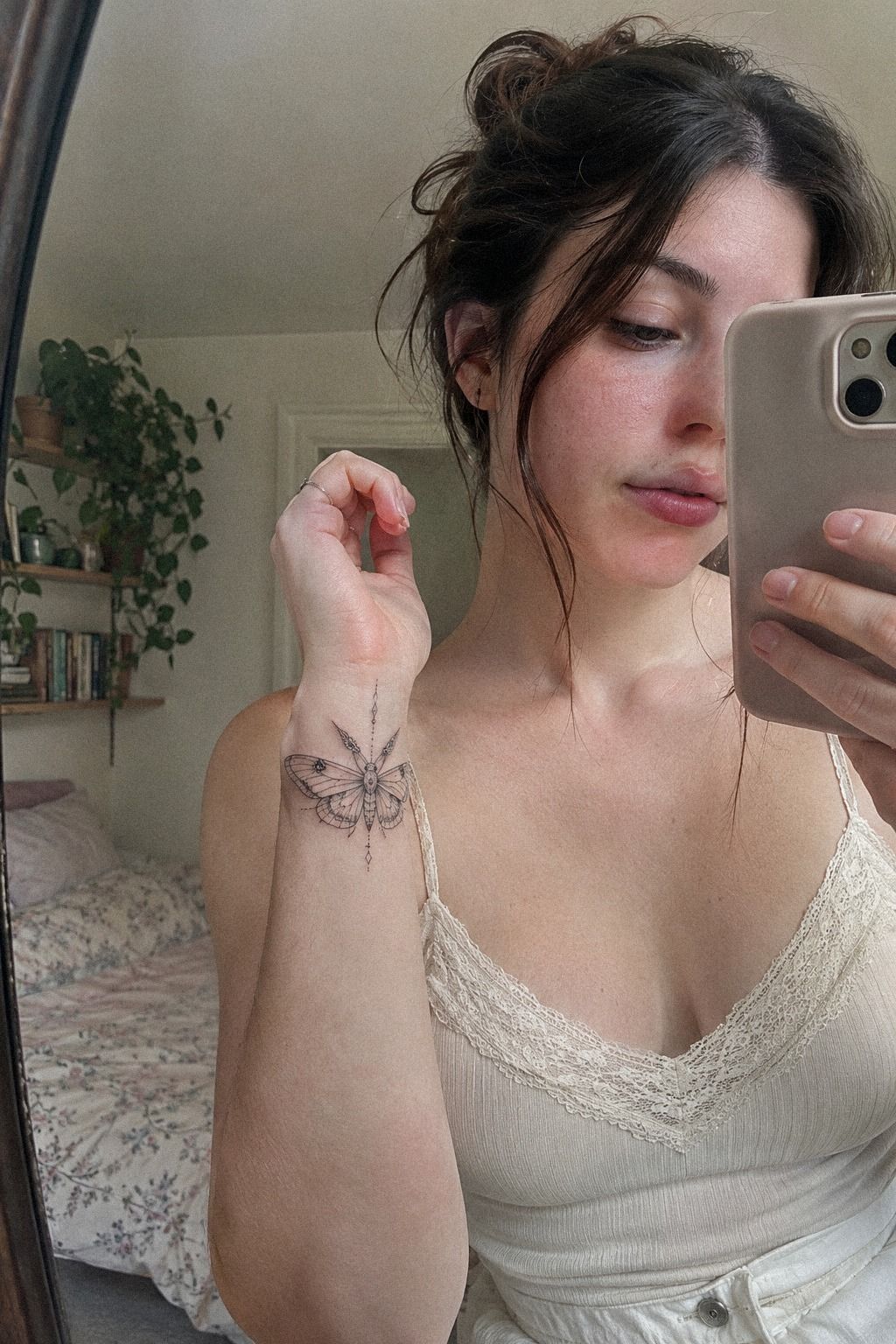
A moth can have delicate linework without becoming weak. The shape should remain clear, while the interior marks create a graceful, understated effect.
Use fine black linework for the body and reserve heavier marks for the eyes, thorax, or central wing structure. Your artist may simplify the antennae, reduce the compartments, or leave the lower wings mostly open.
Those choices aren’t flaws. They’re what keep a small tattoo from becoming muddy. A dainty design still needs enough visual authority to survive ordinary distance.
The wrist gives a tattoo immediate visibility, so every line needs to earn its place. It’s also exposed to friction, movement, and frequent washing, which makes long-term planning important.
The Wrist Margin
Leave breathing room around the wrist crease and avoid placing the lowest wing point directly inside the fold. Movement can soften a busy area and make the design feel less polished over time.
I’d choose understated over miniature if you’re hiding the tattoo often. A piece that’s small enough to cover but large enough to read will serve you better than a tiny cluster of marks.
Fine lines may broaden as ink settles. Your aftercare, sun exposure, skin, and artist’s technique all matter. Read these tiny moth tattoo references before asking for the smallest possible version.
Visibility Is a Choice
A visible tattoo can still be private in meaning. You decide whether people see a striking shape or understand the story behind it.
If you want moderate exposure, an inner forearm gives you control. If you want a more personal placement, the upper back or thigh may offer better privacy. Your budget should account for the design you’ll actually feel comfortable wearing.
Compare small moth tattoo ideas and minimalist moth tattoo collection while covering each example with your hand. That quick test reveals which details are essential.
8What Should Geometric Style Say About You?

Geometric style works best when it supports meaningful imagery instead of replacing it.
9Test Unique Moth Tattoo Ideas on Skin

Before committing, test your temporary stencil transfer gel on the actual placement. A sketch that looks balanced on a screen can feel too wide, too tall, or oddly tilted once it follows a real arm.
Photograph the stencil in daylight, indoor light, and beneath the clothing you plan to use for concealment. You’ll notice whether the wings still read clearly and whether the hidden placement is truly hidden.
Your artist should give you time to assess the design. A rushed stencil can create an expensive regret, while a careful test gives you useful information before the appointment begins.
The Movement Test
Bend your arm, rotate your wrist, and let your hand rest naturally. This Movement Test shows whether the moth still looks balanced during ordinary motion.
Check the design from the side, not only straight on. If the wings look distorted in every natural position, ask for a small adjustment. Your skin isn’t flat, and the tattoo should move with you.
You’re still allowed to rethink the stencil. That isn’t indecision. It’s part of protecting the final result.
A consultation should feel collaborative, not like a point of no return.
Ask about the artist’s hourly rate, shop minimum, and expected appointment length. Compare proportions with these small moth tattoo designs and bring one or two references instead of an entire folder.
Your Stencil Is a Conversation
The stencil stage is where your idea meets your actual body. Notice the wing height, body direction, garment coverage, and relationship between the design and nearby creases.
If something feels wrong, say it plainly. A professional artist can move the moth, open a wing, reduce a symbol, or change the scale. That conversation can protect the value of the whole appointment.
A strong artist consultation should cover placement, hygiene, healing, pricing, and revisions. You’re paying for judgment as well as execution, so clarity is worth the time.
10Pain, Pace, and Price: What Matters Most

Prepare for sensation without treating pain as a test of courage. Forearms, thighs, and shoulders are often more tolerable, while ribs, feet, hands, and sternum may feel sharper.
Detailed linework can take longer than a simple outline because the artist is placing many controlled marks. Ask how long the detailed linework may take and leave room for stencil placement and adjustments.
Bring fragrance-free moisturizer only for aftercare, not during the appointment unless your artist asks. Wear accessible clothing, eat beforehand, and carry water. You’ll have a steadier session when you aren’t cold or hungry.
Your appointment budget should include the shop minimum, hourly rate, setup time, and possible stencil changes. A lower quote isn’t always better value if it leaves no time for careful placement.
The Session Pace
Ask whether the session pace can include breaks. You don’t need to finish every detail at once if your body or attention has reached its limit.
Don’t use numbing products without discussing them first. Your artist may have a studio policy, and some products can change how the skin behaves. Tell them if you’re sensitive, nervous, or prone to feeling faint.
Here’s a practical cost guide for a typical US appointment. Rates vary by artist, region, size, placement, and studio policy.
A Cost Is Part of the Design
The shop minimum may cover a small moth, but intricate geometry can take longer than you expect. Ask what the minimum includes before you decide whether the quote feels worth it.
An hourly rate is easier to compare when you know the expected duration. The best value is a clear estimate from an artist whose healed work matches the crisp, symbolic result you want.
Ask whether the price includes consultation, stencil adjustments, and aftercare guidance. You’re not only buying ink. You’re buying time, judgment, and a plan.
11Protect Your Crisp Design Through Healing

Your tattoo’s first days can affect how the healing process feels, but you should follow your artist’s specific instructions. Wash gently, avoid soaking, and don’t pick at peeling skin.
Use the recommended aftercare instructions rather than experimenting with several products. Too much product can irritate the area, while too little attention can leave you uncomfortable and uncertain.
Avoid swimming, prolonged soaking, and direct sun while the surface heals. Once the tattoo is fully settled, consistent sun protection can help preserve the crisp contrast.
If redness, swelling, or discomfort seems unusual, contact your artist or a qualified medical professional. Your artist can explain normal healing, but they shouldn’t diagnose a complication.
The Healed Portfolio Check
Before booking, review the artist’s healed portfolio. Look for clean geometry, balanced black areas, readable negative space, and respectful work across different skin tones.
Fresh photographs show the immediate impact. Healed photographs show how the design actually lives. That difference matters when you’re deciding whether the price and process are worth it.
Your final line quality may look softer during healing before the tattoo settles. Judge the result after the timeline your artist recommends, not during the most dramatic stage of peeling.
Healing Tests the Original Plan
A settled tattoo should still reflect the original idea, even if the lines soften slightly. That’s why silhouette, spacing, and placement matter more than a pile of tiny details.
A good aftercare plan protects your investment, but the design itself needs enough structure to age with confidence. If the tattoo only works when every hairline mark is perfect, it’s too fragile.
Why a Hideable Moth Still Deserves a Strong Point of View
A hidden tattoo doesn’t have to be quiet in every way. It can disappear beneath a sleeve and still feel bold presence when you see it alone. The hideable part is about control, not apology.
The best geometric moths balance crisp structure with organic movement. Straight lines make the wings feel sharp edges, while uneven feathered edges keep the image from looking mechanical.
Restraint matters more than novelty. A unique symbol won’t rescue a weak silhouette, and an ornate wing won’t fix poor spacing. Start with the body, wing span, and placement, then ask which details still matter after you remove half of them.
Your artist’s healed portfolio should carry more weight than a trend image. Look for polished linework, balanced black areas, varied skin-tone experience, and photographs taken after the tattoo has settled.
If you change your mind during the stencil stage, say so. A professional conversation can save you years of staring at a placement that never felt right.
I’d rather postpone a tattoo than force a fierce idea into the wrong shape. That patience is powerful!
The Questions Worth Answering First
How much does a geometric moth tattoo usually cost?
A geometric moth tattoo may cost about $50 to $100 at a shop minimum or around $100 to $250 per hour in the US. Your final price depends on the artist, region, size, placement, and detail. Ask whether the quote includes consultation, stencil changes, and the full appointment.
Are geometric moth tattoos a good idea for a first tattoo?
Yes, they can be a meaningful first tattoo if you choose a manageable size and placement. I’d consider the forearm, thigh, or shoulder before ribs, feet, hands, or sternum. A healed portfolio matters more than a low quote, especially when the design depends on crisp geometry.
How do I choose a tattoo artist for a geometric moth tattoo?
Choose an artist with clean geometric linework, healed photographs, and experience across different skin tones. A strong portfolio offers better value than the cheapest quote. Ask how the artist handles symmetry, negative space, black saturation, hygiene, aftercare, and stencil revisions.
How much do geometric moth tattoos hurt?
Pain varies by person and placement. Forearms, thighs, and shoulders are often more tolerable, while ribs, feet, hands, and sternum may feel more intense.
I’d eat beforehand, drink water, wear accessible clothing, and tell your artist if you need a pause. That’s sensible!
How long does a geometric moth tattoo take to heal?
The surface usually heals in about 2 to 3 weeks, while complete healing can take about 2 to 3 months. Follow your artist’s aftercare, wash gently, moisturize as directed, avoid swimming and soaking, and protect the settled tattoo from direct sun.
What’s the best placement for a geometric moth tattoo?
The inner forearm is a strong choice if you want readable geometry, moderate visibility, and easier concealment under a sleeve. The upper back offers more space and privacy, while the wrist works for a smaller understated design. Your artist should test the stencil while your body is relaxed and moving.
Where I’d Start First
If I had to pick one step, I’d start with the silhouette. A clear wing shape survives size changes, skin movement, and time better than decorative detail.
Test it on your actual placement before adding symbols. Then compare geometric moth tattoo ideas and choose the version that still feels expressive after you remove what it doesn’t need.
A strong tattoo doesn’t need every possible detail. It needs a meaningful shape, a realistic budget, a thoughtful artist, and enough restraint to stay readable.
That combination is worth it. Ask again if the stencil feels wrong, simplify before you regret it, and let the moth keep its sharp point of view!