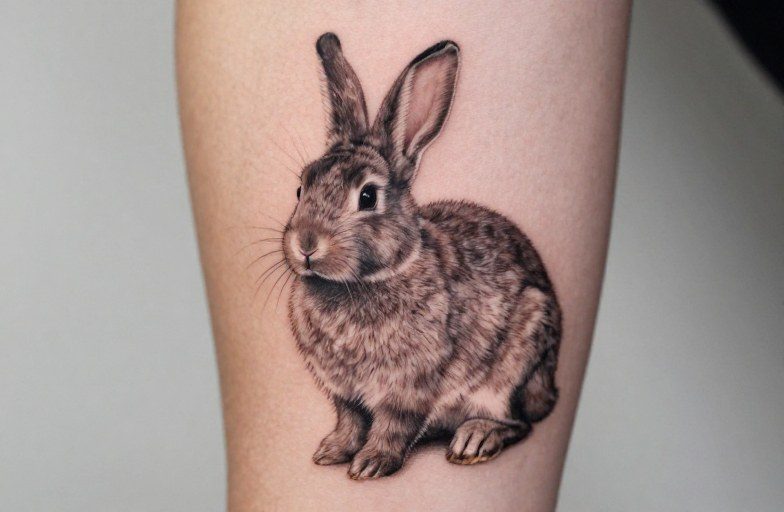
A rabbit tattoo most commonly signals fertility, luck, and the quiet alertness of prey animals that survive anyway. Some people choose it for the lunar connection, rabbits appear in moon myths across cultures, while others want the trickster energy or the soft, non-threatening aesthetic. The meaning depends heavily on which symbolic thread you pull: reproduction and abundance, vulnerability, lunar cycles, or the clever survivor who outpaces predators.
How It Ages on Skin
Rabbit designs age in predictable ways based on how much fine detail you pack in. The long ears, the whisker-thin lines, the small eye with its highlight dot, these are the first elements to blur as skin settles and sun exposure accumulates. A rabbit rendered at palm-size or smaller will lose facial definition within five to eight years unless you build in some insurance.
Line Weight and Silhouette Strategy
Thicker outer contours hold. A rabbit tattoo with a bold silhouette, think a single clean outline in black, maybe 3mm at the ear edges, tapering to 1mm internally, reads as “rabbit” even when the inner fur texture softens. Fine-line-only rabbits, especially those with stippled fur texture or single-needle whiskers, tend to dissolve into soft grey smudges on high-movement areas like wrists or ankles. If you want that delicate look, place it on the upper outer arm, upper back, or ribs where skin shifts less dramatically.
Shading vs. Open Skin
Soft greywash shading mimics fur well but requires maintenance. Solid black rabbits with negative-space fur lines (the “cutout” style where skin shows through as hair texture) age more gracefully than fully shaded pieces. Color rabbits, especially those with pink inner ears or brown tonal work, fade unevenly because red and yellow pigments break down faster under UV exposure. Black and grey rabbits with strategic skin breaks look readable for decades.
History & Cultural Roots
The rabbit’s symbolic weight predates tattooing as we know it. In many traditions, the animal sits at the intersection of mundane and sacred, too common to be exotic, too prolific to be ignored.
Lunar and Feminine Associations
East Asian traditions often link the rabbit to the moon, where it pounds the elixir of immortality or pounds mochi, depending on the telling. This lunar tie connects to menstrual and fertility cycles, which is why rabbit imagery frequently accompanies goddess figures and harvest rituals. A moon-and-rabbit tattoo draws on this lineage explicitly. In pre-Columbian Mesoamerica, the rabbit was one of the day signs in the tonalpohualli calendar, associated with fertility deities and agricultural abundance.
African Diaspora and Hoodoo
In American South folk practices, the rabbit foot as a luck charm carries specific rules: it must be the left hind foot, taken from a graveyard rabbit, killed under particular conditions. The tattooed rabbit foot operates as a permanent, ethical alternative, same symbolic function, no ritual procurement. This thread connects to Br’er Rabbit and the broader trickster-survivor archetype in African American storytelling, where the physically weak outwit the powerful through cunning rather than force.
Color vs Black and Grey
The color choice changes what the rabbit communicates, not just how it looks.
- Black and grey: Reads as more serious, sometimes mournful. A grey rabbit in profile can evoke the Watership Down strain of British nature writing, beautiful, harsh, survivalist. The absence of color emphasizes form and shadow, which suits rabbits in motion or predator-prey compositions.
- Traditional color (bold reds, greens, yellows): Connects to Sailor Jerry-era luck and fertility symbolism. A green rabbit might seem odd until you recognize the Irish and broader Celtic associations, rabbits as fairy creatures, as omens, as liminal beings between worlds.
- Soft watercolor or pastel: Tends toward the cute or whimsical, which can undermine the darker symbolic threads unless you intentionally contrast it (a pastel rabbit with a skull, for instance, or a wounded posture).
- White ink on dark skin: Creates a ghost-rabbit effect that plays with the animal’s reputation for elusiveness and its association with moonlight. White ink fades to a subtle scar-like texture, which suits the rabbit’s “here and gone” quality but requires touchups.
Mythology & Folklore
Rabbit mythology clusters around a few repeating archetypes: the lunar companion, the trickster, the fertility engine, and the psychopomp or boundary-crosser.
Trickster Rabbits
The Br’er Rabbit cycle, the Anansi-adjacent West African hare stories, and the Japanese kitsune-adjacent rabbit tales all share a structure: the small, fast, breeding animal survives through deception, timing, and knowledge of terrain. A rabbit tattoo in a running pose, especially with a backward glance or an object in its mouth, activates this trickster reading. The “lucky rabbit” of American carnival culture descends partly from this, surviving the shell game, the fixed wheel, the rigged contest.
The Moon Rabbit
Chinese, Japanese, Korean, and Vietnamese traditions all place a rabbit in the moon. The specific task varies, pounding medicine, pounding rice, making the elixir of life, but the core image is consistent: solitary, industrious, associated with cyclical time. A rabbit paired with moon imagery (crescent, full moon, moon phases wrapping around the body) references this directly. The rabbit’s silhouette against a moon is one of the most compositionally stable tattoo designs because both shapes are immediately readable and culturally loaded.
Best Placements
Rabbit anatomy maps well to human body contours if you think about movement and proportion.
- Outer upper arm: The classic rabbit-in-profile placement. The ear follows the deltoid curve; the body sits flat on the muscle belly. Heals well, ages well, visible but coverable.
- Side of the calf: A running rabbit here mimics actual leaping posture. The muscle movement can animate the design slightly when you walk. Avoid the back of the knee, too much friction, too much distortion.
- Ribs or flank: Suits a curled or sleeping rabbit, playing the soft belly vulnerability against the protected torso. Painful, but the emotional resonance of a hidden, tender image matches the rabbit’s symbolic profile.
- Hand or fingers: Only for bold, simple silhouettes. The rabbit’s ear can extend along a finger; the body sits on the back of the hand. Fades fast, high maintenance, but immediately communicative.
- Behind the ear: Small, discreet, the ear placement echoing the rabbit’s own prominent ears. Works as a private symbol rather than a displayed piece.
Placement also affects meaning. A rabbit on the chest reads more vulnerable; on the thigh, more fertile or sexual; on the hand, more trickster and public.
Who Chooses This Tattoo
The rabbit attracts people who want symbolism without aggression. It’s not a wolf, not a bear, not a predator display. The people who sit for rabbit tattoos often have specific personal connections: childhood pets, lunar interests, fertility experiences (including loss, which the rabbit’s prolific breeding can symbolize in reverse), or identification with the prey-survivor archetype.
Gender and the Rabbit
The rabbit’s association with fertility has made it historically coded feminine, but that reading is narrowing. More men now choose rabbits for the trickster and luck associations, or for hunting and nature-culture connections. A rabbit paired with a weapon or in a trap activates a very different symbolic register than a rabbit with flowers or a moon. The tattoo’s context, surrounding imagery, style, placement, determines gender reading more than the rabbit itself.
The “Soft” Aesthetic Crowd
Rabbit tattoos cluster in certain contemporary style movements: the “cottagecore” interest in domestic and agricultural imagery, the dark-academia overlap with Victorian natural history illustration, and the broader neo-traditional revival that mines early 20th century American flash for its luck-and-charm content. Someone choosing a rabbit in 2024 is often making a deliberate stylistic period reference, not just selecting an animal they like.
Final Word
The rabbit tattoo works because it carries contradictory meanings without collapsing into vagueness. Fertility and vulnerability. Luck and prey status. Lunar distance and bodily abundance. The design succeeds when you choose which tension to emphasize rather than trying to include all of them. A bold silhouette on the upper arm reads as survivor. A soft, detailed piece on the ribs reads as tender and hidden. A moon-and-rabbit composition reads as cyclical and mythic. Know which rabbit you’re getting, and build the tattoo around that specific animal, not the generic symbol.
Frequently Asked Questions
Does a rabbit tattoo always mean fertility?
No. While fertility is the most common cultural association, many people choose rabbits for lunar symbolism, trickster energy, or personal pet memorials. The meaning depends on accompanying imagery and your own intent.
How small can a rabbit tattoo be before it blurs?
Palm-sized is the practical minimum for a recognizable rabbit with facial detail. Smaller than that, stick to a bold silhouette without internal features. Fingers and behind-the-ear placements need simple, high-contrast designs.
Is a rabbit foot tattoo the same as carrying a lucky rabbit foot?
Symbolically related, but the tattoo is a permanent, ethical alternative. The traditional charm requires specific ritual conditions; the tattoo captures the luck association without the cultural baggage of animal parts.
What style works best for a rabbit that looks serious rather than cute?
Black and grey with strong contrast, profile or running pose rather than frontal, and minimal roundness in the eye shape. Avoid pink inner ears, fluffy cloud-like outlines, and cartoon proportions. Reference Victorian natural history illustration or neo-traditional flash for tonal reference.

Leave a Reply