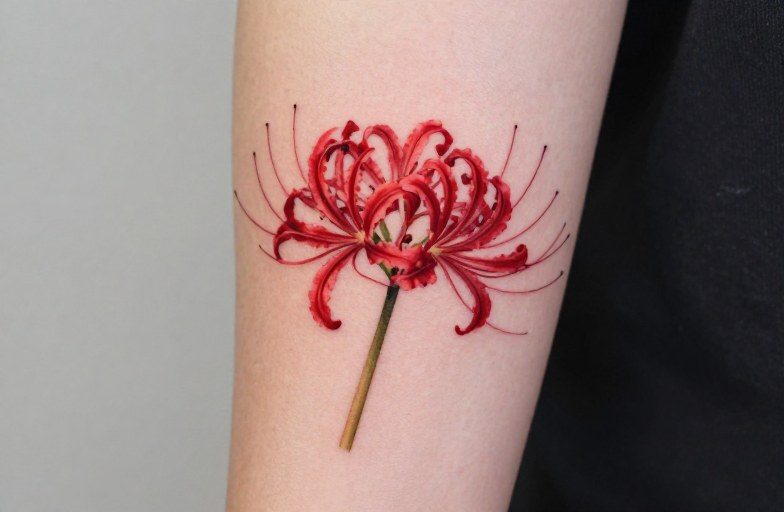
The red spider lily tattoo most commonly signals final partings, memories that persist after loss, and the threshold spaces between life and death. On skin, it functions as a memorial marker, an acknowledgment of transformation, or a quiet nod to Japanese and broader East Asian folklore where this flower grows in profusion along paths and riverbanks associated with departure.
History and Cultural Roots
In Japan, the red spider lily (Lycoris radiata, higanbana) blooms during the autumn equinox, often when families honor ancestors. The timing is not incidental. Buddhist temples and grave sites have planted them deliberately because the flowers arrive as the living commune with the dead. The bulbs are toxic, which kept rodents from disturbing burial grounds; practical function layered with symbolic weight over centuries.
The flower’s biological reality reinforces its meaning. It sends up leafless stalks that bloom alone, the leaves emerging only after the flower fades. This separation of flower and foliage, often linked to Chinese and Korean folk tales about two spirits forbidden to meet, transformed into flower and leaf, never coinciding. The botanical fact and the story have grown inseparable.
In Korea, the flower carries similar funerary associations, though with less literary romanticizing and more direct linkage to actual burial sites and ancestral rites. In China, it is often linked to the underworld in folk tales, though less systematically than in Japan.
Popular Culture and Global Spread
Post-war Japanese popular culture amplified the flower’s meaning. Anime, manga, and literature repeatedly deploy red spider lilies at moments of separation or death, cementing the visual shorthand for audiences globally. Someone getting this tattoo today may reference personal loss, but they are also tapping into a visual language that circulated through Tokyo Ghoul, Demon Slayer, and countless other media. The cultural transmission matters: the flower’s meaning on skin is partly inherited, partly chosen, partly filtered through whatever media first exposed the wearer to it.
Regional Variations in Meaning
- Japan: Ancestral remembrance, the ohigan season, literal grave-marker plantings
- Korea: Death anniversaries, sometimes unrequited love through the flower-leaf separation motif
- China: Often linked to the underworld in folk tales, though less systematically than in Japan
- Western adoption: Frequently chosen for aesthetic drama first, meaning discovered or assigned afterward
Religious and Spiritual Angles
Buddhist contexts dominate. The flower’s blooming period overlaps with ohigan, the seven-day service for the dead, making it inseparable from Pure Land Buddhist practice in Japan. The red color itself carries associations with blood, vitality, the passion that persists beyond physical existence.
Beyond Buddhism
Secular spiritual seekers sometimes adopt the flower as a symbol of liminality: the in-between state, neither fully one thing nor another. This resonates with people navigating major transitions. Grief, certainly, but also recovery, emigration, gender transition, any passage where the old self is definitively gone but the new one not yet solid. The flower’s structure supports this reading: petals that look like spider legs, something organic that resembles something feared, beautiful and slightly wrong.
Placement and What It Changes
Where this flower sits on the body changes how it reads.
- Forearm or wrist: Visible, almost conversational. Signals willingness to discuss the meaning, or at least to have it seen. Works well with the long stem curving along the radius.
- Ribcage or side: Private, revealed selectively. The vertical space suits the flower’s natural growth habit. Pain here is significant; the commitment itself becomes part of the meaning.
- Upper arm or shoulder: Classic placement for Japanese-influenced work. Allows for full bloom plus bud stages, creating narrative progression in the design.
- Thigh or calf: Larger scale possible. The flower’s radial symmetry works as a standalone piece or integrated into a larger composition.
- Behind the ear or neck nape: Small, intimate. Often chosen for personal memorials rather than public statement.
Scale and Composition
Single blooms read differently than clusters. One flower: singular loss, one person, one moment. A field of them: cumulative grief, ancestral weight, the impersonal scale of death itself. The stem’s length matters too. A cut flower versus rooted growth implies different relationships to the loss being marked.
Who Chooses This Tattoo
Patterns exist, though they are not absolute. People who have lost someone to suicide, overdose, or sudden accident gravitate here because the flower’s associations with unexpected departure match their experience. Adopted individuals sometimes choose it to mark unknown biological family. People with terminal diagnoses occasionally get it as preparation, a way to hold their own death before it arrives.
There is also a significant contingent who simply love the visual drama: the red against skin, the spidery delicacy, the way it photographs. Meaning gets constructed backward from aesthetic attraction. That is valid. The flower’s cultural weight is available to anyone who chooses to engage with it, regardless of initial motivation.
Similar and Related Symbols
Understanding what the red spider lily is not helps clarify what it is.
- Chrysanthemums: Also death-associated in Japan, but more imperial, more formal, less visceral. The chrysanthemum is state ceremony; the spider lily is personal grief.
- Cherry blossoms: Transience, yes, but specifically the beautiful brevity of life, not its end. Cherry blossoms celebrate living; spider lilies mark having survived someone else’s death.
- Marigolds: Mexican Dia de los Muertos equivalent, bright and communal rather than solitary and melancholic.
- Willows: Grief in Chinese tradition, but passive, weeping. The spider lily is sharper, more abrupt.
Pairings in tattoo design matter. Red spider lily with a lantern: guidance for the dead. With a river or bridge: the Sanzu River, Buddhist boundary between worlds. With a skull: redundant unless handled with irony; the flower already does that work.
Color and Technical Realities
The red is almost the point. In full color, the flower’s specific hue, verging on orange-red, not blue-red, creates immediate visual recognition and emotional punch. Black and grey versions shift the meaning toward something more universal, less specifically Japanese. They work for people who want the form without the cultural specificity, or who simply prefer monochrome aesthetics.
How Red Ink Ages
Red ink fades differently than black. On lighter skin, it softens to pinkish within five to ten years, sometimes faster with sun exposure. On darker skin, the red may read more subtly from the start, requiring bolder saturation in the initial application. Line-heavy designs with minimal shading age cleaner than fully rendered color pieces. The spider lily’s thin petals are unforgiving. Blurring happens, and the distinctive spidery quality degrades faster than, say, a rose’s layered curves.
White highlights, often added for petal texture, frequently disappear entirely within a few years as the immune system processes the lighter pigment. Plan the design expecting this: what reads as subtle gradation fresh will flatten over time.
Common Questions
Does this tattoo always mean someone died?
Not necessarily. While the flower carries strong memorial associations, people also choose it for transformation, liminal life stages, or pure aesthetic appeal. Context and accompanying imagery usually clarify the wearer’s intent.
How well does the red color hold up?
Red ink fades faster than black, typically softening within five to ten years. Sun exposure accelerates this. Expect touch-ups to maintain saturation, especially on high-exposure placements like forearms.
Is it culturally appropriative if I am not Japanese?
This depends on approach and context. The flower has become globally recognized through popular media, and many non-Japanese artists and wearers engage with it respectfully. Problems arise when the specific Buddhist or ancestral associations are ignored or flattened into generic “exotic” symbolism. If you choose this flower, learning its history and treating it as a living cultural symbol rather than decoration matters more than ethnicity.
What makes a good spider lily design?
Accuracy in the petal structure: six long, curling stamens, six petals, that particular radial spread. Many reference photos show the flower from above, but tattoo designs often benefit from a three-quarter angle that shows the stem’s curve and the bloom’s face simultaneously. Work with an artist who understands botanical tattooing, not just floral genericism.
Before You Decide
The red spider lily tattoo carries specific, heavy associations: ancestral remembrance, sudden loss, the threshold between worlds. Its meaning is anchored in Japanese Buddhist practice but has traveled globally through popular media and diaspora. Placement, scale, and color choice all modify how that meaning presents.
The flower works as genuine memorial, spiritual symbol, or aesthetic choice, sometimes all three simultaneously. What matters is your relationship to the associations, not the associations themselves. The flower does not demand grief; it offers a structure for processing it, or simply a beautiful form that happens to carry depth for those who recognize it.
If you are drawn to it, sit with that draw. Ask whether you want the meaning known or private, whether the red matters or whether black and grey would serve your particular story better. Consider the aging body, the fading ink, the decades this flower will travel with you. The red spider lily is not a casual choice, and that gravity is precisely what makes it worth choosing.
Frequently Asked Questions
Does this tattoo always mean someone died?
Not necessarily. While the flower carries strong memorial associations, people also choose it for transformation, liminal life stages, or pure aesthetic appeal. Context and accompanying imagery usually clarify the wearer’s intent.
How well does the red color hold up?
Red ink fades faster than black, typically softening within five to ten years. Sun exposure accelerates this. Expect touch-ups to maintain saturation, especially on high-exposure placements like forearms.
Is it culturally appropriative if I am not Japanese?
This depends on approach and context. The flower has become globally recognized through popular media, and many non-Japanese artists and wearers engage with it respectfully. Problems arise when the specific Buddhist or ancestral associations are ignored or flattened into generic ‘exotic’ symbolism. If you choose this flower, learning its history and treating it as a living cultural symbol rather than decoration matters more than ethnicity.
What makes a good spider lily design?
Accuracy in the petal structure: six long, curling stamens, six petals, that particular radial spread. Many reference photos show the flower from above, but tattoo designs often benefit from a three-quarter angle that shows the stem’s curve and the bloom’s face simultaneously. Work with an artist who understands botanical tattooing, not just floral genericism.
One response to “Red Spider Lily Tattoo Meaning: Finality, Memory & the In-Between”
[…] Red Spider Lily Tattoo Meaning: Finality, Memory the In-Between […]
Leave a Reply