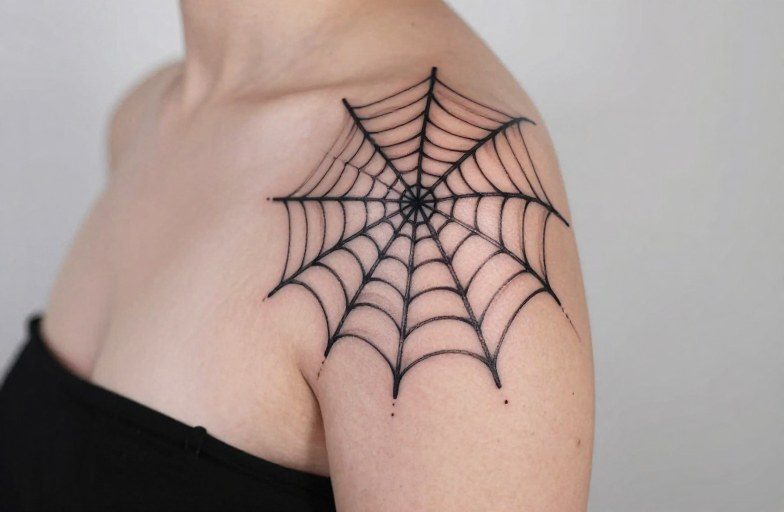
A spider web shoulder tattoo most commonly symbolizes feeling trapped, doing time, or overcoming struggle, but that’s only one layer. On the shoulder specifically, the web’s placement turns the body into a frame, making the skin itself feel like a caught surface. The meaning shifts dramatically depending on if you’re drawing from prison tradition, Native American spider symbolism, or simply the aesthetic of something delicate holding tension against a muscular joint.
Symbolism & Core Meaning
The Prison Connection
The elbow and shoulder web emerged from American prison culture, where each ring of the web could represent years served. On the shoulder rather than the elbow, the web reads less as a “counting” tattoo and more as a statement of being marked by the system. The shoulder placement makes it harder to hide than the back, easier to show than the chest, strategic for someone who wants control over when the story gets told. Not everyone wearing this design has done time; plenty of people get it for the aesthetic without understanding the weight. That disconnect causes real problems in some communities, so know your local context before committing.
Broader Symbolic Readings
Outside prison context, the web represents patience, craft, and the architecture of survival. Spiders build, destroy, and rebuild. The web catches what sustains and what threatens simultaneously. On the shoulder, a joint that rotates, carries, defends, the web becomes a map of how we hold burdens. The negative space matters as much as the lines: what’s caught, what’s missing, what’s torn through. Some wear it as a memorial for someone “caught” in addiction or mental illness. Others use it to mark a period of being stuck and the slow climb out.
History & Cultural Roots
Indigenous and Global Threads
The spider as creator appears across cultures, often linked to weaving and storytelling traditions. In some Native American teachings, Spider Woman brings the skill of weaving. West African Anansi stories cast the spider as trickster and keeper of all stories. These roots rarely connect directly to the shoulder web’s modern popularity, but they explain why the symbol feels loaded even when stripped of context. The tattoo’s history is patchy, no clean origin story, no single inventor. What we know: the shoulder web gained traction in American street and biker culture by the 1970s, often associated with white supremacist prison gangs before spreading wider. That contamination still lingers in certain regions and subcultures.
Subcultural Adoption
Punk and metal scenes picked up the web in the 1980s as general anti-authoritarian imagery, deliberately blurring the prison connection. By the 1990s, it was common enough in tattoo flash sheets that many artists applied it without asking about meaning. The shoulder became the default placement because it follows the natural cap of the deltoid, letting the web’s center sit on the ball of the joint with lines radiating naturally across the upper arm and collarbone area.
Design Tips & Pairings
Line Weight and Web Density
Spider webs fail as tattoos when every line weighs the same. The structural “spokes” need to hit harder than the spiral “capture threads”, usually one needle grouping thicker for the radiating lines, finer for the concentric rings. A common mistake is making the web too symmetrical; real webs have irregular spacing, broken sections, debris caught in the strands. On the shoulder, the web’s center should sit slightly forward of the joint’s rotation point, not dead center, so it reads correctly when the arm hangs naturally. The web needs to extend far enough toward the neck and chest to feel anchored, not like a sticker floating on the muscle.
What Pairs Well
- Spider at the center or escaping the edge: Adds narrative direction, something alive managing the structure.
- Skull in the negative space: Pushes the mortality reading without becoming cliché if the skull is small and integrated.
- Traditional roses or daggers threading through: Classic juxtaposition, works best in American traditional style with bold limited color.
- Moths or flies caught in strands: Literalizes the “trap” meaning; can feel heavy-handed unless rendered with subtlety.
- Barbed wire or chain links replacing outer rings: Explicitly prison-coded; know your audience.
Black and grey realism demands softer, more broken lines in the web. Bold traditional needs cleaner geometry with slight wobble to feel hand-drawn. The shoulder’s curved surface distorts straight lines when the arm moves, design for the relaxed position, accept that stretching happens.
Color vs Black and Grey
When Color Works
Spider webs in color rarely improve the concept. The exception: a single accent, the spider in red, a caught insect in yellow, morning dew as pale blue dots. Full color webs tend to look like clip art or carnival decorations. The shoulder’s large flat planes can handle a background wash behind the web (deep green, night blue, bruised purple), which sets the structure forward without competing. Watercolor-style splashes behind a black web have become common; most age poorly as the color bleeds and the web lines hold, creating a muddy overlap.
Black and Grey Longevity
Black and grey is the honest choice for longevity. The web’s readability depends on contrast between lines and skin, and that contrast fades faster when color competes. Grey wash shading in the web’s “holes” can add depth without sacrificing clarity, but keep it subtle, heavy shading turns the negative space positive and loses the web effect. Aged black and grey webs often look better than fresh ones; the slight blur mimics the organic irregularity of real silk.
How It Ages on Skin
The Shoulder’s Specific Challenges
The shoulder sees sun, friction from bag straps, and constant micro-movement. Spider webs, with their fine parallel lines, are especially vulnerable to blowout and spread. Lines that start at 3mm wide can double in five years. The spiral threads, being closer together, merge into grey bands. Plan for this: ask your artist to space concentric rings slightly wider than looks “perfect” fresh. The web should hold its structure even when lines soften.
Touch-Up Reality
Shoulder tattoos generally heal well, the skin is thick, not too oily, decent blood flow. But the web’s fine lines scab heavily and can lose ink during healing if you’re reaching, lifting, or sleeping on that side. The first two weeks matter enormously. Long-term, expect a touch-up at 5-8 years to redefine the spokes. The center point, where lines converge, tends to blur most; some artists intentionally leave it slightly open to prevent a solid black blob from forming.
Personal & Modern Meanings
Today, people assign their own readings with varying awareness of historical load. Recovery communities sometimes use the web to mark being “caught” and then released from addiction. Artists and makers identify with the spider’s craft. Some simply like how the shoulder’s anatomy accepts radial designs. The meaning you carry matters less than if you’re prepared for what others project onto it. In job interviews, at family gatherings, in certain neighborhoods, this tattoo can close doors or open uncomfortable conversations regardless of your personal intent. That’s not fair, but it’s real. The shoulder’s visibility makes it a deliberate choice about public identity.
Modern variations try to distance from prison coding: webs with flowers growing through them, geometric webs that abandon the traditional spiral, webs placed higher toward the neck or lower on the upper arm. These shifts work aesthetically but don’t fully erase the symbol’s weight. If you’re drawn to this image, sit with why. The best reason is specific to you, not borrowed from a Pinterest caption.
Key Takeaways
A spider web shoulder tattoo carries genuine historical weight that can’t be decorated away, but also genuine personal flexibility in how you inhabit the symbol. The shoulder placement exploits the body’s natural geometry while making the design impossible to ignore. For longevity, prioritize black and grey, varied line weights, and slightly exaggerated spacing between spiral threads. Research your local context, this tattoo signals differently in a rural Texas shop than a Brooklyn studio. The web’s power is in its tension: beauty and threat, structure and fragility, what holds and what traps. Build yours knowing both sides.
Frequently Asked Questions
Does a spider web shoulder tattoo always mean someone went to prison?
No, though the design originated in American prison culture. Many people wear it for aesthetics, craft symbolism, or personal struggle. Context and accompanying imagery matter more than the web alone.
How painful is getting a spider web tattoo on the shoulder?
The shoulder cap rates moderate, bone near the surface hurts more, the outer deltoid less. The fine, repetitive lines of a web can feel like scratching sunburn by the end of a longer session.
Will a spider web tattoo on my shoulder stretch if I build muscle?
Moderate muscle growth won’t distort it badly, but significant bodybuilding can widen the web’s center. The shoulder’s rotation point shifts less than the bicep or thigh with growth.
Can I cover up an old spider web shoulder tattoo with something completely different?
Covering dense black web lines is challenging. The radiating spokes create a strong pattern that limits coverup options. Laser lightening first, or incorporating the web into a larger dark design like a mandala or animal portrait, works better than direct replacement.
Leave a Reply