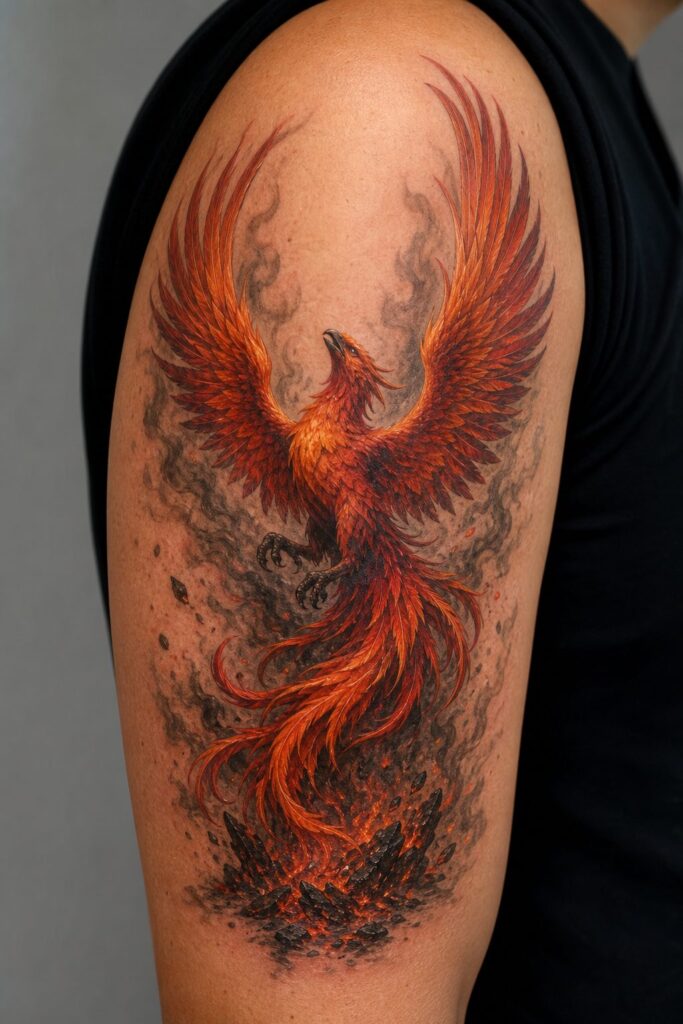
A phoenix rising from the ashes tattoo represents rebirth after destruction, the cycle of burning down and building back stronger. It’s one of the most requested mythological designs in shops, and for good reason, the imagery carries immediate emotional weight without needing explanation. The core meaning centers on survival: not avoiding hardship, but emerging from it transformed.
Symbolism & Core Meaning
Fire destroys and creates simultaneously. The phoenix embodies that paradox, consuming itself to be born again. This makes the design especially resonant for people who’ve survived addiction, divorce, career collapse, or health crises. The ashes aren’t decorative; they’re the point. The tattoo acknowledges that something had to die for the current self to exist.
The Ashes as Active Element
Many designs treat the ashes as mere background, but the strongest compositions make them integral. Swirling grey particles, ember fragments, or scorched earth beneath the bird ground the image in the moment of transformation rather than just showing a pretty bird. This visual emphasis shifts the tattoo from generic “strength” symbolism to something more specific: the messiness of actual recovery.
Direction of Flight
Upward trajectory reads as triumph and forward motion. Some collectors prefer the phoenix mid-burst, wings still partially skeletal, emphasizing the incompleteness of renewal, becoming rather than arrived. Others choose the bird fully formed, ascending with flames trailing. Neither is “correct”; the direction changes the emotional register from struggle to resolution.
How It Ages on Skin
Phoenix designs live or die on line weight and contrast. The intricate feather details that look stunning fresh often blur into muddy texture within five to seven years. Fine single-needle work in the flames particularly suffers, what reads as delicate energy becomes indistinct grey wash.
Feather Strategy
Large, simplified feather groupings age cleaner than individually rendered plumes. Think graphic shapes with defined negative space rather than photorealistic barbs. The tail especially needs bold structure; it’s typically the largest area and first to lose definition. A skilled artist builds feather texture through varied line weights and limited stippling, not dense crosshatching that will settle into solid grey.
Fire and Ash Longevity
Red and orange inks fade faster than black, shifting toward pink and peach. This actually works for some designs, cooling embers rather than active flames. If you want sustained intensity, saturated magentas and deeper crimsons outlast bright orange. Black and grey ashes hold indefinitely but need sufficient density; too light and they disappear into skin tone, too heavy and they read as solid black blobs.
Color vs Black and Grey
Color phoenix tattoos dominate the market, but black and grey versions carry different weight. Full color emphasizes the supernatural, the literally mythological, this bird doesn’t exist in nature. Black and grey reads more somber, more about the ashes than the fire, more funereal rebirth than triumphant explosion.
- Color pros: immediate visual impact, flame readability, traditional Japanese and Chinese reference points
- Color cons: higher cost, longer sessions, faster fading in yellows and oranges, more frequent touch-ups
- Black and grey pros: timeless aesthetic, better aging, often faster healing, works at smaller sizes
- Black and grey cons: can lose the “fire” element without careful design, reads as generic bird tattoo from distance
Some of the most effective designs split the difference: black and grey body with selective color in the flames or a single accent feather. This preserves longevity while maintaining the fire’s presence.
Design Tips & Pairings
Placement shapes the composition dramatically. The phoenix’s wingspan demands horizontal space, upper back, chest, outer thigh, or wrapping the ribs. Vertical placements like forearms or calves require the bird to fold or spiral, which changes the energy from ascension to coiled potential.
Complementary Elements
Clocks and hourglasses pair naturally but risk cliché unless stylized uniquely. More interesting additions include: broken chains (liberation from what burned), geometric frames containing the chaos (order from destruction), or negative-space silhouettes of the “old self” in the ash clouds. Some collectors integrate actual scar tissue into the ash design, making the body’s history part of the symbolism.
Scale Reality
Below palm-sized, the phoenix becomes unrecognizable, a bird with some lines. Minimum effective size for readable detail is roughly six inches in wingspan. Sleeve or back-piece scale allows the full narrative: burning, ashes, emergence, flight. Small designs must sacrifice either the flames or the ashes, weakening the core concept.
Personal & Modern Meanings
Contemporary collectors rarely reference the classical phoenix’s thousand-year cycle. Instead, the tattoo marks specific, recent transitions: sobriety anniversaries, post-chemotherapy milestones, gender affirmation, leaving religious communities, surviving violence. The meaning contracts to human scale, rebirth not as cosmic event but as Tuesday morning decision to keep going.
Some wear the phoenix preemptively, not commemorating survival but committing to it. This shifts the tattoo from memorial to promise, which carries its own pressure. The image becomes accountability: you marked yourself as someone who rises, so you have to.
Community Reclamation
Phoenix imagery has been adopted by specific recovery communities, sometimes with shared visual conventions that signal membership. This can create unexpected connection or unwanted disclosure, depending on the wearer’s preference for privacy. The design’s popularity means it doesn’t automatically read as “recovery tattoo” to general observers, but insiders may recognize particular stylistic choices.
History & Cultural Roots
The phoenix myth spans multiple ancient cultures, often linked to Egyptian Bennu bird traditions, though direct continuity is debated. Greek sources from Herodotus onward describe the Arabian phoenix, emphasizing its solitary death and regeneration. Chinese fenghuang and Japanese hō-ō share some visual characteristics but carry distinct cultural meanings, imperial virtue, harmonious rule, the union of yin and yang.
Western tattooing adopted the phoenix through sailor and military traditions, where it commonly marked survival of shipwreck or combat. The “rising from ashes” specific imagery became dominant in American tattooing during the 1970s-80s, as the counterculture embraced personal transformation narratives. Earlier traditional versions often showed the bird perched or in flight without the destruction element.
Appropriation Considerations
The fenghuang and hō-ō are not interchangeable with Western phoenix imagery. Specific color conventions, companion elements, and directional orientation carry cultural significance. If your design references these traditions, research matters, consulting with artists from those cultural backgrounds prevents flattening complex symbols into generic “exotic bird” aesthetics.
Before You Decide
Ask yourself what specifically burned. The phoenix tattoo works best with concrete memory, not vague aspiration. If you can’t articulate what the ashes represent, the design risks becoming decorative rather than meaningful. That doesn’t invalidate the choice, plenty of beautiful tattoos exist purely as visual preference, but the phoenix specifically asks for context.
Consider timing. Getting this tattoo during active crisis can feel urgent and necessary, but the design you’ll want at your five-year survival mark may differ from what you need at month three. Some artists recommend waiting; others understand the tattoo as part of the process itself. Neither position is universally correct.
Finally, budget for quality. This design fails cheaply. Bad line work on a phoenix doesn’t read as charming folk art; it reads as wrong bird, wrong anatomy, wrong energy. The flames especially expose technical weakness. Save for the artist whose portfolio demonstrates they understand fire as structure, not just decoration. Your future self, looking at this mark for decades, will notice the difference daily.
Frequently Asked Questions
Does a phoenix rising from ashes tattoo work on dark skin?
Absolutely, but design choices matter. High contrast and bold lines read clearer than fine detail. Some color inks, particularly lighter yellows and oranges, may need adjustment for visibility, but deep crimsons, magentas, and solid black perform beautifully. An experienced artist adjusts values for your specific skin tone rather than using a one-size-fits-all approach.
How long does a detailed phoenix tattoo take?
A full back piece with flames and ashes typically requires 15-25 hours across multiple sessions. Smaller designs with limited detail might finish in 3-5 hours. The color saturation needed for effective fire imagery generally adds time compared to black and grey work. Healing between sessions affects total timeline more than chair time alone.
Can a phoenix tattoo cover old scars or tattoos?
The design adapts well to cover-ups because the flames and ashes naturally incorporate irregular textures. Dark scars can become part of the ash field; raised tissue reads as ember or debris. However, the bird itself needs relatively smooth skin for proper feather detail. A consultation with specific attention to your scar or old tattoo placement determines feasibility.
What’s the difference between a phoenix and an eagle tattoo?
Anatomically, phoenixes allow artistic liberty, elongated tails, flame-shaped feathers, impossible wing structures. Eagles demand biological accuracy for recognition. Symbolically, eagles represent power, nation, or predatory focus; phoenixes center on transformation through destruction. The phoenix carries narrative weight that the eagle typically doesn’t: something had to end for this image to matter.


Leave a Reply