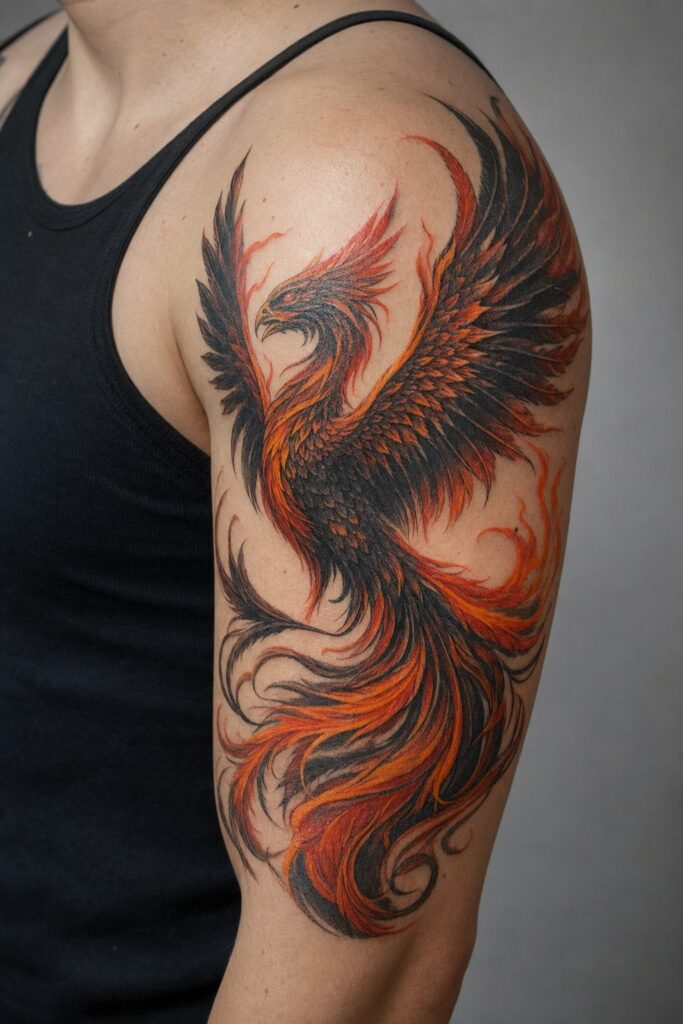
A phoenix bird tattoo primarily means rebirth through destruction, rising renewed after everything burns down. The design speaks to survival, second acts, and the refusal to stay defeated. Most people who choose it have lived through something specific: divorce, recovery, career collapse, or the loss of someone they weren’t sure they’d survive losing.
Symbolism & Core Meaning
The phoenix carries layered symbolism that shifts slightly depending on how you render it. At its foundation, the bird represents cyclical renewal, the idea that endings feed beginnings. Unlike generic “strength” tattoos, the phoenix specifically acknowledges that growth requires ash. The fire isn’t optional; it’s the mechanism.
Placement Changes the Message
Where you put this tattoo alters how it reads. A phoenix across the upper back, wings spread, suggests emergence and forward motion, literally rising. On the chest over the heart, it tends to signal emotional survival: grief, heartbreak, or psychological rebuilding. Forearm or wrist placements keep the reminder visible, which suits people actively working through recovery rather than commemorating something finished. Ribs and thighs offer space for detailed flame work but hurt more during application; the pain becomes part of the ritual for some.
Line Work vs. Shading vs. Full Color
Line-only phoenix designs read cleaner but age faster. Single-needle outlines blur after five to seven years, especially in the wing feathers. Heavy black shading holds contrast longer and suits the charred-to-renewed narrative. Full color demands more touch-ups but makes the fire read immediately. Most artists recommend bold outlines with selective color saturation if you want longevity without sacrificing impact.
Color vs Black and Grey
Color choices carry specific weight with this design. Traditional red, orange, and yellow flames dominate, but the palette you choose signals different nuances.
What Different Colors Communicate
- Red and orange: Classic destruction-to-rebirth narrative. Reads as passionate, urgent, almost aggressive in its renewal.
- Blue or purple flames: Spiritual or intellectual rebirth rather than emotional. Suggests transformation through insight, not just endurance.
- Gold accents: Often linked to solar symbolism, some trace it to Egyptian Bennu connections. Reads as triumphant, almost regal.
- Black and grey: Mourning and recovery intertwined. The absence of color can signal that the fire is past, the rebuilding is present.
Black and grey phoenixes also age more gracefully on skin types that hold red ink poorly. Reds are notorious for fading to pink or orange-brown within a few years, especially with sun exposure. If you’re set on crimson flames, budget for a saturation pass every three to five years.
Religious & Spiritual Angles
The phoenix isn’t tied to one tradition, which makes it adaptable but also occasionally misunderstood.
Christian Interpretations
Early Christian writers sometimes used the phoenix as a resurrection symbol, though this was allegorical, not doctrinal. The bird appears in medieval bestiaries and some Old English poetry as a Christ figure. Modern Christian wearers often emphasize the three-day death-and-rebirth parallel, though this requires some interpretive stretching, the phoenix myth lacks a specific timeline.
Eastern and Esoteric Traditions
In Chinese tradition, the Fenghuang (often conflated with the phoenix) represents virtue and grace rather than rebirth, it’s a different bird with separate symbolism. Japanese Ho-ō imagery shares visual DNA but carries imperial and Buddhist associations. Western esoteric traditions sometimes link the phoenix to alchemical transformation, the “nigredo” stage of breaking down before refinement. Tattoo clients drawn to this angle often request ouroboros elements or planetary symbols integrated into the design.
History & Cultural Roots
The phoenix myth spans multiple ancient cultures, though the versions diverge significantly.
Greek and Roman Sources
Herodotus and Pliny the Elder described the bird as a rare, single creature that regenerates from its own pyre. The lifespan varies by source, 500 years, 1,461 years, or 12,954 years depending on the text. This inconsistency matters for tattoo symbolism: there’s no canonical “correct” version, which gives artists and wearers freedom to interpret.
Egyptian and Near Eastern Connections
The Bennu bird of Egyptian mythology, often linked to the sun god Ra and the cycles of time, shares visual and thematic overlap with the Greek phoenix. Some scholars argue the Greek myth borrowed from Egyptian sources; others see independent development. For tattoo purposes, the Bennu connection offers an alternative visual language, more heron-like, less eagle-based, often rendered with solar disks rather than flames.
Medieval European heraldry adopted the phoenix as a symbol of renewal and unwavering commitment. This lineage survives in some family crest tattoos and military unit insignia where the bird appears.
Who Chooses This Tattoo
Certain life patterns show up repeatedly among phoenix clients, though there’s no single type.
Common Motivations
- Addiction recovery: The destruction-rebirth arc maps cleanly onto sobriety narratives. Often paired with dates or clean-time markers.
- Post-divorce or breakup: Especially when the relationship defined a long portion of the wearer’s identity.
- Career collapse and reinvention: Layoffs, business failures, or leaving high-status fields for uncertain paths.
- Health crises: Cancer remission, surgical recovery, or managing chronic conditions that flare and remit.
Age distribution skews slightly older than average tattoo demographics, late twenties through forties rather than early twenties. The design requires lived experience to feel authentic rather than aspirational. Younger wearers sometimes choose it preemptively, which can read as tempting fate or simply premature.
Similar & Related Symbols
People considering phoenixes often compare them to related imagery. Understanding the distinctions helps clarify what you actually want.
Phoenix vs. Dragon
Dragons symbolize power, protection, or chaos depending on cultural context. They don’t inherently carry the destruction-rebirth cycle unless specifically rendered with self-immolation imagery. A dragon coiled in flames borrows phoenix language; a dragon alone doesn’t.
Phoenix vs. Ouroboros
The snake eating its own tail represents eternal cycles, but without the fire and without the explicit improvement narrative. Ouroboros suggests repetition; phoenix suggests escalation and transformation. Some designs combine both, which can read as cyclical rebirth or as confused symbolism depending on execution.
Phoenix vs. Lotus
The lotus rises from mud, not fire. Its symbolism is gentler, purity emerging from difficulty rather than identity forged through destruction. Lotus designs suit growth narratives; phoenixes suit survival narratives. The distinction matters for personal alignment.
Phoenix vs. Koi Dragon
The Japanese koi transforming into a dragon through waterfall struggle shares the perseverance-through-trial theme but lacks the total destruction element. The koi keeps its essential nature; the phoenix must become ash first.
The Bottom Line
A phoenix tattoo works best when the fire in your design references actual fire you’ve walked through. The symbolism is specific enough to feel hollow if applied generically, it’s not a default resilience symbol like a semicolon or a lotus. Work with an artist who understands feather anatomy and flame dynamics; bad phoenixes look like rubber chickens in campfires. Budget for color maintenance if you go bright, and consider whether you want the bird ascending, descending into flame, or mid-transformation. Each phase tells a different story. The most successful pieces leave room for the next cycle, because the myth isn’t about arriving, it’s about continuing.
Frequently Asked Questions
Does a phoenix tattoo always have to include flames?
No, but removing the fire shifts the symbolism significantly. Flameless phoenixes can read as generic birds unless other elements, ash, smoke, or a rising posture, carry the rebirth narrative. Discuss the visual shorthand with your artist.
How well does a phoenix tattoo age on hands or fingers?
Poorly. The fine feather details and gradient flame work that make phoenixes striking blur fastest on high-movement, high-sun areas. If you want longevity, stick to larger placements with more stable skin.
Can a phoenix tattoo be small and still work visually?
Under three inches, feather detail becomes muddy and flame reads as blob. Small phoenixes sacrifice the grandeur that makes the symbol effective. Consider a phoenix feather or ash motif instead for smaller scales.
Is it culturally appropriative to get a phoenix if I’m not Greek or Egyptian?
The phoenix exists across enough traditions and lacks sacred restriction in modern practice that appropriation concerns are minimal. Be accurate about which cultural version you’re referencing, and avoid mixing unrelated sacred elements from separate traditions.
Related Tattoo Meanings
One response to “Phoenix Bird Tattoo Meaning: Symbolism, Color & Style Guide”
[…] Phoenix Bird Tattoo Meaning: Symbolism, Color Style Guide […]
Leave a Reply