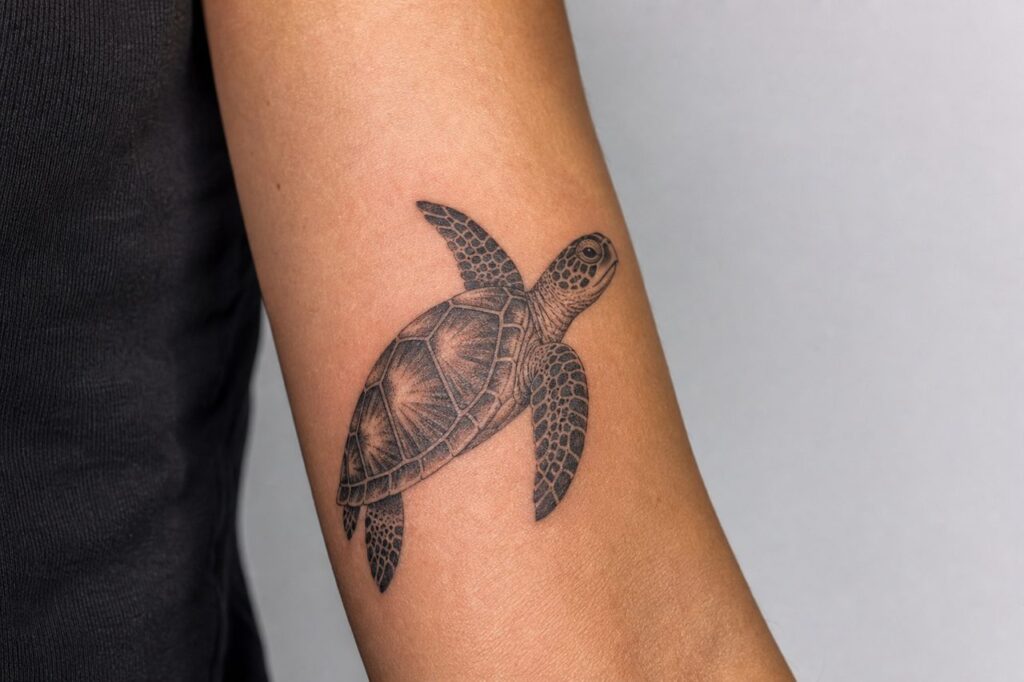
A turtle tattoo most commonly represents longevity, patience, protection, and a steady, grounded approach to life. Across many cultures, the turtle carries the world on its back or emerges from the sea as a symbol of creation and endurance. The meaning shifts with specific imagery, an all-seeing eye on the shell, a sea turtle mid-swim, or a geometric tribal pattern each carries its own weight.
Symbolism & Core Meaning
The turtle’s biology feeds its symbolic power. Slow metabolism, hard shell, long lifespan, roughly 80 to 150 years for many species, with some giant tortoises pushing past 200. That physical reality translates into universal associations: persistence, self-protection, and the wisdom of taking your time.
Water connects turtles to emotional depth and intuition; land ties them to stability and foundation. A turtle tattoo can signal someone who moves deliberately through life, who values home and safety, or who has survived hard seasons by retreating into inner strength.
Shell as Shield and Home
The shell deserves its own focus. Unlike a hermit crab’s borrowed shelter, the turtle’s shell grows with its body, bone fused to spine and ribs. Tattoo designs often exploit this: mandala patterns mapping onto shell segments, family names tucked into scute borders, or realistic cracks showing damage survived. A broken shell mended with gold, kintsugi-style, speaks to repair and resilience without needing words.
Direction and Movement
- Swimming upward: aspiration, breaking through difficulty
- Descending: introspection, diving deep
- Side-profile crawl: steady progress, marathon not sprint
- Top-down view: wholeness, seeing the full picture
Religious & Spiritual Angles
Native American traditions, particularly Iroquois and Lenape, often linked the turtle to creation, North America itself as “Turtle Island,” carried on the back of a giant turtle after a flood. Some Hindu traditions trace the world-supporting turtle to Kurma, the second avatar of Vishnu, who supported Mount Mandara during the churning of the cosmic ocean. In Chinese cosmology, the turtle is one of the “Four Auspicious Beasts,” associated with north, winter, water, and endurance.
Taoist and Buddhist Threads
In Taoist practice, the turtle sometimes pairs with the crane as a longevity symbol, black tortoise xuanwu guarding the northern sky. Buddhist interpretations lean toward the turtle’s withdrawal into shell as meditation, the still point within. A tattoo drawing on these traditions needs accuracy; a lotus blooming from a turtle’s back fuses two potent symbols but risks cultural mashup if handled carelessly. Research matters, and so does the artist’s familiarity with the specific visual language.
Common Variations & Styles
Realistic sea turtles dominate coastal shops, especially in Florida, Hawaii, and California. These pieces demand technical skill: the shell’s dimensional texture, the flipper’s membrane-thin edge, the way light refracts through water. A strong realistic piece works best at palm-size or larger; smaller than three inches, shell detail muddies into grey blur within a few years.
Tribal and Polynesian Influences
Polynesian honu designs carry specific lineage. The shell pattern, flipper markings, and surrounding enata (human figures) encode family history and status. These aren’t decorative templates to grab from Pinterest, authentic work requires consultation with artists trained in the tradition. Many Polynesian practitioners now distinguish between commissioned cultural work and inspired-by pieces; respect the boundary.
Illustrative and Neo-Traditional
Neo-traditional turtle tattoos often feature jewel-toned shells, decorative bordering, and stylized wave backgrounds. Illustrative approaches might show a turtle as a living landscape, mountains on its shell, a forest growing from its back. These work well on thighs, ribs, and upper arms where the curved canvas matches the animal’s form.
Color vs Black and Grey
Color brings obvious impact to sea turtle tattoos: the amber and green of a hawksbill’s shell, the blue-grey of a leatherback’s watery home. But color fades, especially the yellows and soft greens most characteristic of turtle imagery. Expect significant saturation loss by year five without religious sun protection; plan for touch-ups.
Black and grey ages more gracefully, particularly for detailed shell work. Single-needle black ink can achieve remarkable texture in scute patterns, and the natural grey wash of aging ink actually suits the weathered, ancient quality turtles embody. For a piece meant to read as timeless rather than bold, black and grey often wins.
Strategic Color Placement
- Limit bright color to focal points: eye, shell center, or a single accent flower
- Background water in muted blue-grey; let the turtle carry the warmth
- Consider red sparingly, culturally loaded, visually aggressive, but powerful for protection symbolism
Personal & Modern Meanings
Contemporary wearers layer personal narrative onto traditional symbolism. A turtle tattoo might mark recovery from illness, slow healing, carrying your protection with you. Parents sometimes choose turtles for children born prematurely, honoring the months in NICU as a kind of shell-bound development. Others get turtles after major relocations, the animal’s home-on-its-back resonating with rootlessness and self-sufficiency.
Environmental and Conservation Connections
Sea turtle populations face documented threats: plastic ingestion, nesting habitat loss, poaching. Some wearers choose the tattoo as quiet advocacy, a permanent reminder of marine vulnerability. Artists increasingly incorporate ghost nets, plastic fragments, or entanglement scars into designs, visually striking, morally loaded. These pieces work best when the environmental element is integrated, not pasted on; a six-pack ring cutting into a flipper is more affecting than a generic “save the turtles” banner.
Similar & Related Symbols
Tortoise versus turtle matters in some contexts. Land-dwelling tortoises emphasize groundedness, slowness, ancient wisdom; sea turtles add migration, navigation, and the ocean’s emotional symbolism. Choose deliberately.
Related imagery that pairs well: the octopus (shared marine intelligence, contrasting softness), the anchor (stability, but external rather than internal), the ouroboros (cyclical time versus linear longevity). A turtle with a compass rose on its shell fuses navigation and self-direction; a turtle carrying a city on its back references both Discworld fantasy and genuine mythological precedent.
The Takeaway
A turtle tattoo succeeds when the specific imagery matches the specific meaning you want to carry. The general symbolism, longevity, patience, protection, is broad enough to fit many lives, but the best pieces narrow it down: a particular species, a particular moment of movement, a particular cultural tradition. Work with an artist who understands shell anatomy and how to render it at your chosen size. Plan for aging, especially with color. And know that unlike trend-driven imagery, the turtle’s associations have held for millennia; this is one tattoo unlikely to embarrass you at fifty.
Frequently Asked Questions
What’s the best placement for a turtle tattoo to show shell detail?
The upper thigh, outer arm, and ribs provide curved surfaces that complement the turtle’s rounded form. Flat areas like the forearm or back work too, but the shell’s dimensionality reads more naturally when it follows body contour. Avoid spots where the skin stretches significantly, like the stomach, if you want fine scute patterns to hold.
Do turtle tattoos have to be large to look good?
Not necessarily, but detail suffers below three inches. Small turtles work better as simple silhouettes, minimal line work, or tiny flash-style designs. If you want realistic shell texture or Polynesian patterning, commit to at least palm-sized placement.
How do I avoid culturally appropriating Polynesian turtle designs?
Learn the difference between inspired-by work and sacred ta moko or tatau. Many Polynesian artists distinguish between cultural tattoos for Polynesian clients and stylized pieces for others. If you’re not Polynesian, avoid specific family symbols, and consider commissioning an artist from that tradition rather than copying patterns from image searches.
Why does my artist recommend black and grey over color for a turtle?
Turtle shells naturally feature muted earth tones, olive, amber, brown, that fade faster than bolder palettes. Black and grey ages more predictably and can achieve remarkable texture through dotwork and whip shading. If you want color, consider limiting it to one accent area and accepting future touch-ups.
Leave a Reply