An elephant tattoo most commonly signals strength without aggression, deep family loyalty, and sharp memory. The animal’s matriarchal herds and famous recall make it a natural symbol for anyone who values who they carry with them. Beyond the obvious, elephants also represent patience, longevity, and the ability to endure hardship without losing gentleness.
Common Variations & Styles
How you render the elephant changes what the tattoo emphasizes. A charging bull with tusks forward reads as raw power and protection. A mother with calf tucked beneath her hits the family note immediately. Solo elephants walking away create a quieter, more contemplative mood, sometimes chosen after loss, sometimes simply to suggest moving forward.
Minimalist Line Work
Single-needle or fine-line elephants strip the image to silhouette or contour. These age faster than bold traditional work; lines blur and thin areas can drop out entirely within five to seven years. The trade-off is elegance and placement flexibility, behind the ear, along the collarbone, or wrapped around a wrist. Best for someone who wants the symbol present but not shouting.
Realistic & Neo-Traditional
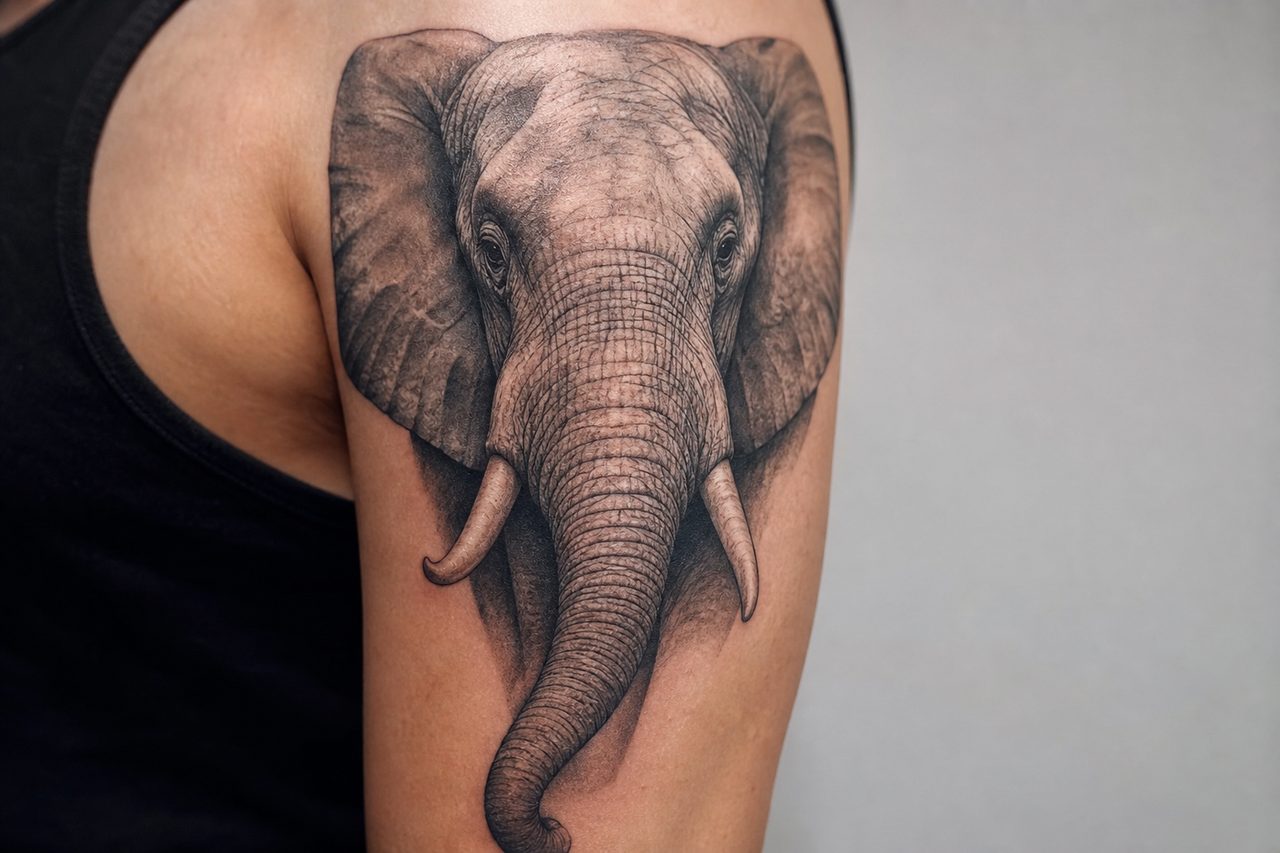
Realistic portraits capture wrinkled skin texture and eye detail, which holds up better at larger sizes. Neo-traditional versions use bold outlines with limited but saturated color blocks, think deep teals, dusty roses, or mustard yellows against black. Both styles demand serious skin real estate; an elephant’s head alone needs at least palm-sized space to read clearly.
Color vs Black and Grey
Color choices shift the emotional temperature. Black and grey emphasizes gravity, timelessness, and the sculptural quality of an elephant’s form. The heavy skin folds render beautifully in greywash, creating natural depth without needing hue.
Earth Tones & Accents
When color does appear, it often carries specific weight. Deep reds and golds connect to Ganesh and Hindu ceremonial tradition. Dusty savanna oranges and browns ground the piece in African landscape. Bright, unnatural colors, electric blues, neon pinks, tend to read as playful or ironic, which can undercut the traditional symbolism unless that’s the intent.
One practical note: the grey and pink of an elephant’s natural skin is notoriously hard to match in tattoo pigment. Most artists build “grey” from black wash rather than trying to nail that specific tone, which actually ages better anyway.
Religious & Spiritual Angles
In Hindu practice, Lord Ganesh, the elephant-headed deity, removes obstacles and blesses new beginnings. Tattoos of Ganesh specifically carry devotional weight and should be approached with cultural awareness, not just aesthetic appreciation. A full Ganesh is a religious icon, not a decorative animal.
Buddhist symbolism often uses the elephant to represent mental strength and the taming of desire. The Buddha’s mother dreamt of a white elephant before his birth, making the white elephant specifically an auspicious sign in several Asian traditions. White ink on darker skin creates a subtle, scar-like effect that some choose for this association, though it yellows unpredictably over time.
Modern Spiritual Use
Outside formal religion, elephants frequently appear in mindfulness and recovery communities. The animal’s slow, deliberate movement and long memory serve as metaphors for staying present and learning from past experience without being chained to it. This usage tends toward simpler, more meditative imagery, single elephants in profile, eyes closed or half-lidded.
History & Cultural Roots
Elephant imagery in body art stretches across continents, though specific meanings vary sharply. African traditions often linked the elephant to chiefdom, wisdom, and ancestral connection, killing one historically required ritual justification in many societies. Southeast Asian war elephants and their riders appear in Thai and Khmer temple art, sometimes reproduced in tattoo form.
The Western adoption of elephant tattoos accelerated through colonial-era fascination and later conservation movements. Modern Western wearers rarely invoke specific African or Asian lineage, which raises ongoing questions about cultural borrowing versus appreciation. The symbol has become genuinely global, but its origins remain geographically specific and worth knowing.
Colonial-Era Imagery
British and French colonial forces used elephant iconography in regimental badges and insignia. Some vintage-style tattoos reference this visual language, often without the wearer realizing the imperial baggage. Worth researching if you’re drawn to that particular aesthetic.
Best Placements
Elephant tattoos need room to breathe. The head’s proportions, large ears, distinctive trunk, heavy brow, distort badly when compressed. That said, clever placement can solve scale issues.
- Upper arm/shoulder: Classic for full profiles or head-and-trunk compositions. The natural curve of the deltoid echoes the elephant’s brow ridge. Heals well, ages well, easy to show or cover.
- Thigh: Excellent for larger pieces, especially family groupings or elephants with detailed environment. The skin here is stable and holds saturation.
- Ribcage: Painful, but the vertical space suits a standing elephant or trunk-reaching pose. Wrinkled skin texture in this area can blur faster due to movement.
- Forearm: Works for smaller, bolder designs. A trunk wrapping around the wrist creates natural flow, but fine details in the face will soften within a few years.
- Back: Only placement that truly accommodates a full scene, herd, landscape, sky. Demands commitment and budget.
Trunk direction carries folk meaning in some traditions: upward for luck and prosperity, downward for mourning or grounded energy. Most Western artists treat this as optional symbolism rather than rigid rule.
Mythology & Folklore
Elephants populate origin stories across their range. In some African tales, the elephant carries the world on its back or created the first rivers with its trunk. Southeast Asian folklore often casts the elephant as a shape-shifter or forest spirit, wise but dangerous when disrespected.
The White Elephant
The “white elephant” gift exchange takes its name from a Thai tradition where rare albino elephants were given to courtiers who couldn’t refuse but couldn’t afford to maintain them, ruining the recipient through obligation. This double-edged quality, blessing and burden together, occasionally surfaces in tattoo choices: the white elephant as beautiful weight, something precious that costs.
Memory and the Afterlife
Several cultures link elephants to death and memory specifically. Their reputed graveyards and mourning behavior, touching bones of the dead, standing vigil, make them natural memorial tattoo subjects. A common composition shows an elephant facing or walking toward a setting sun, sometimes with dates or names integrated into the landscape.
Key Takeaways
An elephant tattoo works best when the specific symbolism matters to you, family, endurance, memory, spiritual protection, and when the style matches that intent rather than defaulting to whatever image shows up first in search results. The image carries enough cultural weight that a little research pays off, especially around religious imagery like Ganesh.
Technically, prioritize bold readable shapes over fine detail unless you’re committing to large scale and ongoing touch-ups. The elephant’s silhouette is instantly recognizable; that’s your safety net as the tattoo ages. Work with an artist who understands how skin holds ink, not just how to draw the animal on paper.
Finally, trunk up or down, color or black, realistic or stylized, the core meaning remains: something heavy that moves with purpose, remembers what matters, and protects its own.
Frequently Asked Questions
Does the direction of the elephant’s trunk actually matter for luck?
Trunk-up is widely considered lucky in several folk traditions, especially Thai and Indian. Trunk-down emphasizes grounding, storage, or mourning. Most modern wearers choose based on composition rather than superstition, but the symbolism is genuine in origin cultures.
How well do elephant face tattoos age on smaller areas like wrists?
Facial detail, eyes, wrinkles, ear texture, blurs significantly on small scales within five years. A bold silhouette or solid black profile holds much better. If you want a small piece, simplify rather than miniaturize.
Is it culturally appropriate for non-Hindus to get a Ganesh tattoo?
Ganesh is a religious deity, not decorative imagery. Many Hindu practitioners find non-devotional use disrespectful. If you’re drawn to the elephant-headed form, consider whether your connection is spiritual enough to justify the choice, or choose a secular elephant instead.
What’s the most painful placement for an elephant tattoo?
Ribcage and sternum hurt most due to thin skin over bone. The trunk wrapping around a wrist or finger also sits on sensitive, high-movement areas. Thigh and outer upper arm are generally most manageable for larger pieces.