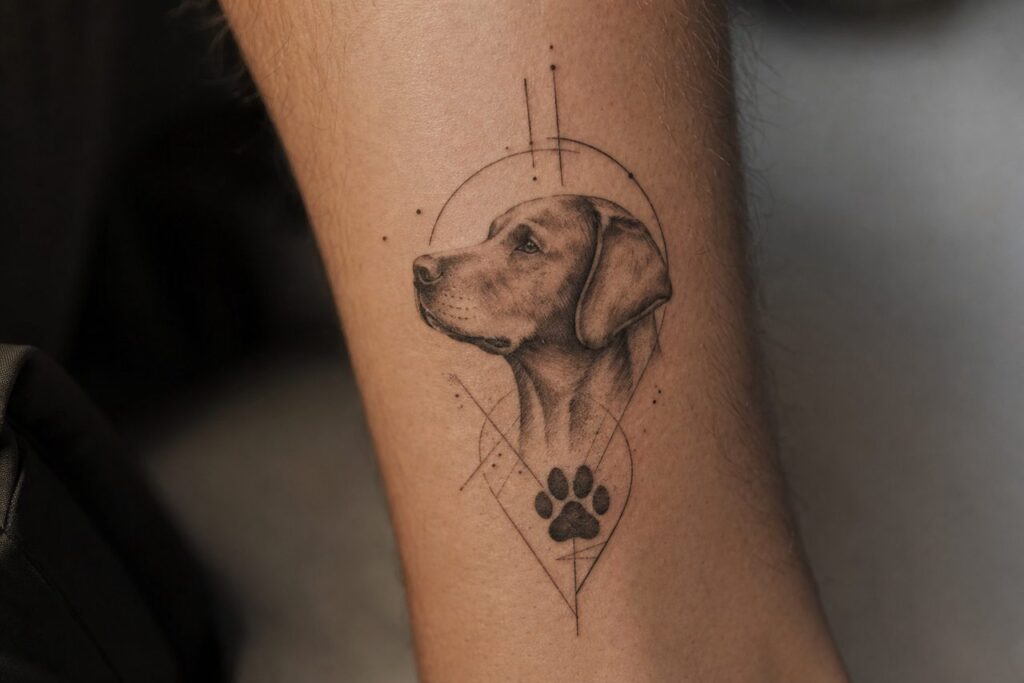
The symbol of the dog in tattoo culture carries weight that predates most written language. it represents loyalty without condition, the guardian instinct, and the human-animal bond that shaped civilization itself. People choose this symbol to honor deceased pets, to mark themselves as protectors of family, or to claim the dog’s traits as personal virtues, persistence, alertness, devotion that outlasts convenience.
Color vs Black and Grey
The choice between color and monochrome changes what the symbol communicates and how it holds up over decades.
Black and Grey Realism
Black and grey excels for dog portraits and breed-specific work. The tonal range captures fur texture, the wet shine of a nose, the depth of eye color through shading alone. Labs, shepherds, and pit bulls translate particularly well, their coat variations read clearly in greyscale. This approach also ages more predictably; black ink stays stable while color shifts, and greywash backgrounds soften naturally rather than turning muddy.
Color Symbolism
Color carries specific associative weight. Golden tones suggest warmth and domesticity. Deep reds and blacks evoke the hellhound or guardian hound of folklore. Blues and purples, rarely seen in natural dog coloration, push the image toward the spiritual or memorial. Watercolor-style color splashes behind a solid dog silhouette create contrast but require touch-ups sooner, the lighter pigments fade faster, especially on high-friction areas like forearms or calves.
Design Tips & Pairings
Placement and companion elements determine whether the symbol reads as personal tribute or broader statement.
Effective Placements
- Forearm or calf: Long vertical space suits running or standing dog poses; visible enough for conversation, easy to reference personally.
- Shoulder or upper arm: Wraps well with circular compositions, dogs curled in sleep, or the Celtic-style hound chasing its tail.
- Chest over heart: Standard for memorial pieces; the proximity to the heartbeat matters to people who’ve lost a specific animal.
- Thigh: Accommodates larger breed portraits with room for environmental detail, grass, water, a favorite toy.
Common Pairings
Dog symbols pair naturally with objects that clarify intent. A dog with a military helmet or flag background marks service animal connection or K9 unit membership. Dogs with hourglasses or dates specify memorial context. Paired with a human figure, child, ancestor, or self-portrait, the composition becomes narrative without needing text. Avoid overloading small pieces; a dog’s head with a single rose or name banner carries more impact than cluttered scenes.
How It Ages on Skin
Dog tattoos face specific aging challenges based on their typical design elements.
Fine fur detail, individual hair strokes, whisker dots, the texture of a wet nose, spreads over time. Lines that read as “realistic fur” at two years can become uniform grey texture by ten. The solution is building texture through stippling and dotwork rather than hair-thin lines, or committing to periodic refresh sessions every 5-8 years.
White ink highlights on noses or eye reflections yellow or disappear entirely on most skin tones. Experienced artists now substitute light greywash for white, creating the illusion of shine through contrast rather than relying on pigment that won’t last.
Large black areas in silhouettes or tribal-style hound designs hold up well but can blow out at edges where the stencil sat heavy or the artist overworked the skin. The dog’s recognizable silhouette, pointed ears, snout shape, tail carriage, survives moderate spreading better than more ambiguous symbols; the brain fills in canine identity even when details soften.
Mythology & Folklore
The dog’s symbolic presence spans cultures with remarkable consistency, though specific attributions vary.
European and Celtic Traditions
Celtic art often linked the hound to healing and the hunt. The Gaelic cu sith (fairy hound) was a harbinger of death, enormous and green, yet also associated with the underworld’s capacity for transformation. Greyhounds and wolfhounds appeared on warrior armor and high crosses, guardians of thresholds between living and dead. Norse mythology placed Garmr at the gates of Hel, a blood-stained watchdog paralleling Greek Cerberus, both figures emphasizing the dog’s role as boundary-keeper, not aggressor.
Asian and Mesoamerican Associations
In Chinese tradition, the dog is one of the zodiac animals, associated with honesty, loyalty, and straightforwardness, sometimes bluntness. The foo dog (actually a lion in origin, but dog-like in Western interpretation) guards temple entrances across East Asia, a protective emblem that translates powerfully to tattoo form. Aztec and Maya cultures linked dogs to the afterlife; the Xoloitzcuintli guided souls through Mictlan, and archaeological evidence shows dogs buried with humans as companions for the journey beyond.
These layers mean a dog tattoo can signal cultural heritage, spiritual protection, or personal transformation depending on stylistic choices, Celtic knotwork versus Aztec geometric versus Chinese brushstroke.
Who Chooses This Tattoo
Demographics here are broader than breed-specific stereotypes suggest.
Military and first responders often select K9 or German shepherd imagery to honor working dogs or unit mascots. The placement tends toward upper arm or back, visible in uniform sleeves or during physical training. Parents choose dog symbols for children born in dog zodiac years, or to represent the family pet that predated the child and shaped their early years. People in recovery sometimes select dog imagery, service animals figure heavily in addiction and PTSD treatment, and the tattoo marks a specific living helper or the abstract concept of faithful companionship during isolation.
The memorial market is significant: pet loss grief carries social stigma that the tattoo partially addresses, making private mourning publicly legible. Unlike human memorial portraits, dog memorials rarely include birth and death dates; the name and a heart or paw print suffices, keeping focus on relationship rather than chronology.
Common Variations & Styles
Style choice determines whether the symbol reads as contemporary, traditional, or deliberately archaic.
- American traditional: Bold outlines, limited color palette, the dog as fierce guardian or hunting companion. Holds up exceptionally well; the style was built for aging.
- Neo-traditional: Expanded color range, decorative elements like florals or jewels framing the dog, more emotional expression in the animal’s face. Popular for pet portraits with personality.
- Japanese irezumi: The shisa or temple guardian dog, often in pair compositions, integrated into larger back pieces with waves or wind bars.
- Minimalist line work: Single continuous line forming a dog silhouette. Trendy, requires precise placement on flat skin areas, ages faster than weighted styles.
- Geometric/dotwork: The dog constructed from triangles, mandala patterns, or pointillism. Visually striking, demands technical precision, can obscure the subject’s readability if overdone.
Final Word
The dog symbol endures because it names something humans struggle to name otherwise: devotion without transaction, presence without performance, love that doesn’t require explanation. Whether rendered in the heavy black of a traditional banner or the whisper-thin line of a wrist silhouette, it marks the wearer as someone who values or mourns or aspires to that quality. The best dog tattoos don’t flatter the animal or the person, they recognize the relationship, which has always been the actual subject.
Frequently Asked Questions
What’s the best tattoo style for a dog memorial that will still look good in 20 years?
American traditional and black and grey realism age most reliably. Avoid watercolor backgrounds and excessive fine-line detail that will blur beyond recognition. Prioritize strong silhouette and contrast over photographic precision.
Does the breed of dog in the tattoo change the meaning?
Breed carries cultural associations, shepherds suggest protection, retrievers suggest friendliness, pit bulls suggest resilience against stigma, but personal context overrides general symbolism. Your specific dog’s breed matters more than generic breed stereotypes.
Is it disrespectful to get a dog tattoo if I don’t currently own one?
Not inherently. Many people choose the symbol for its abstract qualities, loyalty, guardianship, or to honor past animals. The meaning depends on your stated intent and design choices, not ownership status at the moment of tattooing.
How do I choose between a realistic portrait and a stylized dog symbol?
Realistic portraits work best for specific memorials with clear reference photos and budget for maintenance. Stylized or traditional designs communicate symbolic meaning more immediately and require less upkeep. Consider whether you want recognition of a specific animal or an emblem of a quality.

Leave a Reply