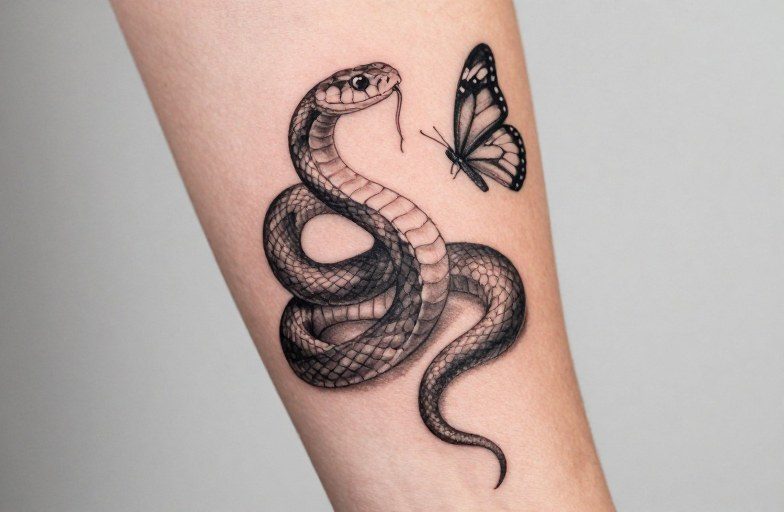
A snake and butterfly tattoo fuses two of nature’s most loaded creatures into one image about change, risk, and renewal. The butterfly carries obvious associations with metamorphosis and fragility; the snake brings in shedding, danger, and primal energy. Together, they usually speak to someone who has lived through a hard transformation and recognizes that growth rarely comes without threat.
Symbolism & Core Meaning
This pairing works because the two animals contradict and complete each other. Butterflies signal visible, celebrated change, caterpillar to chrysalis to winged adult. Snakes embody change that happens in darkness, through shedding skin that happens quietly, even violently. One is pollinator-pretty; the other is venom and constriction. The tension between them is the point.
Life, Death, and the Space Between
Many who choose this combination have survived something: addiction, loss, a body that no longer matches who they are. The snake can represent what was survived, the threat or the ugly phase. The butterfly marks the emergence. Neither erases the other. The design refuses to pretend transformation is purely beautiful.
Duality and Balance
There’s also a gendered reading some people lean into, snake as masculine, serpentine, earthy; butterfly as feminine, airy, delicate. That binary is reductive but common in flash art. More interesting designs play against it: a coiled snake protecting a resting butterfly, or butterfly wings emerging from a shed snakeskin, suggesting the same creature in two forms.
- Snake + butterfly coiled together: interdependence of threat and beauty
- Butterfly landing on snake head: momentary peace, uneasy truce
- Shared body, split head: literal transformation narrative
- Snake skeleton with living butterfly: death feeding life
History & Cultural Roots
Both animals carry heavy symbolic freight across continents, though the specific pairing is a modern tattoo convention rather than an ancient motif. Separately, their histories are deep and sometimes conflicting.
Snakes in Human Symbolism
Serpent imagery predates written language. In Mesoamerican cultures, snakes often carried cosmic weight, Quetzalcoatl was feathered, bridging earth and sky. In ancient Mediterranean societies, the snake was linked to healing and prophecy, often associated with chthonic powers. The ouroboros, a snake eating its own tail, emerged in Egyptian and later Greek traditions as a symbol of cycles and eternal return. European Christianity complicated this, casting the serpent as tempter and deceiver, a reading that still shadows Western tattoo choices.
Butterflies Across Cultures
Butterfly symbolism is often linked to the soul. In Japanese tradition, the butterfly sometimes represented the spirit of the living or the dead, particularly in contexts of marriage and ancestral memory. In Mexican folk practice, butterflies are commonly associated with the returning dead during Día de los Muertos, often traced to Nahua beliefs about the souls of fallen warriors. European folklore took a darker turn at times, butterflies as witches in disguise, or omens of death. The modern “pretty butterfly” tattoo meaning is largely a 20th-century Western development, stripping away some of this older ambiguity.
Mythology & Folklore
Direct myths pairing snake and butterfly are rare, but both creatures populate transformation stories independently, and tattoo artists borrow freely from these traditions.
The Greek myth of Psyche, whose name means “soul” and “butterfly,” involves trials that include descending to the underworld, snake territory. She earns love through suffering and transformation, a narrative that maps neatly onto the snake-and-butterfly motif. Orpheus’s descent to retrieve Eurydice similarly crosses butterfly-soul imagery with chthonic snake guardians.
In some West African and diaspora traditions, snakes serve as intermediaries between worlds, while butterflies signal spiritual presence. The combination can suggest someone moving between states, living and dead, earthly and spiritual, past self and future self.
Contemporary tattooing often treats these mythologies as visual vocabulary rather than literal belief. A client might not worship any tradition, but the accumulated weight of centuries gives the image resonance beyond personal biography.
Religious & Spiritual Angles
How this tattoo reads depends heavily on the wearer’s background and the viewer’s assumptions. There’s no universal spiritual meaning, only a field of possibilities that people navigate individually.
Christian Contexts
Within Christianity, the snake often carries negative weight as the Eden tempter, while the butterfly’s resurrection symbolism (emerging from the tomb-like chrysalis) is more positive. Pairing them can create productive tension, acknowledging sin and redemption as intertwined, or the necessary descent before ascent. Some Christian wearers use the snake to represent the old self, the butterfly the new creation. Others avoid the combination precisely because the snake feels too loaded.
Eastern and Esoteric Traditions
Kundalini energy in Hindu and yogic practice is often depicted as a coiled serpent at the base of the spine, rising through transformation to awaken consciousness. The butterfly’s metamorphosis offers a natural visual parallel. In some Buddhist imagery, transformation without attachment is central; both creatures change form dramatically, though the snake’s shedding is more repetitive, less final. Tattoo designs in this vein sometimes incorporate lotus elements or mandala geometry to anchor the spiritual reference.
Color vs Black and Grey
This choice changes the tattoo’s emotional temperature significantly. Color, particularly in the butterfly wings, allows for monarch oranges, morpho blues, or poisonous warning patterns that echo the snake’s danger. Bright color reads as vitality, sometimes defiance, look at what survived, look at what thrives.
Black and grey pushes the image toward memorial or shadow work. A greyscale snake with a single white or pale butterfly creates stark contrast; the eye goes to the fragile element. Heavier black shading on the snake, lighter stipple or whip shading on the butterfly, emphasizes their different textures, scales versus wing dust. Over time, both will soften, but color fades faster and more noticeably. Black and grey ages more gracefully on most skin tones, though well-saturated color can hold for decades with sun protection.
Placement matters for color visibility: inner bicep, thigh, or calf protect from sun; hands, forearms, and collarbones bleach faster. Snake scales in black and grey allow for precise technical work that still reads clearly at smaller sizes; butterfly wings need adequate space for color gradients to avoid muddying.
Design Tips & Pairings
The snake and butterfly combination offers real compositional challenges. The snake provides linear structure, coils, S-curves, vertical strikes, while the butterfly adds planar, symmetrical elements. Poor integration looks like two separate flash pieces glued together. Strong designs find actual physical connection: snake tongue touching butterfly antenna, scales transitioning into wing patterns, shared negative space.
Floral and Natural Additions
Roses are common but not mandatory. A snake coiled through thorns with a butterfly perched above reads as struggle and fragile reward. Skull flowers, particularly in Mexican-influenced work, tie into the death/life cycle explicitly. Cherry blossoms or peonies soften the image, sometimes too much, consider whether you want the edge preserved. Leaves and vines can unify the composition, giving both creatures shared ground.
Stylistic Approaches
Traditional American bold lines and limited color make this readable at small sizes and hold up over time. Japanese irezumi allows for larger, more narrative compositions, snake as dragon-adjacent power, butterfly as seasonal accent. Fine line and single needle work can render butterfly wings with delicacy, but the snake needs enough weight to balance; otherwise the composition feels top-heavy. Neo-traditional and illustrative approaches offer middle ground, allowing detailed scales and translucent wing effects without full Japanese commitment.
- Forearm: classic placement, good for medium-scale narrative flow
- Thigh: allows large coiled snake with butterfly near knee or hip
- Ribcage: follows natural curve, painful but dramatic for vertical designs
- Back piece: full Japanese-style potential, snake ascending, butterfly descending
- Hand or neck: high visibility, consider professional implications, needs bold simplicity
Before You Decide
Spend time with the specific combination, not just the individual symbols. A snake tattoo means one thing; a butterfly another. Together they create a third thing that depends on their interaction. Bring reference images that show how you want them to relate, touching, separate, one emerging from the other. Be wary of artists who treat this as a default “transformation” design without pushing into what kind of transformation, and at what cost.
Consider the direction of movement. A snake ascending, butterfly descending, suggests meeting in the middle. Both ascending reads as escape. Both coiled static suggests tension without resolution, sometimes accurate, but know if that’s what you want. The best snake and butterfly tattoos carry specific personal weight because the wearer did this thinking beforehand, not because the symbols are inherently profound.
Healing will be standard for the style you choose, fine line needs careful aftercare to preserve detail; heavy black saturation requires longer initial healing before the true values settle. Expect some loss of subtlety in wing patterns regardless; plan for a touch-up at 6-12 months if the piece matters deeply to you.
Frequently Asked Questions
Does a snake and butterfly tattoo always mean transformation?
Not necessarily. While transformation is common, some people emphasize the danger-beauty tension, duality of nature, or personal survival without framing it as change. The meaning depends on how the two creatures are positioned and what the wearer brings to it.
Which placement works best for this design?
Medium to large areas like the thigh, forearm, or ribs allow the snake’s coils and butterfly’s wings to interact without crowding. Small placements often force simplification that loses the relationship between the two elements.
Is this combination culturally appropriative?
The specific pairing is modern tattoo culture, not tied to one tradition. However, adding specific cultural elements, Day of the Dead sugar skulls, Hindu deity imagery, or Japanese sacred motifs, requires research and respect. Ask your artist about origins if incorporating distinct cultural styles.
How well does this tattoo age over time?
Snake scales in black and grey age reliably; butterfly color fades faster, especially yellows and light blues. Bold outlines help both elements stay readable. Expect wing detail to soften within 5-10 years without touch-ups, and plan sun protection from day one.
Related Tattoo Meanings
One response to “Snake And Butterfly Tattoo Meaning: Duality, Change & Rebirth”
[…] looking gloomy. If you want symbolism with more depth, read about rose butterfly tattoo meaning and snake and butterfly tattoo meaning. Your personal reason should remain the strongest […]

Leave a Reply