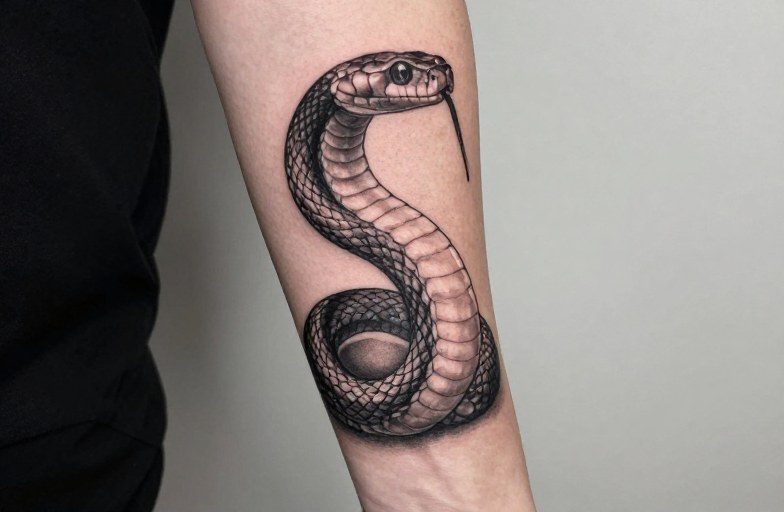
A snake man tattoo shows a human figure merged with or accompanied by serpent imagery. Sometimes a face splits into scales. Sometimes a full hybrid creature. Sometimes a figure locked in struggle. The meaning shifts completely depending on whether snake and human are allies, adversaries, or the same being.
How It Ages on Skin
Snake man tattoos carry specific aging risks that separate lasting pieces from muddy regrets. Scales and human features compete for limited space. Poor planning turns both into grey blobs within a few years.
Line Weight and Scale Detail
Scales drawn too small, especially under an inch across, blur together as ink spreads. Single-needle scale work looks crisp initially, then collapses into textureless shading within two to three years. For longevity, scales need enough size to hold their shape, or the artist must suggest them through negative space and contrast rather than outlining every one. The human portions demand the opposite treatment: clean edges on facial features, solid blacks in hair and eye sockets to anchor the composition. When both elements fight for detail, the eye reads chaos instead of narrative.
Scale-heavy areas also require more needle passes, which increases blowout risk in thin skin. An experienced artist plans this, spacing scale work away from the most vulnerable spots or simplifying where the skin is thinnest.
Placement Reality
- Forearm/outer bicep: Excellent visibility, but frequent sun exposure fades greens and yellows fastest; the snake’s body wrapping around the limb creates natural flow
- Thigh: Fat padding preserves detail longer than bonier spots; large canvas suits full hybrid figures
- Back piece: Ideal for dramatic man-versus-snake compositions, though you will never see it without mirrors
- Hand or neck: High visibility, aggressive fading, and the small scale forces simplification that often weakens the concept
Skin movement matters too. A snake coiling around a human torso looks distorted when that torso twists or sits. The best designs account for your body’s mechanics, not just its static shape. Weight fluctuation or muscle gain can stretch a coiled snake into something unrecognizable; placement should anticipate your actual life, not just your current physique.
Symbolism and Core Meaning
The snake man image carries layered meanings that predate any single culture. The serpent represents what exists outside human order: poison, fertility, death, rebirth through shedding. The human figure brings consciousness, social rules, the attempt to tame or understand. Their combination creates tension that never fully resolves.
Transformation and Duality
Shedding skin mirrors human reinvention: leaving relationships, identities, addictions behind. A snake man tattoo often marks a period of deliberate, painful change. The hybrid form literalizes the feeling of becoming something else while still recognizably yourself. Unlike a pure snake tattoo, which might read as purely “rebirth,” the human element keeps the struggle visible. You are not finished becoming; you are mid-shed.
Power and Its Costs
Snakes kill silently, strike without warning, move through spaces others cannot. The snake man can symbolize claimed power, especially power that others find threatening. But the image also carries cost: the isolation of the venomous, the coldness required to survive certain environments. Some choose this specifically for that ambivalence, rejecting sanitized symbols of strength.
Color vs Black and Grey
The color choice changes what the tattoo communicates and how long it remains legible.
Black and grey snake man tattoos dominate for good reason. The snake’s dimensionality reads through expert shading rather than hue, and the human face maintains its emotional impact without color dependency. Greywash allows subtle transitions between scale and skin that color sometimes fights against. For Japanese-influenced pieces, black and grey carries traditional weight; the snake’s danger reads through form, not warning colors.
Color opens specific symbolic doors. Green serpents connect to nature, poison, envy. Red scales suggest blood, passion, imminent violence. Gold or white snakes read as divine or otherworldly, as in naga traditions, where serpent deities shimmer with unnatural light. The tradeoff is maintenance: saturated greens and yellows fade to khaki and cream within a few years of sun exposure. Blue-purple snakes hold better but can read as cartoonish if the palette is not restrained. A common successful approach keeps the human in black and grey while the snake carries limited, strategic color, focusing the eye and preserving the face’s impact.
Common Variations and Styles
The snake man concept stretches across tattoo traditions with noticeably different results.
Neo-Traditional and American
Bold outlines, limited but saturated color palettes, and readable imagery from across a room. The snake man here often appears with sideshow attraction aesthetic, the human figure exaggerated and theatrical. Scales get simplified to patterned shading. The meaning leans toward spectacle and outsider identity rather than personal transformation.
Japanese (Irezumi)
The hebi (snake) wrapped around figures or emerging from mouths and sleeves carries established vocabulary. In this tradition, the snake man is not a literal hybrid but a human marked by snake influence: possessed, cursed, or protected. The snake’s body flows with your contours in ways Western compositions often ignore. Background elements, wind, waves, cherry blossoms, are not decorative filler; they contextualize the snake’s mood. These pieces demand large scale and long sessions. A small Japanese snake man usually fails because the vocabulary needs room to breathe.
Realism and Dark Surrealism
Photographic snake textures on human anatomy, or human faces splitting open to reveal serpent features beneath. The technical demands are severe: asymmetrical scale patterns, believable skin transitions, the unsettling quality of almost-human eyes in a reptile face. These pieces succeed or fail on the artist’s understanding of reptile anatomy and how light actually falls on convex scale surfaces. Many reference medical illustration or Victorian scientific drawings for their disturbing authority.
Mythology and Folklore
Snake-human hybrids appear across cultures, though specific meanings vary sharply and historical connections are often debated.
The naga of Hindu and Buddhist traditions are often linked to water, protection, and esoteric knowledge. Depicted with human torsos and snake tails, they guard treasure and teach those who prove worthy. A snake man tattoo drawing on this tradition usually emphasizes the serpent’s wisdom rather than its danger.
The Gorgon Medusa carries possible connections to older protective goddesses, though scholars dispute this lineage. Her snake hair marks female power that later narratives framed as monstrous. Modern reclaimings of this image are common, though the gender dynamics complicate application to a “snake man” specifically.
In Mesoamerican cosmology, Quetzalcoatl and similar feathered serpent deities blur human-divine-animal boundaries entirely. The feathered serpent combines sky and earth, bird and snake, in ways a purely snake-and-human design cannot fully capture, though some tattooists add feather elements to gesture toward this tradition.
The biblical serpent in Eden offers another vector: knowledge gained through transgression, the human becoming “like God” through forbidden contact. Snake man tattoos occasionally play this as the moment of transformation itself, the human form already changing, the apple still in hand.
Personal and Modern Meanings
Contemporary wearers often layer personal narrative onto these mythic foundations without requiring traditional alignment.
Addiction recovery appears frequently: the snake as the substance or compulsion, the human as the self trying to integrate or escape it. The image works because it refuses easy resolution, neither pure victory nor pure victimhood, but ongoing entanglement. Some choose the snake man after betrayal, the serpent representing the capacity for harm that they discovered in themselves or survived from another.
Medical and scientific professionals sometimes select the design for its connection to the Rod of Asclepius, though the single-snake staff differs from the intertwined Caduceus. The snake man here becomes healer with dangerous tools, acknowledging the harm that medicine can also inflict.
Gender transition narratives occasionally adopt the imagery for its literal metamorphosis, though this is less common than butterfly or moth motifs. The snake’s shedding offers a more aggressive, less delicate metaphor for becoming, useful for those who reject prettiness in their transition imagery.
What to Remember
The snake man tattoo lives or dies on technical execution. Poor scale planning, wrong placement for your lifestyle, or color choices that ignore your sun exposure habits will waste a concept with genuine depth. The image carries enough cultural weight that you should know which tradition you are drawing from, even if you are subverting it. The best pieces do not resolve the human-snake tension; they let it stay uncomfortable. That discomfort is the point. A snake man that looks too harmonious, too settled, has missed what makes this image worth wearing permanently.
Frequently Asked Questions
How long does a detailed snake man tattoo take?
A full hybrid figure with detailed scales and realistic human features typically requires 15 to 30 hours across multiple sessions. Japanese-influenced back pieces can exceed 50 hours. Small simplified designs exist but sacrifice the concept’s strength.
Do snake man tattoos hurt more than other designs?
The scale-heavy areas require repeated needle passes, which increases intensity on thin skin. Bone-adjacent placement (ribs, spine, ankles) amplifies this. Thigh and outer arm are generally more manageable for long sessions.
Can a snake man tattoo work as a cover-up?
The snake’s coiling body offers strategic cover potential, wrapping around or through old ink. However, the human face portion needs clean skin for readable detail. A skilled artist can design the snake to obscure and the human to sit on clearer areas.

Leave a Reply