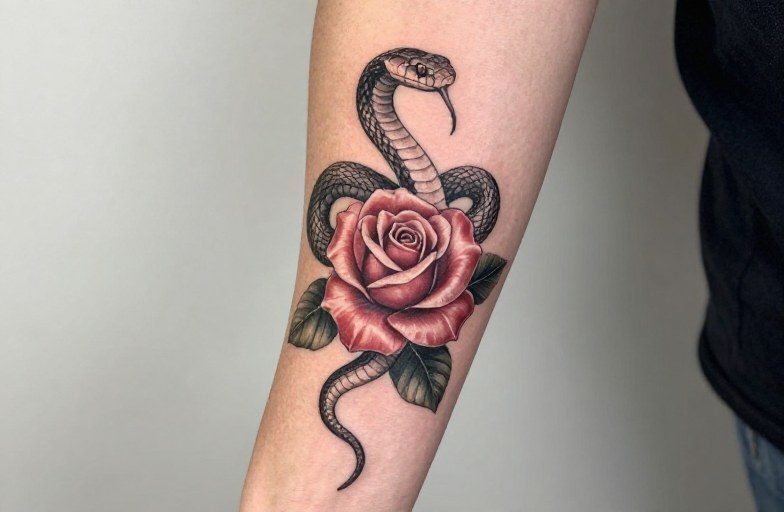
The snake and rose tattoo works because two loaded symbols collide. The rose carries beauty, love, desire, the things people want. The snake carries danger, deception, primal instinct, the things people fear. Together they make a single question: what are you drawn toward that might also harm you? Some wear this pairing after a destructive relationship. Others wear it to mark a hard transformation, beauty that survived because of danger rather than despite it.
How the Elements Interact
The physical arrangement changes everything. A snake coiled around a rose reads as protection. A snake striking or consuming the rose reads as destruction, corruption, passion that devours. A snake emerging from behind the bloom, as if grown from the same stem, suggests the threat and the beauty were never separate to begin with.
Coiled Guardian
When the snake wraps the rose without aggression, the design guards something delicate. This layout suits forearms and calves where the coil can follow muscle curve. Traditional American styling with bold outlines and limited color keeps the image readable across a room. The eye goes to the snake’s head first, then travels to what it protects.
Striking or Consuming
Fangs bared, piercing petals or swallowing the bloom, the design moves into darker territory. Neo-traditional and Japanese-inspired approaches handle this aggression well, with scales rendered in fine detail against softer petal work. The contrast in texture matters more than the violence itself.
- Single needle and fine line: precise scales against soft petals create visual rhythm through contrast alone
- Blackwork: heavy saturation; the rose becomes negative space or dotwork while the snake carries the black
- Biomechanical: snake body fuses with thorned stems, organic boundaries blurred
- Minimalist: contour lines only; depends entirely on viewer recognition of both symbols
Color and Its Absence
Color choice changes the emotional register completely. Red roses with a green or gold snake read as lush, almost Victorian, decadent and romantic. The warmth invites closer inspection. Black and grey pushes toward melancholy or menace. Without color to soften the rose, it can appear wilted or bloodless. The snake becomes corpse-like rather than alive.
Color Specifics
Deep crimson with black snakes creates the classic contrast most people expect. White or pale pink roses with pale snakes shift toward something ethereal, purity threatened by something equally pale and unsettling. Yellow roses rarely appear in this pairing; they would introduce betrayal or jealousy that most designs do not pursue.
How Black and Grey Ages
Snake scales in black and grey hold detail well if the artist builds contrast through whip shading rather than single-pass linework. Rose petals tend to muddy as greywash settles. A skilled artist leaves more skin breaks in petal highlights than feels natural during the session. Those gaps close slightly during healing and settle into proper values around the one-year mark.
Building the Composition
Two symbols this heavy need room to breathe. Crowd them and both diminish. Leave too much space and they read as separate tattoos that happen to sit near each other. The relationship between them must be intentional.
Supporting Elements
Daggers threading through add explicit violence. Skulls beneath the rose root the piece in mortality, snake as time, rose as life briefly blooming. Clocks or hourglasses turn the pairing into memento mori with extra steps. Some designs show the snake’s shed skin as a separate element, making transformation literal.
Text banners work unusually well here because the imagery already carries narrative weight. A phrase above or below can tilt interpretation without explaining too much. Script should be sized to age at the same rate as the imagery. Tiny lettering below a bold traditional piece will blur into illegibility years before the snake’s scales soften.
What to Avoid
- Overly symmetrical layouts; snakes need dynamic curves, roses benefit from slight asymmetry in petal arrangement
- Snake heads too small to read expression; the eye and jawline carry the emotional weight
- Roses with too many petals packed too tightly; they become grey blobs within five years
- Wrapping the composition around a limb without considering how it looks from the wearer’s perspective, not just the viewer’s
Religious and Spiritual Readings
The Garden of Eden narrative often surfaces with this pairing, though the snake and rose are not directly linked in biblical text. The rose developed later as a Marian symbol; the serpent’s temptation came first. Wearers sometimes combine them anyway, creating personal iconography of fall and redemption growing from the same source.
Non-Christian Frameworks
Kundalini energy, often depicted as a serpent, rises through chakras sometimes represented as lotus flowers. Roses occasionally substitute in Western adaptations, shifting the design toward awakening rather than temptation. Ouroboros imagery with a rose at the center collapses cycles of death and rebirth into one emblem. Some trace this to alchemical traditions, though the specific rose-and-ouroboros pairing belongs more to modern tattoo vocabulary than to historical symbol.
In Mesoamerican contexts, feathered serpents like Quetzalcoatl carry associations with Venus and morning star imagery. Roses connect to blood sacrifice through color symbolism. These threads rarely appear in actual tattoo work but inform a small subset of designs by artists with specific cultural knowledge.
Where the Pairing Comes From
Snake and rose combinations do not appear as a fixed motif in any single historical tradition. The elements traveled separately through visual culture and merged in tattooing during the 20th century, often linked to American traditional artists expanding beyond anchors and eagles.
Separate Lineages
Roses entered Western tattooing heavily through Sailor Jerry’s work in the mid-1900s, typically paired with names, daggers, or hearts. Snakes appeared in Japanese irezumi as part of larger compositions, and in American shops as symbols of danger or medicine. Their combination accelerated as tattooing embraced more overtly symbolic, narrative-driven designs, though pinning an exact date is difficult.
The formal compatibility likely helped the pairing catch on. Both symbols move in S-curves that interlock naturally. Artists noticed this worked compositionally before clients widely requested it as a specific meaning-cluster.
Placement and Scale
Body curvature affects this design more than most. The snake’s body needs space to move. The rose needs enough flat area for petal detail to read.
High-Impact Locations
Outer forearm: the snake wraps slightly around the muscle belly while the rose sits on the flatter inner surface. This creates natural dimension without forced perspective. Thigh front or side: ample flat space for both elements at substantial size, with the snake’s tail disappearing around the leg’s curve. Ribs: the snake’s body follows the floating ribs dramatically; the rose sits higher, near the heart. Pain here is significant, and the stretch of breathing during the session tests both artist and client.
Smaller Adaptations
Behind the ear: a single rose with a snake’s head emerging, requiring extreme simplification, working best in black. Wrist: the snake circles as a bracelet, the rose sits atop the wrist bone. Ankle: similar bracelet effect, but bone proximity makes lining difficult and healing temperamental. Hands: possible but the rose ages poorly; snake scales survive better than petal detail on constantly moving skin.
Back pieces allow the snake to span shoulder to hip with the rose at a focal point, but this scale demands genuine commitment to the motif. Most who choose this pairing prefer it contained, intense, and visible.
The Bottom Line
The snake and rose tattoo endures because it refuses single meanings. It can signal guardedness, celebrate survival, warn against seduction, or simply exploit two visually compatible forms. What matters is the specific execution: a snake’s eye that reads hostile or sorrowful, a rose that blooms or wilts. The symbolism lives in those details, not in the generic pairing itself. Choose an artist who builds narrative through proportion and expression rather than relying on the symbols to do all the work. And sit still. The best version of this design requires patience from both sides of the chair.
Frequently Asked Questions
What does a snake and rose tattoo mean?
It generally represents the tension between beauty and danger, desire and risk. The specific meaning depends on how the elements interact: a coiled guardian suggests protection, while a striking snake suggests destruction or corrupted innocence.
Do snake and rose tattoos work in black and grey?
Yes, but the approach must be deliberate. Snake scales hold detail well with proper whip shading. Rose petals tend to muddy over time, so artists need to leave more skin breaks in highlights than feels natural during the session.
Where should I place a snake and rose tattoo?
The outer forearm and thigh work well for medium to large pieces where the snake’s curve can follow body shape. Ribs offer dramatic flow but significant pain. Smaller versions behind the ear or on the wrist require extreme simplification to read clearly over time.
Is there a historical tradition of snake and rose tattoos?
Not as a fixed pairing. Roses and snakes entered tattooing through separate lineages, American traditional and Japanese irezumi respectively, and merged more recently based on formal compatibility rather than shared symbolic history.

Leave a Reply