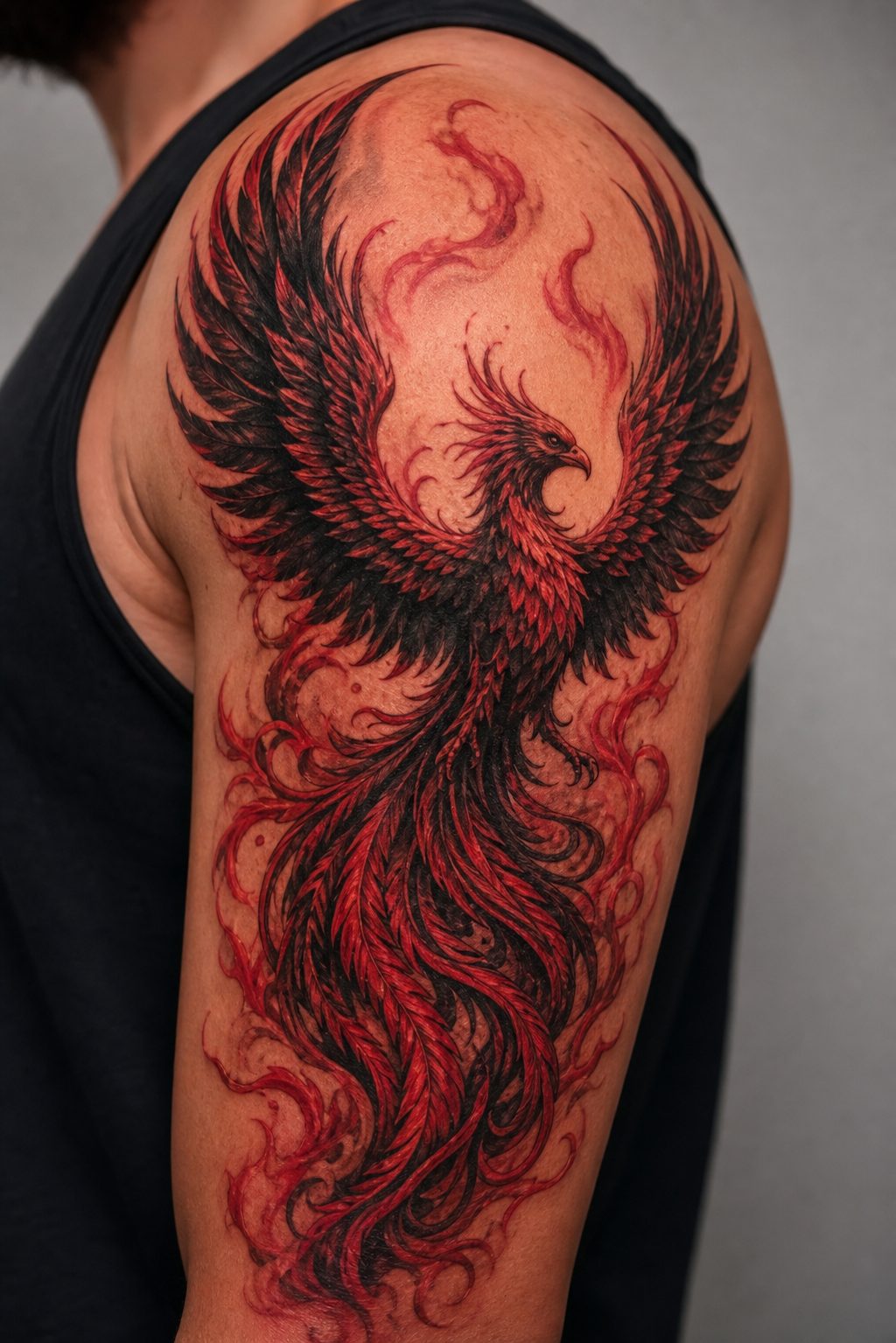
The phoenix tattoo means rebirth through destruction, rising from literal or figurative ashes stronger than before. It’s one of the most loaded symbols in tattooing because the meaning is immediate and universally understood: something burned, something returned. People choose it after divorce, recovery, career collapse, the death of someone close, or any experience that required them to become someone new to survive.
History & Cultural Roots
Most phoenix imagery in Western tattooing descends from Greek and Roman accounts, though similar fire-bird figures appear across cultures. The Greek phoenix was said to live for centuries, build a nest of spices, ignite it, and emerge renewed from the flames. Roman naturalists treated it as a real creature; early Christians adopted it as a resurrection symbol.
Eastern Parallels
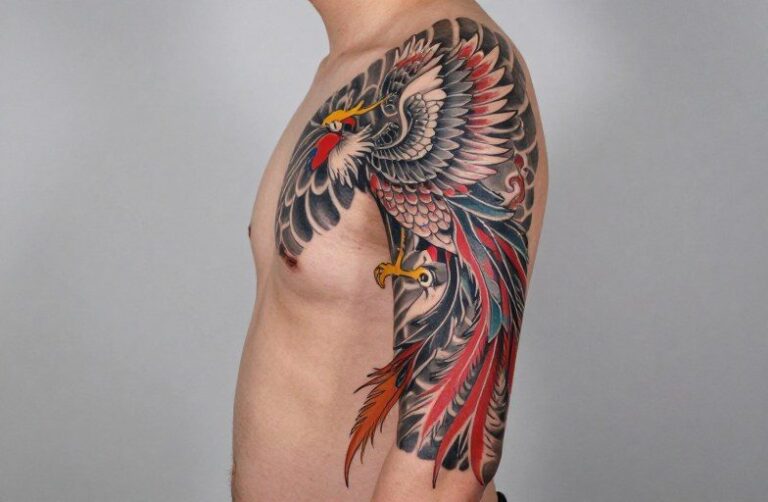
China’s fenghuang and Japan’s hō-ō are often linked to the phoenix, though they’re distinct beings. The fenghuang represents virtue and prosperity, not cyclical rebirth. In tattooing, these get visually blended, clients ask for a “phoenix” and artists pull from both traditions depending on the style requested. The visual language matters: fenghuang-style birds carry more flowing tail feathers and ornate plumage; Western phoenixes tend toward sharper, more angular wings and dramatic flame framing.
From Sailor Lore to Modern Shops
Traditional American tattooing adopted the phoenix as part of its broader mythological repertoire in the mid-20th century. Sailors and servicemen got them as symbols of surviving the unsurvivable, shipwreck, combat, imprisonment. The design stayed in the American canon and exploded again during the 1990s tribal tattoo era, then shifted toward more illustrative and Japanese-influenced approaches as collectors became more visually sophisticated.
Religious & Spiritual Angles
Early Christians used the phoenix as a resurrection metaphor, and it still carries that weight for some believers. The bird’s self-immolation and return mirror Christ’s death and resurrection without requiring a crucifixion image, which some people prefer for personal or family reasons.
Beyond Christianity
The symbol functions in secular spiritual contexts too, recovery programs, grief counseling, trauma therapy. The phoenix doesn’t require deity belief to work. It frames suffering as generative rather than purely destructive, which is a psychological stance, not necessarily a religious one. Some trace this interpretive flexibility to the symbol’s long use in alchemy, where it represented the purification of base material into something refined through fire.
Best Placements
Phoenix tattoos need room. The wingspan demands horizontal space; the rising motion wants vertical. These aren’t small behind-the-ear pieces unless you’re doing something extremely minimal and abstract, which sacrifices most of the visual impact.
- Full back: The classic placement. Allows full wingspan, tail feathers trailing, head craned upward. Artists can use the entire shoulder width and spine as a central axis. This is where Japanese-style phoenixes thrive, massive, colorful, wrapping slightly onto the upper arms.
- Thigh (front or side): Growing in popularity, especially for clients who want visibility control. A front thigh phoenix rises when you stand; side placement lets the wings curve with the muscle.
- Ribcage: Painful, but the verticality suits a rising bird. The wing can follow the rib curve. Line work here needs to be bold enough to hold; fine detail often spreads or drops out as the skin ages and shifts.
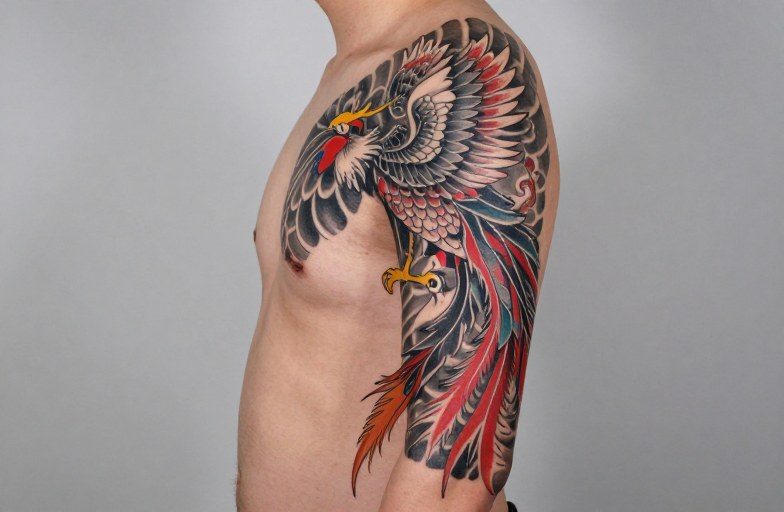
- Upper arm to shoulder (half sleeve start): Common for first large piece. The shoulder cap becomes the bird’s body, wings extending down the outer arm. Leaves room to expand into a full sleeve later.
Forearms and calves work for smaller, simpler versions, but cramming a full phoenix there usually results in muddy detail within five years. Ink migrates; fine feather lines blur together. If you’re committed to a smaller placement, go heavier on line weight and simpler in design.
Symbolism & Core Meaning
The phoenix carries several interlocking meanings that clients layer depending on their situation.
Rebirth & Transformation
This is the headline meaning. Not improvement, transformation. The old version doesn’t survive. The phoenix doesn’t heal from its wounds; it becomes something else entirely. People who’ve fundamentally changed who they are, sober after years of addiction, leaving abusive systems, transitioning gender, often gravitate here because the symbol matches their experience of non-continuity with their past self.
Endurance & Cyclical Return
Less dramatic but equally valid: the phoenix also means surviving repeated destruction. Some people don’t have one catastrophic event; they have a lifetime of smaller burns. The tattoo acknowledges that the cycle continues, and so do they. This reading often produces more restrained designs, less explosive flame, more settled posture, the bird already risen rather than mid-ignition.
Common Variations & Styles
Style choice radically changes what the tattoo communicates visually and how it ages.
Japanese (Irezumi)
Large, colorful, flowing. The phoenix shares space with peonies, wind bars, and background clouds. Heavy saturation means these hold color for decades but require serious sessions and commitment. The bird often looks more hō-ō than Western phoenix, longer tail, more ornate head crest, less explicit flame.
Traditional American
Bold black outlines, limited color palette (red, yellow, green, black), stylized rather than realistic. The bird is immediately readable from across a room. These age well because the design was built for skin from the start, not adapted from paper or screen. The traditional phoenix reads as tough, straightforward, unpretentious.
Black and Grey Realism
Feather texture, smoke, ember glow rendered through shading rather than color. Can be stunning but requires an artist who understands how greywash heals, too light and it disappears into skin tone; too dark and it muddies. The flame element is harder to make convincing without color, so artists often use negative space or very light grey to suggest heat.
Geometric/Abstract
Low-poly wings, mandala-body hybrids, single-line interpretations. These trend younger and often carry less explicit “rebirth” narrative, more aesthetic choice. Fine line work in this territory rarely holds crisp beyond a few years on high-movement areas.
Personal & Modern Meanings
Contemporary phoenix tattoos increasingly carry specific, non-generic stories. A parent after losing a child. A veteran reintegrating into civilian identity. Someone who walked away from a career that was killing them. The symbol works because it’s ancient enough to feel grounded but open enough to absorb private meaning without requiring explanation.
Social media has changed how people arrive at the design. They see a phoenix on someone who shared their specific story, infertility, bankruptcy, religious deconstruction, and the symbol becomes available to them in a new way. This isn’t appropriation; it’s how symbols live. The phoenix has survived millennia precisely because people keep finding new ashes to rise from.
Some clients pair it with dates, names, or small accompanying images (flames, clocks, broken chains). Others let the bird stand alone. Both approaches work; the addition should earn its place visually and not clutter the central form.
The Takeaway
A phoenix tattoo means you survived something that should have finished you, and you’re not the same as you were. The symbol’s power is in its simplicity: burn, return, repeat. Placement and style choices determine whether it reads as a private reminder or a public declaration. Work with an artist who understands how your chosen style heals in your specific skin, on your specific body part, because a phoenix that can’t be read in ten years misses the point. The fire is real; the return should be too.
Frequently Asked Questions
Does a phoenix tattoo always have to include flames?
No. While flames are the most common visual shorthand for the rebirth narrative, some designs use smoke, ash, or simply the bird’s upward posture to suggest transformation. Japanese-style phoenixes often omit explicit fire in favor of background elements like wind or clouds.
How well do phoenix tattoos age compared to other designs?
They age like any detailed piece, poorly if done too fine, well if built with bold structure. Large Japanese and traditional American versions hold up because of heavy line weight and saturation. Small, delicate phoenixes with fine feather detail tend to blur within five to seven years on most body parts.
Can a phoenix tattoo work for someone who hasn’t had a major tragedy?
Yes, though the symbol carries enough weight that it often prompts questions. Some people choose it for aspirational reasons, commitment to ongoing self-improvement, or simply for the visual power. You don’t need trauma to earn the image, but you should be comfortable with what it communicates.
What’s the difference between a phoenix and a Japanese hō-ō tattoo?
The hō-ō is a distinct mythological bird associated with virtue, justice, and prosperity, not cyclical rebirth. In practice, tattoo artists often blend visual elements, but a traditional hō-ō carries specific accompanying imagery (paulownia trees, certain flowers) and follows stricter compositional rules. Ask your artist which tradition they’re drawing from.