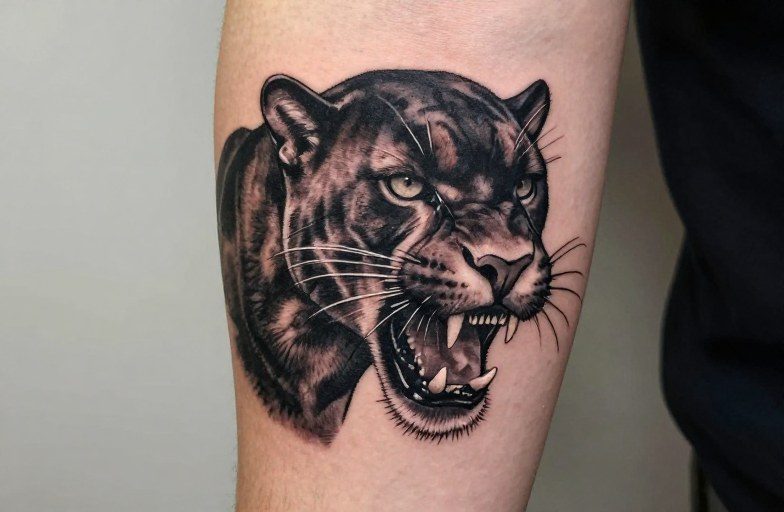
The sucky panther tattoo means embracing deliberate imperfection as a form of authenticity and a quiet rebellion against polished, Instagram-ready tattoo culture. It celebrates the raw, energetic, and often technically rough traditional panther flash that came out of street shops and biker culture, where attitude mattered more than precision. For many wearers, it signals that you do not take yourself too seriously, that you value character over technical perfection, and that you understand tattoo history beyond what photographs well on a screen.
Where It Comes From
Street Shop Origins
Traditional panther tattoos have been a staple of American tattooing since the mid-20th century, crawling across biceps and chests in countless variations. The “sucky” variant specifically traces to the working-class street shops where artists cranked out walk-in flash at volume, often late at night, sometimes under less-than-ideal conditions. These panthers came out with wonky proportions, crossed eyes, lopsided jaws, or legs that melted into the surrounding skin. They were not meant to be ironic then. They were simply what you got for twenty bucks at two in the morning. The charm accumulated later, as tattooing professionalized and such raw output became harder to find.
The Ironic Reclamation
By the 2010s, collectors began deliberately seeking out these crude panthers, often from artists who could technically do cleaner work but chose not to. The aesthetic connected to broader movements in art and fashion that valued the rough and the naive: outsider art, punk flyers, deliberately crude zine illustrations. Online tattoo communities helped spread the look, as sharing truly terrible vintage work became a form of entertainment and bonding. The sucky panther became a quiet signal: if you understood it, you knew something about tattoo culture that newcomers obsessed with photorealism had not yet learned.
Who Gets This Tattoo
Industry Insiders and Lifelong Collectors
You will find sucky panthers on tattooers themselves, shop owners, and people with substantial coverage who no longer need to prove anything. After years of collecting precise Japanese back pieces or intricate black-and-grey portraits, the deliberate crudeness feels like a palate cleanser. It announces that you are in the culture for the long haul, not chasing trends. Placement matters here: forearms, calves, and the sides of knees, where the distortion can be appreciated and shown off easily.
Punk and DIY Aesthetics
Musicians, artists, and people embedded in punk, hardcore, or noise scenes often gravitate toward this imagery. The sucky panther aligns with values of anti-professionalism, accessibility, and rejecting gatekeeping. Unlike a panther that costs eight hours and several hundred dollars, the sucky version democratizes the symbol. Anyone can afford it, and the “flaws” are the point. There is overlap with people who collect stick-and-poke or homemade tattoos, though the sucky panther is usually machine-done, just deliberately loose.
- People with extensive traditional tattoo coverage looking for contrast
- Artists and creatives who work in deliberately rough or naive aesthetics
- Anyone pushing back against the hyper-polished presentation of modern tattooing on social media
- Collectors who value historical authenticity over visual perfection
How It Ages on Skin
Ironically, the very qualities that make a panther “sucky” often help it age better than technically precise work. Heavy, bold lines with slight blowouts blur into something that looks intentionally weathered rather than accidentally degraded. The limited color palette, usually black with maybe red or green accents, means less fading and shifting over decades. Where a delicate panther with fine gray shading might become a blue-gray blob, the sucky panther’s crude shapes remain readable from across the room even as they soften.
That said, placement affects longevity. A sucky panther on a frequently sun-exposed forearm will still fade and spread. The difference is that this degradation often enhances rather than ruins the effect. On fatty areas like the outer thigh or upper arm, the lines hold their character longer. The one risk: if the artist is too deliberately bad, the tattoo can become genuinely illegible rather than charmingly crude. There is a line between “sucky” and “unreadable mush” that experienced artists navigate by maintaining certain structural elements, a clear silhouette, a recognizable head shape, while loosening others.
Similar and Related Symbols
Other Crude Traditional Animals
The sucky panther exists in a broader ecosystem of deliberately rough traditional imagery. Wonky snakes with uneven scales, cross-eyed tigers, and wobbly daggers share the same cultural space. Classic flash designs, when reproduced by less skilled hands or in hurried conditions, often produced this aesthetic organically. Today, artists working in deliberately unpolished modes, sometimes grouped under labels like “ignorant style” though that term is contested, include traditional motifs in their looser work. The sucky panther differs from pure ignorant style in that it specifically references and subverts a known, respected traditional image rather than operating outside those references entirely.
DIY and Punk Visual Cousins
Black flag bars, crude punk flyer illustrations, and intentionally rough band logos share DNA with the sucky panther. All reject the polish of professional design for immediacy and attitude. There is also connection to prison tattooing and other underground traditions where technical limitations produced distinctive aesthetics that later became desirable. The sucky panther is not directly appropriating those traditions. It sits nearby, a way for collectors outside those margins to access some of that raw energy without claiming experiences that are not theirs.
Meaning and Symbolism
Panther Symbolism in Traditional Tattooing
Before the ironic turn, the panther carried established meanings in tattoo culture: strength, cunning, ferocity, and the ability to move unseen. The animal’s black coat made it a natural for solid black tattooing, which held up well and showed boldly on skin. These associations do not disappear when the panther becomes “sucky.” They are complicated, layered with new meaning rather than replaced. The wearer still claims some of that traditional power, just through a filter of self-awareness and humor.
The Trickster or Fool Figure
Across many cultures, the deliberately foolish or incompetent version of a powerful figure serves important functions. The court jester could speak truth to power; the trickster survives by wit rather than strength. The sucky panther operates similarly. It deflates the machismo of traditional tattooing while still participating in it. The pattern, a powerful symbol made comically inept, recurs too widely to claim one direct origin. What matters is the function: the sucky panther lets the wearer have the symbol without the heavy solemnity.
Design Tips and Pairings
Working With the Right Artist
Not every tattooer can do “sucky” well. The skill lies in knowing exactly which rules to break and which to maintain. Look for artists with substantial traditional work in their portfolio who also show looser, more experimental pieces. Ask to see their flash sheets or walk-in work rather than only their appointment pieces. The best sucky panthers come from artists who spent years doing clean traditional work before choosing to loosen up. Be wary of beginners using “sucky” as cover for actual inability. There is a real difference between controlled looseness and genuine incompetence. A good test: does the panther still read as a panther from ten feet away? If the shape collapses into confusion, the looseness has gone too far.
Complementary Imagery
Sucky panthers pair naturally with other deliberately crude traditional pieces: crossed-out text, wonky banners, or mismatched filler. They also work well as counterweights to more serious work on the same limb. Picture a meticulously rendered Japanese sleeve on the upper arm with a tiny, terrible panther peeking from the inner wrist. Some collectors build entire limbs of rough tattoos, creating a cohesive aesthetic of deliberate imperfection. Others isolate the sucky panther among precision work for maximum contrast.
- Pair with bold, simple lettering in mismatched fonts
- Surround with traditional filler, daggers, dice, cards, done in equally loose style
- Use as a small accent piece near larger, more detailed work
- Consider the “panther ripping through skin” variant, but rendered deliberately unconvincingly
What to Remember
The sucky panther tattoo works because it means something specific to people who have been around tattooing long enough to understand what it is rejecting. It is not an excuse for bad work, though beginners sometimes try to use it that way. It is not a trend for newcomers, though it has become visible enough that some mistake it for one. It is a knowing nod to the history of the form, to the street shops and late-night walk-ins and imperfect human hands that built American tattooing before it became an industry of polished portfolios and social media metrics.
If you are considering one, know what you are choosing. The sucky panther asks you to value character over polish, history over hype, and humor over pretension. It ages well because it was never trying to look perfect in the first place. And it stays readable because the artists who do it best understand that looseness requires its own kind of control. Get it from someone who knows the rules well enough to break them with intention, not from someone who never learned the rules at all.
Frequently Asked Questions
What makes a panther tattoo ‘sucky’ versus just badly done?
A sucky panther is deliberately crude but structurally sound. The silhouette still reads, the head is recognizable, but proportions are off, lines are loose, and details are simplified. Bad work collapses into confusion; sucky work maintains enough structure to be intentional.
Will a sucky panther tattoo age better than a detailed one?
Often yes. Heavy bold lines and limited color fade more gracefully than fine detail. The roughness tends to look intentionally weathered rather than accidentally degraded. Sun protection still matters, and placement on less-exposed skin helps longevity.
How do I find an artist who can do this style well?
Look for artists with years of solid traditional work who also show looser experimental pieces in their portfolio. Ask to see flash sheets and walk-in work, not just appointment pieces. Avoid beginners using ‘sucky’ to cover actual inability. The best practitioners learned to do it right before learning to do it rough.

Leave a Reply