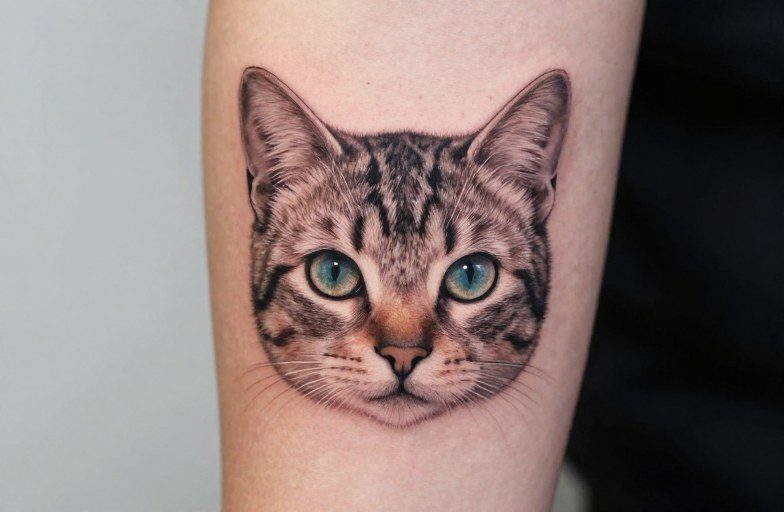
The eye cat tattoo merges two potent symbols: the cat’s reputation for seeing what humans miss, and the eye as an emblem of awareness, protection, or judgment. Together, they create a design about perception itself, watching, knowing, guarding. Most people who choose this aren’t after a cute pet portrait; they want the cat as a sentinel, a creature that moves unseen while seeing everything.
Symbolism & Core Meaning
The Cat as Seer
Cats have long carried associations with hidden knowledge. Their slit pupils, vertical and narrow, look alien compared to human eyes, already a visual cue for otherworldly sight. In the tattoo, exaggerating that eye (making it the sole focus or the largest element) pushes this further: the cat becomes pure perception, stripped of domestic softness. The design often signals that the wearer values intuition over explanation, noticing what others overlook.
The Eye’s Dual Nature
The eye in this context isn’t always protective. Sometimes it’s confrontational, a stare that challenges the viewer, or a self-aware mark that the wearer is watching their own behavior. When the cat’s eye contains additional imagery (a moon, a skull, a human face reflected in the pupil), the meaning narrows to something specific: lunar cycles, mortality, self-examination. Without those additions, the eye stays open to broader interpretation, which many prefer.
How It Ages on Skin
Line Work vs. Solid Fill
The eye cat lives or dies by its linework. Thin, delicate lines around the iris will blur within five to eight years, especially on high-movement areas. Bold outlines, think 3-5 needle groupings, not single needles, hold their shape. Solid black cats with negative-space eyes (the eye cut out, showing skin tone) age more gracefully than full-color realism; the contrast stays readable even as edges soften slightly.
Shading and Color Fades
Yellows and bright greens in the iris fade fastest, often shifting to muddy olive within a decade. Gray-wash shading in the fur holds better but can go chalky if overworked during application. The smartest long-term approach: heavy black in the cat’s body, limited color in the eye itself, and no color gradients in small designs under three inches. Large pieces with space for detail age better because the eye doesn’t shrink to an unreadable blob.
Best Placements
The eye cat demands a flat surface. Curved areas distort the circular eye, making it look oval or lopsided as the body moves. The outer upper arm, outer thigh, and upper back (between shoulder blades) offer the most stable canvas. These spots also heal relatively easily, less friction, less sun exposure, less stretching during daily movement.
- Forearm: Visible, but the eye will oval slightly when the wrist turns. Best for designs where the cat’s face is already angled, not dead-center circular.
- Ribcage: Flat when standing, but breathing distorts the shape. Painful healing due to constant movement. Save for experienced collectors with solid aftercare discipline.
- Calf: Good flat plane, easy to show or hide. Slightly more sun exposure over years; sunscreen matters here.
- Behind the ear: Trendy but problematic. The area moves constantly, skin is thin, and the small size forces detail loss within a few years.
Who Chooses This Tattoo
Patterns in Placement Requests
There’s no single demographic. The eye cat attracts people who identify with observation, night shift workers, writers, people in surveillance or security fields, those who’ve learned to read rooms for survival. It also draws practitioners of various folk traditions who connect cats to spiritual sight. The common thread isn’t aesthetic preference; it’s a self-image built on watching before acting.
What They Usually Want
Most who request this design reject overly cute interpretations. They push for slit pupils, not round; shadowed sockets, not bright cartoon whites. There’s a desire for menace or gravity, even in small pieces. The eye cat isn’t typically a first tattoo; it arrives after someone has developed opinions about what they want their skin to say.
Mythology & Folklore
Mediterranean and Near Eastern Roots
The eye cat sits at a crossroads of several traditions. The nazar, often linked to Turkish and broader Mediterranean cultures, uses the eye as apotropaic magic, something that turns harm back on its source. Cats, commonly associated with ancient Egyptian protection deities like Bastet, carried similar guardian functions. The combination isn’t historically documented as a unified symbol, but the overlap feels natural enough that the design has proliferated without a single origin story.
Later European Accretions
Medieval European associations of cats with witchcraft added another layer: the familiar spirit, the creature that sees for its human partner. Some trace the eye cat’s modern popularity to this confluence, the witch’s cat as extended perception, the eye as mark of that bond. Whether or not wearers consciously invoke this, the visual language resonates because these associations remain culturally legible.
Common Variations & Styles
Traditional/Americana
Bold black outlines, limited color palette, the eye simplified to concentric circles with a heavy lid line. This style ages best and reads immediately from distance. The cat’s face may be reduced to just the eye and a suggestion of ear shape, making it almost abstract.
Blackwork and Woodcut
Heavy black with white highlights scratched or left negative. The eye becomes a void with a single catch-light, dramatic and graphic. These pieces often enlarge the eye beyond natural proportion, creating something closer to a symbol than a creature. Healing is straightforward; the density of black means less open skin to scab.
Realism and Neo-Traditional
Detailed fur texture, accurate feline anatomy, the eye rendered with color gradients and reflection. Striking when fresh, but the fine detail in the iris and the subtle grays in the fur demand large size and skilled aftercare. Expect touch-ups within five years if the piece is under five inches.
- Third eye variations: A cat with a human-style third eye on its forehead, or a human eye replacing the cat’s own. Shifts meaning toward expanded consciousness rather than natural feline perception.
- Multiple eyes: Drawing from H.P. Lovecraft or purely surreal influences, cats with dozens of eyes or eyes in non-standard locations. More about unease than protection.
- Jeweled or bejeweled eyes: The eye as gemstone, faceted and ornamental. Softens the menace, adds decorative tradition from South Asian or Middle Eastern visual culture.
Final Thoughts
The eye cat tattoo works because it refuses to settle into pure cuteness or pure threat. It occupies the space between pet and predator, between watched and watcher. For a design that will last decades, the practical advice is simple: prioritize bold structure over delicate detail, place it where skin stays relatively still, and accept that any color in the eye will shift over time. The meaning doesn’t need to be explained to strangers; the image does its own work. What matters is that the wearer knows why they wanted a creature that sees in the dark marking their skin permanently.
Frequently Asked Questions
Does an eye cat tattoo need to face a specific direction?
No universal rule exists, but forward-facing eyes create direct confrontation, while profile placement feels more observational. Some prefer the eye looking outward as if guarding the wearer, others inward as self-reflection. Discuss the psychological effect with your artist before finalizing.
Can the eye cat work as a small tattoo?
It can, but below two inches the eye loses distinguishable detail and becomes a dark blob over time. Minimum three inches is safer for any iris detail. Simpler designs with heavy black negative-space eyes survive better at small sizes than realistic color renderings.
Is the eye cat culturally appropriative if I’m not from eye-symbol traditions?
The generic eye symbol has diffused globally enough that most combinations with cats aren’t tied to specific religious practice. However, directly copying nazar color patterns (concentric blue circles) or sacred imagery from particular traditions without understanding carries risk. Original designs blending cat and eye motifs generally avoid this concern.
How painful is this tattoo compared to others?
Pain depends entirely on placement, not design. The eye cat itself has no special pain profile. Ribs and sternum hurt more due to bone proximity and thin skin. Outer arm and calf are moderate. The heavy black fill common in this design means longer sessions, which accumulates fatigue even if the individual passes aren’t extreme.


Leave a Reply