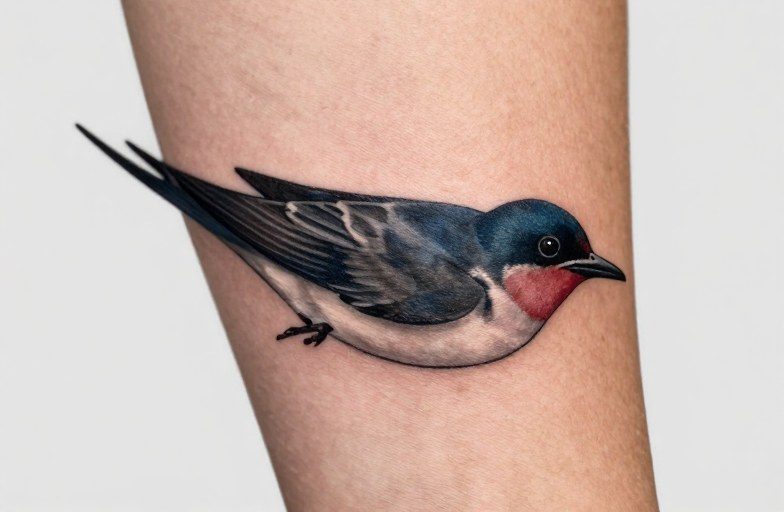
The navy swallow tattoo carries one of the most specific and trackable histories in Western tattooing. Traditionally, a single swallow meant 5,000 nautical miles logged; a second marked 10,000. Beyond mileage, the bird promised safe return, sailors believed swallows carried souls to heaven if the man didn’t make it home. That combination of earned credential and protective talisman made it a staple of American and European naval tattooing from at least the early 1900s.
Design Tips & Pairings
Placement and proportion matter more than most people expect with this design. The swallow’s forked tail and pointed wings need room to read clearly; too small and the tail feathers muddy into a blob within a few years.
Best Placements
Traditional placement sits on the backs of the hands, the sides of the neck just below the ear, or across the chest, each location visible enough to serve as a public marker. On the hand, the bird flies toward the thumb or across the knuckles. Chest pieces usually pair two swallows facing inward, framing a larger central image like a ship or heart. Forearms work well for modern sizing, but the wrist bone can distort the wing line over time as skin shifts.
- Hands: high visibility, fast fading due to sun and washing, bold lines essential
- Chest: allows for pairs, accommodates detail, ages slowly with proper care
- Neck: traditional but employment-limiting; the classic spot sits just below the earlobe
- Upper arm/shoulder: modern preference, easy to expand into larger nautical sleeves
Common Pairings
Swallows pair naturally with other maritime imagery. A single bird often accompanies a ship, compass rose, or banner with a name or date. Two swallows facing each other across the chest traditionally framed a heart or dagger. Modern variations add banners with coordinates, children’s names, or service dates. The key is keeping the swallow identifiable, bury it in too much surrounding detail and the silhouette gets lost.
Similar & Related Symbols
Several maritime tattoos overlap with the swallow in meaning or origin, and they’re often confused. Knowing the distinction helps if you’re building a coherent nautical piece.
The sparrow, frequently mistaken for a swallow, carries different connotations. Sparrows were sometimes inked by sailors who hadn’t yet earned their miles, aspirational rather than documentary. The swallow’s forked tail and long pointed wings distinguish it visually; tattooers traditionally emphasized that silhouette precisely to mark the difference.
- Anchor: stability, often a first tattoo or mark of crossing the Atlantic
- Compass rose: guidance, sometimes paired with swallows as directional complements
- Ship full-rigged: specific voyage completion, more detailed and prestigious than mileage marks
- Shellback: crossing the Equator, a separate initiation tradition
- Dragon: service in Asian waters, typically larger and more elaborate
Swallows also relate to civilian bird tattoos like the sparrow or bluebird, but the naval version maintains stricter conventions: forked tail, red breast patch, specific flight posture with wings angled back.
Color vs Black and Grey
Traditional Color Palette
Classic naval swallows use a limited, functional palette. The body runs blue-black or deep purple, the breast a solid red or orange patch, the beak yellow. White highlights on the wings add dimension without softening the silhouette. This scheme wasn’t arbitrary, early tattooers worked with what pigments held reliably in skin, and these colors proved stable on sailors who spent their lives in salt and sun.
Black and Grey Adaptations
Modern black and grey versions sacrifice the immediate naval recognition for versatility and faster sessions. Without color, the form becomes everything: the curve of the wing, the split tail, the relationship between head and body. Shading can suggest dimension, but heavy black fill risks the same muddying problem as oversaturated color. The best black and grey swallows use whip-shading on the wings and solid blacks only at the wingtips and eye, letting negative space carry the form.
Color longevity differs significantly. Red breast patches often fade to pink or orange within five years on sun-exposed skin. Blues hold better but can shift toward green as they age. Black and grey ages more predictably, though it can look flat if the original shading was too subtle.
Personal & Modern Meanings
Contemporary wearers adapt the swallow without always adopting naval mileage. The core associations, safe return, loyalty, distance traveled, translate to civilian experience with minimal stretching.
Some use it to mark a specific journey: immigration, military deployment, recovery from illness, a period of living abroad. The bird’s return migration makes it a ready metaphor for coming home, whatever home means. Others choose it for the loyalty aspect, particularly as matching tattoos between partners or family members, though this risks generic sentiment if the design isn’t personalized.
A smaller group maintains the traditional earning logic: the tattoo commemorates actual distance traveled, whether nautical or otherwise. Long-distance cyclists, overland truckers, and commercial pilots have adopted the swallow with the same documentary function sailors used. The meaning stays coherent because the form hasn’t changed, it’s still a swallow, still earned, still visible.
Who Chooses This Tattoo
Naval and Maritime Service Members
Active and former sailors, Coast Guard, and merchant marine remain the most traditional wearers. For them, the swallow often functions within a larger collection of service tattoos, each marking specific qualifications or voyages. The bird’s small size makes it fillable around larger pieces or addable when a new milestone passes.
Civilians Drawn to Maritime Aesthetics
Traditional tattoo collectors frequently include a swallow as part of an American traditional sleeve or torso piece, regardless of personal sailing history. The design’s graphic strength and historical weight appeal independently of biography. Others with family naval connections use it as memorial or tribute, sometimes incorporating dates or initials in banners.
The swallow also attracts people seeking a small, meaningful tattoo with established visual conventions, it’s easier to explain and harder to execute poorly than many alternatives. That accessibility cuts both ways: the design’s popularity means mediocre versions abound, and finding a tattooer who understands the traditional proportions takes effort.
Mythology & Folklore
The swallow’s association with safe return predates organized tattooing. Ancient Greeks linked the bird to Aphrodite and household protection. European folklore held that swallows nesting on a house brought luck; killing one brought misfortune. These associations likely traveled with sailors rather than originating in naval culture.
The soul-carrying belief, often linked to, though not definitively traceable to, specific documented traditions, served practical psychological function. Sailors faced genuine mortality; the tattoo functioned as both badge and preparation. If the bird would carry the soul home, the body could be lost without total loss.
Some trace the specific 5,000-mile measurement to British naval practice, though documentation remains scattered. American and Scandinavian traditions overlap without clear priority. What matters for contemporary choice is that the measurement became standardized across Western maritime tattooing by the mid-20th century, recognized across navies and merchant fleets.
Final Word
The navy swallow tattoo works because its form carries its history. You don’t need to explain the forked tail or the red breast; they explain themselves to anyone familiar with the tradition. Whether you earn it by water, by road, or by personal trial, the design rewards respect for its conventions. Choose a tattooer who understands the silhouette, place it where it can be seen, and let the bird do what it’s always done, mark the distance, promise the return.
Frequently Asked Questions
Do I need to have sailed 5,000 miles to get a navy swallow tattoo?
No. The traditional mileage requirement was specific to naval culture, not a universal rule. Modern wearers choose the swallow for many reasons, though some service members and maritime workers still observe the earning tradition.
What’s the difference between a swallow and a sparrow tattoo?
Swallows have forked tails and long, pointed wings; sparrows have shorter, notched tails and rounder bodies. In naval tradition, swallows marked verified miles traveled while sparrows sometimes indicated aspiration or lesser experience.
How well does the red breast color hold up over time?
Red pigment fades faster than black or blue, especially on sun-exposed skin. The breast patch typically softens to pink or orange within five to ten years. Touch-ups restore saturation if the original line work remains solid.
Can a swallow tattoo be covered up or modified later?
The swallow’s simple silhouette makes it adaptable. Small versions can expand into larger pieces; facing pairs can be separated or integrated into sleeves. The key is preserving the wing and tail proportions so the bird remains recognizable.

Leave a Reply