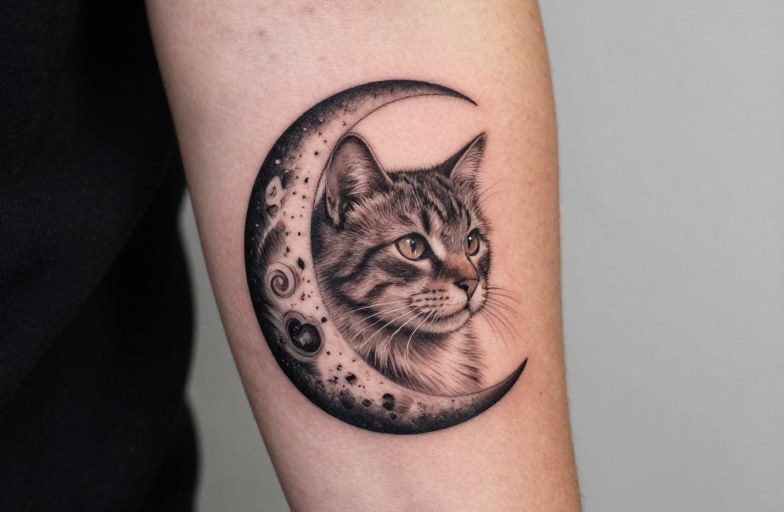
A moon cat tattoo fuses two ancient symbols: the cat as a creature of instinct and shadow, and the moon as a marker of cycles, night, and hidden knowledge. Together, they create a design that speaks to duality, domestic and wild, seen and unseen, calm surface and active undercurrent. Most people drawn to this image aren’t after a single fixed meaning; they’re identifying with the tension between those two forces.
Symbolism & Core Meaning
The core of this design sits in opposition. Cats operate by their own rhythm, refusing the obedience of dogs or the predictability of livestock. The moon operates the same way, present but not controllable, governing tides and moods without asking permission. Pairing them creates a symbol of autonomous intuition, of trusting what you feel rather than what you’re told.
Color choices shift this balance. A black cat silhouetted against a full moon leans into folklore and edge, the witch’s familiar, the thing that crosses your path at midnight. A more rendered cat in softer gray tones, maybe curled with a crescent, reads gentler, lunar nurturing, the cat as companion rather than omen. Both are valid; the difference is tonal, not hierarchical.
The Moon Phase Matters
Full moons suggest completion, exposure, or peak energy. Crescent moons imply growth, potential, or the hidden half. A cat paired with a waning moon carries different weight than one with waxing, decline versus ascent, letting go versus building toward. Most tattooers see clients choose crescent for its visual elegance; the full moon works better when the cat itself is smaller, a silhouette element rather than a detailed portrait.
Mythology & Folklore
Cats and moons share deep roots in multiple traditions, though specifics vary and should be treated as association rather than proven lineage. In ancient Egyptian practice, cats were often linked to lunar deities; the goddess Bastet, sometimes depicted with feline features, carried connections to the moon’s cycles and protective night energy. Japanese folklore offers the maneki-neko as a separate tradition, but the broader figure of the cat as spirit guardian, able to see what humans cannot, resonates across East Asian stories.
European medieval and early modern periods commonly associated black cats with witchcraft, and by extension with night rites performed under moonlight. This wasn’t universal; regional variation was enormous, and the negative association was often class-based or politically motivated rather than organic folk belief. Some trace the moon-cat pairing to these periods, but the evidence is scattered rather than continuous.
Contemporary Pagan and Witchcraft Circles
Modern neopagan practice has reclaimed the cat-moon pairing as a symbol of feminine intuition, shadow work, and personal ritual. The cat’s nocturnal eyes, reflecting light rather than generating it, mirror how practitioners often describe their own relationship to lunar energy: receptive, reflective, responsive. This is a living tradition, not an ancient one, and its practitioners are generally clear about that distinction.
Common Variations & Styles
The moon cat tattoo appears across virtually every tattoo style, but some approaches suit the subject better than others.
- Traditional/Americana: Bold black outlines, limited color palette, the cat as stylized silhouette or simplified form. Holds up excellently over time. The moon often becomes a flat disk or simple crescent behind the cat’s head or body.
- Blackwork and dotwork: Detailed fur texture rendered in stipple or solid black, the moon as negative space or fine-line orbital rings. High contrast ages well; extremely fine dotwork in the moon itself can blur after a decade.
- Neo-traditional: More illustrative, jewel-toned moons, ornamental framing. The cat may have humanized eyes or decorative elements. Color saturation is critical, pale moon yellows and soft oranges fade faster than deep blues or blacks.
- Minimalist and fine-line: Single needle or tight three-round, often small placement. Elegant but fragile; the moon’s curve and the cat’s spine must be drawn with precision or they’ll read as generic blobs in ten years.
- Japanese-inspired: The cat as nekomata or spirit cat, moon as background element with wind bars or clouds. Requires a specialist in Japanese iconography; the moon’s placement relative to the cat carries specific compositional rules.
Placement Considerations
The upper arm outer bicep and calf back offer flat, stable surfaces where the moon’s circle and the cat’s body read clearly. Ribs and sternum contort both shapes; the moon becomes oval, the cat compresses. Wrist and ankle placements force miniaturization, which sacrifices the cat’s identifiable posture. For maximum longevity, keep the moon at least the size of a quarter, the cat’s head no smaller than a thumbnail.
How It Ages on Skin
All tattoos blur and soften. The moon cat design has specific vulnerabilities.
The moon’s edge, if it’s a hard circle, will feather slightly over time, ink spreads laterally under skin, and a perfect geometric curve becomes slightly organic. This isn’t necessarily bad; it can look more natural. But if you want crisp, plan for touch-ups every 7-10 years.
Cat eyes are a common detail that fails. Tiny white highlights, pinprick pupils, fine lines for eyelids, all of this can collapse into dark smudges. Better to render eyes as simple dark shapes with one larger highlight, or to let the cat’s silhouette face away from the viewer entirely.
Shading in the moon creates the most long-term variation. Smooth gray gradients (“black and gray wash”) tend to settle more evenly than patchy or overworked fills. Solid black moons with no interior texture are the safest bet for aging, but they can dominate the composition and reduce the cat to secondary status.
Line weight matters. A moon outline done in a single thin pass may disappear into surrounding skin; doubling the line or building it with a tight three-round shader gives it presence that lasts. The cat’s whiskers, if included, should be drawn with the understanding that they’ll thicken, start thinner than you want them to end up.
Personal & Modern Meanings
Beyond inherited symbolism, people assign this tattoo highly specific personal significance. Someone who works night shifts may see the cat-moon pairing as an acknowledgment of their inverted schedule, not a mystical statement. Another person might choose it after a period of solitary growth, the cat’s self-sufficiency as emblem for their own.
The design also carries weight in neurodivergent communities, where the cat’s social selectivity and the moon’s reliable but non-human rhythm resonate with experiences of autism or introversion. This isn’t a universal mapping, but it’s common enough that tattooers recognize it as a recurring motivation.
Pet memorials sometimes use this format: a specific cat, rendered recognizably, with a moon that marks a date or phase significant to the animal’s life or death. The moon becomes clock and calendar, the cat immortalized in its nocturnal element.
Who Chooses This Tattoo
There’s no single demographic, but patterns exist. Women in their twenties and thirties request this design most frequently, often as a first or second tattoo, often placed where it can be shown or concealed. The appeal crosses subcultural boundaries, it’s as common among software engineers as among practicing witches, though the stated meaning differs.
Men choose the design less often, but when they do, the style tends harder: blackwork, aggressive linework, the cat in pounce or yowl rather than curl. The moon may be blood-red or absent entirely, replaced by a more abstract dark orb.
Age of request has dropped slightly over the past decade; tattooers report more moon cat inquiries from clients under twenty-five, possibly due to social media visibility of the design. The core audience remains consistent: people who identify with interiority, who value self-direction over group belonging, who want a symbol that reads as personal rather than institutional.
Before You Decide
Bring reference images that show mood, not just subject. “I like this cat’s posture but this moon’s texture” gives your tattooer more to work with than ten versions of the same Pinterest result. Discuss line weight explicitly, ask how the moon’s edge will be built, how the cat’s eyes will be handled, what happens if you want to add color later.
Consider the moon’s orientation. A crescent cradling the cat from below reads protective; a crescent above, like a horn, reads more dynamic or threatening. The cat facing the moon versus facing away changes the relationship, is it drawn toward, or independent of?
Finally, sit with the design through one full moon cycle before committing. The image should feel right in bright morning and at 3 AM, when you’re actually most like the creature you’re considering wearing.
Frequently Asked Questions
Does a moon cat tattoo have to be black and gray?
No. Color works well, especially deep blues, purples, or muted oranges for the moon. Just know that lighter yellows and pastels fade faster and may need more frequent touch-ups than saturated darker tones.
Can I include my actual pet cat’s features in the design?
Absolutely. Most tattooers can adapt a reference photo into the moon cat format. The key is choosing a pose that works compositionally, curled or seated cats fit the moon’s curve better than stretched or running poses.
Is there a ‘correct’ moon phase to use?
No correct phase exists. Full moons offer visual balance and strong silhouette potential. Crescent moons create more dynamic negative space and carry associations of change or growth. Choose based on what you want to emphasize.
Will the fine details in the cat’s fur still look good in ten years?
Fine fur texture tends to soften and merge over time. For longevity, ask your tattooer to build fur with slightly bolder line groupings or strategic solid black areas rather than hair-thin individual strokes throughout.
Leave a Reply