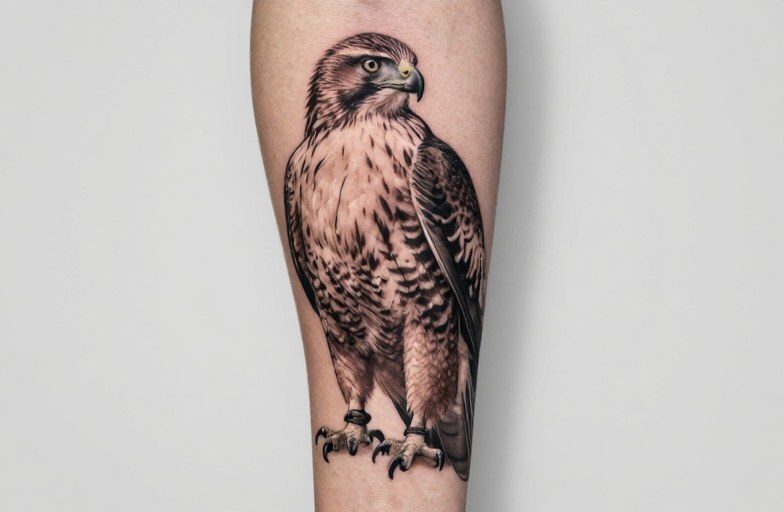
A hawk tattoo most commonly signals sharp perception, unwavering focus, and the ability to see what others miss. The bird’s reputation as an apex aerial predator gives it natural associations with power, clarity, and decisive action. Beyond that surface reading, the imagery carries layered cultural and personal significance that shifts depending on specific species depicted, accompanying elements, and placement on the body.
Symbolism and Core Meaning
The hawk’s defining trait is its vision, estimated at roughly eight times sharper than human sight. Tattoo imagery leans hard into this biological fact. A hawk piece typically communicates watchfulness, strategic patience, and the capacity to strike precisely when the moment arrives. The bird spends hours motionless before exploding into action, so the symbolism extends to discipline and timing, not mere aggression.
Coloration matters symbolically. Red-tailed hawks, the most common North American species in tattoo art, carry specific associations with grounding and territorial protection due to their prevalence in open landscapes. Darker species like the Harris’s hawk, which hunts cooperatively, can shift meaning toward loyalty and group strategy. A stylized blackwork hawk tends to read as more ominous or militaristic; full-color pieces usually emphasize naturalism and spiritual connection.
Flight Position and Posture
A hawk in dive, wings folded, talons extended, reads as imminent action, aggression, or personal breakthrough. Perched and alert suggests vigilance, guardianship, or readiness. Wings spread in soar emphasizes freedom, perspective, and transcendence. These postural differences are not subtle; they fundamentally alter what the piece communicates to observers who recognize the body language.
History and Cultural Roots
Human fascination with hawks spans continents and millennia, though specific symbolic weight varies significantly by tradition.
In ancient Egypt, the sky god Horus was often depicted with a falcon head, frequently conflated with hawk imagery in modern tattoo interpretation, though falcons and hawks are taxonomically distinct. This association linked the bird to kingship, divine sight, and protection of the pharaoh. Native American traditions across numerous tribes commonly associated red-tailed hawks with messengers between worlds, carriers of prayers, and indicators of spiritual awakening. The specific role varied: Plains nations often linked them to warfare and protection, while Southwestern traditions emphasized their connection to weather and storm spirits.
European heraldry adopted the hawk and falcon as nobility symbols, particularly in Germanic and English traditions. The sport of falconry required significant wealth and land, so the imagery became shorthand for status and refined power. Japanese tattooing, or irezumi, incorporated hawk imagery through Chinese influence, where the bird represented boldness and martial prowess, often paired with pine trees or rising sun backgrounds in traditional compositions.
Modern Cultural Permeation
Military and law enforcement adoption of hawk imagery, unit insignias, operation names, and tactical company logos has layered contemporary associations with surveillance, tactical superiority, and state power. This can complicate personal interpretation; a hawk piece may read differently in contexts where institutional hawk symbolism dominates.
Mythology and Folklore
Norse tradition often linked hawks to the god Odin, who dispatched his two ravens for thought and memory but also utilized hawk-form for direct observation. Some trace Celtic warrior traditions to hawk-totem practices, though documentation remains sparse and often conflated with falconry’s later medieval arrival in Ireland and Britain.
Greek mythology features less prominent hawk presence than eagles, which served as Zeus’s animal, but the harpy, a bird-woman hybrid, carries tangential hawk-like associations that occasionally surface in darker, more aggressive tattoo designs. Persian and Zoroastrian traditions sometimes connected hawks to divine justice and the cosmic order maintained against chaos.
Contemporary pagan and neoshamanic practice has revived and sometimes invented hawk symbolism, often emphasizing spirit animal or totemic concepts. Tattoo clients drawing from these sources may emphasize visionary experience, spiritual awakening, or personal transformation narratives.
Personal and Modern Meanings
Outside established cultural frameworks, hawk tattoos frequently mark personal turning points. Recovery from addiction, surviving violence, or professional reinvention, any experience requiring renewed clarity and vigilance, finds expression in hawk imagery. The bird’s cyclical molting and renewal offers concrete visual metaphor for personal rebuilding.
Some choose hawk pieces to commemorate sharpened perception after deception or betrayal. The eyes-open quality resonates with people who have learned to read situations more accurately. Others emphasize the hunting patience: waiting through difficulty for the right opportunity rather than forcing action.
Professional contexts matter. A large hawk chest piece or hand tattoo carries different weight in corporate environments than identical imagery hidden under clothing. The bird’s predatory nature can read as intimidating or aggressive in professional settings where softer symbolism might serve better, something to weigh in placement decisions.
Gendered Interpretation Shifts
Historically more common on men in Western tattooing, hawk imagery has shifted considerably. Women now frequently choose hawk pieces emphasizing the bird’s nurturing aspects, mate selection, nest defense, and cooperative hunting in some species, rather than pure aggression. This broadening has expanded design vocabulary and challenged assumptions about who connects with predatory imagery.
How It Ages on Skin
Hawk tattoos present specific aging challenges that influence design decisions from the start.
Detailed feather work, especially fine-line approaches popular from roughly the mid-2010s through 2020, degrades noticeably within five to ten years. Individual barbs blur together; subtle color gradations muddy into indistinct patches. The hawk’s distinctive facial pattern, dark cap, lighter throat, often a malar stripe, requires crisp edge definition to remain readable. Without it, the head becomes generic bird-shape rather than recognizable species.
Black-and-gray hawk pieces age more predictably than color, but contrast must be aggressive. Soft gray washes in feather texture disappear faster than bold black silhouette work. The eye, crucial for hawk recognition, needs solid black pupil with sharp highlight reserve, uninked skin, to maintain life-like quality over decades.
Placement significantly affects longevity. Upper arms and thighs, with relatively stable skin and less sun exposure, preserve detail better than hands, feet, or collarbone areas where constant movement and UV exposure accelerate fading. Chest pieces on men often stretch and distort with age and weight change, potentially warping the hawk’s proportionally critical wing structure.
Scale Minimums
Below approximately four to five inches in longest dimension, hawk tattoos lose species specificity entirely. The hooked beak, brow ridge, and talon curvature require minimum space to render recognizably. Micro-hawks under two inches typically age into generic small bird silhouettes within a few years.
Design Tips and Pairings
Successful hawk tattoo design requires understanding what elements complement versus compete.
- Complementary backgrounds: Mountain landscapes, storm clouds, or geometric sunbursts frame hawk imagery without overwhelming it. Traditional Japanese wind bars or water patterns provide dynamic movement.
- Problematic pairings: Roses, clocks, and other heavily symbolic objects can create visual confusion unless carefully integrated. The hawk already carries substantial symbolic weight; overcrowding diminishes impact.
- Eye direction: Hawks looking toward the viewer create confrontational, guardian energy. Profile or three-quarter views read as more observational, less aggressive.
- Talon emphasis: Extended talons add predatory intensity; tucked feet suggest control and restraint. This choice dramatically alters emotional tone.
Style selection matters. American traditional, with bold lines and limited color palette, produces durable, readable results that age well. Realistic black-and-gray requires skilled execution and accepts faster degradation of fine detail. Neo-traditional approaches allow color and stylization while maintaining structural clarity. Full photorealism demands exceptional artist skill and commits the wearer to significant future maintenance.
Skin tone affects design choices too. On darker skin, high-contrast blackwork preserves definition better than subtle gray shading. Color saturation must be deeper and more opaque to remain visible. An experienced artist will adjust feather detail density and background darkness accordingly, not apply identical stencils across all clients.
Working With Your Artist
Bring reference photos of specific species rather than generic hawk images. A red-tailed hawk’s plumage differs markedly from a Cooper’s hawk or a goshawk. If cultural symbolism matters to you, communicate which tradition you are drawing from so the artist avoids mixing incompatible visual languages, Japanese wind bars with Egyptian solar disks, for instance.
Ask to see healed photos of the artist’s bird work, not just fresh tattoos. Feather detail that looks crisp on day one often blurs by year three. An artist confident in their technical execution will have long-term documentation.
Before You Decide
A hawk tattoo rewards careful consideration because the imagery carries such concentrated symbolic weight. You are not merely choosing a bird; you are aligning yourself with centuries of accumulated meaning about perception, power, patience, and predation. That alignment can feel empowering or uncomfortable depending on your circumstances and how others read your visible ink.
Consider what specifically draws you to hawk imagery. Is it the vision, the hunting patience, the aerial freedom, or something less nameable? Naming your own motivation helps you and your artist arrive at a design that feels personal rather than borrowed from Pinterest boards or military insignia catalogs.
Think about placement in terms of daily visibility, not just aesthetics. A hawk you see every morning in the mirror reinforces different qualities than one hidden under clothing, revealed only selectively. Neither choice is better, but they are different relationships with the symbol.
Finally, respect the technical demands. Hawk tattoos fail more often than many common designs because clients underestimate the scale, contrast, and detail required for the bird to remain recognizable as it ages. Choose an artist with demonstrated expertise in bird anatomy and long-term planning, not just someone who can render a striking photograph. The hawk you wear at year fifteen should still suggest the qualities that drew you to it originally, still watch, still wait, still strike with precision when the moment arrives.
Frequently Asked Questions
Does a hawk tattoo always mean aggression or dominance?
No. While the hawk’s predatory nature carries some intensity, posture and context shift meaning significantly. A perched, watchful hawk reads as vigilance and patience rather than aggression. Cooperative species like Harris’s hawks carry associations with loyalty and group strategy. Personal meaning often centers on clarity, recovery, or renewed perception rather than dominance.
What is the best tattoo style for a hawk that will age well?
American traditional and neo-traditional styles generally age best due to bold outlines, limited but saturated color, and structural clarity. Realistic black-and-gray can work with aggressive contrast, but fine detail degrades faster. Full photorealism requires exceptional skill and ongoing maintenance. Avoid fine-line approaches for hawk-specific facial patterns and feather barbs.
Is there a cultural appropriation concern with hawk tattoos?
Specific combinations carry weight: Horus imagery with Egyptian styling, specific tribal design elements, or Japanese irezumi compositions draw from closed or partially closed traditions. A generic realistic hawk carries less concern, but if you are incorporating specific cultural visual language, research its origins and consider whether your connection justifies its use. When uncertain, consult with artists from that tradition.


Leave a Reply