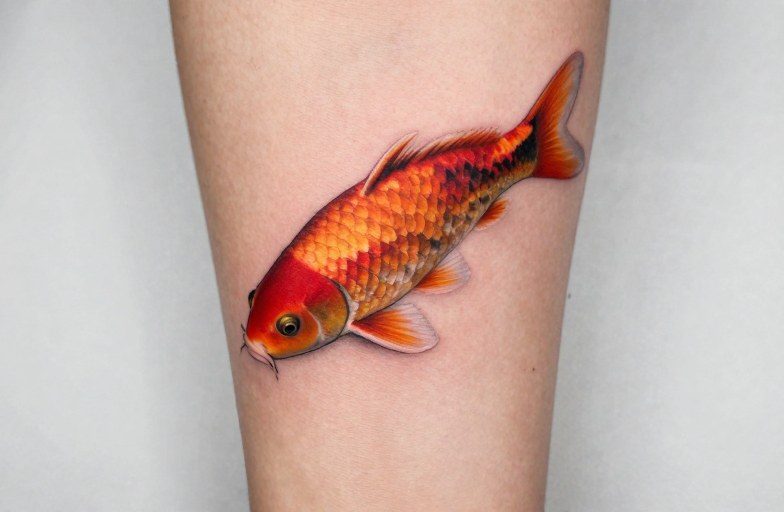
A koi fish tattoo’s color does the heavy lifting on meaning. While the fish itself carries broad associations with perseverance and transformation, the specific hue tells onlookers if you’re marking a romantic milestone, a battle survived, or a family bond. Here’s how each color reads, where it works best on skin, and what separates an authentic piece from generic flash.
Best Placements
Flowing with the Body
Koi designs demand movement. The curved spine of the fish follows natural anatomy beautifully, swimming upstream along a forearm, circling a calf, or cresting over a shoulder toward the chest. Large scales and long fins need real estate to read properly; a thumbnail-sized koi loses every detail that makes the tattoo recognizable.
Full sleeves and back pieces remain the classic showcase. The fish’s S-curve mirrors the arm’s musculature, and water elements, cherry blossoms, waves, lotus, fill gaps organically. For a single koi without background, the outer thigh or ribs give enough vertical space for the tail to trail without distortion.
Color Retention by Location
Hands and feet chew through pigment. The red and orange tones that make koi pop? They fade fastest where skin regenerates aggressively. If you’re set on a foot koi, expect touch-ups every few years. Upper arms and backs hold saturation longer; the skin there sees less abrasion and UV exposure.
- Inner bicep: excellent for private, personal meaning; colors stay vivid
- Side of torso: dramatic curve potential, but stretching with age can distort proportions
- Back of calf: visible in shorts, enough flat surface for detail work
- Neck/clavicle: trending for smaller koi, but limits size and complexity
Religious & Spiritual Angles
Buddhist and Shinto Threads
The koi’s upstream swim connects to Buddhist perseverance narratives, specifically, the fish that became a dragon after climbing the Yellow River’s waterfall. In tattoo form, this often pairs with lotus flowers (purity emerging from murk) or temple gates. Black koi especially carry this spiritual weight, representing the darkness overcome through discipline.
Shinto shrines sometimes use koi imagery for prayers regarding children and fertility. A parent might choose a multicolor koi school to represent offspring, with each fish’s color matching a child’s birth month or personality.
Non-Religious Spiritual Readings
Even without doctrinal attachment, the koi functions as a marker of personal transformation. The color choice becomes the specific chapter: gold for prosperity achieved, white for a fresh start after loss, blue for calm found through struggle. These aren’t universal dogmas, they’re visual shorthand the wearer and those close to them understand.
History & Cultural Roots
Japanese tattooing (irezumi) raised the koi to iconic status during the Edo period, though the fish’s symbolic importance in East Asia predates organized tattoo culture by centuries. Chinese origins often linked koi to scholarly success and imperial examination perseverance. The Japanese adaptation emphasized the dragon-gate myth more heavily, layering warrior virtues onto the image.
Color specificity in koi tattoos grew more nuanced as the design spread globally. Traditional Japanese tattooers worked with a limited palette, sumi black, vermilion red, indigo blue. Modern pigment chemistry expanded possibilities, but the core associations remained: red for strong emotion, black for overcoming hardship, gold for wealth and success.
Western adoption sometimes flattens these distinctions. A pink koi in Tokyo reads as juvenile or feminine; in Los Angeles, it might scan as simply “pretty.” Context matters. Working with a tattooer who understands the visual grammar prevents unintentional miscommunication.
How It Ages on Skin
Color Fading Reality
Red and orange koi look electric fresh. Five years later, without sun protection, they trend toward a muted coral or salmon. The yellow-gold spectrum shifts most dramatically, bright cadmium becomes mustard, then beige. Black linework and shading provide the structural skeleton that keeps the fish readable even as chroma dulls.
White ink, sometimes used for highlights or pale koi, presents special challenges. On lighter skin, it yellows or disappears entirely. On darker skin, it can read as ashy or scar-like. Experienced tattooers often substitute negative space (skin showing through) for white ink, or use very light gray to suggest pale scales without the volatility.
Line Weight and Detail Longevity
Traditional Japanese koi rely on bold outlines, think 7-14 needle groupings, not single needles. These thick borders hold for decades. Delicate fin rays rendered in 3rl or smaller? Those blur within five to eight years. A smart design balances expressive detail in the face and scales with simplified tail and fin treatment that won’t muddy.
Shading technique matters too. Smooth whip-shading (common in Japanese work) ages more gracefully than stippled or hyper-realistic approaches. The gradient from dark back to light belly should read clearly from across a room, not just in close-up photos.
Similar & Related Symbols
Dragon koi hybrids represent the transformation completed, the fish that succeeded. These typically show scaled heads emerging, or full dragon bodies with koi tails. Choosing this over a standard koi signals you’ve crossed the finish line, not that you’re still swimming.
Pairing koi with specific elements modifies meaning:
- Cherry blossoms: beauty’s transience, often memorializing someone lost
- Waves: the struggle itself, the current being fought
- Lotus: purity or spiritual awakening alongside worldly effort
- Maple leaves: autumn, maturity, the beauty of decline
Goldfish tattoos sometimes get confused with koi in Western contexts. They’re distinct symbols, goldfish suggest domestic luck and prosperity, not the arduous journey. A good tattooer will steer you correctly if you bring reference that doesn’t match your stated intent.
Personal & Modern Meanings
Beyond the Traditional Palette
Purple koi, nonexistent in nature, have emerged as cancer survival markers, blending the traditional adversity narrative with ribbon-culture color coding. Teal and turquoise variations sometimes reference mental health struggles or specific awareness campaigns. These aren’t “authentic” Japanese meanings, but they’ve achieved circulation through repetition and shared understanding among wearers.
Tattooers report clients increasingly choosing koi colors to match personal aesthetics rather than symbolic dictionaries. A burnt sienna koi because it complements existing sleeve work. An all-black koi for someone who wants the form without the color commitment. This isn’t wrong, it’s just a different contract with the image. The wearer knows; the casual observer might not.
Gender and the Koi
Historically, full koi bodysuits were male-dominated in Japanese tattooing. Contemporary Western shops see balanced gender distribution, with women often choosing placement that accommodates professional visibility (upper thigh, rib, upper back) and men still trending toward full sleeves and calves. Color choice shows no consistent gender split anymore, red and pink koi appear across all clients.
The Bottom Line
Color transforms the koi from a generic perseverance symbol into a specific personal statement. Red for love and courage, black for adversity overcome, gold for prosperity, white for renewal, blue for calm through struggle, these aren’t rigid codes, but they’re the vocabulary the tattoo speaks. Match that vocabulary to your actual experience, not what sounds impressive.
Find a tattooer whose koi portfolio shows solid line weight, color saturation that held in healed photos, and understanding of Japanese compositional flow. The cheapest koi flash won’t carry the weight you’re paying for in skin. This is one design where the investment in craft pays off every time you see it.
Frequently Asked Questions
Can I combine multiple koi colors in one tattoo?
Absolutely. A pair of koi, one red, one black, commonly represents balancing love with struggle, or two people navigating hardship together. Schools of multicolor koi work for family pieces, with each fish’s color keyed to an individual member.
Does a koi swimming upstream versus downstream change the meaning?
Upstream traditionally signals ongoing struggle or ambition; downstream suggests the battle is won, or acceptance of circumstances. Some wearers choose upstream for motivation and downstream for remembrance. Not every tattooer enforces this distinction, but it’s worth discussing.
Why do some koi tattoos look muddy after healing while others stay crisp?
Usually line weight and saturation. Thin lines blur; washed-out color lacks the pigment load to survive skin’s healing process. Bold black outlines and densely packed color fields age better. Aftercare matters too, sun exposure without SPF degrades red and yellow fastest.
Is it cultural appropriation to get a koi tattoo if I’m not Japanese?
The koi has become a globally circulated symbol, but respectful execution matters. Avoid random Japanese characters you can’t read, learn the specific meaning you’re claiming, and consider supporting a tattooer with actual training in Japanese tattoo tradition rather than copying Pinterest flash.


Leave a Reply