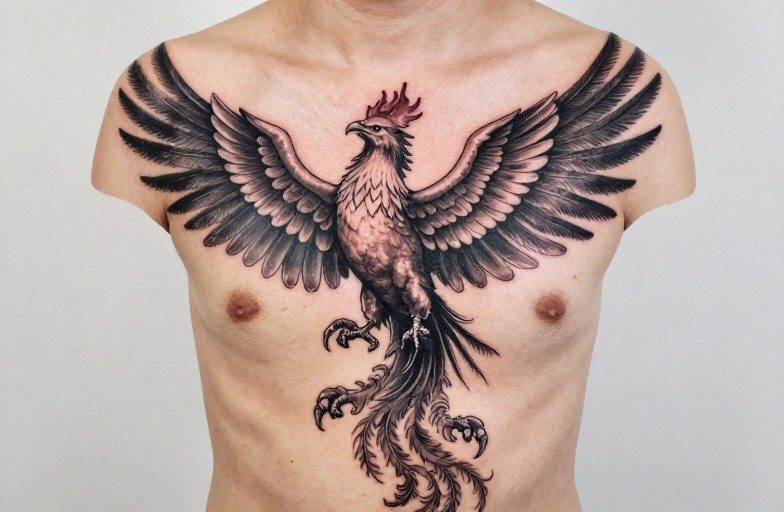
The phoenix tattoo carries one of the most universally understood meanings in tattoo culture: rising from destruction to begin again. it symbolizes rebirth, resilience, and the ability to endure catastrophic loss while emerging stronger. Someone wearing this image has usually marked a pivotal transformation, surviving addiction, divorce, illness, or any life-shattering event that demanded they rebuild themselves from nothing.
Symbolism & Core Meaning
The Fire Cycle
The phoenix’s defining act is self-immolation. Unlike other renewal symbols that suggest gentle growth, this bird demands total annihilation before regeneration. That distinction matters for placement and design. A phoenix rising from visible flames reads differently than one already airborne with smoke trailing behind. The former emphasizes the struggle; the latter, the triumph. Line work handles the fire differently than shading, fine lines create licking, energetic flames, while whip shading builds smoky, atmospheric backgrounds that soften the overall impact.
Color vs. Black and Grey
Traditional phoenix designs lean heavily into saturated reds, oranges, and golds. Japanese-inspired pieces often incorporate teal and blue accents for contrast. Black and grey phoenixes, though less common, carry a more somber, stripped-down weight. The absence of color shifts focus to form and movement, the arch of the neck, the spread of primary feathers, the talons grasping at ash. Over time, red pigments fade fastest; a crimson phoenix will need more frequent touch-ups than its monochrome counterpart to maintain impact.
- Full color: maximum visual impact, faster fading, higher maintenance
- Black and grey: sharper aging, subtler symbolism, better for smaller scales
- Single accent color (red flame, gold eye): compromise approach that ages cleanly
Personal & Modern Meanings
Beyond the Obvious Metaphors
Rebirth narratives can feel generic in a consultation, but the phoenix offers specificity that other renewal symbols lack. The koi swims upstream; the lotus pushes through mud. The phoenix burns. Modern wearers often choose it to mark deliberate self-destruction, the act of quitting a career, leaving a country, cutting off family, followed by conscious reconstruction. It’s less about surviving what happened to you and more about choosing to destroy what no longer served you.
Gendered Interpretations
There’s no inherent gender to the phoenix, though placement trends differ. Men often choose full back pieces or chest panels with wings spread across pectorals. Women frequently select rib placements with the bird curving along the body’s natural line, or thigh pieces where the tail feathers can trail downward. These aren’t rules, just observed patterns. The image adapts to any body, any scale, any orientation.
Mythology & Folklore
Greek and Roman Sources
The phoenix appears in Greek writings often linked to Heliopolis, the Egyptian city of the sun. Herodotus described a bird that appeared every five hundred years, carrying its predecessor’s remains. Roman naturalists repeated and embellished these accounts. The details vary wildly across sources, some specify cinnamon, myrrh, and spikenard for the funeral nest; others mention a worm emerging from the ashes that transforms into the new bird. No single authoritative version exists, which actually benefits tattoo design: artistic license is built into the tradition.
Chinese Fenghuang and Japanese Hou-ou
East Asian phoenix variants differ significantly from Western depictions. The Chinese fenghuang represents virtue, grace, and the union of yin and yang, often paired with the dragon in wedding imagery. The Japanese hou-ou, commonly associated with the legendary phoenix, appears in temple art with a more peacock-like tail and distinct facial features. Tattoo wearers sometimes blend these traditions unconsciously, combining Western flame imagery with Eastern tail plumage. The result works visually but carries mixed symbolic baggage for those familiar with both traditions.
Who Chooses This Tattoo
The phoenix attracts a specific psychological profile more than a demographic. It’s the person who needs external proof of internal change, the visible mark that says “I was there and I came back.” Common trigger events include sobriety milestones, post-cancer remission, surviving violent crime, or escaping religious or political persecution. The tattoo functions as both reminder and warning: remember what you survived, don’t return to what burned you.
Placement often correlates with visibility needs. Someone rebuilding their life semi-publicly, a recovered addict in a twelve-step community, for instance, might choose a forearm or calf. Someone processing private trauma may hide it on a hip, upper back, or ribcage. The phoenix works at any scale, but detail demands space. A tiny phoenix loses the feather definition that makes the design read as majestic rather than generic bird.
Similar & Related Symbols
The Ouroboros
The snake eating its own tail shares the phoenix’s cyclical DNA but emphasizes eternal return rather than linear progression. Where the phoenix moves forward, new bird, new life, the ouroboros suggests repetition. Some wearers combine both, a phoenix within an ouroboros circle, though this risks symbolic overload. The pairing works best when the snake forms the nest or ash bed from which the bird rises.
The Lotus and the Koi
These Eastern symbols of perseverance offer softer alternatives. The lotus doesn’t require destruction; it simply grows despite environment. The koi struggles but doesn’t die. Someone drawn to the phoenix’s intensity might find the lotus too passive, the koi too continuous. Conversely, the phoenix can feel melodramatic for quiet, sustained endurance. The choice between them reveals something about how the wearer understands their own hardship.
- Phoenix: catastrophic change, total reset, dramatic rebirth
- Lotus: gradual growth, maintaining purity despite environment
- Koi: persistent effort against resistance, never surrendering
- Ouroboros: cyclical time, self-creation and self-destruction as one
Religious & Spiritual Angles
Christian Adaptation
Early Christians adopted the phoenix as a resurrection symbol, some linking it to Christ’s three-day cycle. The bird appears in medieval bestiaries and church carvings. Modern Christian wearers sometimes add crosses, halos, or scriptural references to anchor the pagan imagery in their tradition. The theological tension is obvious, the phoenix saves itself through its own destruction, while Christian resurrection depends on divine intervention, but the visual parallel persists.
Contemporary Spiritual Use
Outside organized religion, the phoenix serves in New Age and eclectic spiritual practice as an archetype of personal alchemy. The concept of “burning away what no longer serves you” appears in everything from tarot imagery to guided meditation scripts. Tattooed phoenixes in these communities sometimes incorporate alchemical symbols, planetary glyphs, or elemental markers. The design becomes a personal sigil rather than a cultural reference.
What to Remember
The phoenix tattoo endures because its meaning is immediately legible without being simplistic. Viewers recognize rebirth; wearers know the specific fire. That gap between public reading and private significance is where good tattoo meaning lives.
For actual execution, consider how the design ages. Intricate feather layering looks stunning fresh but can muddy into indistinct texture within five years. Bold outlines around major feather groups preserve readability. Flame backgrounds need negative space to breathe, solid black fire becomes a blob over time. The bird’s pose matters: ascending reads hopeful, descending into fire reads still in process, perched reads contemplative.
Most importantly, this symbol carries weight. Not every hardship requires a phoenix. Wearing one lightly, as trendy imagery without personal connection, tends to read as hollow to those who earned theirs. The design rewards sincerity and punishes posture.
Frequently Asked Questions
Does a phoenix tattoo have to be large to look good?
No, but detail suffers at small scales. A palm-sized phoenix can work with simplified lines and minimal feather texture. Anything smaller risks becoming a generic bird silhouette. The tail feathers need enough length to establish the distinctive phoenix shape.
What’s the best placement for a phoenix tattoo?
The back, chest, and ribs allow the wingspan and tail to extend naturally along body contours. Thighs work well for vertical compositions with the bird rising. Avoid spots where frequent sun exposure will accelerate fading, especially for red-heavy designs.
How much does a phoenix tattoo typically cost?
A detailed, palm-sized phoenix in color runs several hundred dollars at minimum. Full back pieces require multiple sessions and cost significantly more. The complexity of flame backgrounds and feather detailing demands experienced linework and shading, which commands higher rates.
Can a phoenix tattoo be covered up or modified later?
Yes, but the flame elements complicate cover-up work. Dark, saturated fire backgrounds limit options. If you anticipate wanting change later, leave more skin space around the main figure and avoid heavy black fill in peripheral areas.
Related Tattoo Meanings
2 responses to “Phoenix Tattoo Meaning: Symbolism, Mythology & Modern Designs”
[…] Phoenix Tattoo Meaning: Symbolism, Mythology Modern Designs […]
[…] Phoenix Tattoo Meaning: Symbolism, Mythology Modern Designs […]
Leave a Reply