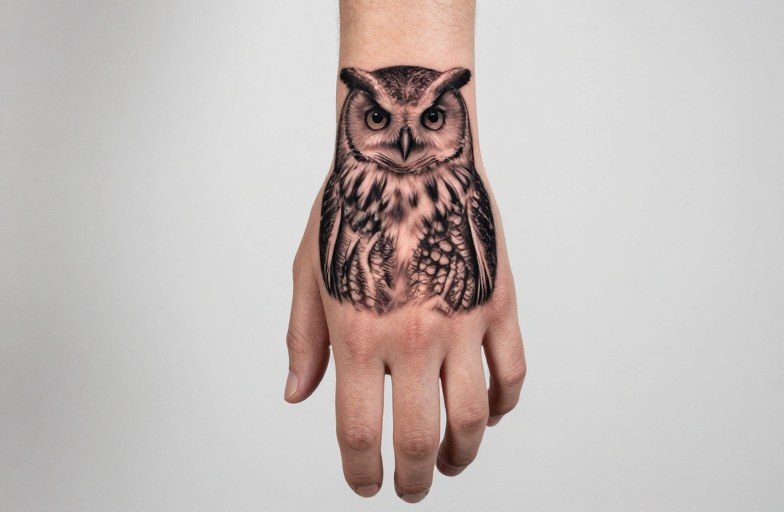
An owl hand tattoo typically signals wisdom, intuition, and the ability to see what others miss. On the hand specifically, it becomes a declaration, visible, unhideable, tied to action and presence. The meaning tightens around vigilance, the choice to watch rather than speak, and a certain comfort with darkness that others might avoid.
Symbolism & Core Meaning
The Eye and the Unseen
Owls carry their symbolism in the face. Those forward-facing eyes, set flat like a human’s, create an immediate connection that sideways-eyed prey birds never achieve. A hand placement amplifies this: every gesture, every reach toward something, carries the owl’s gaze. The design often reads as “I notice before I’m noticed.”
Death associations run through owl symbolism too, though they’re frequently sanitized in modern tattoo culture. The barn owl’s scream, the species’ nocturnal habits, their presence near barns where grain attracted rodents and rodents attracted death, these threads tangle together. A hand tattoo doesn’t shy from this. It sits where you shake hands, where you gesture while speaking, where you cover someone’s eyes as a joke. The proximity to daily human interaction makes the mortality edge sharper, not softer.
What Changes on the Hand
Hand skin moves constantly. The owl here isn’t a static emblem; it flexes, stretches, grips, releases. Some artists design specifically for this, splitting the image across knuckles so the eyes widen slightly when you make a fist. Others center the face on the back of the hand and let the wings wrap toward the wrist. The meaning shifts with these choices, knuckle placement reads more aggressive, more watchful; centered back-of-hand placement feels more contemplative, more emblematic.
Mythology & Folklore
Greek and Roman Threads
Athena’s owl sits at the center of Western associations. The little owl, Athene noctua, appeared on Athenian coinage as a symbol of the city’s wisdom and strategic warfare. Roman culture inverted this somewhat, owls became witch familiars, bad omens, creatures of the underworld. A tattoo drawing from either tradition carries different weight: Athenian lineage feels intellectual, civic, measured; Roman folk strands feel wilder, more liminal, more dangerous.
Indigenous Americas and Beyond
Among the Hopi and other Pueblo peoples, owls often served as messengers from the spirit world, sometimes associated with fertility, sometimes with death. The specific meaning varied by clan and context. In some Mesoamerican traditions, owls accompanied the journey after death. Japanese yōkai lore features the fukurō in ambiguous roles, protective, vengeful, or simply strange. These aren’t interchangeable. A tattoo referencing specific cultural traditions should do so with precision, not as vague “spiritual” garnish.
Color vs Black and Grey
Color owl hand tattoos face real technical challenges. Hand skin is thin, blood-rich, and prone to faster fading than the upper arm or back. Bright yellows and oranges in a barn owl’s face often muddy within two to three years. Blues and deep purples in a great horned owl’s shadowing hold better but still require more frequent touch-ups than black and grey.
Black and grey dominates for good reason. The tonal range suits nocturnal subject matter naturally. A skilled artist can render feather texture through whip shading and stippling that ages more gracefully than solid color fields. That said, selective color, a single amber eye, a blood-red background moon, can anchor a design without committing the whole piece to high-maintenance pigments.
- Full color: Best for stylized or neo-traditional approaches; budget for touch-ups every 2-3 years
- Black and grey: Natural fit for realism and traditional styles; softer edge blowout over time
- Selective color accent: Compromise that highlights the eyes or a specific symbolic element
Common Variations & Styles
Traditional and Neo-Traditional
The traditional owl tattoo carries specific conventions: bold black outlines, limited color palette, simplified feather shapes into readable patterns. On the hand, this clarity matters. Fine detail blurs; strong shapes hold. A traditional owl with a death’s-head moth or hourglass fits the hand’s limited real estate without crowding. Neo-traditional allows more illustrative detail, more color gradation, more personal symbolism while keeping the bold outline structure that ages well.
Realism and Graphic Stylization
Photorealistic owl portraits on hands demand exceptional technical skill. The artist must compensate for how ink spreads in hand skin, slightly more than elsewhere, enough to soften edges that need to stay crisp. Graphic stylization, whether geometric breakdown or heavy blackwork silhouette, sidesteps some of these challenges. The tradeoff is recognizability: a highly stylized owl needs to still read as owl, not abstract bird, from conversational distance.
Design Tips & Pairings
Hand placement limits size and shape in ways that shape the design itself. The owl’s round head and broad facial disc naturally suit the hand’s available canvas better than a long, narrow bird silhouette would. Most successful designs either fill the back of the hand as a single focal piece or split across multiple fingers for a knuckle-spanning composition.
Common pairings carry specific weight:
- Skull: Death and wisdom intertwined, memento mori tradition
- Clock or hourglass: Time, night hours, the owl’s temporal domain
- Key: Hidden knowledge, access to what’s locked
- Moon: Reinforces nocturnal identity without redundancy
- Floral elements: Night-blooming flowers specifically, moonflower, night-blooming cereus, maintain thematic coherence
Text pairings on the hand rarely work well. The owl’s face already commands attention; lettering competes rather than complements. If you must include words, consider them as background texture or integrated into the design’s negative space rather than as a separate element.
History & Cultural Roots
From Sailor Marks to Modern Skin
Owl tattoos entered American tattooing through multiple channels. Maritime tradition included them as protective symbols for night watchmen and sailors on night shifts. Prison tattooing adopted them in various codes, sometimes marking informants (the owl watches), sometimes marking solitary status. These histories overlap and contradict; the owl’s meaning was never singular. Modern tattooing inherited this multiplicity rather than resolving it.
The Hand as Statement Canvas
Hand tattooing itself carries weight. Historically, visible hand tattoos marked you as outside conventional employment, committed to a subculture, or both. The owl’s traditional associations with wisdom and watchfulness create an interesting tension here: it’s a thoughtful choice placed where thoughtfulness is least expected. That friction can be the point.
The Takeaway
An owl hand tattoo works when the design respects both the symbol’s weight and the placement’s demands. The hand will fade faster, hurt more during the session, and read more aggressively to strangers than a shoulder or thigh placement. The owl’s meanings, wisdom, death, night vision, silent observation, compress into something more immediate, more confrontational, more public.
Choose clarity over complexity. The hand isn’t a large canvas, and its skin doesn’t forgive fine detail. A strong silhouette, readable at arm’s length, outlasts intricate feather rendering that blurs within months. The meaning you carry isn’t in the symbolism you research but in what you actually live: the watching, the waiting, the willingness to move in darkness while others sleep.
Frequently Asked Questions
How badly does an owl hand tattoo hurt compared to other placements?
Hand tattooing hurts significantly more than fleshier areas due to thin skin, numerous nerve endings, and proximity to bone. The knuckles and finger sides are particularly intense. Most people find it manageable in sessions under two hours, but it’s not a gentle introduction to tattooing.
Will an owl hand tattoo fade faster than one on my arm or back?
Yes, hand tattoos fade faster due to constant use, sun exposure, and the skin’s natural regeneration rate. Plan for touch-ups every 2-4 years to maintain crisp lines and readable detail. Black and grey designs generally age better than color on hands.
Can I get a detailed realistic owl on my hand, or should I stick to simpler designs?
Realism is possible but risky on hands. Fine detail often blurs within months due to ink spread in thin skin. Most experienced artists recommend bold, simplified designs with strong contrast that will read as an owl even as aging softens the edges.
Do owl hand tattoos carry negative connotations in any cultures?
In some Latin American and Indigenous traditions, owls are associated with death or witchcraft rather than wisdom. If you’re drawing from specific cultural symbolism, research thoroughly and consider whether your intended meaning aligns with or contradicts those traditions.
Leave a Reply