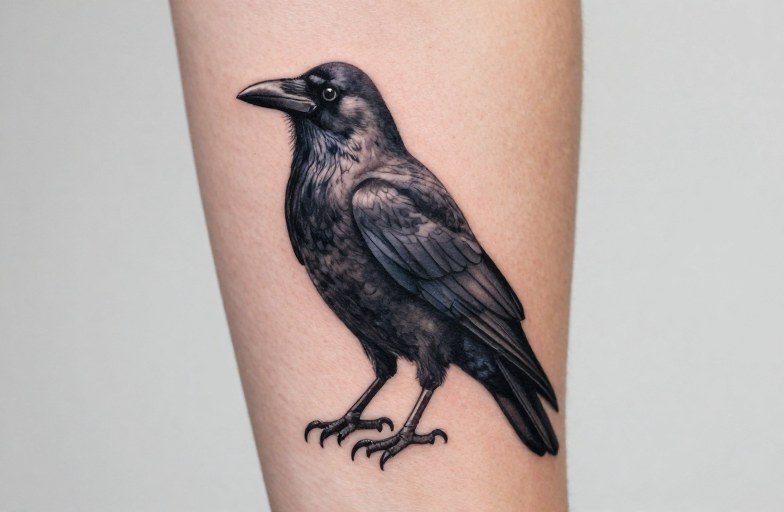
A crow tattoo most commonly signals death, transformation, or keen intelligence, though the exact weight shifts depending on cultural context and personal intent. Some people wear it as a memento mori, others as a nod to the bird’s problem-solving reputation in nature. The meaning isn’t fixed; it accumulates from mythology, the wearer’s own narrative, and how the design actually sits on the body over time.
Mythology & Folklore
Crows occupy a liminal space across nearly every folklore tradition, neither fully sacred nor purely ominous, but something that moves between worlds. This ambiguity makes them rich tattoo material, though it also means the symbol can be misread depending on the viewer’s background.
Norse & Celtic Threads
In Norse tradition, Odin’s two ravens, Huginn and Muninn, represent thought and memory. While ravens and crows are distinct species, the visual overlap in tattoo art is nearly total, black corvid, often perched or in flight. Celtic lore often linked crows to the battlefield and the goddess Morrígan, who appeared in crow form to foretell death or victory. A tattoo drawing on this lineage tends to read as darker, more martial, sometimes paired with swords or knotwork.
Native American & East Asian Variations
Several Pacific Northwest tribes cast the crow as a trickster figure, clever, self-interested, capable of both theft and accidental creation. This reads differently on skin than the European death-omen version; the trickster crow suits someone who identifies with outsmarting systems rather than succumbing to them. In Japanese folklore, the three-legged crow (Yatagarasu) guided Emperor Jimmu and remains a symbol of divine intervention. That specific iconography, three legs, often rendered in red and black, carries a very different charge than a realistic American crow.
Similar & Related Symbols
Corvid tattoos cluster with certain visual neighbors, and the choice of companion imagery sharpens or dilutes the meaning.
- Raven: Larger, heavier beak, associated with prophecy and war in Norse and Haida traditions. A raven tattoo tends to read more solemn, less urban.
- Skull: Pairs with crow to intensify the memento mori reading. The combination can tip into cliché if rendered too cleanly; rougher linework or woodcut styling saves it.
- Key or lock: Plays on the “secret-keeper” or threshold aspect of crow lore. Works best at smaller scales.
- Full moon: Adds nocturnal, witchy association. The circular shape also gives the composition a natural frame.
- Barren tree branch: Classic perch, immediately readable. The negative space between branches matters as much as the bird itself.
Mixing crow with phoenix or dove creates visual confusion, the symbolic registers clash. Most successful crow tattoos commit to the darkness or the trickster angle rather than trying to soften it.
How It Ages on Skin
Crow tattoos present specific aging challenges because of their near-total reliance on black ink and fine detail. Understanding how this plays out helps you choose a style that won’t blur into a smudge.
Black Ink Behavior
Solid black holds up better than color over decades, but crow designs often depend on subtle gradations, feather texture, eye shine, beak highlights. These delicate shifts are the first to go. A crow rendered in heavy blackwork with minimal interior detail will stay readable at fifteen years. One built from hundreds of fine hairlines to suggest individual feathers will soften and merge. The trade-off is immediate visual impact versus longevity.
Style-Specific Durability
- Traditional/Americana: Bold outlines, limited shading, strong silhouette. Ages excellently. The crow remains a crow even as lines gain slight fuzz.
- Realism: Requires large scale to preserve detail. A palm-sized realistic crow loses definition; a full-chest or thigh piece holds better. Expect touch-ups.
- Dotwork/stipple: Creates texture through density of dots. Medium density ages well; very fine stipple can read as uneven gray after healing.
- Silhouette: Pure shape, no interior. Most durable of all, but offers no narrative detail. Best for small placements or as part of larger compositions.
White ink highlights, sometimes used for eye catchlights or feather edges, almost always disappear within 2-5 years on most skin tones. Plan for their absence.
Personal & Modern Meanings
Outside mythology, crows carry contemporary resonance that drives a lot of current tattoo requests. The bird’s actual behavior, tool use, facial recognition, communal mourning of dead, makes it appeal to people who value intelligence over sentimentality.
Urban crow populations thrive in human-altered landscapes, scavenging and adapting. That resilience reads as working-class persistence for some wearers. The “crow’s eye” perspective, seeing what others miss, attracts people in investigative or creative fields. Grief association persists too: crows are one of few non-human species observed responding to dead companions, which resonates with people processing loss without wanting overt memorial imagery.
Modern crow tattoos sometimes reference specific media, Neil Gaiman’s “The Sandman,” the film “The Crow,” or the Baltimore Ravens logo, but these read as fandom rather than symbolic depth. The line between meaningful and referential blurs depending on execution.
History & Cultural Roots
The crow’s symbolic load isn’t uniform across time or place, and responsible tattooing acknowledges these fractures rather than flattening them.
European Christian Context
Medieval Europe often cast crows as carrion-eaters and therefore spiritually suspect, associated with execution sites, plague, and unshriven death. This negative valence persists in horror imagery. A tattoo drawing on this tradition tends toward gaunt, aggressive rendering, sometimes with exposed bone or tattered feathering.
Indigenous North American Perspectives
Various tribes hold crow as creator, messenger, or transformer. The Hopi kachina tradition includes crow figures with specific ceremonial roles. These associations are often linked to specific clan or regional knowledge rather than generic “Native American spirituality.” Someone outside these traditions should approach crow imagery with care, avoiding direct replication of sacred designs or claiming spiritual connection they haven’t earned.
Contemporary Japanese tattooing (irezumi) maintains the Yatagarasu as a viable motif, though it’s less common than koi or dragons. The three-legged form is distinctive enough to avoid confusion with Western crow symbolism.
Best Placements
Crow anatomy and typical poses suit certain body areas better than others. The bird’s horizontal posture in flight or perched stance maps naturally to human topography.
- Upper arm/outer bicep: The classic perch. A crow here reads as watchful, accessible for detail work, and ages well with moderate sun exposure.
- Forearm: High visibility, suits smaller scales. The crow’s forward-facing pose works here, beak and eyes directed at the viewer. Expect fading if you work outdoors unprotected.
- Chest/sternum: Centered flight pose, wings spread. Demands larger scale to avoid the “bat” misreading at distance. Painful, but the canvas rewards the commitment.
- Thigh: Excellent for detailed realism, easily concealed. The muscle curve can distort a perched crow slightly when sitting; design around standing posture.
- Back/shoulder blade: Large surface for full wingspan compositions. The scapula movement can animate the wings slightly, which some artists exploit.
- Hand/finger: Small silhouette only. Detail is lost; the crow becomes a generic black shape. High fade zone.
Neck placement risks employment consequences and accelerates fading. The skin there turns over faster, and sun exposure is constant.
The Takeaway
A crow tattoo means what you build it from: death or memory, trickery or survival, specific cultural lineage or personal invention. The symbol’s strength is its elasticity, but that same quality means lazy execution reads as vague darkness rather than intentional statement. Choose your visual references precisely, scale for the style’s durability, and place it where the body supports the bird’s natural posture. The best crow tattoos don’t explain themselves, they watch, and wait for the viewer to catch up.
Frequently Asked Questions
Does a crow tattoo always mean death or something negative?
No. While European folklore links crows to death and battlefields, other traditions emphasize intelligence, creation, or guidance. The meaning depends on the specific cultural references in your design and what you intend to communicate.
What’s the difference between a crow and raven tattoo?
Visually, ravens have heavier beaks and shaggy throat feathers, but tattoo art often blurs the distinction. Symbolically, ravens lean more toward Norse prophecy and solemnity, while crows accommodate trickster and urban-survival readings more easily.
Will a detailed crow tattoo with feather texture age well?
Fine feather detail softens significantly within 5-10 years. For longevity, prioritize strong silhouette and bold contrast over intricate interior linework. Plan for touch-ups if you want realistic texture preserved.
Is it culturally appropriative to get a crow tattoo?
Generic crow imagery crosses few boundaries, but specific sacred forms, like the three-legged Yatagarasu or certain clan-specific Northwest Coast designs, require respect and research. Avoid copying ceremonial art without understanding its context and restrictions.
Leave a Reply