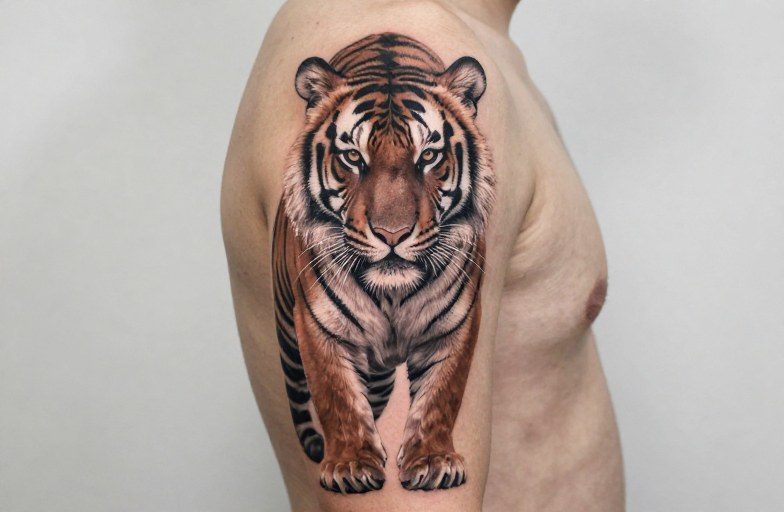
A tiger tattoo most commonly symbolizes raw strength, fierce independence, and protective energy. The imagery carries weight across cultures, representing both the danger of untamed power and the nobility of controlled force. What starts as a straightforward symbol of courage often accumulates deeper personal significance once it lives on someone’s body.
Symbolism & Core Meaning
Power Without Restraint
The tiger occupies a unique symbolic space. Unlike the lion, which Western tradition often frames as regal and social, the tiger stands alone. Solitary, territorial, and devastating when provoked. A tattoo here speaks to personal sovereignty, the kind of strength that doesn’t require a pack to validate it. The coiled muscle in a tiger’s shoulder, the visible calculation in its eyes, translates to skin as a warning and a standard.
Protection & Guardian Energy
In several Asian traditions, tiger imagery serves as active protection. Korean folklore places tiger paintings at entryways to ward off evil spirits. Chinese practice associates the animal with military might and the defense of borders. A tattoo drawing on this lineage functions as personal armor, particularly when placed where the wearer can see it, chest, forearm, thigh. The belief isn’t passive decoration; it’s an active claim of guarded space.
How It Ages on Skin
Stripes, Lines, and the Passage of Time
Tiger tattoos present specific aging challenges that other animal imagery doesn’t. The black stripes demand crisp edges to read correctly. Over years, those edges soften. On high-movement areas, the ribs, the side of the neck, the ditch of the arm, stripes can blur into indistinct bands rather than the sharp contrast that makes a tiger recognizable. Placement matters enormously for longevity.
Orange and yellow pigments, staples of traditional tiger coloration, fade faster than black or dark blue. Sun exposure accelerates this dramatically. A chest piece partially covered by clothing holds color far longer than a forearm tiger that sees daily UV. Artists working in this imagery often push for higher saturation than seems natural, knowing the eventual fade. The wise collector accepts this trade-off or commits to touch-ups.
- Bold black linework around stripes extends readable contrast by years
- White highlights (whiskers, eye catchlights) typically disappear entirely within 5-7 years
- Large-scale pieces age more gracefully than small ones, detail collapse is real
- Textured fur rendered with stippling or fine lines softens to a pleasant haze; smooth gradients can muddle
Style Choices That Last
Traditional Japanese approaches (irezumi) solve the aging problem through scale and bold pattern. The stripes become graphic elements rather than realistic texture. Neo-traditional and American traditional styles similarly prioritize readable silhouette over photographic detail. Photorealistic tiger portraits, while impressive fresh, require significant commitment to maintenance. The collector should enter that choice with open eyes.
Who Chooses This Tattoo
The demographic spans wider than casual assumption suggests. Military personnel, particularly those with Pacific deployment history, often gravitate toward tiger imagery from encountered traditions. Martial artists connect to the animal’s embodiment of explosive, practiced violence. Survivors of violence or illness sometimes select the tiger as reclaimed ferocity, an external marker of internal fight they didn’t know they possessed until tested.
There’s also a significant subset who simply respond to the visual impact. The tiger is objectively striking. That motivation deserves respect without overburdening it with false depth. Not every tattoo needs to carry trauma or philosophy. The image works on pure aesthetic terms, and many collectors are honest about that primary draw.
Common Variations & Styles
Traditional Japanese (Irezumi)
The Japanese tiger (tora) carries specific conventions: wind bars in the background, often paired with bamboo or maple leaves, sometimes confronting a dragon to represent the balance of power. The stripes get rendered as solid black shapes with negative-space texture, not individual hair lines. These pieces demand large scale, sleeve, back piece, or full leg, to accommodate the compositional requirements. Attempting this vocabulary at small scale produces a cramped, illegible result.
Chinese Tiger & Folk Styles
Chinese tradition often renders the tiger more rounded, almost cartoonish in folk art contexts, with exaggerated eyes and sometimes humorous proportions. This transfers to tattoo as a deliberately approachable, less aggressive energy. The protective guardian becomes almost domestic, watchful but not threatening. Contemporary artists working in this mode reference Minhwa (Korean folk painting) or Nianhua (Chinese New Year pictures) directly.
Realism & Blackwork
Photorealistic tigers require exceptional technical execution. The fur texture, the wet quality of the nose, the particular amber of the eyes, any slight failure reads immediately as wrong. Blackwork tigers, stripping away color entirely, rely on negative space and solid black to suggest the stripe pattern. This approach ages with remarkable dignity and suits collectors who want the symbol without the maintenance burden of color.
Personal & Modern Meanings
Beyond inherited symbolism, contemporary collectors layer individual significance. The tiger as recovering addict, claiming the predatory focus once directed toward destruction, now redirected. The tiger as parent, protective, territorial, awake at all hours. The tiger as immigrant narrative, surviving unfamiliar territory through adaptability and threat awareness. These meanings don’t replace cultural history; they sit alongside it, sometimes in tension, sometimes in harmony.
The gendered reading of tiger tattoos has shifted notably. Where once the imagery was marketed almost exclusively toward masculine clients, contemporary collecting shows no such division. Women choosing large-scale tiger pieces increasingly reject the outdated framing of the image as “too aggressive” for feminine presentation. The symbol belongs to whoever claims it.
Mythology & Folklore
East Asian Traditions
The tiger’s mythological presence is dense and geographically specific. In Korean shamanic tradition, the tiger often serves as messenger or mount for spirits, simultaneously dangerous and divine. Chinese cosmology places the White Tiger (Baihu) as guardian of the west, one of the Four Symbols constituting directional and seasonal order. This isn’t decorative mythology, it’s operational cosmology that some tattoo collectors specifically invoke.
South Asian & Southeast Asian Threads
Indian tradition, particularly in regions where tigers remain present in lived experience, treats the animal with complex reverence. Durga rides a tiger as manifestation of divine power that the goddess commands rather than merely possesses. Indonesian and Malaysian folklore often positions the tiger as ancestral spirit or shamanic transformation, becoming the tiger, not merely honoring it. Tattoos drawing on this lineage carry different obligations than decorative appropriation.
The caution here is genuine: not every tiger tattoo engages meaningfully with these traditions, and that’s acceptable. But collectors should know the difference between aesthetic appreciation and claimed spiritual connection. The latter requires relationship, not just imagery.
The Bottom Line
A tiger tattoo offers durable symbolic vocabulary, power, solitude, protection, ferocity, rendered in visually arresting form. The image rewards thoughtful placement and style choice with decades of readable impact. It risks cliché when chosen without consideration, but that failure belongs to the selection process, not the symbol itself. Whether drawing on specific cultural lineage or personal resonance, the tiger on skin remains a serious commitment to a serious animal. The work is making sure your particular tiger earns its place there.
Frequently Asked Questions
Does a tiger tattoo facing left or right change the meaning?
In Japanese tradition, a tiger ascending (climbing) with head facing upward or forward represents ambition and growth, while descending can suggest protection or completed struggle. Directional symbolism is less rigid in other traditions, though many artists consider the flow of the composition relative to the body’s movement.
Is it culturally appropriative to get a Japanese-style tiger tattoo if I’m not Japanese?
Appreciation versus appropriation hinges on context and relationship. Collecting from an educated artist who understands irezumi conventions, without claiming spiritual connection you haven’t earned, generally falls on the respectful side. Avoiding specific sacred motifs you’re not initiated into is wise; the tiger itself is broadly accessible across cultures.
What’s the most painful placement for a large tiger piece?
The rib cage and sternum present the sharpest challenge for expansive tiger work, thin skin over bone, constant movement with breathing. The ditch of the elbow and back of the knee similarly test endurance for striped detail. Thigh and outer upper arm offer the most manageable canvas for large scale with manageable discomfort.
Can a tiger tattoo be covered up or reworked if I no longer want it?
Tiger imagery, with its bold black stripes and often saturated color, presents moderate-to-significant coverup challenge. The black can be incorporated into darker new designs; orange and yellow are harder to mask. Laser fading before coverup often proves necessary. Consult specifically with artists who specialize in coverup work before committing to a removal strategy.

Leave a Reply