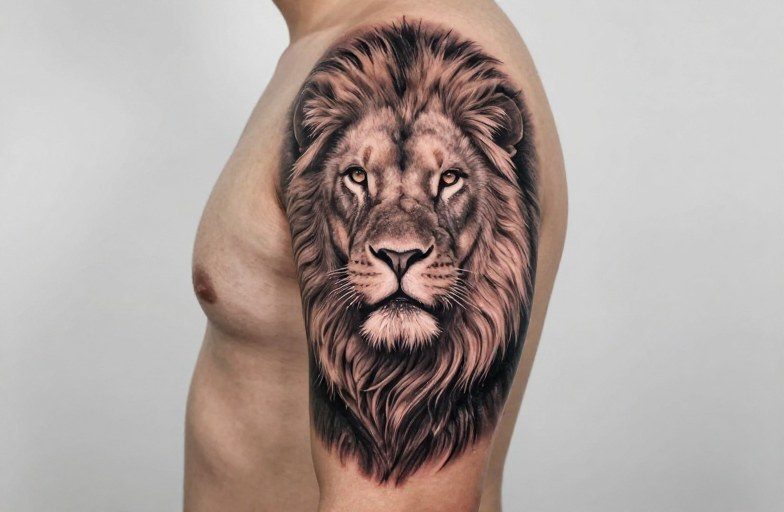
A lion tattoo most commonly symbolizes courage, strength, and authority. Beyond the obvious “king of the jungle” association, it can represent personal resilience, family protection, or a commanding presence that doesn’t need to prove itself. The specific meaning shifts dramatically based on pose, expression, and accompanying elements, an aggressive roaring lion reads entirely differently from a calm, watchful profile.
Common Variations & Styles
Realistic vs Stylized
Photorealistic lion portraits dominate the upper arm and thigh placement. These demand serious technical skill: the mane’s texture requires careful needle grouping, and botched fur detail turns majestic into muddy within months. Stylized versions, geometric breakdowns, neo-traditional bold outlines, or single-needle illustrative work, age more forgivingly. Geometric lions, built from hundreds of fine lines, look striking fresh but soften significantly as skin texture changes; the chest and shoulder blade hold these cleaner than the forearm.
Minimalist line-art lions have surged in popularity for wrist and ankle placement. The constraint forces designers to capture essence in three or four strokes. These work best at small scale (under three inches) where a complex mane would collapse into a blob anyway. Negative-space techniques, carving the lion’s shape from black fill, offer strong contrast but require confident execution; any wobble in the outline kills the illusion.
Full Body vs Portrait Focus
Full-body lion compositions suit the back, thigh, or ribs where the body’s length accommodates the stretch. These allow narrative elements: a lion pacing, hunting, or standing over territory. Portrait focus, head and mane only, concentrates emotional impact into a smaller footprint. The eyes become the critical detail; asymmetry in pupil placement or highlight placement creates an unintentionally deranged expression that’s expensive to correct.
Symbolism & Core Meaning
Traditional Associations
Power and dominance remain the baseline reading, but lions carry layered symbolism worth unpacking. In animal behavior, male lions defend territory while females hunt, so a lioness specifically can signal provider-protector duality, or reject the default masculine reading entirely. A sleeping lion suggests latent strength, the confidence not to posture. Wounded or scarred lions reference survival and earned authority rather than inherited status.
Family structure offers another vector: lion prides are matriarchal cooperative units. Parent-and-cub pairings, common on parents of either gender, emphasize protection and lineage. Multiple cubs can represent actual children, but the imagery risks sentimentality unless the artist finds distinctive poses rather than generic cute rendering.
Personal vs Public Symbolism
Some wearers choose lions to project an image, leadership, intimidation, self-mastery. Others select them for private resonance: a reminder of a specific struggle survived, or a quality being cultivated rather than possessed. The same design reads differently on a visible forearm versus a covered rib placement. Consider whether you want the symbol to broadcast or to serve as personal anchor; this affects not just placement but expression, snarling versus composed, solitary versus grouped.
Color vs Black and Grey
Golden manes in full color require saturated yellow and orange pigments that fade fastest in UV exposure. The upper arm’s outer surface, regularly sun-exposed, will dull these tones within five years without religious sunscreen use. Inner bicep preserves color longer but offers less display surface. Black and grey lion tattoos rely on contrast range, deep blacks in the nose and eye sockets, bright skin-tone highlights for whisker tips, to create dimension. This palette ages more consistently and suits smaller scales where color fields would merge.
Blue-eyed lions have become a specific sub-trend, often referencing the “white lion” rarity or personal eye-color connection. Light blue ink, especially pastel tones, disappears into skin faster than any other hue; expect substantial fading within three years. Amber or green eyes hold better. For mane color, some artists mix warm grey with subtle brown wash rather than pure yellow, achieving golden suggestion with better longevity.
History & Cultural Roots
Ancient and Classical Depictions
Lion imagery in permanent skin marking has precursors across cultures, though direct lineage to modern tattooing is often linked to specific traditions rather than universal practice. Egyptian statuary and tomb painting associated lions with royalty and solar deities; some trace certain protective lion amulet designs to later Mediterranean tattoo practices, though evidence remains scattered. Greek and Roman warriors adopted lion motifs on shields and standards; whether this translated to skin is debated among historians, but the association of lion imagery with martial prowess established early.
European Heraldry and Its Tattoo Legacy
Coat-of-arms lions, rampant, passant, reguardant, created a visual vocabulary still referenced. The heraldic lion’s stylized posture, exaggerated mane, and formal frontality influenced traditional tattoo flash from the 1900s onward. Sailor and military tattooing commonly featured these simplified lions as badges of courage. The specific pose terminology (rampant: rearing; passant: walking) persists in design discussions, though most contemporary clients don’t know the words.
British “lion and unicorn” imagery, Rastafarian lion-of-Judah references, and various African national symbols all draw from overlapping but distinct sources. Awareness of which tradition you’re referencing matters if the design carries specific cultural weight for you.
Design Tips & Pairings
Complementary Elements
Crowns pair with lions so frequently they’ve become almost inseparable; to avoid cliché, consider what the crown specifically means to you, divine right, self-sovereignty, achieved status? Alternative regalia (broken chains, specific landscape elements) can individualize the composition. Clocks and lions together suggest mortality or “time is king,” but this pairing has saturated the market since 2015.
Floral elements soften the lion’s aggression without weakening it. Roses are standard; proteas or acacia branches reference African habitat more specifically. Geometric mandala backgrounds behind a lion’s head create tension between organic and structured that photographs well but demands precise centering on the body.
Placement and Scale Realities
- Chest: symmetrical lion heads work well; asymmetrical poses fight the sternum’s central axis
- Thigh: accommodates detailed mane work; inner thigh hurts significantly more than outer
- Forearm: limited vertical space favors portrait orientation; horizontal compositions wrap awkwardly
- Hand: lion heads at this scale lose all detail; consider paw prints or minimal silhouettes instead
- Back: full back pieces allow environmental storytelling, savanna, sky, prey elements
Skin movement affects design: the shoulder cap’s rotation will distort a perfectly circular mane into an oval during daily motion. Artists should design for the body’s range, not just static posing.
Religious & Spiritual Angles
Judeo-Christian tradition features lions multiply: Judah’s tribal symbol, Daniel’s protected den, the “Lion of Judah” title for Christ in Revelation. These carry specific doctrinal weight; a Christian wearer might emphasize the peaceful or resurrected lion rather than the conquering beast. Buddhist tradition includes the lion as Buddha’s throne support and as guardian of the dharma, distinct from the Western “king” association, more about sacred protection and teaching.
Rastafarian lion imagery specifically references Haile Selassie’s claimed Solomonic lineage, not generic African pride. Using this symbolism without engagement with its meaning is common but worth conscious consideration. Similarly, Chinese guardian lions (foo dogs, though technically distinct species in origin) have become decorative tattoo elements separated from their temple-protection function; the crossed-paw position indicates gender and role in traditional pairs.
Spiritual-not-religious wearers sometimes select lions for “solar plexus chakra” associations or astrological Leo connections. These readings are personally valid but lack the cultural specificity that gives traditional symbols depth; the design challenge becomes avoiding generic sun-and-lion compositions that feel like zodiac clip art.
What to Remember
The lion’s symbolic power is precisely its broadness, it accommodates genuine personal meaning and empty posturing equally. A well-chosen lion tattoo works because the specific design decisions (pose, expression, pairing elements, placement) narrow the general symbol into something particular to you. Poor choices leave a generic powerful-cat image that says nothing specific and ages poorly as trends shift.
Technical execution matters enormously with this subject. Amateur lion tattoos fail most often in the eyes (asymmetrical, dead-looking) or mane texture (either too uniform and wig-like, or so chaotic it reads as scribble). Invest in an artist with demonstrated large-cat work in their portfolio, not just general animal skill. The difference between a lion that commands attention and one that looks like a confused housecat is about five years of specialized practice.
Finally, consider the commitment of visibility. A lion on your throat or hand makes a statement you can’t retract for job interviews or family gatherings. The symbol of confident authority shouldn’t be undermined by placement that creates anxiety about when it’s exposed. Match the boldness of the image to the boldness of your life structure.
Frequently Asked Questions
Does a lioness tattoo mean something different from a male lion?
Yes, though both represent strength, lioness imagery specifically emphasizes hunting prowess, cooperative protection, and maternal ferocity. It often appeals to wearers who want to separate strength from masculine posturing, or who connect with the pride’s actual social structure where females do the sustained work.
How well do detailed lion manes hold up over time?
Fine individual hair strokes tend to blur together after 7-10 years, becoming a textured mass rather than distinct strands. Bold clumps of mane with negative-space highlights age more legibly. Your artist should design for the ten-year version, not just the fresh photo.
Is it culturally inappropriate to get a Lion of Judah tattoo if I’m not Rastafarian?
The Lion of Judah carries specific religious and political meaning within Rastafari and Ethiopian Orthodox traditions. Using it purely as aesthetic African imagery can read as appropriation. If the symbol resonates with you, learning its history is respectful; if you just want an African-themed lion, a generic savanna lion avoids that specific weight.
What’s the most painful placement for a large lion piece?
The ribs and sternum area cause the most consistent difficulty due to thin skin over bone and the diaphragm’s movement during breathing. The outer thigh and upper arm are manageable by comparison. For extensive work, plan multiple sessions rather than enduring marathon sittings that degrade both artist precision and your pain tolerance.
Leave a Reply