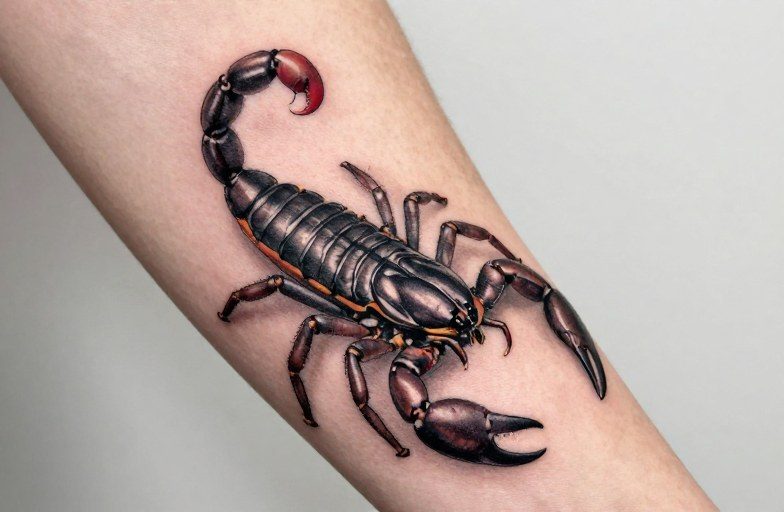
A scorpion tattoo primarily signals danger survived, not danger sought. The creature kills to eat and defend, never for sport, making it a symbol of proportional violence, of striking only when cornered. On skin, it translates to resilience, sexual intensity, and the willingness to endure what others won’t.
Symbolism & Core Meaning
The Dual Nature: Death and Protection
The scorpion carries venom capable of killing, yet its own exoskeleton is its armor. This duality drives most of its tattoo appeal. You aren’t marking yourself as a predator; you’re marking yourself as someone who has learned to protect their softness with something hard. The stinger faces backward, which matters, this creature doesn’t hunt forward aggressively. It warns, then retaliates. That posture resonates with people who’ve been underestimated.
Sexual and Emotional Intensity
In several traditions, the scorpion governs sexual passion and jealousy. Its venom is literally a cocktail of neurotoxins that causes overwhelming sensation, pain or paralysis, depending on dose. Tattoo collectors sometimes choose this creature to signal intensity that borders on destructive, an acknowledgment that their own capacity for feeling runs hot enough to damage. It’s not subtle symbolism, and it’s not meant to be.
History & Cultural Roots
Mesopotamian and Egyptian Origins
The scorpion goddess Serket often appears in Egyptian funerary art, her creatures guarding the dead and guiding transitions. Some trace protective amulet use to these periods, though the exact lineage gets murky. Mesopotamian cylinder seals show scorpions as guardians of thresholds. The through-line is consistent: boundary protection, especially around death and transformation.
Contemporary Military and Prison Associations
Specific military units across several countries have adopted scorpion insignia, often linked to desert deployment or special operations. In prison tattooing, particularly in Russian and Eastern European traditions, the scorpion can indicate a former soldier or someone who has done time in harsh conditions. Placement matters enormously here, knuckles, neck, and face carry different social weight than a shoulder or thigh piece. If you’re drawn to the military resonance, research your specific unit’s actual imagery rather than generic “tactical scorpion” designs.
How It Ages on Skin
Scorpion tattoos age distinctly because of their anatomy. The pincers, legs, and segmented tail create natural thin lines that blur faster than solid blackwork. Here’s what actually happens:
- Tail segments: The stacked oval or triangular segments along the tail merge over 5-10 years if placed too small or with too-tight spacing. Go bigger than you think, or accept the blur.
- Pincers: These claw shapes need consistent line weight. Uneven lines here look like mistakes, not style choices, as they soften.
- Legs: Eight thin legs are the first thing to disappear into gray wash. Consider which legs actually need to read versus which can be suggested by negative space.
- Stinger: The curved tip holds up well if it’s a single bold line or solid black drop. Detailed barbs on the stinger vanish fast.
Shading versus line work creates different aging profiles. A fully rendered, shaded scorpion with background holds visual weight longer than an outline-only piece. The silhouette approach, solid black scorpion, no interior detail, lasts decades but sacrifices the anatomical segmentation that makes a scorpion read as a scorpion from distance. Your artist should show you healed photos of their scorpion work at 2+ years, not fresh photos.
Similar & Related Symbols
Scorpion vs. Spider
Both arachnids, both venomous, both read as “dark” or “dangerous.” The spider leans more toward patience, construction, entrapment. The scorpion is reactive, terrestrial, more about warning than web-building. On skin, spiders allow more ornamental possibility, web backgrounds, geometric integration. Scorpions demand more respect for their actual body plan; a distorted scorpion just looks wrong, where a stylized spider can still read.
Scorpion vs. Snake
The snake sheds its skin; the scorpion molts too, but the visual association is less clean. Snakes carry more explicit rebirth symbolism across cultures. Scorpions carry more explicit “don’t touch me” energy. If your meaning centers on transformation after harm, either works, but the snake offers more fluid design possibilities for wrapping around limbs. The scorpion works better as a contained emblem, a crest, a warning sign.
The Scorpio Zodiac Connection
Massive overlap here, obviously. The astrological Scorpio borrows the creature’s associations, intensity, secrecy, loyalty, revenge, and many tattoo collectors conflate the two. The constellation itself is faint and unremarkable; most zodiac scorpion pieces use the creature rather than star mapping. If you want both, integrate the constellation as background dots rather than forcing the scorpion into an unnatural pose to match star positions.
Who Chooses This Tattoo
There’s no single type, but patterns emerge in placement and style choices:
- Neck and hand: Often signals lived hardness, sometimes institutional background. The visibility is the point, you can’t hide a warning.
- Thigh and hip: Frequently chosen by women, often with more stylized or ornamental rendering. The curve of the tail follows body lines well here.
- Chest and back: Larger compositions, sometimes with desert backgrounds, skulls, or floral elements. Room for narrative detail without the small-piece blur problem.
- Forearm: The working-class classic. Visible, proportionate, reads clearly at handshake distance.
Style choices split roughly into three camps: traditional American (bold lines, limited color, heavy black), photorealistic (hyper-detailed, often with desert substrate or amber tones), and blackwork/geometric (stylized segments, sometimes sacred geometry integration). The photorealistic approach ages worst; the traditional approach holds longest; the geometric approach risks becoming dated as trends shift.
Religious & Spiritual Angles
Christian and Islamic Contexts
The scorpion appears in both Bibles and Quranic texts as a creature of wilderness, testing, and divine protection. In Luke 10:19, believers are given authority “to trample on snakes and scorpions.” Some interpret this as triumph over evil; others as stewardship over dangerous things. Islamic tradition includes scorpions among the creatures whose harm is forbidden to inflict unnecessarily. Tattooing this symbol doesn’t automatically signal religious devotion, but the resonance exists for believers who’ve studied the texts.
Shamanic and Indigenous Associations
Several desert traditions in the Americas feature scorpion in healing and boundary-setting ceremonies. Often linked to transformation through pain, the creature appears in initiatory contexts. If you’re drawn to this lineage, work with an artist who understands the specific visual language rather than generic “tribal” patterning. Appropriation concerns are real, and the scorpion is common enough that you can find authentic collaboration without theft.
Before You Decide
Size and placement should be driven by how long you want the piece to read clearly, not just by where you have space. A scorpion smaller than your palm will lose its legs. The tail curve should follow a natural body line, against the curve of a calf, with the spine, along the collarbone, not fight it.
Consider whether you want the creature alone or in context. Desert ground, a skull, a flower, a constellation, each shifts meaning. Alone, it’s pure warning. With a rose, it’s danger and beauty intertwined, which can read as either complex or clichéd depending on execution. With a clock or hourglass, it’s time and mortality. The combination matters more than the single element.
Color choices are limited by subject: scorpions are naturally brown, black, yellow, or translucent. Blue or purple scorpions read as fantasy creatures, which is fine if that’s your intent, but know you’re stepping away from the naturalistic symbolism that gives the tattoo its weight. Red accents on the stinger specifically signal danger concentrated, a nice touch if you want emphasis without full color.
Finally, the scorpion faces a direction. Tail curled left or right, head raised or lowered, stinger poised or relaxed, these aren’t arbitrary. A poised stinger reads as ready; a relaxed one reads as confident enough not to need readiness. Your artist should discuss this with you, not default to their reference folder’s most common pose.
Frequently Asked Questions
Does a scorpion tattoo always mean someone has been to prison?
No. While prison and military associations exist in specific traditions, millions of people wear scorpion tattoos with no institutional background. Context, placement, and style usually make the distinction clear.
What’s the best size for a scorpion tattoo to age well?
At least palm-sized for line-work pieces, larger if you want detailed leg segments. The tail alone needs enough space for 4-5 distinct segments to avoid merging into a solid blur over time.
Can a scorpion tattoo be feminine or is it only masculine?
Absolutely not gender-exclusive. Many women choose scorpion tattoos, often with ornamental framing, specific placement on hip or rib, or stylized rendering that emphasizes the curved tail’s natural flow with body lines.
Should I get a scorpion if I’m a Scorpio but don’t like the creature itself?
The zodiac symbol is abstract enough that you can use the glyph, the constellation, or related imagery like eagle or phoenix (Scorpio’s evolved forms) instead. Don’t force a literal scorpion if the creature doesn’t resonate.
Leave a Reply