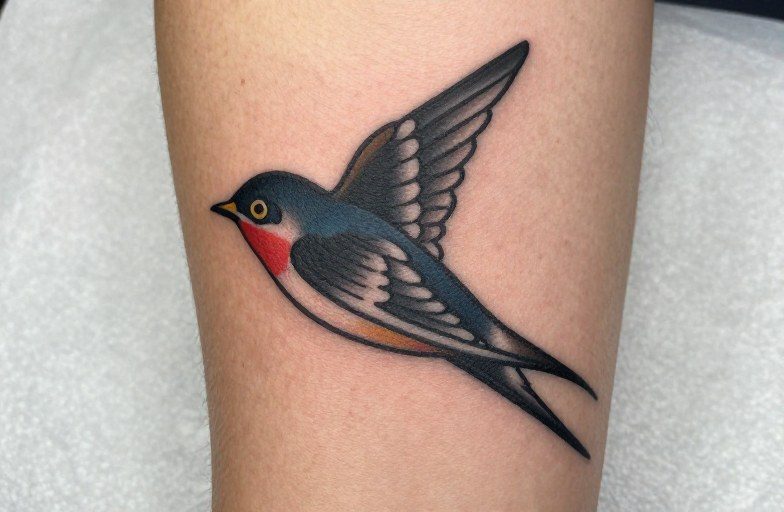
The traditional swallow tattoo most commonly signals safe return, loyalty, and the miles someone has traveled, literally or metaphorically. Two swallows traditionally meant a sailor had logged 5,000 nautical miles; one swallow marked 5,000, or sometimes the completion of a first voyage. Beyond nautical roots, the bird’s lifelong mating pair bonds made it shorthand for devotion, homecoming, and finding your way back to where you belong.
Personal & Modern Meanings
Contemporary wearers rarely earn swallows through sea miles, but the core symbolism translates cleanly. The bird’s migration pattern, leaving, enduring, returning, maps onto recovery, military deployment, long-distance relationships, or any journey with a promised endpoint.
Commitment & Fidelity
Swallows select one partner and return to the same nesting site annually. This biological fact underpins the tattoo’s use for anniversaries, wedding dates, or memorial pieces. A pair of swallows, each partner wearing one, remains a straightforward choice without veering into matching-heart territory. Single swallows work too, carrying the same weight through the viewer’s knowledge of the symbol rather than literal doubling.
Overcoming Hardship
The swallow’s Atlantic crossing, roughly 6,000 miles of nonstop flight, lends itself to marking survived adversity. Chemo completion, sobriety milestones, prison release: the bird’s arrival on European shores after weeks at sea mirrors any passage through sustained difficulty. The trad style’s bold lines and limited palette suit this reading; there’s no soft-focus sentimentality, just a durable emblem.
Similar & Related Symbols
Understanding what surrounds the swallow in flash sheets and actual skin helps clarify its specific territory.
Swallow vs. Sparrow
These get conflated constantly, but they’re distinct in trad iconography. Swallows carry forked tails, blue-black upper plumage, and chestnut throats in classic color renderings. Sparrows are chunkier, rounder, brown-and-gray. The sparrow tattoo sometimes signified a ship that went down, worn by survivors or in memory of the lost, whereas the swallow always meant return. Mixing them up erases that nuance. If you want the positive homecoming reading, specify swallow to your artist.
Nautical Neighbors
- Anchor: stability, often paired with swallows to balance movement and staying put
- Compass rose: direction-finding, natural companion for the journey theme
- Ship wheel: control over one’s course
- Dagger through swallow: loss of a loved one, betrayal, or the harder side of loyalty
The swallow’s airiness contrasts well with heavy hardware; that’s why the pairing works visually and symbolically.
Religious & Spiritual Angles
The swallow appears in several spiritual frameworks, though none dominate its tattoo usage the way nautical culture did.
Christian Symbolism
Psalm 84:3 mentions swallows nesting near God’s altars, linking them to sanctuary and divine protection. Medieval European art sometimes used the bird to represent the incarnation, Christ’s arrival on earth, or the soul’s resurrection. These associations are thinner in actual tattoo practice than in academic symbolism, but they explain why some Catholic families gravitated toward swallow imagery for memorial pieces.
Folk Beliefs
Across Northern Europe, a swallow nesting on your house meant good luck and protection from fire. Killing one was taboo. These beliefs bled into tattoo culture indirectly: the bird as harbinger, as omen of safe passage. The trad swallow’s upward flight angle, wings spread, captures this guardian aspect better than a perched or feeding posture would.
Design Tips & Pairings
Traditional swallow design has specific conventions that separate authentic trad from generic bird tattoos.
Line Work & Color Palette
Classic trad swallows use bold black outlines with limited filling: cobalt or navy upper wings, rusty orange or red throat patch, cream or pale yellow underbelly. Shading is typically sparse, achieved through whip-shading or minimal gradient rather than smooth realism. The tail must fork, this is non-negotiable for the species and the symbol. Beak is small, pointed, slightly open. Eye is simple black dot or tiny highlight.
Watercolor backgrounds, geometric frames, or photorealistic rendering all pull away from trad meaning toward generic bird tattoo territory. If you want the accumulated cultural weight, stay within the stylistic guardrails.
Common Pairings That Work
- Two swallows, chest or collarbones: symmetrical, classic sailor placement, emphasizes partnership or completed journey
- Swallow with banner/text: names, dates, coordinates, keep lettering period-appropriate (thick serifs, limited flourish)
- Swallow with roses: love + devotion, balanced composition
- Swallow with knife/dagger: sacrifice, protective aggression, the cost of loyalty
Adding too many elements dilutes the symbol. One strong pairing beats a cluttered sleeve patch.
Best Placements
Placement carries meaning in trad work, not just aesthetics.
Historical Placements
Hands, knuckles, and sides of the neck were earned positions, visible, exposed, hard to hide. A swallow on each hand meant you’d sailed around the Horn. Throat swallows indicated deep experience or time served. These locations still carry that resonance, though modern employers and social contexts may override the tradition.
Contemporary Adaptations
Collarbone swallows frame the face and reference the chest pieces of merchant sailors. Forearms offer visibility without the full commitment of hands or neck. Ribs and sternum work for larger compositions with banners or secondary elements. Ankles and feet, while popular for small tattoos, read as more decorative and less anchored in trad meaning, fine if that’s your aim, but know the distinction.
Scale matters: trad swallows are typically palm-sized or larger. Too small, and the forked tail and color blocking become muddy. The lines need room to breathe and hold over decades.
History & Cultural Roots
The swallow tattoo’s maritime origins are well-documented, though earlier uses are harder to pin down with certainty.
British Naval Origins
By the late 19th century, British sailors were wearing swallow tattoos as markers of experience. The specific mileage claims, 5,000 for one, 10,000 for two, surface in multiple oral histories, though written documentation from the period is sparse. The practice spread through Anglophone navies and merchant fleets, then into civilian tattoo culture via port city shops.
Early American Tattooing
Sailor Jerry Collins, Bert Grimm, and other foundational American tattooers featured swallows heavily in their flash. The design’s compact shape, clear silhouette, and strong color contrast made it technically suitable for early electric machines and the limited palettes available. Its popularity among servicemen during World War II cemented it as a core American trad image, often linked to Pacific theater deployment and the promise of return.
Some trace the swallow’s presence in even earlier European tattooing, Celtic or Romano-British traditions, but these connections are speculative rather than established. The maritime lineage is the solid ground.
Before You Decide
A trad swallow tattoo carries genuine symbolic density, but only if the design and placement respect the tradition. Research your artist’s flash work, do they understand the color rules, the tail shape, the proportion? A swallow that reads as generic songbird loses the meaning you’re paying for.
Consider whether you want the nautical heritage active in your piece or just the abstract symbolism of return and loyalty. Both are valid, but they lead to different design choices. The heritage route demands stricter adherence to convention. The abstract route allows more flexibility but risks dilution.
Finally, think about aging. The bold outlines and limited color palette that define trad swallow work aren’t stylistic preference alone, they’re structural. Thin lines blur. Complex shading falls out. A well-executed trad swallow in saturated black, cobalt, and rust will remain legible at twenty years in a way that delicate alternatives won’t. The symbol of safe return should itself endure.
Frequently Asked Questions
Can I get a swallow tattoo if I’ve never been a sailor?
Absolutely. The symbolism has broadened far beyond its nautical origins. What matters is understanding the tradition you’re drawing from, not literal eligibility. Choose an artist who respects the trad conventions, and wear it with the personal meaning you assign.
What’s the difference between a swallow and a bluebird in traditional tattooing?
Bluebirds in trad work are often associated with happiness and sometimes specifically with sailing a set distance from home, distinct from the swallow’s emphasis on return. They’re visually similar but carry separate symbolic loads. Your artist should know which flash sheet tradition they’re pulling from.
Do swallow tattoos have to be in color?
Black-and-grey trad swallows exist and work fine, but the classic palette, blue upper wings, rusty throat, pale belly, is part of the symbol’s visual shorthand. Going black-and-grey shifts the reading slightly toward memorial or grittier territory. Neither is wrong; they’re different tones.
How do I keep the colors from fading to mush?
Start with an artist who saturates color properly during application. After healing, consistent SPF on the tattooed skin prevents the quickest fade. Moisturizing helps skin quality but won’t save poorly applied ink. Trad designs hold up specifically because of their bold outlines; even if color softens, the shape remains readable.
Leave a Reply