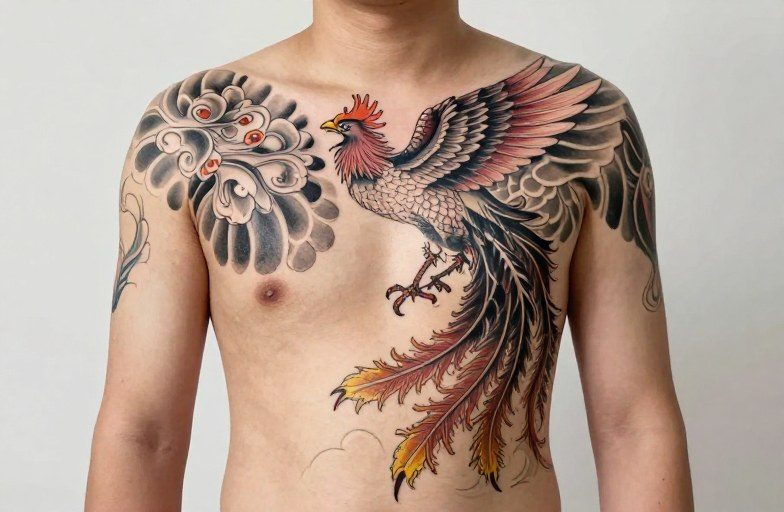
A traditional phoenix tattoo follows the conventions of American traditional tattooing: bold black outlines, limited but saturated color palette, flat shading with minimal gradation, and an iconic, immediately readable image. The bird rises with wings spread, flames curling beneath it, often rendered in reds, oranges, yellows, and greens against a blue or black background. The style prioritizes clarity over realism, what matters is that the phoenix reads as a phoenix from across a room, not that every feather looks photographically accurate.
Origins & History
The phoenix motif entered Western tattooing through maritime and military culture, often linked to sailors and soldiers who saw the bird as a symbol of survival and renewal. Sailor Jerry Collins and other mid-20th century American tattooers refined the imagery into the bold, graphic style we recognize today. Their phoenix designs drew from earlier Japanese depictions, some trace it to Edo-period woodblock prints that reached Western ports, but stripped away the fine detail in favor of heavy outlines and solid color fields that would hold up over decades of sun and salt.
From Flash to Custom
Classic phoenix designs once lived on flash sheets, the pre-drawn pages hung in shop windows. Customers picked a design, and the artist might adjust size or add a name banner. Today’s traditional phoenix tattoos are more often custom-drawn, but the visual rules remain: symmetrical or near-symmetrical wing spread, head turned in profile or three-quarter view, flames rendered as distinct teardrop or ribbon shapes rather than realistic fire. The background typically includes clouds, wind bars, or simple geometric filler like dots and stars.
Japanese Influence vs American Simplification
Japanese phoenix tattoos (hou-ou) feature intricate linework, subtle color transitions, and flowing composition across large body areas. American traditional deliberately rejected this complexity. The traditional phoenix compresses the drama into a single focal point: wings up, tail down, flames contained within the silhouette. This simplification wasn’t aesthetic laziness, it was practical. Bold tattoos age better under harsh conditions, and the style developed for people who worked outdoors and couldn’t afford frequent touch-ups.
Color vs Black and Grey
Color dominates traditional phoenix tattoos for good reason. The bird’s association with fire demands warm tones, and the style’s palette, red, yellow, green, blue, black, creates immediate visual impact. Red wings with yellow highlights and green tail feathers read instantly as “phoenix” even to casual observers. Black serves as the structural skeleton: outlines, eye detail, and flame shadows.
When Black and Grey Works
Black and grey traditional phoenix tattoos exist but require careful planning. Without color, the design relies entirely on line weight and whip shading to separate elements. The wings need heavier outlining; the flames become negative space or stippled greywash rather than absent color. This approach suits skin that doesn’t hold red well, some darker skin tones push out crimson pigment over time, or personal preference for a more subdued look. The trade-off: the phoenix loses some of its immediate recognizability and can blur into generic bird imagery if the silhouette isn’t perfect.
Color Longevity Reality
Yellow and white fade fastest in traditional phoenix tattoos, often dropping to skin tone within five to ten years depending on sun exposure. Red holds better but can shift toward pink or brown. Dark green and blue survive longest. Smart placement accounts for this: a phoenix on the outer upper arm, constantly exposed to sun, will degrade faster than one on the chest or thigh. Artists compensate by packing yellow more densely and using orange as a buffer between yellow and skin.
Who It Suits
The traditional phoenix demands space. The wingspread silhouette needs width, at minimum four to five inches across the chest, back, or outer thigh. Attempting this design on a wrist or behind the ear collapses the detail into an unreadable blob. The style works best on flat or gently curved surfaces where the symmetry isn’t distorted.
Body Placement Priorities
- Chest center or sternum: Classic placement, symmetrical, allows full wingspan with flames dropping toward the stomach.
- Outer upper arm: Visible, traditional location, but sun exposure accelerates fading; plan for future touch-ups.
- Thigh front or outer: Large canvas, less sun damage, accommodates detailed background elements.
- Back upper center: Maximum space for elaborate flame and cloud backgrounds, easy to expand into full back piece later.
- Forearm or calf: Possible but requires vertical orientation, bird rising with wings partially folded rather than full spread.
Skin Tone Considerations
Darker skin doesn’t exclude traditional phoenix tattoos, but color choices shift. Deep reds and dark greens show well; yellows and light oranges may require heavier saturation or substitution with gold or amber tones. Some artists prefer black and grey with selective color accents, red flames only, for instance, rather than full palette. The key is contrast: the black outline must remain visible against the skin, and color fields need enough saturation to read as distinct from surrounding skin tone.
Cost & Sessions
A traditional phoenix tattoo ranges from a single session for a compact design to multiple sessions for large-scale work with extensive background. Pricing varies by region, artist reputation, and complexity, but expect to pay for the time required to pack solid color and maintain clean lines. Rush jobs show in the healed result: patchy color, blown lines, and uneven saturation.
Session Breakdown
A palm-sized phoenix on the forearm might complete in three to four hours. A chest piece with full background demands six to eight hours minimum, often split across two sessions to let swelling subside in heavily worked areas. Large back pieces with multiple background elements can stretch to four or more sessions. The color packing phase, filling each section with solid, even pigment, takes longer than linework and can’t be shortcut without visible inconsistency.
Budgeting for Quality
Traditional tattooing requires specific technical skill: consistent line weight, smooth color saturation without overworking the skin, and understanding how the design will settle as it heals. Artists who specialize in this style often charge more per hour than generalists because their efficiency and healed results justify it. A cheap traditional phoenix with blown outlines and scarred color packing costs more to fix than doing it right initially. Research portfolios for healed photos, not just fresh work.
Aftercare Notes
Traditional phoenix tattoos with heavy color packing and bold lines create significant skin trauma. The thick saturation that makes the style bold also means more plasma and ink runoff in the first days. Expect heavier scabbing than fine-line work, and resist the urge to pick, color loss from scab removal is permanent and obvious in solid fields.
Healing Timeline Specifics
Days one to three: heavy plasma, possible bruising around color-packed areas, especially red and black. Days four to seven: scabbing forms, itching intensifies. Weeks two to three: scabs flake, color looks dull and dusty beneath the shedding skin. Week four onward: color brightens as the epidermis settles, though final clarity takes six to eight weeks. Large pieces on the chest or back may take longer due to movement and friction from clothing.
Long-term Maintenance
Traditional tattoos age well structurally, the bold outlines prevent the design from dissolving into blur, but color vibrancy depends on protection. Sunscreen on exposed phoenix tattoos isn’t optional; UV degrades red and yellow fastest. Moisturizing maintains skin elasticity, preventing the cracking that makes solid color look chalky. After ten to fifteen years, touch-ups refresh faded areas, though good traditional work often needs less revision than softer styles because the black outline preserves the structure even as color mutes.
Common Mistakes to Avoid
Clients and artists both make predictable errors with traditional phoenix designs. Avoiding these saves money, pain, and disappointment.
Design Errors
- Too much detail: Fine feather texture, realistic flame gradation, or excessive background elements fight the style’s graphic strength. The phoenix should read in a glance.
- Asymmetry without purpose: Traditional composition relies on balance. A tilted head or uneven wing spread looks accidental, not dynamic.
- Color overload: Using every available hue muddies the image. Pick three to four dominant colors with black as anchor.
Technical & Placement Errors
- Overworking the skin: Dense color packing requires multiple passes; trying to achieve full saturation in one pass causes scarring and patchy healing.
- Wrong scale for placement: A full-spread phoenix crammed onto a bicep inner curve distorts when the arm moves. Design for the body’s movement, not just a static pose.
- Ignoring natural body lines: The phoenix’s upward rise should follow the body’s vertical flow. A bird fighting against the torso’s natural lines looks forced and uncomfortable.
Final Thoughts
The traditional phoenix endures because it does exactly what American traditional tattooing promises: bold, readable, lasting imagery that carries weight without pretension. The design doesn’t need personal symbolism to justify its place on your skin, the visual impact is sufficient. What matters is finding an artist who understands the style’s constraints and strengths, who won’t soften the lines or add unnecessary detail that compromises the graphic punch. Get the silhouette right, pack the color solid, protect it from sun, and you’ll have a phoenix that still reads clearly decades later, rising from its own ashes every time someone sees it.
Frequently Asked Questions
How big does a traditional phoenix tattoo need to be to work properly?
At minimum, four to five inches across to maintain the wing spread and flame detail. Smaller than that, the elements collapse together and the healed result becomes a blurry blob rather than a readable bird.
Can a traditional phoenix tattoo be covered up or reworked later?
Yes, the bold black lines and solid color fields actually make traditional work easier to cover than softer styles. The existing structure can be incorporated into a larger design or blasted over with new bold work, though light colors and yellow are harder to mask.
Why do some traditional phoenix tattoos look muddy after healing?
Usually overworking during the session, too many passes trying to force saturation, causing scar tissue that traps ink unevenly. Or poor aftercare with thick scabs pulled off prematurely, removing packed color with them.
Is a traditional phoenix tattoo more painful than other styles?
The pain depends on placement and your personal tolerance, not the design itself. However, the heavy color packing requires more needle time in each area, which can feel more intense than light shading or single-pass linework.

Leave a Reply