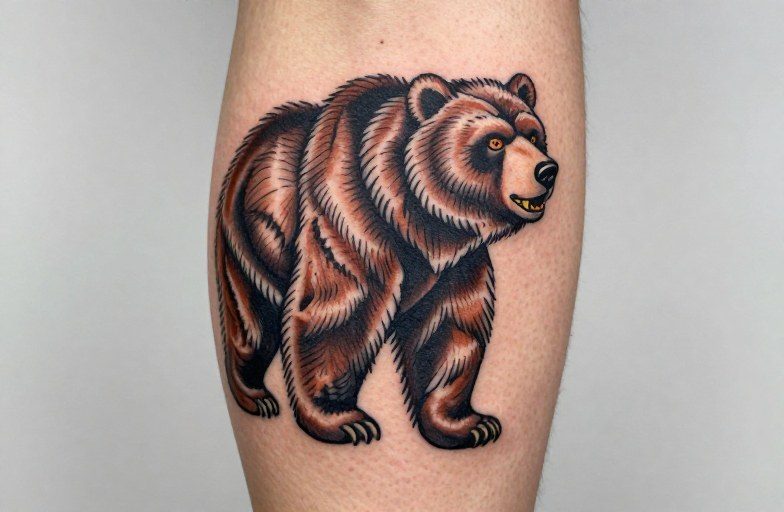
The American traditional bear tattoo is a heavy-weight classic: thick black outlines, a restricted palette of red, yellow, green, and black, and a bear rendered in aggressive profile or three-quarter stance. Born from the flash sheets of the early-to-mid 20th century, this motif carries connotations of raw strength, wilderness, and resilience. The style demands simplicity that reads instantly from across a room. Fur becomes a series of rhythmic swirls or solid black shapes. The muzzle is blocky, the eyes small and fierce, the claws exaggerated. Every element must survive decades of sun and skin changes.
Linework & Technique
Outline Weight and Structure
American traditional lives or dies on its outline. Bear designs typically employ a single bold black contour, sometimes doubled or “pumped” with a slightly thinner parallel line for depth around the head and shoulders. The linework must be consistent, wobbly or hesitant passes create visible damage that color cannot hide. A well-executed bear outline uses tapering strategically: thicker at the jaw and paw, slightly thinner at ear tips and claw points. This variation creates weight without breaking the flat, graphic quality essential to the style.
Needle grouping matters here. Most artists reach for a tight 7-14 round liner for the main contour, switching to a 5-round for finer details like nostril slits or eye highlights. The bear’s fur texture is rarely rendered with individual hair strokes; instead, artists build volume through negative space and solid black “fur blocks” that suggest mass without literal depiction.
Color Packing and Saturation
Traditional bear color follows strict rules. The body is often left skin-tone or filled with a warm honey yellow. Accents hit in blood red, tongue, inner mouth, decorative roses or banners. Green appears sparingly, usually in background foliage or as a secondary accent. Black serves as shadow, silhouette, and texture simultaneously.
Color must be packed to uniform saturation. Patchy or “washed” color in a traditional piece reads as amateur work. The bear’s chest and belly might carry a lighter value, but transitions remain abrupt, not blended. This is not realism. A skilled artist “whips” the machine to create consistent stippled saturation, especially in the larger black areas that define the bear’s silhouette against any background elements.
- Limit your palette to 3-4 colors maximum
- Black should occupy 40-60% of the design’s surface area
- Avoid graywash shading; use solid black shapes for dimension
- Leave strategic skin breaks for “white” highlights rather than using white ink alone
Common Mistakes to Avoid
Over-Detailing the Subject
One of the most frequent errors is treating a traditional bear like a neo-traditional or illustrative piece. Individual fur strands, realistic muscle anatomy, or soft blended shading destroy the graphic punch. The bear’s face should be simplified to almost cartoon severity, broad nose, heavy brow, small fierce eyes. Adding too many decorative elements (roses, daggers, banners) without integrating them into the silhouette weakens the overall composition. Every element must lock together like puzzle pieces.
Weak Composition and Flow
Bears are bulky. A design that ignores the body’s natural curves will fight the placement forever. The bear’s posture, rearing, walking, or snarling, must follow the muscle flow of the chosen body part. A rearing bear on a forearm works because the vertical rise matches the arm’s length. A walking bear across the chest flows with pectoral movement. Reversing these creates visual tension that ages poorly as the tattoo settles and shifts.
Another pitfall: insufficient contrast between the bear and its background. A traditional piece needs clear figure-ground separation. If the bear and surrounding roses or scrollwork share similar values, the entire image muddies within a few years.
- Don’t request photorealistic reference be translated into traditional style
- Never place a complex bear design too small, minimum palm-sized for readability
- Skip trendy techniques like watercolor splashes or dotwork within a traditional framework
Aftercare Notes
Traditional bear tattoos carry heavy black saturation, which creates specific healing considerations. The large solid black areas, paws, muzzle shadows, background silhouettes, will weep more plasma and form thicker scabs than fine-line work. Resist the urge to pick. Lifted scabs pull ink with them, leaving permanent “holidays” or light spots in what should be uniform black fields.
During the first 72 hours, the black portions may appear dull gray beneath plasma buildup. This is normal. The true saturation reveals itself after the superficial healing completes, typically around day 10-14. Moisturize sparingly, over-hydrated scabs soften and detach prematurely. For a bear with extensive red or yellow areas, expect slightly longer healing; these pigments sit higher in the dermis and flake more visibly.
Long-term, the bold outline protects this style better than most. However, the honey yellows and bright reds are vulnerable to sun degradation. A traditional bear on a frequently exposed area like the forearm or calf will need SPF 50+ applied regularly after the first year to prevent the warm tones from drifting toward muddy orange or pink.
Cost & Sessions
Size and Time Estimates
A palm-sized traditional bear, clean and simple, runs most clients 2-3 hours of machine time. This translates to $400-$800 depending on the shop’s hourly rate and regional market. A larger piece, thigh, outer arm, or back shoulder, incorporating background elements like roses, scrollwork, or a moon face, extends to 4-6 hours and $1,000-$1,800.
Multi-session bears usually split at logical design breaks: outline first, then color fill. Some artists prefer knocking out smaller pieces in one sitting to maintain consistent machine tuning and hand freshness. The heavy black packing is physically demanding; an artist working past hour four may show fatigue in line quality.
What Drives Price Up
Custom flash painted specifically for you costs more than pulling a sheet design. Extensive background elements, multiple bears, or integration with existing tattoos require design time billed separately. Name banners and lettering add complexity despite their small size, getting traditional script to curve correctly and maintain legibility is its own specialty.
- Shop minimums often apply; a tiny bear below 3 inches rarely works in this style
- Touch-ups within 6 months are usually free; sun-damage corrections are not
- Traveling for a specialist artist adds consultation and deposit logistics
Best Placements
High-Impact Locations
The outer upper arm remains the quintessential traditional bear placement. The cylindrical surface shows the design cleanly from the front, and the muscle padding provides stable, predictable skin. Thighs offer similar advantages with more canvas, ideal for a bear with extended background or companion elements like a ranger’s arrow or mountainscape.
Chest pieces work when the bear’s posture follows sternum lines. A rearing bear centered on the chest, claws raised, reads powerfully. However, sternum and collarbone skin is thinner and more sensitive; the heavy lining required will test pain tolerance. Ribs and stomachs are generally avoided for substantial traditional work, the skin movement and stretching distort the rigid geometry over time.
Scale Considerations
Traditional bear tattoos must maintain minimum scale for their details to hold. The eye, typically a small black dot with a white highlight, needs enough room to avoid healing into a solid blob. Claws require distinct separation. As a rule, the bear’s head alone should be no smaller than a golf ball. Full-body bears need palm-sized minimums at absolute smallest. Shrinking below this threshold sacrifices the boldness that defines the style.
- Forearm: excellent visibility, moderate pain, easy aftercare access
- Calf: stable skin, good for walking or standing bear postures
- Back of arm above elbow: classic “patch” placement, limited distortion
- Hand/finger: generally inadvisable; scale too small, detail loss guaranteed
Modern Variations
Contemporary artists have pushed the traditional bear in several directions without abandoning its core vocabulary. The “California traditional” approach often incorporates more extensive black-fill background, denser compositions, and slightly looser line quality influenced by 1990s street shop culture. Japanese-American fusion pieces place the bear amid waves, maple leaves, or temple guardians, maintaining the bold outline but borrowing compositional complexity from irezumi.
Some practitioners explore “tough guy” nostalgia: the bear paired with daggers, women’s faces, or military insignia in strictly period-appropriate flash arrangements. Others have developed “bear heads only” as repeatable flash icons, stripping the body to concentrate on expressive muzzle variation, snarling, sleeping, or tongue-lolling.
A newer trend sees bears rendered with slightly exaggerated proportions: massive paws, tiny ears, almost cubist facial geometry. This pushes the style toward folk art territory while keeping the technical requirements intact. The successful variations all share one trait: they never sacrifice the immediate readability from ten feet away that makes American traditional effective.
The Takeaway
The American traditional bear tattoo endures because it solves a visual problem elegantly: how to render power and wildness with tools that must survive human skin for decades. The solution is restraint. Bold outline, limited color, simplified form, aggressive posture. Get these elements right and the tattoo will look as correct in thirty years as the day it was done. Choose an artist who actually works in this style regularly, not someone who “can do anything.” The traditional bear has rules, and breaking them doesn’t make it personal, it makes it fail.
Frequently Asked Questions
Do American traditional bear tattoos always have to include red and yellow?
No, but straying from the classic palette changes how the piece reads. Black-and-grey traditional bears exist and can look striking, though they sacrifice some of the style’s immediate recognition. Adding purple or blue pushes toward neo-traditional territory.
How do I know if an artist is actually skilled in American traditional?
Check their portfolio for consistent bold outlines, proper whip-shading saturation, and healed photos from one to five years out. Flash painting experience matters, artists who design their own sheets understand the style’s structural logic better than those who only copy.
Will a traditional bear tattoo stretch badly if I gain muscle?
Moderate muscle growth affects large solid black areas less than fine detail. The bear’s simplified shapes absorb some distortion. However, placements over fast-growing areas like the biceps peak or chest outer edge may show more change than stable zones like the outer forearm.
Can a traditional bear cover up an older tattoo?
Often yes, due to the heavy black coverage inherent in the style. The bear’s solid silhouette blocks previous work effectively. Success depends on the old tattoo’s color density and the new design’s scale, consultation with flash in hand is essential.


Leave a Reply