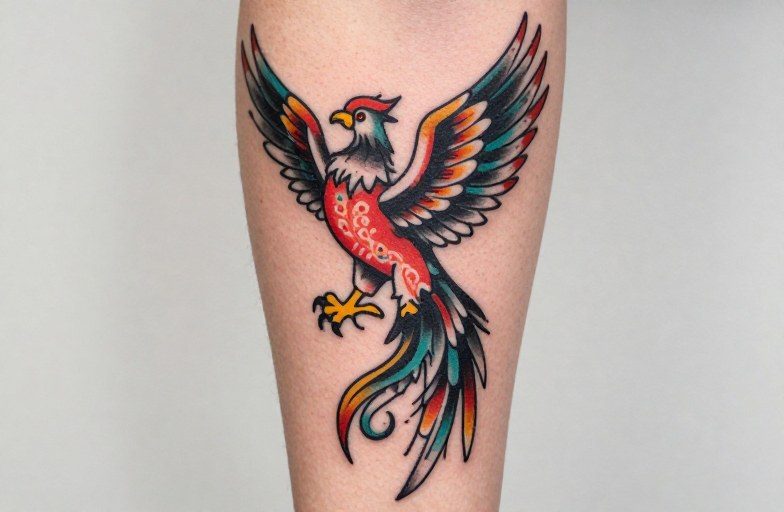
The traditional phoenix tattoo means survival through destruction, rising after everything falls apart. In classic American tattoo style, it carries this rebirth symbolism with unapologetic boldness: thick black outlines, limited but saturated color palette, and a stylized bird that looks ready to claw its way out of the ashes. No subtle shading, no delicate realism. The trad phoenix announces that you’ve been through something and emerged on the other side.
Best Placements
Where the Wingspan Works
The phoenix demands space for those outstretched wings. A chest piece lets the bird spread wide across the pecs, wings curling toward the shoulders, classic, balanced, and visible when you want it. Full backs carry the composition with room for the tail feathers to trail down. Thighs offer another natural canvas, especially the outer thigh where the wing shape follows the muscle curve.
- Upper arm to chest cap: the wing sweeps naturally onto the shoulder
- Forearm: smaller, but the bird wraps well around the cylinder
- Side of the calf: vertical space suits the rising posture
- Behind the knee: not for beginners, but the phoenix “rises” with every step
What Gets Cramped
Hands, fingers, and the throat choke this design. The phoenix needs room for its defining features, the fan of tail feathers, the crest, the flame suggestions. Shrink it too small and you lose the silhouette that makes it read instantly as phoenix rather than generic bird. Wrists and ankles can work for a simplified head-and-flame motif, but the full traditional composition wants more real estate.
Design Tips & Pairings
Building the Composition
Traditional phoenix designs rely on a few non-negotiables. The head faces left or right in profile, beak open, often with a flame or smoke curl passing through. Wings extend upward and outward in a pronounced V or sweeping curve. Tail feathers cascade downward in layered, teardrop-shaped plumes. The body sits compact and muscular, not elongated like a heron or crane.
Background elements common to the style: clouds rendered as simple curved bands, dots for texture, occasional banner scrolls with lettering. Keep the scroll clean, too many words clutter the silhouette. “Rise” or a single significant date works better than a paragraph.
What Pairs Well
- Flames at the base, either as background fill or the bird emerging from them
- Hourglasses above or below, time running out and starting over
- Daggers through or beside, the old “death and rebirth” pairing
- Roses for contrast, organic softness against the bird’s angular lines
- Snakes as opposing energy, both cyclical symbols
Pairings work best when they share the same visual language. A realism snake with a trad phoenix looks mismatched; a traditional dagger or coiled traditional serpent keeps the piece cohesive.
Color vs Black and Grey
The traditional phoenix is historically a color piece. The classic palette runs hot: cadmium red and orange for the body, yellow highlights, maybe green in the tail feathers as a nod to the Japanese hou-ou influence that filtered into American trad. Black outlines contain everything, preventing the warm colors from bleeding into visual noise.
Black and grey trad phoenixes exist but fight the symbol’s nature. The fire, the heat, the very concept of burning and renewal, all want color. If you go black and grey, push the contrast hard: solid blacks in the wing tips and tail edges, bright white highlights on the head and breast, dense stipple or whip shading for texture. Without that contrast, a grey phoenix can look like a muddy eagle.
Skin tone matters for saturation. On darker skin, the red/orange/yellow spectrum needs to be bolder, less pastel. Some artists shift toward deeper crimson and vermillion, or add white ink highlights that pop against melanin-rich skin. On very fair skin, yellow can heal toward a mustard tone; a skilled artist compensates with more orange in the mix.
Similar & Related Symbols
Close Cousins
The ouroboros shares the cyclical rebirth concept but wraps it in self-consumption rather than destruction from outside. The scarab beetle, particularly in Egyptian-influenced traditional work, carries resurrection symbolism with a different visual weight. Japanese hou-ou tattoos look similar, long tail feathers, crested head, but carry distinct cultural associations and typically more intricate, less graphic line work.
What Sets the Phoenix Apart
Unlike the ouroboros’s closed loop, the phoenix is linear: burn, die, return. That narrative arc appeals to people marking a specific transition rather than an ongoing cycle. Unlike Christian resurrection imagery (crosses, empty tombs), the phoenix carries no denominational baggage. It functions across belief systems as a universal symbol of getting back up.
Contemporary adaptations sometimes merge the phoenix with other motifs: a phoenix skull for “what died and what remains,” or phoenix feathers scattered as a sleeve filler suggesting the rebirth is still in process. These variations keep the core symbol flexible without diluting it.
How It Ages on Skin
The Reality of Bold Lines
Traditional tattoos age better than most styles because the heavy black outlines act as retaining walls. In a phoenix specifically, those thick wing edges and tail feather borders hold the design together even as color saturation fades. After ten years, a well-executed trad phoenix still reads as a phoenix. A realism piece with subtle color gradations might become unrecognizable.
The red and orange pigments do shift, though. Red can pinken or move toward brown depending on the specific ink batch and your skin’s chemistry. Yellow often fades fastest, sometimes to a pale cream. The green in traditional tail feathers tends to hold. Black outlines spread slightly over decades, expect a millimeter or two of softening, not a blowout if the artist knew their machine speed.
Touch-Up Strategy
Plan for a refresh at year eight to twelve. The chest and upper arm, common placements, see moderate sun exposure even with shirts. The upper back ages slower. When you do touch up, the artist can reinforce the original lines rather than redesign, preserving the vintage quality that makes old trad tattoos distinctive. Letting it age untouched has its own appeal: a faded phoenix carries the metaphor further, surviving, weathered, still present.
History & Cultural Roots
The phoenix myth spans multiple ancient cultures, though details vary. Greek sources often linked it to the sun god, with the bird burning and regenerating in a cycle of centuries. Egyptian mythology contained the bennu, a heron-like solar deity, sometimes traced as an influence on later phoenix imagery. Chinese and Japanese traditions developed the fenghuang and hou-ou as auspicious, harmonious birds rather than strictly fire-associated, though flame elements entered their artistic depictions over time.
In American traditional tattooing, the phoenix entered the canon through Sailor Jerry and contemporaries who absorbed Asian influences during Pacific naval travel. The 1940s-1960s saw it stabilize as a recognizable flash design: bold, graphic, adaptable to various sizes. It sat alongside eagles, swallows, and ships as a staple of the trade, not yet loaded with the heavy personal symbolism it carries today.
The rebirth meaning intensified in later decades as tattooing moved from subculture to mainstream. Clients began choosing the phoenix specifically to mark recovery from addiction, divorce, illness, or other life-altering disruptions. The symbol’s ancient pedigree lent legitimacy; the traditional style’s graphic punch made it visually durable. That combination, deep time plus bold execution, keeps it in steady demand.
Final Thoughts
A trad phoenix tattoo commits to the long game. The style’s heavy lines and saturated color require confidence in both the design and the story behind it. The bird doesn’t whisper; it announces. Placement, palette, and composition all serve that directness.
What separates a good phoenix from a generic one is specificity in the flame. Is the bird fully formed, rising clean? Or still half-charred, mid-transformation? The best pieces capture a moment in that process, not just the triumphant end state. That honesty, acknowledging the burning as part of the image, matches the lived experience of most people who choose this symbol. The ashes aren’t background; they’re the point.
Work with an artist who builds trad compositions regularly, not someone who dabbles. The wing geometry, the feather spacing, the balance between positive and negative space, all of this takes repetition to get right. A phoenix with lopsided wings or a crowded tail reads as amateur, undermining the very strength the symbol is meant to project. Choose well, heal clean, wear it long.
Frequently Asked Questions
How long does a traditional phoenix tattoo take to complete?
A palm-sized piece runs 3-4 hours. Full chest or back compositions need multiple sessions of 4-6 hours each. The heavy saturation and solid fill work can’t be rushed without compromising the bold trad look.
Can a phoenix tattoo cover up old work?
The dense black outlines and large wing areas make it excellent for cover-ups, especially over faded pieces with similar color families. Dark tail feathers and body areas can mask older ink beneath.
What’s the difference between a phoenix and a hou-ou tattoo?
The hou-ou comes from Japanese tradition, typically rendered with more intricate linework, longer flowing tail feathers, and often paired with paulownia or bamboo. The trad phoenix is more graphic, compact, and rooted in American tattoo conventions.
Does the direction the phoenix faces matter?
Facing left or right is largely aesthetic, though some prefer the bird rising toward the heart on chest pieces. The upward wing sweep matters more than profile direction for conveying the rising motion.
Leave a Reply