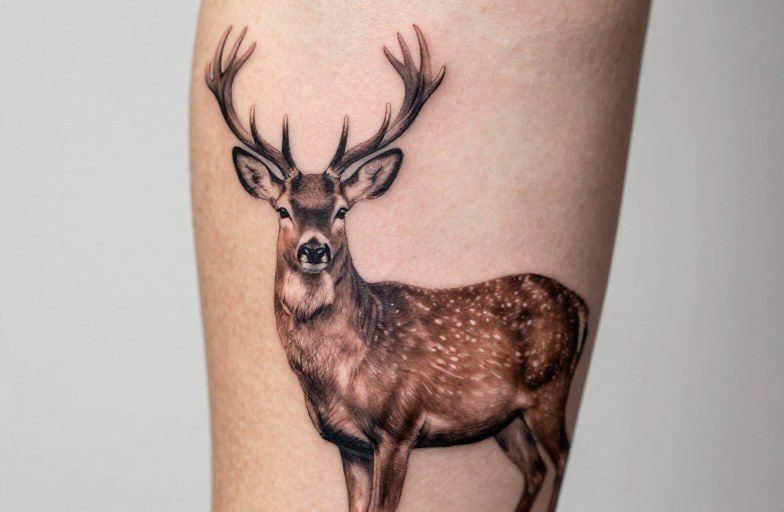
Deer tattoos most commonly symbolize grace under pressure, keen awareness, and the ability to survive through adaptability rather than aggression. The image carries duality, soft eyes and hard antlers, vulnerability paired with the capacity to bolt at 40 miles per hour. For many, the deer represents intuition, regeneration through its annual antler cycle, and a quiet form of masculinity or femininity that doesn’t need to announce itself.
Mythology & Folklore
Across cultures, the deer slips between worlds. It is prey, yes, but also messenger, guide, and shape-shifter.
Celtic and European Traditions
In Celtic lore, the stag often pulled chariots or acted as psychopomp, an escort between life and death. The antlered figure on the Gundestrup Cauldron, a silver vessel from roughly the 1st century BCE, suggests deep ritual significance. Scottish tales of the fianna feature white deer leading hunters into the Otherworld. A tattoo drawing on this tradition might emphasize the antlers as branching paths or doorways, not merely ornamental crown.
East Asian and Indigenous American Threads
Japanese folklore gives us the kasuga deer, messengers of Shinto gods, still protected today in Nara Park. Native American traditions vary widely by nation, but the deer frequently appears as a provider whose meat feeds, whose hide clothes, whose bones become tools. A tattoo honoring this aspect might incorporate arrow or feather motifs, or show the deer as skeletal structure beneath living form, acknowledging the full cycle of use and respect.
Religious & Spiritual Angles
The deer’s spiritual weight sits heavily in several traditions, though specifics matter enormously.
Christian Symbolism
The stag thirsting for water appears in Psalm 42, a image of the soul’s longing for God. Medieval bestiaries claimed the stag could recognize and defeat snakes, making it a symbol of Christ defeating Satan. Saint Eustace’s vision of a crucifix between antlers gave the image military-chivalric associations in European art. For a Christian tattoo, the cross-antler intersection remains visually powerful without requiring literal crucifixion imagery.
Buddhist and Hindu Connections
Buddha’s first sermon occurred in the Deer Park at Sarnath; deer are often depicted peacefully listening, representing the receptive mind. In some Hindu traditions, the goddess Saraswati rides a deer, or the animal draws her chariot. These associations lean toward wisdom, learning, and the gentle transmission of knowledge rather than fierce protection.
Who Chooses This Tattoo
There’s no single demographic, but patterns emerge in the chair. Hunters often choose realistic whitetail or mule deer portraits, sometimes with memorial dates for fathers or grandfathers who taught them. These pieces demand technical precision, fur texture, the particular wetness of a deer’s nose, the exact rake of antlers from a specific animal.
Women and non-binary clients frequently gravitate toward the doe or fawn, or stylized antler-only designs. The imagery speaks to observation over confrontation, to moving through difficult spaces with alertness rather than armor. Survivors of trauma sometimes select the deer for its startle response, hypervigilance reframed as evolutionary wisdom, the body keeping score but also keeping safe.
Antlers specifically attract those in recovery or growth phases. They shed and regrow annually, blood-rich velvet giving way to hardened bone. A tattoo showing this process, velvet peeling, new growth emerging, can mark a period of rebuilding without pretending the process is clean.
History & Cultural Roots
Deer imagery in tattooing follows broader artistic trends with some specific regional flavors.
Traditional American and European Styles
Sailor Jerry-era flash sometimes included deer for hunters and outdoorsmen, rendered in bold line with limited color palette. Germanic and Scandinavian traditional work often favored the stag as nationalist or regional symbol, which carries complicated baggage now. Contemporary artists working in these styles usually emphasize the craft lineage over any political association, but the history exists and clients should know it.
Contemporary Evolution
The geometric deer explosion of the 2010s, antlers fractured into triangles, negative-space faces, has settled into more sustainable territory. What looked fresh on Instagram in 2013 now risks datedness. Better geometric work today integrates the style with actual anatomical knowledge: the scapula’s angle, how antlers emerge from the frontal bone, the deer’s actual proportions rather than a generic triangular head.
Design Tips & Pairings
Specific combinations carry specific weight. Choose deliberately.
- Antlers + florals: The contrast of bone and bloom works visually and symbolically, growth from death, the masculine-coded antler softened by feminine-associated flowers. Peonies, wildflowers, or specific regional blooms (bluebonnets for Texas, lupines for Maine) ground the piece in place.
- Deer + arrow: Direct hunting reference, or Cupid’s weapon if angled toward romance. The arrow’s direction matters: entering, exiting, broken, whole.
- Stag + moon: Nocturnal activity, the rut’s autumn timing, lunar cycles matching antler growth. A full moon behind spread antlers creates strong negative space opportunities.
- Skull or skeletal elements: Memento mori tradition, the deer’s role as food source, or the shed antler itself as found object. The skull requires careful handling, too clean and it reads as generic; too detailed and it becomes disturbing in ways the client may not intend.
Line weight decisions matter enormously. Fine-line deer trend delicate and can blur within five years on high-movement areas. Bold traditional holds but sacrifices subtlety. A competent artist discusses this trade-off explicitly rather than defaulting to their preferred style.
Best Placements
The deer’s verticality, long legs, branching antlers, suits certain locations naturally.
Antler-Heavy Designs
Spread antlers need horizontal or diagonal space. The upper back, spanning shoulder to shoulder, accommodates the full rack. Forearms work for single antler or simplified versions. The sternum, with its natural central line, can frame a deer face with antlers extending toward each collarbone. Ribs and side torso allow the antler’s curve to follow the body’s own architecture.
Full Body or Running Figures
A running deer needs length. The calf, thigh, or full forearm gives the legs room to extend without compressing. A leaping deer on the shoulder cap, descending toward the bicep, uses gravity naturally. Avoid cramming a running figure into too small a space, the compressed legs read as error, not stylization.
Color versus black and grey affects placement longevity. Deer fur has subtle tonal variation that color captures well; black and grey relies on texture and contrast. The deer’s distinctive white throat patch (on many species) offers natural highlighting opportunity that skilled artists exploit for dimension.
The Bottom Line
The deer tattoo endures because it refuses single definition. It is gentle and armed, prey and spirit-guide, food and friend. The symbolism you carry depends on which aspect you emphasize, the velvet growth, the sudden flight, the listening stance. Work with an artist who understands deer anatomy beyond clip-art reference, who can place the antler’s emergence correctly on the skull, who knows that a doe’s face differs from a buck’s in ways beyond antler presence. The image deserves that precision. Your skin deserves that care.
Frequently Asked Questions
Do deer tattoos age badly because of the fine details?
Antlers and fur texture can blur over time, especially below a certain size or on high-movement areas like wrists and ankles. Bold line work holds longer than delicate stippling. Discuss minimum sizing with your artist, most deer portraits need at least palm-sized dimensions to maintain legibility.
What’s the difference between a stag and a doe tattoo symbolically?
Stag imagery emphasizes cycles of growth, protection, and masculine-coded renewal through antler shedding. Doe and fawn imagery lean toward nurturing, gentleness, and survival through awareness rather than confrontation. Both carry strength; the expression differs.
Can a deer tattoo work in minimalist or abstract styles?
Yes, but abstraction risks losing species-specific features that make the deer recognizable. Single-line designs and heavy geometric simplification work best when the antler structure remains accurate. A circle with sticks on top reads as generic tree, not deer.
Is there cultural appropriation concern with deer tattoos?
Specific sacred imagery, certain Native American clan symbols, Japanese shika in religious contexts, requires research and respect. A generic realistic deer or Western folk-art stag rarely raises issues. When in doubt, consult the specific tradition and avoid combining unrelated cultural elements into one design.


Leave a Reply